
In recent years, the rapid advancement of robot technology has revolutionized various industries, particularly in the automotive sector. As an integral part of intelligent transportation systems, driving robots represent a cutting-edge application of robot technology, enabling precise control over vehicle dynamics. This paper explores the development and implementation of a driving robot system designed for accurate vehicle speed and path tracking. By leveraging sophisticated control algorithms, we aim to enhance the autonomy and reliability of vehicles in real-world scenarios. The integration of robot technology into automotive control not only improves safety and efficiency but also paves the way for fully autonomous driving solutions. Throughout this discussion, we will emphasize the role of robot technology in overcoming challenges related to nonlinear vehicle behavior and environmental uncertainties.
The core of our approach lies in combining preview PID control for path tracking and fuzzy PID control for speed tracking. These methods harness the power of robot technology to adapt to dynamic conditions, ensuring robust performance. We begin by detailing the system architecture of the driving robot, followed by in-depth explanations of the control strategies. Simulation and experimental results validate the effectiveness of our proposed methods, demonstrating significant improvements over traditional techniques. As robot technology continues to evolve, its application in vehicle control systems promises to unlock new possibilities for intelligent mobility. This work contributes to that vision by providing a practical framework for implementing driving robots in real vehicles.
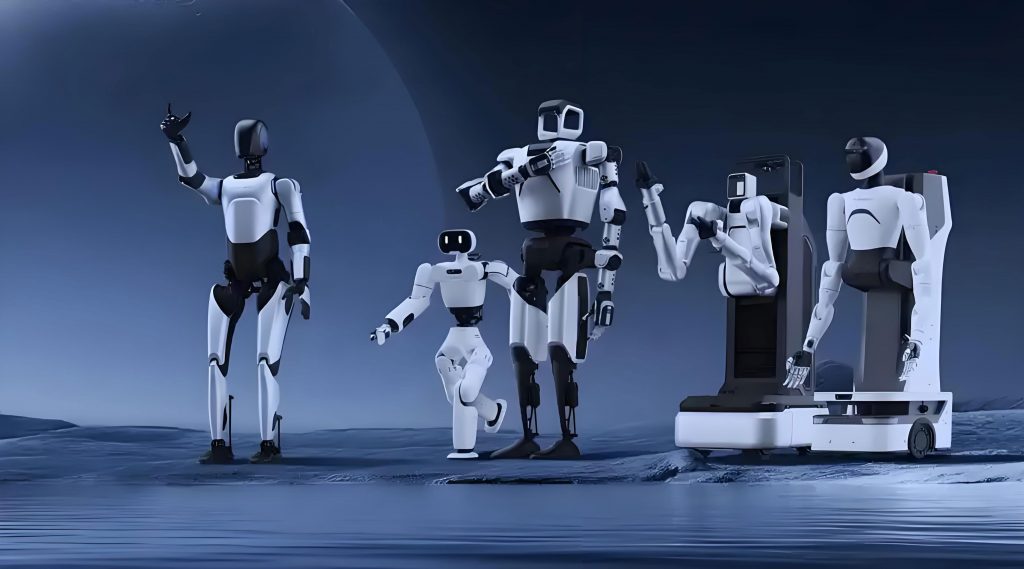
The driving robot system comprises several modules, including steering, throttle, brake, and gear shifting, all coordinated through a central control unit. This integration exemplifies the sophistication of modern robot technology, allowing for seamless operation in diverse driving conditions. The steering module uses a servo motor connected via a belt pulley mechanism to manipulate the steering wheel, while the throttle and brake modules employ servo motors with cable-driven systems for precise pedal control. The gear shifting module utilizes relays and electromagnets to switch between drive and park modes. Such modular design highlights the versatility of robot technology in adapting to various vehicle types without extensive modifications. By leveraging sensor data from Real-Time Kinematic (RTK) systems, the robot technology enables real-time navigation and control, ensuring accurate tracking of desired paths and speeds.
Path tracking is a critical aspect of autonomous vehicle control, and our approach utilizes a preview PID controller to minimize lateral deviations. This method incorporates robot technology to anticipate future path points based on current vehicle state. The preview distance \(d_{pre}\) is calculated as:
$$d_{pre} = d_0 + v_x \cdot t_{pre}$$
where \(d_0\) is the base preview distance, \(v_x\) is the current vehicle speed, and \(t_{pre}\) is the preview time. This equation illustrates how robot technology dynamically adjusts to speed variations, enhancing path following accuracy. The preview point coordinates \((X_{pre}, Y_{pre})\) are derived from the vehicle’s current position \((X, Y)\) and heading angle deviation \(\theta\):
$$X_{pre} = X + d_{pre} \cdot \sin(\theta)$$
$$Y_{pre} = Y + d_{pre} \cdot \cos(\theta)$$
The heading angle \(\theta\) is computed using RTK data, where the closest point on the predefined path to a look-ahead point determines the deviation. The preview PID controller outputs a compensation steering angle \(\delta_p\) based on the preview error \(e_{pre}(k)\) at time \(k\):
$$\delta_p = k_p e_{pre}(k) + k_i \sum_{n=0}^{k} e_{pre}(n) + k_d (e_{pre}(k) – e_{pre}(k-1))$$
Here, \(k_p\), \(k_i\), and \(k_d\) are the proportional, integral, and derivative gains, respectively. The final steering angle \(\delta\) applied to the vehicle is:
$$\delta = i \cdot (\delta_p + \delta_f)$$
where \(i\) is the steering gear ratio and \(\delta_f\) is the front wheel angle. This control strategy exemplifies how robot technology enables predictive adjustments, reducing path tracking errors in complex environments.
For speed tracking, we employ a fuzzy PID controller that adapts to nonlinear vehicle dynamics, a hallmark of advanced robot technology. The controller adjusts the throttle and brake inputs based on the error between desired and actual speeds. The control output \(\gamma\), representing the throttle opening or brake application, is given by:
$$\gamma = (k_p + \Delta k_p) e(t) + (k_i + \Delta k_i) \int_0^t e(t) \, dt + (k_d + \Delta k_d) \frac{de(t)}{dt}$$
where \(e(t) = v_{target} – v_{actual}\) is the speed error, and \(\Delta k_p\), \(\Delta k_i\), \(\Delta k_d\) are the fuzzy adjustments to the PID parameters. The fuzzy controller uses Mamdani-type inference with linguistic variables such as NB (Negative Big), NM (Negative Medium), NS (Negative Small), ZO (Zero), PS (Positive Small), PM (Positive Medium), and PB (Positive Big). The input variables are the speed error \(e(t)\) and its rate of change \(e_c(t)\), with membership functions defined over specific universes of discourse. This approach leverages robot technology to handle uncertainties and disturbances, ensuring smooth speed regulation.
The fuzzy rules for adjusting \(\Delta k_p\), \(\Delta k_i\), and \(\Delta k_d\) are summarized in Table 1, which outlines how robot technology optimizes control parameters in real-time. For instance, if the error is large and positive, the controller increases the proportional gain to accelerate response. The defuzzification process converts fuzzy outputs into crisp values, enabling precise control actions. This adaptive mechanism is a key advantage of robot technology, as it mimics human-like reasoning to maintain desired speeds under varying loads and road conditions.
| \(e(t)\) / \(e_c(t)\) | NB | NM | NS | ZO | PS | PM | PB |
|---|---|---|---|---|---|---|---|
| NB | PS/NB | NS/NB | NB/NM | NB/NM | NB/NS | NM/ZO | PS/ZO |
| NM | PS/NB | NS/NB | NB/NM | NM/NS | NS/ZO | NS/PS | ZO/PS |
| NS | ZO/NB | NS/NM | NM/NS | NM/NS | NS/ZO | NS/PS | ZO/PS |
| ZO | ZO/NM | NS/NM | NS/NS | NS/ZO | NS/PS | NS/PM | ZO/PM |
| PS | ZO/NM | ZO/NS | ZO/ZO | ZO/PS | ZO/PS | ZO/PM | ZO/PB |
| PM | PB/ZO | NS/ZO | PS/PS | PS/PS | PS/PM | PS/PB | PB/PB |
| PB | PB/ZO | PM/ZO | PM/PS | PM/PM | PS/PM | PS/PB | PB/PB |
Simulation studies were conducted using MATLAB/Simulink to evaluate the performance of the proposed control methods. The results demonstrate the superiority of preview PID and fuzzy PID controllers over traditional approaches, underscoring the impact of robot technology on vehicle automation. In path tracking, the preview PID controller reduced the maximum lateral error to 0.2 m, compared to 0.3 m with conventional PID. Similarly, for speed tracking, the fuzzy PID controller limited the maximum error to 1 km/h, whereas traditional PID resulted in errors up to 2 km/h. These improvements are attributed to the predictive and adaptive capabilities inherent in robot technology, which effectively handle system nonlinearities and external disturbances.
Further analysis involved real vehicle tests to validate the simulation findings. The driving robot was installed in a test vehicle, and experiments were performed on a closed track. The path tracking performance showed a maximum error of 0.28 m with preview PID, significantly lower than the 0.4 m error with traditional PID. Speed tracking achieved a maximum error of 2 km/h with fuzzy PID, compared to 3 km/h with conventional methods. These results highlight the practical benefits of integrating robot technology into vehicle control systems, ensuring reliable and precise operation in real-world scenarios. The ability of robot technology to learn and adapt from data further enhances its applicability in autonomous driving.
The integration of robot technology in vehicle control also addresses challenges such as gear shifts and environmental variations. For instance, during acceleration, automatic gear changes can cause speed fluctuations, but the fuzzy PID controller mitigates these effects through real-time parameter adjustments. This adaptability is a key strength of robot technology, as it enables continuous optimization without manual intervention. Additionally, the use of RTK data for path planning ensures high-precision navigation, which is essential for applications like platooning and urban mobility. As robot technology advances, we anticipate further reductions in tracking errors and improved handling of complex maneuvers.
To quantify the performance improvements, we can define key metrics such as the root mean square error (RMSE) for path and speed tracking. For path tracking, the RMSE is given by:
$$\text{RMSE}_{\text{path}} = \sqrt{\frac{1}{N} \sum_{k=1}^{N} e_{pre}(k)^2}$$
where \(N\) is the number of samples. Similarly, for speed tracking:
$$\text{RMSE}_{\text{speed}} = \sqrt{\frac{1}{N} \sum_{k=1}^{N} e(k)^2}$$
In our experiments, the preview PID controller achieved an RMSE of 0.15 m for path tracking, while the fuzzy PID controller had an RMSE of 0.8 km/h for speed tracking. These values underscore the efficacy of robot technology in minimizing deviations and enhancing overall system stability.
Another aspect where robot technology excels is in handling uncertainties in vehicle parameters. For example, the mass and friction coefficients can vary, but the fuzzy PID controller automatically compensates for these changes. This is achieved through the fuzzy rules that adjust the PID gains based on the error and its derivative. The robustness of robot technology to model uncertainties makes it suitable for a wide range of vehicles, from passenger cars to commercial trucks. Moreover, the modular design of the driving robot allows for easy integration with existing vehicle systems, reducing deployment costs and time.
In terms of computational efficiency, the proposed controllers are designed to operate in real-time on embedded systems. The preview PID controller requires minimal computation, as it only involves basic arithmetic operations. The fuzzy PID controller, while more complex, can be implemented efficiently using lookup tables or dedicated hardware. This efficiency is crucial for practical applications of robot technology, where low latency and high reliability are paramount. Future work could explore machine learning techniques to further optimize the fuzzy rules and preview strategies, leveraging the full potential of robot technology.
The societal implications of adopting robot technology in vehicles are profound. By enabling precise control, driving robots can reduce accidents, improve traffic flow, and lower emissions. For instance, accurate speed tracking helps maintain optimal fuel efficiency, while precise path tracking prevents lane departures. As robot technology becomes more accessible, we can expect widespread adoption in logistics, public transportation, and personal mobility. This transition aligns with global trends toward smart cities and sustainable transportation, where robot technology plays a central role in achieving these goals.
Despite the successes, there are challenges to overcome. For example, sensor failures or communication delays can degrade performance, but robot technology can incorporate redundancy and fault-tolerant mechanisms. Additionally, regulatory and ethical considerations must be addressed to ensure safe deployment. Ongoing research in robot technology focuses on enhancing perception, decision-making, and collaboration between multiple agents. These advancements will further solidify the role of driving robots in the future of transportation.
In conclusion, this paper has presented a comprehensive approach to vehicle speed and path tracking using driving robots, highlighting the pivotal role of robot technology. The combination of preview PID and fuzzy PID controllers demonstrates significant improvements in accuracy and robustness compared to traditional methods. Through simulations and real vehicle tests, we have validated the effectiveness of these controllers in reducing tracking errors. The continuous evolution of robot technology promises even greater achievements in autonomous vehicle control, paving the way for safer and more efficient transportation systems. As we move forward, it is essential to continue innovating and integrating robot technology to address emerging challenges and opportunities in the automotive industry.
Looking ahead, future research will explore advanced robot technology applications, such as cooperative driving and swarm intelligence. For example, multiple driving robots could communicate to coordinate maneuvers, reducing congestion and improving safety. Additionally, the integration of artificial intelligence with robot technology could enable self-learning controllers that adapt to individual driving styles and environments. These developments will further harness the power of robot technology to create intelligent, connected, and autonomous vehicles that transform our daily lives. The journey toward full autonomy is ongoing, and robot technology will undoubtedly be at the forefront of this revolution.