
In the field of robot technology, underground quadruped robots are increasingly deployed for hazardous tasks such as mine inspections and disaster response. However, maintaining stable walking postures in complex underground environments remains a significant challenge due to unpredictable terrain disturbances. Traditional control methods often fail to provide adequate stability, leading to inefficient operations. This paper proposes a novel distributed hierarchical feedback control approach to enhance the walking posture stability of underground quadruped robots. By integrating kinematic modeling, stepwise control structures, and recursive feedback mechanisms, this method ensures adaptive stability across varied surfaces like sand and gravel. The following sections detail the kinematic model construction, control input derivation, hierarchical control design, and experimental validation, emphasizing the role of advanced robot technology in solving real-world problems.
The foundation of effective posture control lies in accurately modeling the robot’s dynamics. For an underground quadruped robot, we establish a ground inertial reference frame to analyze its motion. The general constraints for the robot’s movement, assuming zero potential energy under typical conditions, are given by:
$$ \frac{1}{t} \left( A(\alpha_i) – A(\beta_i) \right) = \chi_i, \quad i = 1, 2, \ldots, I $$
where \( t \) represents time, \( A \) denotes the system kinetic energy, \( \alpha \) and \( \beta \) are generalized coordinate and velocity constraints, respectively, \( \chi_i \) is the generalized vector constraint, and \( I \) is the number of constraints. The system kinetic energy is computed as:
$$ A = \frac{1}{2} \int m \mathbf{S}_j \times \mathbf{S}_j \, dm $$
Here, \( m \) is the distributed mass, \( \mathbf{S}_j \) is the velocity vector at any point \( j \). Applying constraints through the natural orthogonal complement method and Lagrange’s formulation yields the kinematic equation:
$$ \mathbf{H}(\mathbf{C}_0, \boldsymbol{\theta}) \ddot{\mathbf{q}} + \mathbf{G}(\mathbf{C}_0, \boldsymbol{\theta}) + \mathbf{D}(\mathbf{C}_0, \boldsymbol{\theta}) = \boldsymbol{\chi}_i(\mathbf{C}_0, \boldsymbol{\theta}) $$
In this equation, \( \mathbf{H} \) is the mass matrix, \( \mathbf{G} \) represents nonlinear velocity terms, \( \mathbf{D} \) is the gravity vector, \( \mathbf{C}_0 \) is the position and orientation vector matrix, \( \boldsymbol{\theta} \) is the joint position vector, and \( \mathbf{q} \) is the generalized coordinate vector. This kinematic model serves as the basis for deriving posture stability control inputs, leveraging principles of robot technology to handle dynamic environments.
To achieve stable posture control, we first describe the robot’s pose using homogeneous transformation matrices. The robot’s structure, as illustrated in the context of robot technology, consists of multiple joints with specific degrees of freedom. The homogeneous transformation matrix for the torso is defined as:
$$ \mathbf{T} = \begin{bmatrix} \mathbf{R} & \mathbf{p} \\ \mathbf{0} & 1 \end{bmatrix} $$
where \( \mathbf{R} \) is the rotation matrix and \( \mathbf{p} = [O\phi_H, O\phi_G, O\phi_D]^T \) represents the 3D coordinates of the body’s center in the ground frame. The position vector of a single leg’s end point is derived using vector addition and rotation matrices. For instance, for the right front leg, the end position vector \( \mathbf{p}_K \) is calculated as:
$$ \mathbf{p}_K = \mathbf{p}_O’ + \mathbf{R} \cdot \mathbf{p}_Q – \mathbf{p}_O $$
Here, \( \mathbf{p}_O’ \) is the position vector of the body center, \( \mathbf{p}_Q \) is the hip joint point, and \( \mathbf{R} \) is the rotation matrix. This vector serves as the input for attitude stability control, ensuring that the hip joints maintain a stable relationship with the ground. The precise computation enables the robot technology to adapt to surface variations, which is critical for underground applications.
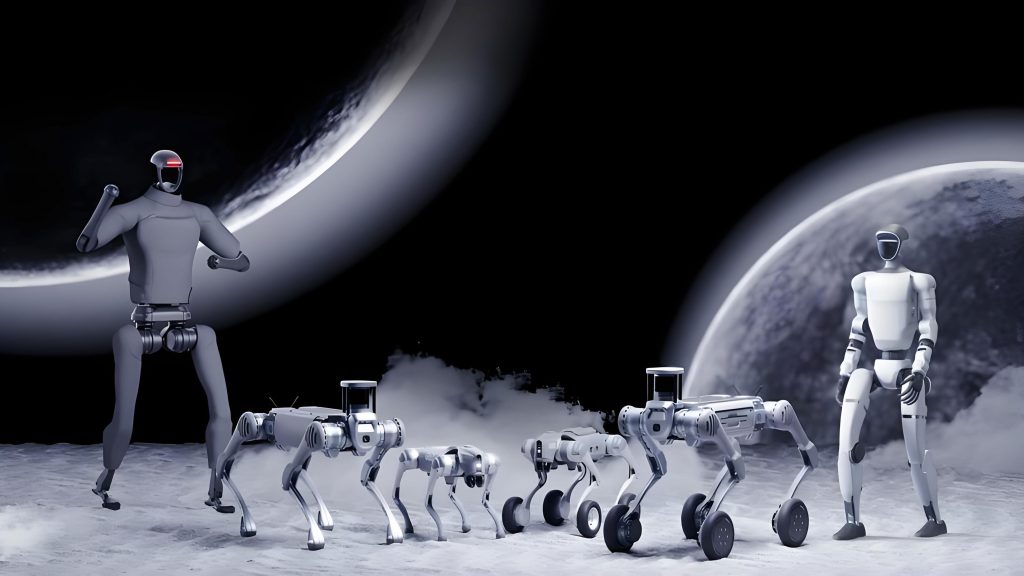
The distributed hierarchical control structure for posture stability involves two main steps: non-singular terminal sliding mode control and finite difference-based sliding mode control. This stepwise approach addresses the complexity of multi-joint coordination in robot technology. The control variable, defined as the motor output rotation angle, follows the equation:
$$ \mathbf{M}(\boldsymbol{\iota}) \ddot{\boldsymbol{\iota}} + \boldsymbol{\gamma}(\boldsymbol{\iota}, \dot{\boldsymbol{\iota}}) \dot{\boldsymbol{\iota}} + [0, \boldsymbol{\theta}] = [0, \boldsymbol{\omega}] $$
where \( \mathbf{M}(\boldsymbol{\iota}) \) is the coordinate constraint matrix, \( \boldsymbol{\gamma} \) is the centrifugal and Coriolis force vector, \( \boldsymbol{\iota} \) is the vector of spatial attitude and joint angles, \( \boldsymbol{\theta} \) is the feedback joint angle, and \( \boldsymbol{\omega} \) is the motor output rotation angle. The first control law, based on non-singular sliding mode control, is designed to reduce approximation errors:
$$ [0, \boldsymbol{\omega}_1] = [0, \boldsymbol{\theta}] + \boldsymbol{\sigma} + \left( \frac{\boldsymbol{\iota}}{p} e^{2 – \frac{\boldsymbol{\iota}}{p}} \right) + \boldsymbol{\Phi}(\boldsymbol{\psi}) + d \boldsymbol{\Gamma}(\boldsymbol{\nu}) $$
In this expression, \( \boldsymbol{\omega}_1 \) is the first-step control variable, \( \boldsymbol{\sigma} \) is the approximation error, \( p \) is a diagonal matrix, \( e \) is the base of natural logarithms, \( \boldsymbol{\Phi} \) is the joint angle error function, \( \boldsymbol{\psi} \) is an exponential trend term, \( d \) is the approaching speed, and \( \boldsymbol{\Gamma} \) is the switching saturation function. The second control law minimizes chattering during walking:
$$ \boldsymbol{\kappa} = -\vartheta \left[ \mathbf{f}_2 + \mathbf{X}(\boldsymbol{\omega} – \mathbf{f}_1) \right] + \boldsymbol{\xi}(\boldsymbol{\omega}_1 – \boldsymbol{\theta}) – \boldsymbol{\psi} – d \boldsymbol{\Gamma}(\boldsymbol{\nu}) $$
Here, \( \boldsymbol{\kappa} \) is the output torque, \( \vartheta \) is the joint drive motor end inertia matrix, \( \mathbf{f}_1 \) and \( \mathbf{f}_2 \) are virtual control variables computed via finite differences, \( \mathbf{X} \) is a diagonal positive definite matrix, and \( \boldsymbol{\xi} \) is the torsion stiffness matrix. Adaptive laws for weight vectors and gain switching ensure stability, showcasing the integration of advanced robot technology in hierarchical control systems.
To generate adaptive stable walking postures, a central pattern generator (CPG) recursive feedback model is incorporated. This model consists of three reflective layers: high-level (using visual and auditory sensors), mid-level (using pressure sensors and gyroscopes), and low-level (monitoring foot pressure and posture). The CPG model, represented by two first-order differential equations, produces rhythmic gait patterns:
$$ \begin{aligned}
\dot{\mathbf{l}} &= \upsilon_1 (\rho – \mathbf{l}^2 – \mathbf{v}^2) \mathbf{l} – \partial \mathbf{v} \\
\dot{\mathbf{v}} &= \upsilon_2 (\rho – \mathbf{l}^2 – \mathbf{v}^2) \mathbf{v} – \partial \mathbf{l}
\end{aligned} $$
where \( \mathbf{l} \) and \( \mathbf{v} \) are the input posture vectors after recursive control, \( \dot{\mathbf{l}} \) and \( \dot{\mathbf{v}} \) are the output posture vectors, \( \upsilon_1 \) and \( \upsilon_2 \) are convergence coefficients, \( \rho \) is the amplitude constraint of the oscillator, and \( \partial \) is the frequency. This recursive feedback enables real-time adaptation to environmental changes, a key advantage in robot technology for underground settings.
Experiments were conducted in a simulated underground environment with diverse obstacles such as pits, bumps, and slopes. The quadruped robot, equipped with thermal imaging and environmental detection systems, was tested under randomized parameters to evaluate robustness. Key parameters varied within specified ranges, as summarized in Table 1.
| Parameter | Minimum Value | Maximum Value |
|---|---|---|
| Joint Moment of Inertia (kg·m²) | 0.8 × Original | 1.2 × Original |
| Body Mass (kg) | 0.8 × Original | 1.2 × Original |
| Joint Friction Coefficient | 0.5 | 1.5 |
| Motor Friction Coefficient | 0.01 | 0.05 |
| Sensor Noise (dB(A)) | 0.95 × Original | 1.05 × Original |
The control performance was assessed by measuring roll and pitch angles during walking on sand and gravel surfaces. Under the proposed method, the fluctuation ranges of roll and pitch angles were consistently maintained between -0.03° and 0.03°, as shown in Table 2. In contrast, traditional methods like reinforcement learning and singular perturbation-based control exhibited larger fluctuations, highlighting the superiority of the distributed hierarchical feedback approach in robot technology.
| Control Method | Sand Surface Fluctuation Range (°) | Gravel Surface Fluctuation Range (°) |
|---|---|---|
| Proposed Distributed Hierarchical Feedback | -0.03 to 0.03 | -0.03 to 0.03 |
| Reinforcement Learning-Based Control | -0.1 to 0.1 | -0.1 to 0.1 |
| Singular Perturbation-Based Control | -0.2 to 0.2 | -0.2 to 0.2 |
Additionally, joint motion trajectories were analyzed to verify control precision. The CPG-based recursive feedback ensured smooth flexion and extension phases without over-extension, as described by the differential equations. The phase difference and stability were quantified using the following relationship for joint angle \( \phi \):
$$ \phi(t) = \phi_0 + \int_0^t \left( \upsilon (\rho – \phi^2) \phi – \partial \dot{\phi} \right) dt $$
where \( \phi_0 \) is the initial angle. This formulation prevents negative angles at full extension, enhancing safety in robot technology applications. The experimental results confirm that the proposed method achieves high adaptability and stability, meeting the demands of underground operations.
In conclusion, the distributed hierarchical feedback control method effectively addresses the walking posture stability of underground quadruped robots. By combining kinematic modeling, stepwise control laws, and CPG recursive feedback, this approach enables robust adaptation to complex terrains. The experimental validation demonstrates significant improvements in roll and pitch angle stability compared to conventional methods, underscoring the transformative potential of this robot technology. Future work will focus on integrating binocular vision for enhanced localization in low-visibility conditions, further advancing the capabilities of autonomous robots in challenging environments.