
With the rapid advancement of the coal industry, there is an escalating demand for automation and intelligent solutions in coal sampling and preparation processes. Traditional manual methods often fall short in terms of efficiency, accuracy, and safety, failing to meet the stringent standards of modern industrial operations. In response, we have developed a laser-navigated transport robot system that leverages cutting-edge robot technology to address these challenges. This system integrates laser navigation, precise path planning, and real-time obstacle avoidance to ensure reliable performance in complex industrial settings. By incorporating data acquisition and real-time monitoring modules, the system enhances operational efficiency and safety while minimizing errors associated with human intervention. This paper elaborates on the design, implementation, and evaluation of this robot technology, highlighting its transformative impact on coal sampling and preparation.
The foundation of our robot technology lies in laser navigation, which utilizes LiDAR sensors for high-precision distance measurement. The core principle involves emitting laser pulses and calculating the time difference between emission and reception to determine distances. The fundamental formula for this measurement is:
$$d = \frac{c \times \Delta t}{2}$$
where \(d\) represents the distance in meters, \(c\) is the speed of light (approximately \(3 \times 10^8\) m/s), and \(\Delta t\) denotes the time interval. Through repeated scanning, LiDAR generates detailed point cloud maps of the environment. When combined with Simultaneous Localization and Mapping (SLAM) algorithms, the system achieves real-time localization and mapping, enabling the robot to navigate dynamically. Path planning is optimized using algorithms such as A* or Dijkstra, with the A* algorithm’s cost function defined as:
$$f(n) = g(n) + h(n)$$
Here, \(f(n)\) is the total cost from the start node to the goal via node \(n\), \(g(n)\) is the actual cost from the start to \(n\), and \(h(n)\) is the heuristic estimate from \(n\) to the goal. This approach ensures efficient pathfinding even in cluttered environments. For obstacle avoidance, we employ the artificial potential field method, where the potential function is:
$$U(x) = U_{\text{attr}}(x) + U_{\text{rep}}(x)$$
In this equation, \(U_{\text{attr}}(x)\) attracts the robot toward the goal, and \(U_{\text{rep}}(x)\) repels it from obstacles, facilitating safe navigation. This integration of algorithms and sensors exemplifies the sophistication of modern robot technology in industrial applications.
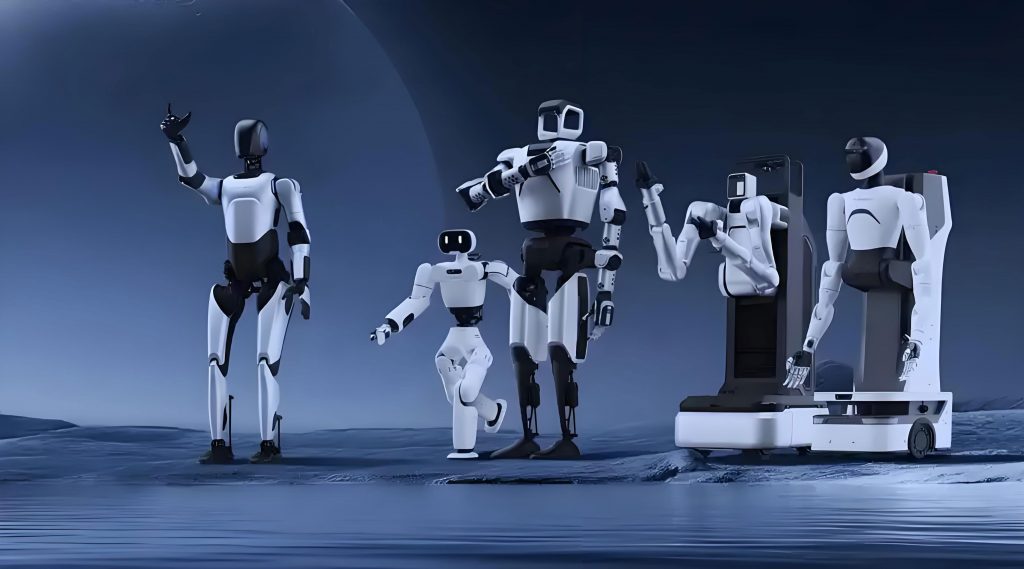
The transport robot is composed of several key subsystems: the power system, control system, perception system, and mechanical structure. The power system includes motors and drivers that provide propulsion, utilizing electronic differential control for smooth steering. The control system, which is the brain of the robot, features an embedded controller that processes data from LiDAR, manages weight measurements, executes path planning, and oversees navigation tasks. The perception system incorporates LiDAR, infrared sensors, and an Inertial Measurement Unit (IMU) to perceive the environment, measure attitude, and detect obstacles. The mechanical design emphasizes a low center of gravity to maintain stability during sample transport, preventing spills or tipping. By fusing LiDAR and IMU data, the control system continuously adjusts the robot’s movement, ensuring adaptability to varying terrains. This holistic design underscores the versatility of robot technology in handling demanding industrial operations.
The operational workflow of the robot technology encompasses multiple stages: task reception, path planning, sample transport, and data upload. Initially, the system receives tasks from a central control platform, detailing sampling points, routes, and schedules. During path planning, the robot employs laser navigation and SLAM to generate optimal paths based on real-time sensor data and environmental maps. Algorithms like A* or Dijkstra are applied to minimize travel time and avoid hazards. In the sample transport phase, the robot navigates to designated points, uses a mechanical arm or gripper for precise sample collection, and returns to a storage or handover location. Finally, data on sampling activities and robot status are transmitted to a monitoring system, enabling comprehensive reporting and analysis. This seamless workflow demonstrates how robot technology streamlines complex processes, reducing reliance on manual labor.
Automation in coal sampling and preparation systems typically involves mechanical, electrical, and sample collection components. These systems achieve automation through remote control, intelligent start-stop mechanisms, online sample preparation, automatic collection, and full-process monitoring. In sampling, a cross-belt primary sampler collects representative sub-samples based on time intervals, while online systems handle crushing and division during preparation. The sample collection system gathers processed sub-samples for further analysis. However, traditional mechanized equipment often requires manual intervention for sample retrieval, leading to inefficiencies, contamination risks, and increased labor costs. To overcome these limitations, automation must prioritize high-precision sampling, intelligent path planning, real-time monitoring, obstacle avoidance, and precise sample handling. Our robot technology addresses these needs by enabling autonomous navigation between sampling points, with path planning errors under 1 cm, thanks to algorithms like A*. Coupled with Programmable Logic Controller (PLC) systems, this robot technology ensures accurate execution of sampling and preparation tasks, paving the way for fully unmanned operations.
In the application design for coal sampling and preparation, path planning is critical for the robot’s efficiency. Using LiDAR-generated environmental maps, the system implements A* and Dijkstra algorithms to devise optimal routes. The cost function in path planning accounts for factors such as distance, obstacle density, and terrain complexity, aiming to reduce traversal time. Main paths are designated for direct routes, while secondary paths are selected flexibly based on sampling requirements. A dynamic obstacle avoidance module continuously monitors the environment; if an obstacle is detected within 1.5 meters, the system recalculates the path locally to ensure safety. This proactive approach highlights the adaptability of robot technology in unpredictable settings.
Navigation and obstacle avoidance are enhanced through the fusion of LiDAR and IMU data. LiDAR provides millimeter-accurate scans to create 2D maps, while IMU supplies real-time attitude and acceleration data, maintaining stability during movement. The obstacle avoidance strategy relies on the artificial potential field method, where attractive forces guide the robot toward goals and repulsive forces divert it from obstacles. The detection zone covers a 120-degree扇形 area in front of the robot, with scans performed 10 times per second to promptly identify moving obstacles. Additional sensors, such as ultrasonic devices, improve detection of low-lying obstacles in confined or dimly lit areas, further bolstering the reliability of this robot technology.
The data acquisition and real-time monitoring system collects a wide range of parameters, including robot position, attitude angles, speed, obstacle distances, and environmental conditions. Local processing units filter and fuse this data to eliminate noise and generate precise location information, which is then transmitted to a remote monitoring platform. The platform displays real-time updates on robot status, paths, sampling progress, and environmental metrics at a frequency of 10 updates per second. If anomalies like speed fluctuations, path deviations, or sensor failures occur, the system triggers immediate alerts for operator intervention. This comprehensive monitoring capability ensures the integrity of the sampling process and exemplifies the advanced features of modern robot technology.
The weighing function of the transport robot incorporates capacitive mass sensors connected to the control system. When a sample is placed on the robot, the sensor’s internal charge decreases proportionally to the mass, and this change is measured in volts and converted to mass units. This functionality significantly enhances the system’s intelligent warning capabilities in two key areas: First, by monitoring sub-sample mass after online preparation, consistent mass values across multiple samples may indicate equipment malfunctions or blockages. Second, by comparing actual sub-sample mass with theoretical values derived from primary sample mass and system division ratios, deviations can signal impending blockages. For instance, if consecutive samples show decreasing mass, early warnings are issued to prevent operational disruptions. The weighing process involves measuring mass post-collection, comparing it to expected values, and triggering alerts for deviations, thereby improving overall system resilience through integrated robot technology.
To evaluate the performance of the laser-navigated transport robot, we assessed its operational efficiency across different environments. Key metrics included total sampling time, average transport speed, obstacle avoidance response time, task completion rate, and failure rate. The results, summarized in Table 1, demonstrate the robot’s adaptability and efficiency.
| Parameter | Normal Environment (No Obstacles) | Light Obstacle Environment | Heavy Obstacle Environment |
|---|---|---|---|
| Total Sampling Time (min) | 15 | 18 | 25 |
| Average Transport Speed (m/s) | 0.8 | 0.6 | 0.5 |
| Obstacle Avoidance Time (s) | 3 | 8 | 15 |
| Task Completion Rate (tasks/h) | 4 | 3.5 | 3 |
| Average Failure Rate (failures/day) | 0.2 | 0.4 | 0.6 |
In normal conditions, the robot completes tasks quickly with high speed and minimal avoidance time. As obstacles increase, performance metrics decline slightly, but the system remains functional, underscoring the robustness of this robot technology. The slight rise in failure rates in heavier obstacle environments reflects the challenges of complex terrains, yet the overall reliability supports its practical deployment.
We also analyzed the weighing accuracy and stability of the robot technology under different environmental conditions. Assessments focused on weighing deviation and repeatability, with results presented in Table 2. High-precision sensors and dynamic filtering algorithms were used to mitigate environmental noise, ensuring measurements closely align with true sample masses.
| Metric | Normal Environment (No Obstacles) | Light Obstacle Environment | Heavy Obstacle Environment |
|---|---|---|---|
| Weighing Deviation (g) | 5 | 8 | 12 |
| Weighing Repeatability Deviation (g) | 3 | 5 | 7 |
| Daily Weighing Operations | 50 | 48 | 45 |
In obstacle-free settings, deviations are minimal, indicating high precision and stability. Light obstacles cause slight increases in deviation, while heavy environments lead to more significant impacts, yet the system maintains acceptable performance levels. This resilience is crucial for applications where accuracy is paramount, and it highlights the effectiveness of the embedded robot technology in maintaining operational standards.
The economic benefits and feasibility of implementing this robot technology were evaluated based on data from various sites, including ports, power plants, and large coal mines. Analysis covered equipment costs, maintenance expenses, labor savings, efficiency gains, and payback periods, as detailed in Table 3.
| Factor | Port | Power Plant | Large Coal Mine |
|---|---|---|---|
| Equipment Purchase Cost (10,000 yuan) | 50 | 80 | 100 |
| Annual Maintenance Cost (10,000 yuan) | 5 | 8 | 10 |
| Annual Labor Cost Saving (10,000 yuan) | 15 | 25 | 40 |
| Sampling Efficiency Improvement (multiplier) | 1.2 | 1.5 | 2 |
| System Payback Period (years) | 3 | 2.6 | 2 |
Ports incur lower initial costs but still achieve substantial labor savings and efficiency improvements, with a payback period of three years. Power plants and large coal mines see higher investments but greater returns, including shorter payback times and more pronounced efficiency gains. These findings validate the economic viability of this robot technology across diverse operational scales, emphasizing its potential for widespread adoption.
In conclusion, the laser-navigated transport robot represents a significant advancement in robot technology for coal sampling and preparation. By integrating laser navigation with sophisticated path planning and real-time monitoring, the system achieves high precision, efficiency, and safety in challenging industrial environments. Performance evaluations confirm its reliability, with minimal failure rates and consistent operation across varying conditions. The economic analysis reveals compelling benefits, including cost savings and rapid returns on investment. As industries continue to prioritize automation, this robot technology offers a scalable and effective solution, with promising prospects for future applications and enhancements in the field of autonomous industrial systems.