
As I observe the global landscape of robotics and artificial intelligence, one nation stands out for its rapid ascent and strategic focus: China. The development of China robot enterprises has become a cornerstone of technological advancement, driven by national initiatives and market dynamism. In this article, I will delve into the intricacies of China robot ecosystems, exploring how traditional companies are transforming, new players are emerging, and artificial intelligence is being seamlessly integrated. My goal is to provide a comprehensive overview, enriched with tables and formulas, to highlight the momentum behind China robot innovations.
The concept of artificial intelligence robots represents the fusion of cognitive capabilities with physical embodiment. In China, this fusion is accelerating, propelled by policies like the “Next Generation Artificial Intelligence Development Plan” issued in 2017. This plan envisions AI integration across traditional industries, aiming for global leadership by 2030. Consequently, China robot development has transcended mere commercial interest to become a matter of national strategy. I see this as a pivotal shift, where robots are no longer just tools but intelligent entities capable of perception, decision-making, and action. The journey begins with understanding the two primary categories: legged robots and service robots.
Legged robots, such as those with four or two feet, epitomize high-end robotics due to their complex locomotion. However, in China, these are less prevalent compared to service robots. The reason lies in the technical and cost barriers. Each joint in a legged robot requires precise servo mechanisms, simulating biological articulation. The dynamics can be modeled using equations like: $$ \tau = M(q)\ddot{q} + C(q,\dot{q})\dot{q} + G(q) $$ where $\tau$ is the joint torque vector, $M(q)$ is the inertia matrix, $C(q,\dot{q})$ represents Coriolis and centrifugal forces, $G(q)$ is the gravitational vector, and $q$, $\dot{q}$, $\ddot{q}$ denote joint position, velocity, and acceleration. This complexity increases with the addition of machine vision and AI, making it a domain dominated by well-funded entities. In contrast, service robots in China thrive due to lower development costs and market demand for smart functionalities rather than advanced mobility. This disparity underscores a strategic focus where China robot companies prioritize practical applications over experimental prowess.
To illustrate the differences, I present a table comparing legged and service robots in the China robot context:
| Feature | Legged Robots | Service Robots |
|---|---|---|
| Primary Use | Research, military, high-mobility tasks | Household, commercial, customer service |
| Technical Complexity | High (kinematics, dynamics, balance control) | Moderate (navigation, interaction, task-specific AI) |
| Cost Factor | High due to servo joints and sensors | Lower, scalable for mass production |
| AI Integration | Advanced perception and adaptive control | Focused on voice, vision, and data analytics |
| Market Presence in China | Limited, niche applications | Widespread, booming industry |
This table highlights why service robots dominate the China robot scene. The weak AI era we inhabit today prioritizes capabilities like visual and speech recognition, which align perfectly with service robot functionalities. For instance, visual recognition can be expressed mathematically as: $$ P(y|x) = \frac{e^{z_y}}{\sum_{j=1}^{K} e^{z_j}} $$ where $P(y|x)$ is the probability of class $y$ given input $x$, and $z$ represents logits from a neural network. Such formulas underpin the smart features in China robot products, enabling tasks from object detection to emotional analysis.
Transitioning from legged to service robots, I note that traditional China robot companies are actively reinventing themselves. One notable example is a legacy robot manufacturer that began in 1998. This company, initially focused on hardware, has embraced AI to stay competitive. Its transformation involves upgrading existing products like window-cleaning and floor-sweeping robots with intelligent navigation and autonomous charging. The shift can be summarized as a move from mechanical automation to cognitive automation, driven by algorithms for path planning: $$ J = \int_{0}^{T} (x_d – x)^2 dt $$ where $J$ is the cost function minimizing deviation from desired path $x_d$. By integrating such AI, this China robot firm exemplifies how traditional players are evolving to lead the smart revolution.
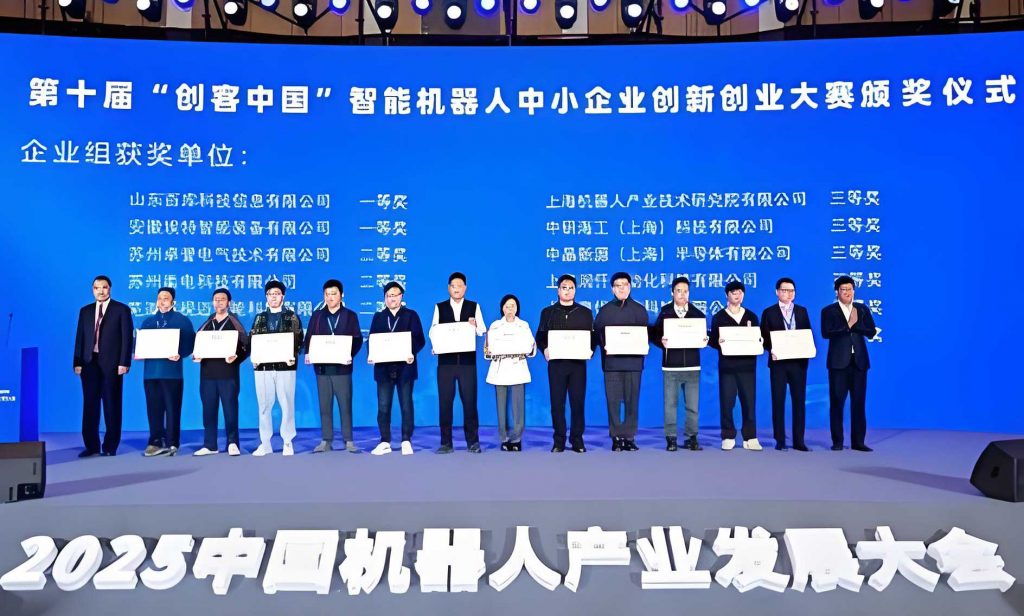
The image above captures the essence of China robot advancements—showcasing intelligent machines in action. It symbolizes the seamless blend of AI and robotics that defines modern China robot enterprises. As I reflect on this visual, it becomes clear that perception is key; robots must “see” and “hear” to interact effectively, a capability enabled by convolutional neural networks (CNNs) for vision: $$ f(x) = \max(0, W * x + b) $$ where $*$ denotes convolution, and ReLU activation introduces non-linearity. These technical foundations empower China robot systems to navigate homes, recognize faces, and even engage in sales calls.
Beyond traditional firms, emerging China robot companies are rising as unicorns, focusing exclusively on AI-driven solutions. One prominent player gained fame through a large-scale dance performance, demonstrating the appeal of humanoid robots. This company has invested heavily in research, attracting top talent to work on machine vision, semantic understanding, and motion control. Its product lines span both business and consumer segments, with robots designed for commercial service and educational programming. The innovation here lies in emotive interaction, where robots display lifelike behaviors through servo mechanisms and LED expressions. The dynamics of such servos can be modeled as: $$ \theta(t) = K_p e(t) + K_i \int e(t) dt + K_d \frac{de(t)}{dt} $$ where $\theta$ is the output angle, $e$ is the error, and $K_p$, $K_i$, $K_d$ are PID gains. This precision allows China robot creations to mimic human gestures, enhancing engagement.
To detail the landscape, I compile a table of influential China robot enterprises based on recent rankings and analyses. This table includes key players and their specialties, reflecting the diversity within the China robot sector:
| Rank | Company | Focus Area | Notable Contribution |
|---|---|---|---|
| 1 | E-commerce Tech Giant | AI platforms, smart robotics | Develops intelligent robots for judicial and predictive tasks |
| 2 | Industrial Automation Leader | Industrial robots, flexible arms | Pioneered composite robots with vision navigation |
| 3 | Logistics and Retail Powerhouse | Service robots, automation | Introduced smart patrol robots for data centers |
| 4 | Service Robot Pioneer | Household robots, AI research | Established AI institute, focuses on smart home devices |
| 5 | Personalized Robot Platform | Customizable AI robots | Offers platform for tailored robot solutions |
| 6 | Humanoid Robot Innovator | Bipedal robots, education | Created Walker robot for stable walking and stair climbing |
| 7 | Companion Robot Developer | Pet robots, smart care | Designs robots for pet interaction and monitoring |
| 8 | Voice AI Specialist | Speech recognition, robots | Collaborates on smart robots with video capabilities |
| 9 | AI Robot Startup | Consumer robots, investment-backed | Produces home assistant robots with voice integration |
| 10 | Sales Robot Provider | Automated calling systems | Develops robots for telemarketing and customer service |
| 11 | System Solution Provider | Retail, medical, AI platforms | Offers tailored robot applications for various industries |
| 12 | Travel Robot Creator | Portable travel assistants | Focuses on handheld robots for tourism and guidance |
| 13 | Intelligent Robot Manufacturer | Production and R&D | Engages in smart robot development for diverse uses |
| 14 | Legged Robot Explorer | Quadruped robots, mobility | Built AI-powered robotic dog for dynamic movement |
| 15 | Drone and Robot Developer | Industrial drones, robotics | Works on UAVs and robotic systems for specialized tasks |
| 16 | Home AI Device Maker | Smart speakers, robots | Creates voice-activated robots for domestic settings |
| 17 | Q&A Robot Specialist | Dialogue systems, NLP | Deepens technology for intelligent conversational robots |
| 18 | Scenario Robot Firm | AI applications, funding-driven | Targets industry-specific robot deployments |
| 19 | Insurance AI Innovator | Chatbots, financial services | Implements robots in insurance for customer interaction |
| 20 | HR Robot Provider | HR automation, NLP | Offers robots for human resources using deep learning |
| 21 | Cloud Robot Operator | Cloud-based robotics | Operates robots via cloud platforms for scalability |
| 22 | Telephony Robot Company | Automated call systems | Specializes in phone robots for sales and outreach |
| 23 | Medical Robot Developer | Healthcare, machine vision | Applies vision tech to diagnostic robots |
| 24 | Service Robot Integrator | Entertainment, AI platforms | Combines robots with internet entertainment features |
| 25 | Content Robot Creator | Text generation, editing | Builds robots for editorial tasks and error correction |
This table underscores the breadth of China robot enterprises, each contributing uniquely to the ecosystem. As I analyze these entries, it’s evident that China robot innovation spans from industrial automation to intimate home companions. The growth is fueled by AI technologies, such as reinforcement learning for robot training: $$ Q(s,a) \leftarrow Q(s,a) + \alpha [r + \gamma \max_{a’} Q(s’,a’) – Q(s,a)] $$ where $Q$ is the action-value function, $s$ and $a$ are state and action, $\alpha$ is learning rate, $r$ reward, and $\gamma$ discount factor. Such algorithms enable China robot systems to learn from interactions, improving efficiency in tasks like sales calls or patrolling.
Delving deeper into AI integration, I explore how China robot companies leverage machine learning for perception and control. Computer vision, a critical component, relies on models like YOLO (You Only Look Once) for real-time object detection: $$ \text{Pr}(object) \times \text{IoU}(pred, truth) $$ where IoU is Intersection over Union. This allows China robot devices to identify obstacles, recognize faces, or even monitor pets. Similarly, natural language processing (NLP) powers voice interactions, using transformer models: $$ \text{Attention}(Q,K,V) = \text{softmax}\left(\frac{QK^T}{\sqrt{d_k}}\right)V $$ with $Q$, $K$, $V$ as query, key, value matrices. These formulas are at the heart of smart assistants and telemarketing robots, showcasing how China robot firms harness AI for practical solutions.
The economic impact of China robot advancements cannot be overstated. In sectors like telemarketing, AI robots outperform humans in call volume and consistency. A single China robot can handle 800 to 1200 calls daily, compared to 100 to 300 for a human agent. This efficiency stems from algorithmic optimization, where call success rates are maximized using probabilistic models: $$ P(\text{sale}) = \frac{1}{1 + e^{-(\beta_0 + \beta_1 x_1 + \cdots + \beta_n x_n)}} $$ a logistic regression for predicting conversion. By reducing labor costs and boosting productivity, China robot solutions drive significant cost savings, aligning with national goals for industrial upgrade.
Looking ahead, the future of China robot enterprises hinges on continued AI breakthroughs. As we progress toward strong AI, robots will gain greater autonomy and adaptability. I anticipate advancements in swarm robotics, where multiple China robot units collaborate using distributed algorithms: $$ \dot{x}_i = \sum_{j \in N_i} (x_j – x_i) $$ describing consensus dynamics for coordination. Moreover, ethical considerations around China robot deployment will emerge, necessitating frameworks for safe and responsible use. The ongoing collaboration between academia and industry, such as partnerships with university AI institutes, will further accelerate innovation, ensuring China robot technologies remain at the forefront globally.
In conclusion, the rise of China robot intelligence is a multifaceted phenomenon, blending policy support, market demand, and technical ingenuity. From service robots simplifying daily life to AI-driven industrial automations, China robot companies are redefining possibilities. Through tables and formulas, I’ve outlined the key players and underlying principles. The journey is far from over; as AI evolves, so too will the capabilities of China robot systems, solidifying their role in shaping a smarter, more connected world. The essence lies in this synergy—where China robot innovations not only enhance efficiency but also inspire new horizons for human-robot collaboration.