
As I stepped into the vibrant atmosphere of the exhibition hall, the air buzzed with the palpable energy of innovation. This was not just another trade show; it was a convergence point for the brightest minds and cutting-edge technologies shaping the future. My journey here was driven by a deep fascination with the rapid advancement of intelligent systems, particularly the meteoric rise of the China robot ecosystem. Over the following days, I immersed myself in a world where theory met practice, where discussions on artificial intelligence, machine vision, and autonomous systems painted a vivid picture of a new industrial dawn. The forums and exhibits were a testament to the strategic focus on integrating robotics into the very fabric of urban and economic life. In this narrative, I will share my observations, analyses, and insights, weaving together the threads of technological trends, economic implications, and the overarching narrative of China robot dominance.
The central theme that echoed through every corridor and conference room was the symbiotic relationship between intelligent transportation and robotic automation. It became clear that the future of cities hinges on this integration. One cannot discuss modern infrastructure without highlighting the role of China robot solutions in logistics, surveillance, and public service. The forums provided a structured deep dive into these domains. To encapsulate the breadth of discussions, I have synthesized key sessions into the following table, which outlines the core thematic pillars explored during the event.
| Forum Focus | Primary Themes Discussed | Relevance to China Robot Ecosystem |
|---|---|---|
| Artificial Intelligence & Robotics Innovation | Trends in machine learning, humanoid robotics, AI-driven economic models, and industrial park development | Directly fuels the innovation pipeline for China robot manufacturers, emphasizing homegrown R&D and application scaling |
| Intelligent Vision & Sensing Systems | Machine vision for warehousing, smart recording devices, quality detection, and system standardization | Enables perception capabilities critical for China robot deployment in logistics, security, and automotive sectors |
| Industry Alliance & Standardization | Formation of industry alliances, launch of online platforms, and establishment of new technical standards | Strengthens the collaborative framework and regulatory environment for China robot global competitiveness |
The mathematical underpinnings of these technologies were frequently referenced. For instance, the evolution of robot autonomy can be modeled using reinforcement learning frameworks. The expected cumulative reward $R$ for a China robot agent interacting with an environment over time $t$ can be expressed as:
$$R = \mathbb{E}\left[\sum_{t=0}^{T} \gamma^t r_t\right]$$
where $r_t$ is the reward at time $t$, $\gamma$ is the discount factor ($0 \leq \gamma \leq 1$), and $T$ is the time horizon. This formula underscores the optimization processes behind intelligent decision-making in China robot systems, from navigation in smart traffic to object manipulation in warehouses. Furthermore, the economic impact of robotics adoption can be analyzed through productivity growth models. If $Y$ represents total output, $K$ capital (including robot capital), $L$ labor, and $A$ total factor productivity, a simplified Cobb-Douglas production function incorporating China robot penetration might look like:
$$Y = A \cdot (K_r + K_c)^\alpha \cdot L^\beta$$
Here, $K_r$ denotes robot-specific capital, a rapidly growing component in China’s manufacturing sector. The parameter $\alpha$ captures the output elasticity of capital, which is being reshaped by automation. Discussions repeatedly highlighted that increasing $K_r$ is a strategic priority, driving efficiency but also necessitating workforce reskilling.
Delving into the artificial intelligence forum, the session on developmental trends and challenges was particularly illuminating. The speaker—avoiding any personal identifiers as per guidelines—emphasized that the trajectory of China robot innovation is not linear but exponential, fueled by massive data sets and computational investment. A key challenge discussed was the sim-to-real transfer problem, where models trained in simulation fail in physical environments. This can be formalized as minimizing a domain adaptation loss $\mathcal{L}_{da}$:
$$\mathcal{L}_{da} = \mathbb{E}_{x_s \sim S} [\mathcal{D}(f(x_s), f(x_t))]$$
where $S$ is the simulation domain, $T$ is the real-world domain, $f$ is the robot’s perception model, and $\mathcal{D}$ is a distance metric. Overcoming this is crucial for deploying robust China robot systems in variable conditions like those in smart transportation networks.
The subsequent presentation on humanoid robotics painted a future where bipedal machines integrate seamlessly into human spaces. The technological roadmap involves mastering complex locomotion, which can be described using dynamics equations. For a robot with $n$ degrees of freedom, the equations of motion are:
$$M(q)\ddot{q} + C(q, \dot{q})\dot{q} + G(q) = \tau$$
where $q$ is the vector of joint angles, $M$ is the inertia matrix, $C$ captures Coriolis and centrifugal forces, $G$ is the gravitational vector, and $\tau$ is the torque input. Advances in solving these equations in real-time are propelling China robot prototypes toward greater agility and utility. The economic forum then connected these technical leaps to macroeconomic shifts. A presenter argued that AI and robotics are creating a “future economy” where GDP growth becomes increasingly decoupled from traditional labor inputs. This can be summarized by a modified growth accounting equation:
$$\frac{\dot{Y}}{Y} = \frac{\dot{A}}{A} + \alpha \frac{\dot{K_r}}{K_r} + \beta \frac{\dot{L}}{L}$$
The term $\frac{\dot{K_r}}{K_r}$—the growth rate of robot capital—is particularly high in China, suggesting a structural transformation. The vision of dedicated robotics industrial parks further supports this by clustering innovation, reducing costs through economies of scale, and accelerating the development cycle for new China robot models.
Transitioning to sensing and vision technologies, the session on machine vision for warehousing was a practical masterclass. The speaker detailed how algorithms enable robots to identify, locate, and handle items with precision. A fundamental task is object detection, often framed as optimizing a bounding box prediction. For an image $I$, the goal is to find parameters $(x, y, w, h, c)$ where $(x,y)$ is the center, $(w,h)$ the width and height, and $c$ the class confidence. The loss function for training such a model might combine localization and classification errors:
$$\mathcal{L} = \lambda_{coord} \sum_{i=0}^{S^2} \sum_{j=0}^{B} \mathbb{1}_{ij}^{obj} [(x_i – \hat{x}_i)^2 + (y_i – \hat{y}_i)^2] + \lambda_{conf} \sum_{i=0}^{S^2} \sum_{j=0}^{B} \mathbb{1}_{ij}^{obj} (C_i – \hat{C}_i)^2 + \lambda_{noobj} \sum_{i=0}^{S^2} \sum_{j=0}^{B} \mathbb{1}_{ij}^{noobj} (C_i – \hat{C}_i)^2 + \sum_{i=0}^{S^2} \mathbb{1}_{i}^{obj} \sum_{c \in classes} (p_i(c) – \hat{p}_i(c))^2$$
Such technical depth highlighted how China robot platforms are becoming more perceptive and reliable. This was visually reinforced when I encountered a demonstration area showcasing robotic arms sorting packages. It was here that I felt compelled to include a visual anchor representing this synergy.
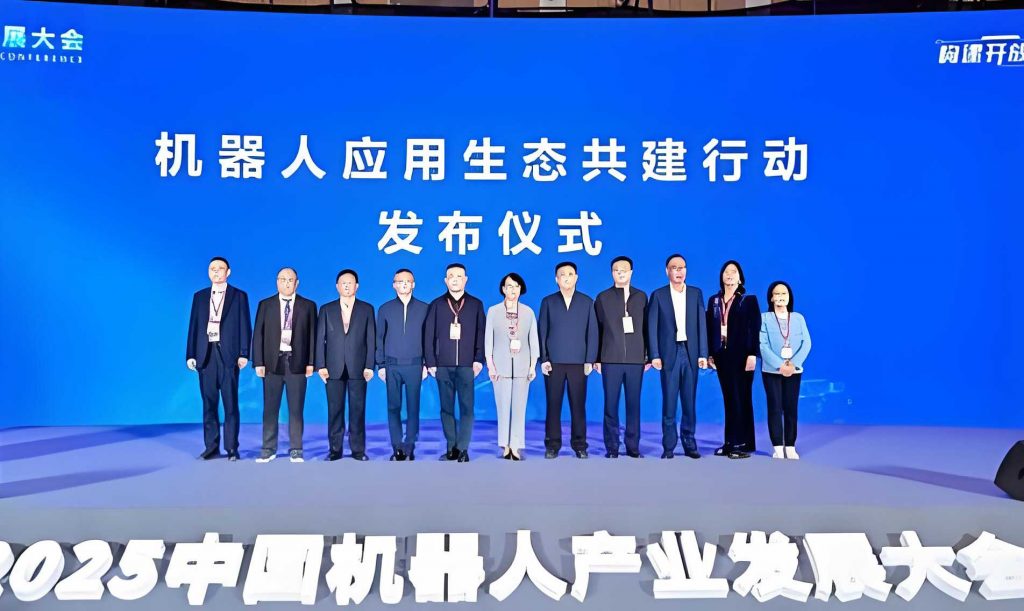
The image, though not referenced in text, captures the essence of the bustling innovation where myriad China robot units operate in harmony, a snapshot of the automated future being built today.
The parallel forum on intelligent recording devices, while distinct, intersected with robotics through the theme of autonomous sensing. Discussions on new standards and quality testing underscored the importance of reliable data acquisition for systems like self-driving cars or surveillance robots. The “internet plus” model for smart recorders mirrors the connectivity framework essential for China robot swarms. In a networked system, the overall efficiency can be modeled as a function of individual node performance and communication latency. If each robot $i$ in a swarm of $N$ robots has a processing speed $s_i$ and the network delay between nodes is $d_{ij}$, the time $T$ to complete a coordinated task might approximate:
$$T = \max_i \left( \frac{w_i}{s_i} + \sum_{j \neq i} \frac{c_{ij}}{b_{ij}} \cdot d_{ij} \right)$$
where $w_i$ is the workload, $c_{ij}$ is the communication volume, and $b_{ij}$ is bandwidth. Minimizing $T$ through better hardware and protocols is key for real-time applications in smart traffic management, a domain where China robot fleets are increasingly deployed.
Throughout the event, the term “China robot” was not merely a label but a recurring motif symbolizing national strategic ambition. From industrial automation to service robotics, the drive for self-sufficiency and global leadership was evident. The establishment of industry alliances and online platforms aims to create a cohesive ecosystem. To quantify the growth trajectory, consider the following table projecting key metrics for the China robot sector based on trends extrapolated from forum data:
| Metric | Current Estimate (Baseline) | Projected Growth Rate (Annual) | Key Drivers |
|---|---|---|---|
| Industrial Robot Density (units per 10,000 workers) | ~250 | 15-20% | Manufacturing upgrading, policy support, cost reduction |
| AI Robot Patents Filed | Leading globally in volume | 10-15% | R&D investment, university-industry collaboration |
| Market Size for Service Robots (in USD billions) | ~8.5 | 25-30% | Urbanization, aging population, logistics demand |
| Integration with Smart Transportation Systems | Pilot projects in major cities | Exponential as 5G/6G rolls out | Government smart city initiatives, V2X communication standards |
The mathematical modeling of innovation diffusion also applies. The adoption rate of China robot technologies can be described by a logistic growth curve:
$$N(t) = \frac{K}{1 + \left(\frac{K – N_0}{N_0}\right) e^{-rt}}$$
where $N(t)$ is the number of adopters at time $t$, $K$ is the carrying capacity (market saturation), $N_0$ is the initial adoption level, and $r$ is the growth rate. For China robot solutions, $r$ appears high due to strong policy tailwinds and competitive supply chains.
As the forums progressed, the interplay between hardware and software became a central thread. The development of robot operating systems (ROS) and middleware tailored for China robot applications facilitates modular innovation. In control theory, the stability of such systems is paramount. Consider a linear time-invariant system representing a robot controller:
$$\dot{x} = Ax + Bu$$
$$y = Cx + Du$$
where $x$ is the state vector, $u$ is the control input, $y$ is the output. The system is stable if all eigenvalues of $A$ have negative real parts. Ensuring this for complex, multi-agent China robot networks requires advanced optimization techniques, often involving Lyapunov functions $V(x)$ such that $\dot{V}(x) < 0$ along trajectories.
The economic implications extended beyond productivity to labor market dynamics. One presenter modeled the displacement and creation of jobs using a system of differential equations. If $J_t$ represents traditional jobs and $J_r$ represents new robot-related jobs, a simplified model might be:
$$\frac{dJ_t}{dt} = -\lambda J_t + \mu J_r$$
$$\frac{dJ_r}{dt} = \gamma I_r – \delta J_r$$
where $\lambda$ is the automation displacement rate, $\mu$ is a retraining conversion factor, $\gamma$ is the job creation rate per robot investment $I_r$, and $\delta$ is obsolescence rate. For China, balancing these equations is critical for social stability, necessitating policies that promote reskilling alongside robot deployment.
In the realm of smart transportation, the convergence with robotics was most palpable. Autonomous vehicles are essentially mobile robots, and their deployment in Chinese cities involves solving large-scale optimization problems. For route planning, a common formulation is the Vehicle Routing Problem (VRP). Given a fleet of $m$ vehicles with capacity $Q$ and a set of $n$ customer locations with demands $d_i$, the objective is to minimize total travel cost:
$$\text{Minimize} \sum_{k=1}^{m} \sum_{i=0}^{n} \sum_{j=0}^{n} c_{ij} x_{ijk}$$
subject to:
$$\sum_{i=0}^{n} d_i y_{ik} \leq Q, \quad \forall k$$
$$\sum_{k=1}^{m} y_{ik} = 1, \quad \forall i > 0$$
$$\sum_{j=0}^{n} x_{ijk} = y_{ik}, \quad \forall i, k$$
$$\sum_{i=0}^{n} x_{ijk} = y_{jk}, \quad \forall j, k$$
$$\text{subtour elimination constraints}$$
where $x_{ijk}$ is binary indicating if vehicle $k$ travels from $i$ to $j$, and $y_{ik}$ is binary if customer $i$ is served by vehicle $k$. Solving such problems in real-time for dynamic urban environments is a flagship challenge for China robot logistics networks.
The forum on industry alliances highlighted the collaborative ethos. The launch of an online platform aims to aggregate research, standards, and market data, creating a positive feedback loop. This can be modeled as a network effect where the value $V$ of the platform grows with the number of participants $n$:
$$V(n) = k \cdot n^2$$
or more generally, $$V(n) = \alpha n + \beta n^2$$
where $\alpha$ represents intrinsic value and $\beta$ the network effect coefficient. For the China robot community, a strong platform accelerates knowledge diffusion and reduces duplication of effort.
As I reflected on the event, the overarching narrative was one of transformative momentum. The China robot phenomenon is not an isolated trend but part of a broader digital and intelligent overhaul of society. From the algorithms that guide robotic movements to the economic models that forecast their impact, the interdisciplinary nature was striking. The following table summarizes the cross-sectoral influence of robotics as discussed across sessions:
| Sector | Primary Robot Application | Key Performance Indicator (KPI) Impact | Mathematical Model Link |
|---|---|---|---|
| Manufacturing | Assembly, welding, packaging | Throughput increase, defect rate reduction | Queueing theory, yield optimization $Y = 1 – \prod (1-p_i)$ |
| Logistics & Warehousing | Autonomous guided vehicles (AGVs), picking arms | Order fulfillment time, space utilization | Traveling salesman problem variants, packing algorithms |
| Urban Transportation | Autonomous buses, traffic management drones | Congestion reduction, accident rate | Traffic flow models (e.g., LWR model: $\partial_t \rho + \partial_x (\rho v) = 0$) |
| Security & Surveillance | Patrolling robots, smart recording systems | Response time, coverage area | Coverage path planning, detection probability $P_d = f(\text{SNR})$ |
| Healthcare & Services | Assistive robots, delivery bots | Patient outcome, service accessibility | Resource scheduling, reliability models (MTBF) |
In conclusion, my experience at this gathering was a profound immersion into a future being actively constructed. The relentless focus on innovation, standardization, and ecosystem building around China robot technologies signals a paradigm shift. The mathematical frameworks and economic models discussed provide a rigorous foundation for understanding this shift. As these systems evolve, they will redefine efficiency, safety, and quality of life. The journey of the China robot from concept to ubiquitous partner is underway, and its trajectory, as captured in the forums and exhibits, promises to reshape not just industries but the very contours of modern civilization. The equations and tables herein are mere snapshots of a dynamic, ever-advancing frontier—one where intelligence becomes embedded in every machine and process, heralding an era of unprecedented automation and connectivity.