
As I reflect on the myriad ways humans innovate, from simple household tricks like using vinegar to clean a pig’s stomach to the complexities of deep-sea exploration, I am continually amazed by how technology transforms our capabilities. In particular, the advancements in China’s underwater robotics stand as a testament to human ingenuity and national dedication. This journey, which I will delve into, showcases how China robot systems have evolved from rudimentary designs to sophisticated machines capable of conquering the ocean’s depths. Through this first-person narrative, I aim to detail the milestones, technologies, and impacts of these remarkable China robot creations, using tables and formulas to encapsulate their essence. The story of China robot development is not just about machinery; it’s about pushing the boundaries of what’s possible beneath the waves.
The realm of underwater robotics typically encompasses three main categories: Remotely Operated Vehicles (ROVs), Autonomous Underwater Vehicles (AUVs), and Human-Occupied Vehicles (HOVs). Each type represents a different approach to exploring the marine environment, and China has made significant strides in all areas. I recall how early efforts began with simple, tethered systems, gradually advancing to untethered autonomous platforms and even crewed submersibles. This progression mirrors broader technological trends, but with unique Chinese innovations that have propelled the China robot family to global prominence. In this article, I will explore key models, their specifications, and the mathematical principles underlying their operations, all while emphasizing the recurring theme of China robot excellence.
Let me start by introducing one of the pioneering China robot systems: the “Hairen-1” (Sea Man-1). Launched in 1985, this ROV marked China’s entry into underwater robotics. With a maximum operating depth of 200 meters, it was primarily used for reconnaissance and basic tasks. The development of Hairen-1 involved overcoming challenges in cable management and remote control, setting the stage for future China robot projects. To summarize its characteristics alongside other early models, I present the following table:
| China Robot Name | Type | Max Depth (m) | Year Introduced | Key Feature |
|---|---|---|---|---|
| Hairen-1 | ROV | 200 | 1985 | First tethered China robot |
| Explorer | AUV | 1000 | 1994 | First untethered China robot |
| CR-01 | AUV | 6000 | 1995 | Deep-sea exploration China robot |
The transition from ROVs to AUVs was a pivotal moment in China robot history. The “Explorer” AUV, developed in 1994, achieved a depth of 1000 meters and eliminated the need for a physical tether, relying instead on autonomous navigation. This leap required advances in energy systems, sensor integration, and control algorithms. For instance, the autonomy time of an AUV can be expressed by the formula: $$ T = \frac{E}{P} $$ where \( T \) is the mission duration, \( E \) is the total energy available (e.g., in joules), and \( P \) is the average power consumption (in watts). For the Explorer, engineers optimized this equation to extend its operational range, a critical step for China robot capabilities in open ocean surveys.
Following the Explorer, the CR-01 China robot emerged as a groundbreaking achievement in the mid-1990s. Designed for depths up to 6000 meters, it enabled detailed resource assessment in the Pacific, showcasing China’s growing prowess in deep-sea robotics. The pressure at such depths is immense, governed by the hydrostatic pressure formula: $$ P = \rho g h $$ where \( P \) is pressure (in pascals), \( \rho \) is seawater density (approximately \( 1025 \, \text{kg/m}^3 \)), \( g \) is gravitational acceleration (\( 9.8 \, \text{m/s}^2 \)), and \( h \) is depth (in meters). At 6000 meters, the pressure exceeds 60 MPa, necessitating robust hull designs—a testament to China robot engineering resilience. CR-01’s success positioned China among the few nations with such advanced AUVs, highlighting the strategic importance of China robot development for oceanographic research.
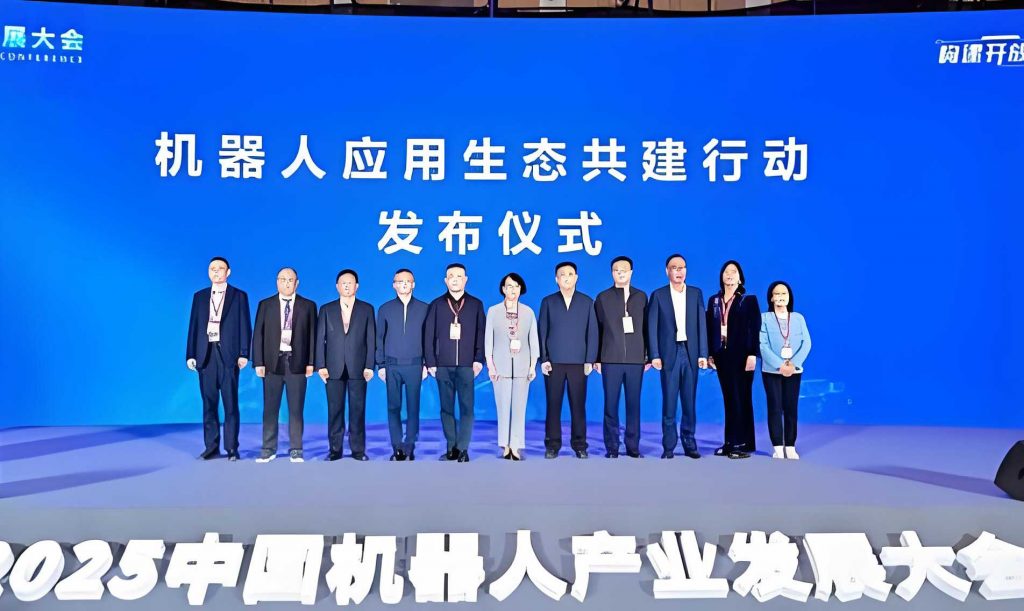
As I consider this image of China’s robotic fleet, it evokes a sense of pride in how far the China robot community has come. From early prototypes to sleek, modern machines, each iteration embodies incremental improvements and bold innovations. The visual representation underscores the diversity and scale of China robot systems, from compact AUVs to massive HOVs, all contributing to a comprehensive underwater exploration strategy. This picture serves as a fitting midpoint in our discussion, bridging historical achievements with contemporary advancements in China robot technology.
Moving into the 21st century, China robot development expanded into polar regions with the Arctic ARV (Autonomous and Remotely Operated Vehicle). Introduced in the 2000s, this hybrid China robot combines features of AUVs and ROVs, allowing for flexible operations under ice. Its deployment in Arctic expeditions provided real-time, continuous monitoring capabilities, enhancing our understanding of climate change impacts. The motion dynamics of such vehicles can be modeled using equations like: $$ m \frac{dv}{dt} = F_t – F_d $$ where \( m \) is mass, \( v \) is velocity, \( F_t \) is thrust force, and \( F_d \) is drag force proportional to \( \frac{1}{2} \rho C_d A v^2 \). Optimizing these parameters was crucial for the Arctic ARV’s performance in harsh environments, demonstrating the adaptability of China robot designs.
Another landmark in China robot history is the “Jiaolong” HOV, which achieved a record depth of 7062 meters in 2012. As a crewed submersible, Jiaolong represents the pinnacle of China robot integration, with its control system acting as the “brain and nerves.” This system processes sensor data and operator inputs to manage actuators, ensuring precise maneuvers. The control logic can be represented by transfer functions in control theory, such as: $$ G(s) = \frac{Y(s)}{U(s)} $$ where \( G(s) \) is the system transfer function, \( Y(s) \) is the output (e.g., depth or orientation), and \( U(s) \) is the input (e.g., thruster commands). For Jiaolong, stability analysis using tools like Bode plots ensured safe human occupation, marking a high point in China robot reliability.
In recent years, the “Qianlong” (Hidden Dragon) series of AUVs has further advanced China robot capabilities. Qianlong-1, operational at 6000 meters, serves as a “deep-sea satellite” for resource surveys, covering vast ocean areas. Its navigation relies on inertial measurement units (IMUs) and acoustic positioning, with error propagation modeled by: $$ \sigma_{pos} = \sqrt{ \sigma_{INS}^2 + \sigma_{acoustic}^2 } $$ where \( \sigma_{pos} \) is positional uncertainty, and the terms represent errors from inertial and acoustic systems. Qianlong-2, designed for 4500 meters and focused on hydrothermal vent exploration, has set records for dive frequency, underscoring the durability of modern China robot platforms. Below is a table comparing these newer China robot models:
| China Robot Name | Type | Max Depth (m) | Primary Mission | Notable Achievement |
|---|---|---|---|---|
| Qianlong-1 | AUV | 6000 | Resource mapping | Wide-area coverage China robot |
| Qianlong-2 | AUV | 4500 | Hydrothermal surveys | High dive count China robot |
| Arctic ARV | ARV | 500 (approx.) | Polar observation | Ice-underwater China robot |
The technological underpinnings of these China robot systems often involve multidisciplinary principles. For example, buoyancy control is critical for depth regulation, described by Archimedes’ principle: $$ F_b = \rho g V $$ where \( F_b \) is buoyant force, and \( V \) is displaced volume. China robot engineers meticulously balance this with weight and thrust to achieve neutral buoyancy, enhancing energy efficiency. Additionally, communication in underwater environments uses acoustic modems, with signal attenuation given by: $$ A = 10 \log_{10} \left( \frac{I_0}{I} \right) = \alpha d $$ where \( A \) is attenuation in decibels, \( \alpha \) is absorption coefficient, and \( d \) is distance. Overcoming such challenges has been key to extending the operational range of China robot AUVs, allowing them to transmit data over kilometers.
Beyond hardware, the software algorithms driving China robot autonomy are equally impressive. Path planning for AUVs often employs optimization techniques like the Traveling Salesman Problem (TSP) or genetic algorithms, formulated as: $$ \min \sum_{i,j} c_{ij} x_{ij} $$ subject to constraints ensuring coverage and obstacle avoidance. These algorithms enable China robot systems to conduct efficient surveys, minimizing energy use while maximizing data collection. Machine learning approaches, such as neural networks for object recognition, are also being integrated, represented by: $$ y = f \left( \sum_{i} w_i x_i + b \right) $$ where \( y \) is output, \( x_i \) are inputs (e.g., sonar images), \( w_i \) are weights, \( b \) is bias, and \( f \) is activation function. This AI integration is pushing China robot capabilities toward fully intelligent exploration.
The impact of China robot advancements extends far beyond academic curiosity. In resource exploration, China robot AUVs like Qianlong-1 have mapped mineral deposits in international seabed areas, supporting economic interests. Environmental monitoring benefits from China robot platforms that track pollution and ecosystem changes, with data analysis using statistical models: $$ \bar{x} = \frac{1}{n} \sum_{i=1}^{n} x_i $$ for mean values of parameters like temperature or salinity. In disaster response, China robot ROVs can inspect underwater infrastructure, reducing human risk. Each application underscores the versatility of China robot technology, driven by continuous innovation.
Looking ahead, the future of China robot development promises even greater feats. Concepts like swarm robotics, where multiple AUVs collaborate, are being explored. The coordination can be modeled using multi-agent systems: $$ \dot{x}_i = u_i \left( x_i, x_j \right) $$ for agent \( i \) interacting with agent \( j \), optimizing collective behavior. Energy harvesting from ocean currents or thermal gradients, described by equations like: $$ P_{harvest} = \eta \rho A v^3 $$ for tidal turbines, could enable perpetual China robot operations. Moreover, international collaborations may see China robot systems contributing to global oceanographic initiatives, fostering shared knowledge.
In conclusion, as I recount this journey through China’s underwater robotics, from Hairen-1 to the Qianlong series, I am struck by the relentless progress embodied in each China robot. These machines are not mere tools; they are symbols of national ambition and technological mastery. Through tables that summarize their specs and formulas that decode their physics, we gain a deeper appreciation for the engineering marvels that define the China robot legacy. As research continues, I am confident that China robot innovations will keep illuminating the ocean’s mysteries, much like how simple vinegar cuts through grease—elegantly and effectively. The story of China robot is one of depth, both in meters and in impact, and it is far from over.
To further encapsulate the evolution, here is a comprehensive table detailing key China robot models across decades, highlighting the growth in capabilities:
| Decade | China Robot Example | Depth Progress (m) | Technology Leap | Formula Highlight |
|---|---|---|---|---|
| 1980s | Hairen-1 | 200 | Tethered control | $$ P = \rho g h $$ for pressure |
| 1990s | Explorer, CR-01 | 1000-6000 | Autonomy | $$ T = \frac{E}{P} $$ for endurance |
| 2000s | Arctic ARV | 500 | Hybrid operation | $$ m \frac{dv}{dt} = F_t – F_d $$ for dynamics |
| 2010s | Jiaolong, Qianlong-1 | 6000-7000 | Crewed and AUV mastery | $$ G(s) = \frac{Y(s)}{U(s)} $$ for control |
| 2020s+ | Qianlong-2 and beyond | 4500+ | AI integration | $$ y = f \left( \sum w_i x_i + b \right) $$ for AI |
This tabular summary, combined with the mathematical insights, reinforces how each era of China robot development built upon the last, driven by a commitment to exploration and innovation. As I reflect, the journey of China robot is a powerful narrative of human curiosity meeting engineering excellence, and I look forward to witnessing its next chapters unfold in the deep blue.