
As an observer deeply immersed in the world of industrial automation, I have witnessed the transformative journey of China robot development over the years. From its nascent stages to the current surge, the narrative of China robot is one of ambition, challenge, and immense potential. In this article, I will delve into the multifaceted aspects of China robot industry, exploring its current state, technological hurdles, future trajectories, and the pivotal role it plays in global manufacturing. Through this first-person perspective, I aim to provide a comprehensive analysis, enriched with tables and formulas to encapsulate key insights. The rise of China robot is not merely a trend; it is a paradigm shift that redefines production landscapes.
The concept of China robot encompasses a broad spectrum of robotic systems designed and manufactured within China, aiming to cater to diverse industrial needs. Historically, China’s manufacturing prowess has been built on labor-intensive models, but with escalating labor costs, environmental regulations, and the imperative for quality enhancement, the shift toward automation via China robot has become inevitable. I recall the early 2010s when discussions around China robot were tentative, but today, they are at the forefront of industrial policy. The government’s proactive stance, through initiatives like the “Guidelines for Promoting Industrial Robot Industry Development” by the Ministry of Industry and Information Technology, has catalyzed this movement. This policy framework underscores the strategic importance of China robot in national economic planning, setting the stage for a robust ecosystem.
To understand the current landscape of China robot, let me present a table summarizing key statistics as of recent years. This data highlights the growth trajectory and comparative metrics that define the China robot sector.
| Metric | Value | Year/Period | Notes |
|---|---|---|---|
| Number of China Robot System Integrators | Over 4,000 | 2014 onwards | Reflects the expanding base of enterprises involved in China robot solutions. |
| Market Share of Domestic China Robot Producers | Less than 15% | 2014 | Indicates dominance by foreign brands like ABB, Fanuc, Yaskawa, and KUKA. |
| Key Component Import Dependency | Ongoing | A critical bottleneck for China robot cost competitiveness. | |
| Annual Growth Rate of China Robot Installations | 2010-2020 | Driven by automotive, electronics, and general manufacturing sectors. |
From this table, it is evident that while the China robot industry is burgeoning, it faces significant headwinds in terms of market penetration and self-sufficiency. I often reflect on the technological underpinnings that dictate the performance of China robot. One fundamental aspect is the precision and speed metrics, which can be expressed through formulas. For instance, the positional accuracy of a China robot arm might be modeled as $$ \Delta x = \sqrt{ \sum_{i=1}^{n} ( \epsilon_i^2 + \delta_i^2 ) } $$ where $\Delta x$ represents the total error, $\epsilon_i$ denotes mechanical backlash, and $\delta_i$ signifies control system deviations. Such formulas are crucial in benchmarking China robot against international standards, revealing gaps that need bridging.
The reliance on imported components for China robot is a persistent concern that I have analyzed extensively. Key items like precision reducers, servo motors, and controllers often come from overseas suppliers, inflating costs and limiting scalability. To quantify this dependency, consider the cost structure of a typical China robot unit. Let $C_{\text{total}}$ be the total production cost, which can be broken down as $$ C_{\text{total}} = C_{\text{domestic}} + C_{\text{import}} $$ where $C_{\text{domestic}}$ covers locally sourced parts, and $C_{\text{import}}$ accounts for imported critical components. Based on industry estimates, $C_{\text{import}}$ can constitute up to 60-70% of $C_{\text{total}}$ for high-end China robot models. This imbalance stifles the affordability and mass adoption of China robot solutions in domestic markets.
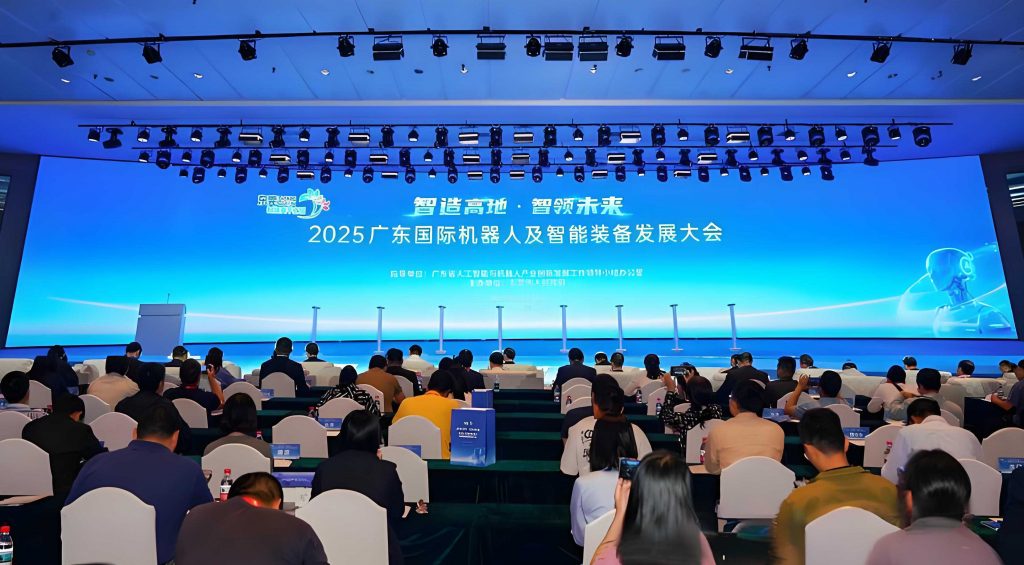
In my observations, the visual representation of China robot applications, as seen in the image above, underscores their growing presence in factories. This aligns with the push toward smarter, more adaptive systems. However, the technological evolution of China robot must address several frontiers. Future China robot platforms are expected to incorporate advanced features such as仿人灵巧操作 (human-like dexterous manipulation), which involves complex kinematics. The degree of freedom (DOF) for a China robot hand can be expressed as $$ \text{DOF} = 6n – \sum_{i=1}^{m} c_i $$ where $n$ is the number of links, and $c_i$ represents constraint equations from joints. Achieving high DOF in China robot designs is essential for tasks beyond repetitive assembly, such as delicate handling in electronics or healthcare.
Another critical area for China robot advancement is autonomous navigation and perception. Modern China robot systems are increasingly equipped with sensors and algorithms for environment mapping. The localization error in a China robot operating in dynamic settings can be modeled using probabilistic frameworks like $$ p(x_t | z_{1:t}, u_{1:t}) = \eta \cdot p(z_t | x_t) \int p(x_t | x_{t-1}, u_t) p(x_{t-1} | z_{1:t-1}, u_{1:t-1}) dx_{t-1} $$ where $x_t$ is the robot state, $z_t$ are observations, and $u_t$ are controls. This Bayesian approach highlights the computational demands for China robot to achieve real-time, reliable operation in unstructured environments. I believe that breakthroughs in these algorithms will define the next generation of China robot capabilities.
The market projections for China robot are a testament to its anticipated growth. By 2020, estimates suggested a demand of 110,000 units annually, with a cumulative installed base of 600,000 units. The market size in monetary terms can be calculated as $$ S = N \times P $$ where $S$ is the market size, $N$ is the number of units, and $P$ is the average price per unit. Assuming $P = \$20,000$ (based on historical data), we get $$ S = 110,000 \times 20,000 = \$2.2 \text{ billion} $$ for annual sales. This underscores the economic scale of China robot adoption. To put this in context, the following table outlines the projected growth across different sectors for China robot deployments.
| Sector | Projected China Robot Installations (2020) | Growth Driver |
|---|---|---|
| Automotive | 40,000 units | Assembly line automation and quality control |
| Electronics | 30,000 units | Precision manufacturing and miniaturization |
| Logistics | 20,000 units | Warehousing automation and e-commerce expansion |
| General Manufacturing | 20,000 units | Labor substitution and efficiency gains |
As I ponder these numbers, it becomes clear that the success of China robot hinges not just on volume but on technological sophistication. The integration of artificial intelligence (AI) into China robot systems is a game-changer. For example, the learning efficiency of a China robot using reinforcement learning can be quantified by the reward convergence rate $$ R(t) = R_{\max} (1 – e^{-\alpha t}) $$ where $R(t)$ is the cumulative reward at time $t$, $R_{\max}$ is the maximum achievable reward, and $\alpha$ is the learning rate parameter. This formula illustrates how China robot can adapt to new tasks through trial and error, reducing programming overhead and enhancing flexibility.
Policy support has been instrumental in nurturing the China robot ecosystem. I have followed the regulatory developments closely, noting how subsidies, tax incentives, and R&D grants have lowered entry barriers for domestic China robot manufacturers. The emphasis on standards-setting, such as formulating industry-specific benchmarks for China robot performance, aims to harmonize quality and safety. This regulatory framework is vital for building trust in China robot brands, both domestically and internationally. In my view, a cohesive policy approach that balances innovation with standardization will accelerate the maturity of China robot industries.
However, challenges remain pervasive. The scalability of China robot production is often hampered by fragmented supply chains. To analyze this, consider the production output $Q$ of a China robot factory, which depends on input factors like labor $L$, capital $K$, and technology $T$. Using a Cobb-Douglas production function, we have $$ Q = A L^\beta K^\gamma T^\delta $$ where $A$ is total factor productivity, and $\beta, \gamma, \delta$ are output elasticities. For many China robot firms, $\gamma$ is low due to limited access to advanced machinery, and $\delta$ is constrained by intellectual property gaps. Addressing these inefficiencies is crucial for China robot to achieve economies of scale.
The human-robot collaboration aspect of China robot also warrants attention. As factories evolve toward smart manufacturing, the interaction between workers and China robot becomes more intimate. The safety metrics for such collaboration can be expressed through risk assessment models like $$ \text{Risk Index} = \frac{\text{Probability of Failure} \times \text{Severity of Harm}}{\text{Controllability}} $$ where lower values indicate safer China robot designs. Innovations in sensor-based collision avoidance and intuitive programming interfaces are reducing this index for China robot systems, making them more palatable for small and medium enterprises.
Looking ahead, I envision a future where China robot not only replicates human tasks but augments them with superhuman capabilities. The convergence of technologies like 5G, edge computing, and digital twins will enable real-time synchronization of China robot networks. The latency in a China robot control loop over a 5G network can be modeled as $$ L = t_{\text{transmission}} + t_{\text{processing}} + t_{\text{actuation}} $$ where $t_{\text{transmission}}$ is minimized with high-bandwidth, low-latency links. This will unlock new applications for China robot in remote surgery, disaster response, and customized production.
In terms of global competitiveness, China robot must carve a niche through cost-effectiveness and customization. The total cost of ownership (TCO) for a China robot over its lifecycle can be compared with foreign alternatives using $$ \text{TCO} = C_{\text{acquisition}} + \sum_{t=1}^{T} \frac{C_{\text{operation}, t} + C_{\text{maintenance}, t}}{(1+r)^t} $$ where $r$ is the discount rate, and $T$ is the lifespan. By reducing $C_{\text{acquisition}}$ through local sourcing and $C_{\text{maintenance}}$ via robust design, China robot can offer compelling value propositions. I have seen emerging success stories where China robot solutions are exported to Southeast Asia and Africa, leveraging this cost advantage.
The educational and research infrastructure supporting China robot is another area I have monitored. Universities and institutes across China are pioneering curricula in robotics engineering, fostering a talent pipeline. The knowledge diffusion rate can be approximated by $$ \frac{dK}{dt} = \lambda (K_{\max} – K) $$ where $K$ is the cumulative knowledge, $K_{\max}$ is the potential maximum, and $\lambda$ is the learning coefficient. With increased investment, $\lambda$ for China robot research is rising, leading to more patents and publications. This intellectual capital is the bedrock for sustained innovation in China robot.
Environmental sustainability is increasingly tied to China robot adoption. By optimizing energy usage, China robot can contribute to greener manufacturing. The energy efficiency of a China robot can be measured by $$ \eta = \frac{\text{Useful Work Output}}{\text{Energy Input}} $$ where higher $\eta$ values indicate better performance. Advances in lightweight materials and regenerative braking for China robot joints are pushing $\eta$ upward, aligning with global carbon reduction goals. I advocate for lifecycle assessments of China robot to quantify their ecological footprints comprehensively.
To encapsulate the strategic imperatives for China robot development, I propose a focus on indigenous innovation cycles. The technology readiness level (TRL) of China robot components can be tracked using a scale from 1 to 9, with 9 denoting market-ready products. Currently, many core components for China robot languish at TRL 4-5, indicating prototype stages. Accelerating this progression requires concerted R&D efforts and public-private partnerships. The following table outlines a roadmap for key China robot technologies.
| Technology Area | Current TRL (China Robot) | Target TRL by 2030 | Key Challenges |
|---|---|---|---|
| Precision Reducers | 5 | 9 | Material science and manufacturing tolerances |
| Servo Motors | 6 | 9 | Power density and thermal management |
| AI-Based Controllers | 4 | 8 | Algorithm robustness and real-time processing |
| Tactile Sensors | 3 | 7 | Integration and durability |
In my concluding reflections, the trajectory of China robot is one of relentless progress. From overcoming import dependencies to pioneering next-gen AI-driven systems, the journey is fraught with hurdles but brimming with opportunities. The phrase “China robot” symbolizes not just a product category but a national endeavor to redefine manufacturing excellence. As I project into the coming decades, I foresee China robot becoming synonymous with innovation, quality, and accessibility on the global stage. The seeds planted today through policy, research, and entrepreneurship will blossom into a vibrant ecosystem where China robot empowers industries and enriches societies. The era of China robot is not on the horizon—it is already here, evolving with each technological leap and market expansion.