
From my perspective as an observer of global industrial trends, the year 2015 marked a pivotal moment where the world’s manufacturing landscape began to shift decisively. A key report released in March highlighted a seismic change: a nation had emerged as the single largest demand center for industrial automation. This nation is China, and its hunger for robotic solutions—what I repeatedly term the rise of the “China robot” phenomenon—is reshaping supply chains, technological development, and economic strategies worldwide. This transformation is not isolated to factory floors; it is part of a broader, urgent push to modernize core industries, from energy to traditional manufacturing, in the face of a new global industrial revolution. The data is clear, the ambitions are high, and the implications are profound for global trade and technology leadership. In this analysis, I will delve into the multifaceted nature of this shift, using data, models, and projections to unpack the dynamics of the “China robot” market, the parallel advances in sovereign nuclear technology, and the overarching drive towards an intelligent, networked industrial ecosystem.
The narrative of the “China robot” boom is best understood through hard numbers. According to a major international industry survey published that spring, global sales of industrial robots reached approximately 225,000 units in 2014, a significant increase of 27% from the previous year. The regional breakdown was even more telling. Asia accounted for nearly two-thirds of all units sold, with its growth rate leading the world. Within this Asian surge, one country stood out with an astonishing year-on-year sales growth of 54%. This country, of course, is China. Its market absorbed 56,000 industrial robots in that single year. To dissect this “China robot” demand, we must look at the supply structure. Of those 56,000 units, about 16,000 were supplied by domestic Chinese manufacturers. The remainder, a substantial majority, came from established international robotics giants. This dichotomy highlights both the scale of immediate demand and the ongoing opportunities for local industry development in the “China robot” sphere.
The concentration of the global “China robot” and broader robotics market is captured in the following table, which summarizes the top national markets from that period:
| Rank (2014) | Country | Key Market Characteristic | Approximate Contribution to Global Sales |
|---|---|---|---|
| 1 | China | Highest growth rate (54%); largest total volume. | ~25% |
| 2 | South Korea | High density of robots in manufacturing sectors. | ~15% |
| 3 | Japan | Major producer and consumer of robotics. | ~12% |
| 4 | United States | Strong demand in automotive and general industry. | ~11% |
| 5 | Germany | Core of European automation and Industry 4.0. | ~10% |
This top five cohort collectively represented about 75% of global industrial robot sales. The dominance of the “China robot” market is not merely a statistical blip. It can be modeled as a compound growth phenomenon. If we let \( R_{CN}(t) \) represent the annual sales of robots in China at year \( t \), and given a growth rate \( g \), we can project future demand. For 2014, \( R_{CN}(2014) = 56,000 \). With a sustained growth rate \( g \), sales in year \( n \) could be estimated by:
$$ R_{CN}(t+n) = R_{CN}(t) \times (1 + g)^n $$
For instance, if the “China robot” market maintained a more conservative annual growth of 20% after 2014, the sales by 2020 would be:
$$ R_{CN}(2020) = 56,000 \times (1 + 0.20)^{6} \approx 56,000 \times 2.986 \approx 167,216 \text{ units} $$
This mathematical projection underscores the potential scale that makes the “China robot” sector a focal point for global suppliers and investors. The financial dimension is equally staggering. The total global market value for industrial robots was estimated at around $5.9 billion in 2014. The value attributed to the “China robot” segment constituted a major and growing portion of this total. The penetration of robots, often measured as robot density (number of robots per 10,000 manufacturing workers), was still lower in China compared to advanced economies like Japan or Germany. This gap itself represents the immense runway for future growth in the “China robot” adoption curve, driven by rising labor costs and the pursuit of manufacturing quality and consistency.
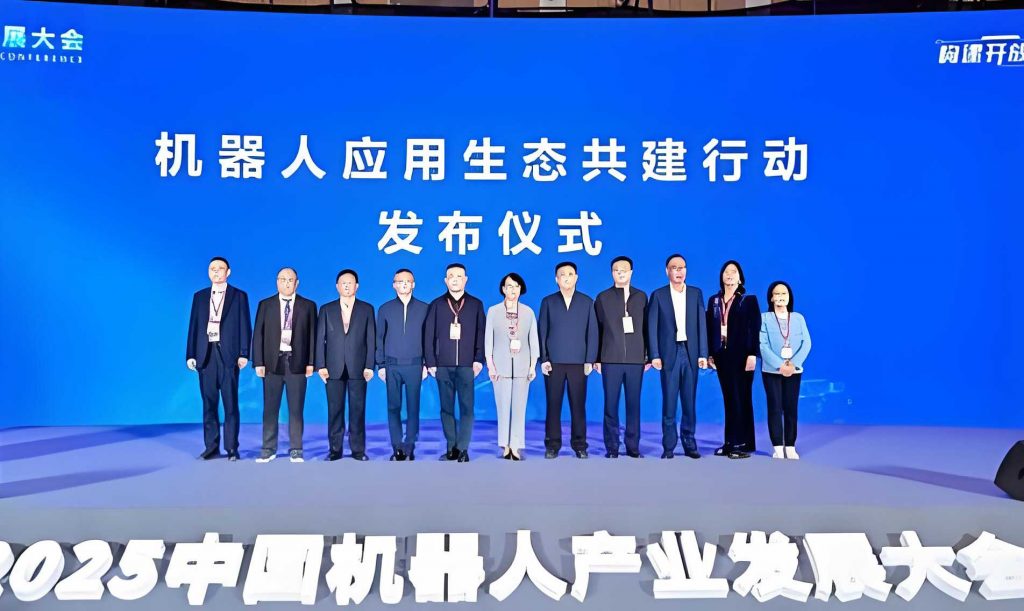
The visual evidence of this “China robot” integration is compelling, as seen in modern automated lines. This physical transformation on the factory floor is just one pillar of a broader national industrial strategy. Concurrently, in the high-tech domain of power generation, a parallel and symbolically important development was underway. Authorities announced that the demonstration project for a new generation of nuclear power technology, developed with sovereign intellectual property, was slated to begin construction in the first half of the year. This project, representing a significant technological leap, was designed with enhanced safety features informed by post-Fukushima disaster reviews and the latest international standards. Key safety augmentations focused on increased resilience against extreme natural events like seismic activity and flooding. The project’s timeline aimed for grid connection around 2020. From an engineering and risk management perspective, such safety enhancements can be framed probabilistically. The core damage frequency (CDF) is a key metric in nuclear safety. If traditional designs had a CDF of \( CDF_{old} \), the new design aims for a significantly lower \( CDF_{new} \). The improvement factor \( \alpha \) can be expressed as:
$$ \alpha = \frac{CDF_{old}}{CDF_{new}} $$
Design targets for next-generation plants often aim for \( \alpha \gg 1 \), for instance, reducing CDF by one or two orders of magnitude. The economic output of such a plant is another critical formula. The annual electrical energy output \( E \) in megawatt-hours (MWh) for a plant with net capacity \( P \) (in MW) and capacity factor \( CF \) is:
$$ E = P \times CF \times 8760 \text{ hours/year} $$
For a large-scale plant, this represents a massive, stable baseload power contribution, supporting industrial growth that, in turn, feeds demand for automation and “China robot” solutions. The following table contrasts key aspects of this new project with preceding generation technologies:
| Feature | New Generation Demonstration Project | Typical Previous Generation |
|---|---|---|
| Design Safety Philosophy | Enhanced defense-in-depth, passive safety systems, higher design basis for external hazards. | Active safety systems, standard design basis for external events. |
| Target Core Damage Frequency | Significantly lower (e.g., < 1×10⁻⁶ per reactor-year). | Higher (e.g., ~1×10⁻⁵ per reactor-year). |
| Localization / IP Ownership | Fully independent intellectual property. | Often based on licensed or imported technology. |
| Primary Driver | Energy security, technology leadership, export potential. | Capacity addition, technology acquisition. |
This pursuit of technological sovereignty in critical infrastructure like nuclear energy is intrinsically linked to the ambitions seen in the “China robot” and advanced manufacturing sectors. It reflects a comprehensive drive to move up the global value chain. This leads directly to the third, overarching theme: the urgent transformation of the entire manufacturing paradigm. Senior policymakers emphasized that the global context was one of dual pressure: developed nations were vigorously revitalizing their manufacturing bases, while developing nations were actively承接 industrial transfer. In this competitive environment, accelerating industrial upgrading and structural adjustment was deemed not just important but imperative for China’s future.
The envisioned path forward is a deep integration of the digital and physical worlds in industry. The conceptual framework, prominently exemplified by Germany’s “Industry 4.0,” advocates for the cyber-physical systems where machinery, workpieces, and systems are connected via the Internet of Things (IoT) and serviced by cloud computing and AI. For China, embracing this new wave of technological and industrial revolution means applying an internet mindset to transform traditional manufacturing. The goal is a manufacturing sector that is networked, informative, intelligent, and specialized. The economic logic behind this can be modeled. Consider a traditional production line’s productivity \( \Pi_{trad} \). Introducing industrial internet and “China robot” systems can boost productivity through factors like reduced downtime, optimized logistics, and predictive maintenance. The new productivity \( \Pi_{smart} \) could be a function of connectivity \( C \) (0 to 1), data utilization \( D \), and automation level \( A \):
$$ \Pi_{smart} = \Pi_{trad} \times (1 + \beta_1 C + \beta_2 D + \beta_3 A) $$
where \( \beta_1, \beta_2, \beta_3 \) are positive coefficients representing the impact elasticity of each factor. The integration of “China robot” solutions directly increases \( A \), while IoT deployment increases \( C \) and \( D \). The synergistic effect when these factors are combined is often super-linear, leading to transformative efficiency gains. The exploration of combining the internet and manufacturing had already begun in China, and the call was for creating conditions to encourage this trend to deepen. The following table outlines the key dimensions of this manufacturing transformation and how the “China robot” ecosystem acts as a critical enabler:
| Transformation Dimension | Description | Role of “China Robot” and Automation |
|---|---|---|
| Networked Production | Machines and systems communicate and cooperate via industrial internet/IoT platforms. | Robots act as intelligent nodes in the network, sending and receiving data for coordinated action. |
| Informative Operations | Full data transparency across the value chain, from supply to production to maintenance. | Robots generate vast operational data (performance, quality metrics) that fuel analytics and optimization. |
| Intelligent Processes | Use of AI and machine learning for adaptive control, predictive analytics, and autonomous decision-making. | Advanced “China robot” systems incorporate vision, force sensing, and learning algorithms for complex, flexible tasks. |
| Specialized Customization | Ability to efficiently produce small batches or even single unique products (mass customization). | Reconfigurable robotic cells and collaborative robots (“cobots”) enable flexible production lines tailored to specific orders. |
The trajectory of the “China robot” market is therefore not an isolated trend but the operational core of this larger industrial metamorphosis. The demand for robots is driven by the need to implement these networked, intelligent systems. This creates a virtuous cycle: as more “China robot” units are deployed, they generate data that makes systems smarter, which in turn justifies further automation investments. To model the economic impact at a macro level, we can consider a simplified Cobb-Douglas type production function for the manufacturing sector, now augmented with a robotics capital stock. Let \( Y \) be manufacturing output, \( K \) be traditional capital, \( L \) be labor, and \( R \) be the stock of robotic systems (the cumulative installed base of “China robot” and similar automation). A possible form is:
$$ Y = A \times K^\alpha \times L^\beta \times R^\gamma $$
where \( A \) is total factor productivity, and \( \alpha, \beta, \gamma \) are output elasticities. The distinctive feature of the “China robot” stock \( R \) is its potential for a high elasticity \( \gamma \) and its interaction with \( A \), as robotics enable smarter processes. Over time, as \( R \) grows exponentially in China, its contribution to \( Y \) becomes increasingly significant, potentially offsetting slower growth in traditional \( L \) and enhancing the productivity of \( K \).
Delving deeper into the “China robot” supply chain dynamics, the 2014 sales mix—16k domestic vs. 40k foreign—reveals a strategic dependency and a clear target for import substitution. The growth trajectory for domestic “China robot” suppliers can be modeled competitively using a market share equation. Let \( M_{local}(t) \) be the market share of local suppliers in China. Its change over time could be driven by factors like technology catch-up rate \( \tau \), government support factor \( \sigma \), and relative cost advantage \( \delta \). A simple differential equation could be:
$$ \frac{dM_{local}}{dt} = \tau \cdot (1 – M_{local}) + \sigma \cdot M_{local} \cdot (1 – M_{local}) – \delta \cdot (M_{local} – M^*) $$
where \( M^* \) is a long-term equilibrium share. Solving such models helps project when domestic “China robot” brands might capture 50% or more of their home market, a key milestone for industrial policy.
The nuclear and robotics/automation stories converge on the theme of systematic risk management and reliability. In nuclear power, probabilistic safety assessment (PSA) uses fault trees and event trees with Boolean algebra. For a robotic workcell in a smart factory, reliability engineering uses similar principles. The availability \( Av \) of a robotic system, crucial for uninterrupted production, is a function of its Mean Time Between Failures (MTBF) and Mean Time To Repair (MTTR):
$$ Av = \frac{MTBF}{MTBF + MTTR} $$
For a production line with \( n \) “China robot” units in series, the overall line availability \( Av_{line} \) is the product of individual availabilities if failures are independent:
$$ Av_{line} = \prod_{i=1}^{n} Av_i $$
This formula highlights why reliability advancements in “China robot” hardware and predictive maintenance software are so critical to the economics of automation.
Looking at the global context, the push for manufacturing transformation is a race. The “China robot” adoption rate must be contextualized against initiatives like “Industry 4.0” in Germany or the “Industrial Internet” in the United States. A comparative metric could be the annual investment in industrial digitalization per unit of manufacturing GDP. If China’s investment intensity \( I_{CN} \) grows at a rate faster than that of competitors \( I_{comp} \), it signals a strong catch-up or forging ahead dynamic. This intensity is a driver for the “China robot” market size.
The integration of the Internet of Things (IoT) with “China robot” systems creates a data-generation engine. The volume of data \( V_{data} \) produced by a single advanced robot per day can be substantial, including positional data, torque readings, vision streams, and error logs. If a factory has \( N_{robots} \), the total daily data load is:
$$ V_{data}^{total} = N_{robots} \times V_{data}^{per\,robot} $$
This data is the feedstock for the intelligent and informative dimensions of manufacturing. Processing this data requires edge computing and cloud analytics, creating a secondary industry around industrial AI—another growth vector spurred by the “China robot” expansion.
In conclusion, the developments of 2015 were not discrete events but interconnected strands of a single national industrial strategy. The explosive growth of the “China robot” market, symbolized by the 54% surge and the 56,000 units absorbed, provides the tangible, hardware-driven momentum for modernization. The advancement of sovereign, safety-enhanced nuclear technology ensures a long-term, low-carbon energy base to power this industrial machine. Both are subsumed under the imperative to comprehensively transform the manufacturing ethos through digital networking and intelligence. From my analysis, the formula for China’s industrial future hinges on the continued, synergistic scaling of these elements. The “China robot” is both a driver and an indicator of this change. Its proliferation on factory floors, supported by robust infrastructure and guided by a vision of intelligent industry, positions China not just as the world’s largest demand center for automation, but as a formidable laboratory and eventual standard-setter for the future of global manufacturing. The mathematical models for growth, market share, productivity, and system reliability all point to a trajectory where the scale of adoption and the depth of integration will create unique ecosystems of innovation. The journey from being the largest market for “China robot” products to being the leading source of “China robot” innovation and integrated smart manufacturing solutions is the next, and perhaps most decisive, phase of this industrial ascent.