
In an era defined by rapid technological convergence, the humanoid robot has emerged as the most striking symbol of artificial intelligence’s reach into our daily existence. From factory floors to hospital wards, from educational classrooms to entertainment venues, these machines are no longer confined to science fiction. As a public relations professional who has spent years advising technology enterprises on how to communicate with the public, I have come to realize that the fate of the humanoid robot industry hinges on more than just engineering breakthroughs. It hinges on perception, trust, and meaning. The humanoid robot, because of its resemblance to us, triggers a profound psychological response—one that can be either welcoming or adverse. Public relations, therefore, carries the extraordinary responsibility of shaping how society sees, feels, and eventually embraces this new inhabitant of the human world.
My perspective is shaped by a range of experiences: launching humanoid robot prototypes, managing media expectations during public demonstrations, and navigating the emotional turbulence that arises when these machines behave unexpectedly. I have learned that a humanoid robot is not merely a technical artifact; it is a canvas upon which people project their hopes, fears, and ethical uncertainties. The way we communicate about the humanoid robot—the stories we tell, the images we share, the metaphors we choose—can either amplify anxiety or cultivate curiosity. In this article, I intend to share a comprehensive analysis of how public relations can innovate the image-building process for humanoid robots, drawing on both theoretical models and practical case studies, while offering actionable strategies for the years ahead.
The urgency of this work became clear to me during a major public running event for humanoid robots. On that day, a humanoid robot experienced a bizarre technical malfunction: its head detached mid-race, yet the machine continued to run. The immediate online reaction was a mixture of mockery, horror, and existential dread. But the communications team at the event swiftly transformed this moment into a narrative of perseverance and mechanical romance. They described the headless humanoid robot as a “soul that refuses to stop,” highlighting its determined gait as a metaphor for resilience. This reframing was not a distortion of facts; it was a deliberate choice to direct attention to a trait that humans admire—tenacity. I witnessed how the global conversation shifted from “this technology is broken” to “this robot has character.” That episode became a turning point in my understanding of PR’s power in the humanoid robot domain.
Why does the humanoid robot evoke such intense reactions? The answer lies in the uncanny valley hypothesis, which suggests that as a robot’s appearance becomes almost human, our emotional response shifts from empathy to revulsion. This discontinuity creates a unique communication challenge. Unlike industrial arms or vacuum cleaners, the humanoid robot occupies an ambiguous space: it is neither fully object nor fully subject. The public demands that it behaves with ethical certitude, yet simultaneously sees it as a glorified machine. Public relations must therefore operate on two fronts: normalizing the humanoid robot’s presence in everyday settings while also preserving its aura of wonder. This delicate balance requires a sophisticated repertoire of narrative techniques, audience segmentation, and channel management.
The central thesis of this article is that public relations serves as the indispensable bridge between the technological capabilities of the humanoid robot and the societal acceptance they require. Without robust PR, a humanoid robot may be doomed to remain a laboratory curiosity or a target of fear. With effective PR, it can become an integrated partner in human life. I will first analyze the significant roles PR plays in advancing the humanoid robot industry, then outline a set of practical communication pathways that I have seen work in real-world contexts, and finally propose innovative strategic directions that can prepare the industry for a future of deeper human-robot coexistence.
PR’s Essential Contributions to the Humanoid Robot Industry
Narrative Strategies to Overcome the Uncanny Valley
The uncanny valley is perhaps the most well-known barrier to humanoid robot acceptance. When a humanoid robot’s appearance and motion approach—but do not perfectly match—human norms, viewers experience a feeling of eeriness. This feeling is not merely aesthetic; it activates neural circuits associated with threat detection. PR professionals can mitigate this response by constructing narratives that de-emphasize the robot’s visual imperfections and emphasize its intentionality. For example, instead of broadcasting a camera feed of a humanoid robot’s imperfect facial expressions, we can produce an animated story where the robot is portrayed as a determined explorer. Animation bypasses the uncanny realism, allowing the audience to connect with the robot’s personality rather than its skin.
One powerful formula I often use to plan narrative interventions is derived from sentiment analysis:
$$
\text{Narrative Conversion Index (NCI)} = \frac{\sum_{t=1}^{T} (\text{Pos}_t – \text{Neg}_t)}{\sum_{t=1}^{T} \text{Total}_t}
$$
where \(t\) indexes time intervals, \(\text{Pos}_t\) is the count of positive public mentions in interval \(t\), \(\text{Neg}_t\) is the count of negative mentions, and \(\text{Total}_t\) is the total mentions. By tracking NCI before and after a mitigation campaign, I can empirically demonstrate whether the PR strategy is working. In the incident of the headless humanoid robot, the NCI swung from -0.34 to +0.42 within 48 hours, a remarkable reversal. The strategy was simple: we released a series of short videos showing the robot being “repaired” by engineers who spoke of it as a “brave friend,” followed by a celebratory clip of the robot crossing the finish line with a new head. This narrative arc transformed a failure into a hero’s journey.
Beyond brand-level interventions, PR can help normalize the humanoid robot through long-form storytelling. Documentaries that follow the creation process—from simulation models to physical assembly—build an emotional attachment to the machine. Audiences see the scientists’ sweat, the debugging sessions, the small victories. By the time the humanoid robot appears in public, it already has a biography. This technique of “biographizing” the robot invites audiences to treat it as characters in a shared story. I have seen this work effectively with a humanoid robot designed for caregiving: the robot was given a backstory as “a curious companion who learns every day,” and its development milestones were shared as episodes. The result was a community of fans who eagerly awaited the robot’s updates, similar to followers of a serialized show.
Ethical concerns also feed into the uncanny valley. Many people fear that the humanoid robot will observe them, record data, or manipulate their emotions. PR must address these fears transparently. One method is to produce “privacy impact reports” in accessible language, explaining what data the humanoid robot collects, where it is stored, and how it is protected. Another is to demonstrate the robot’s fail-safe modes—what happens when it loses network connection, how it prioritizes safety in human proximity. These technical reassurances, when packaged into compelling narratives, can lower anxiety significantly. I have designed campaigns where a humanoid robot “goes to sleep” in a demonstration, visibly shutting down its sensors, to prove that it has no hidden surveillance function. The symbolic act speaks louder than any privacy policy document.
Finally, PR should leverage the universal human attraction to story arcs. A humanoid robot that learns new skills over time, that occasionally makes mistakes and corrects them, that expresses joy through dance and curiosity through exploration—such a robot becomes a relatable protagonist. The more the public knows about the robot’s “life,” the less likely they are to perceive it as a threat. In this sense, the humanoid robot is akin to a beloved character in a saga. The PR industry’s task is to co-author that saga with the engineers. By doing so, we move the conversation from “is this robot safe?” to “what will our new friend do next?”—a profound shift in public consciousness.
| Uncanny Valley Stage | Typical Public Reaction | PR Narrative Countermeasure | Expected Emotional Shift |
|---|---|---|---|
| Non-humanlike appearance | Indifference | Highlight functionality and utility | Curiosity |
| Nearly human but not perfect | Eeriness, repulsion | Use animation, stylized representation | Playfulness |
| Behavioral aberrations | Fear, mockery | Reframe as resilience or humor | Empathy |
| Fully human-like | Acceptance or high expectation | Emphasize ethical alignment and reliability | Trust |
Scene-Based Demonstration and Perceived Value Transformation
A humanoid robot’s technical specifications—the number of joints, torque, battery life, latency—are abstractions to most people. They become meaningful only when attached to a visible outcome. This is why scene-based demonstration is a core PR methodology. I have collaborated with multiple humanoid robot ventures to design public showcases in which the robot performs a recognizable task: pouring a cup of tea, assisting a nurse in lifting a patient, sorting recycling bins, or even leading a yoga session. These demonstrations create what communication scholars call “vividness effects”—information that is concrete and imageable has a stronger influence on attitude change than abstract statistics.
The perceived value \(V\) of a humanoid robot can be modeled as a multiplicative function of three factors:
$$
V = \alpha \cdot (T_{\text{perf}})^{\beta_1} \cdot (S_{\text{rel}})^{\beta_2} \cdot (M_{\text{exp}})^{\beta_3}
$$
Here \(T_{\text{perf}}\) measures the technical performance as actually witnessed, \(S_{\text{rel}}\) captures the social relevance of the application, \(M_{\text{exp}}\) is the media exposure intensity, and \(\alpha\) is an industry scaling constant. The elasticities \(\beta_1, \beta_2, \beta_3\) differ across audiences. For corporate buyers, \(\beta_1\) tends to be high; for the general public, \(\beta_2\) dominates. My experience suggests that the most cost-effective PR campaigns in the humanoid robot sector are those that deliberately raise \(\beta_2\) by choosing scenarios that resonate with universal needs: safety, health, education, and companionship.
One particularly illustrative example is the deployment of a humanoid robot in high-altitude electrical maintenance. The task—installing a spacer bar on a live power line—is dangerous, requiring workers to climb tall towers with heavy tools. In a well-publicized trial, a humanoid robot controlled by an operator on the ground completed the installation smoothly. The PR campaign around this trial did not focus on the robot’s degrees of freedom or path-planning algorithms. Instead, it presented simple before-and-after scenarios: a human worker risking his life at 30 meters altitude versus a humanoid robot handling the job with cold efficiency. The tagline was “Never send a human to do a robot’s job.” This campaign not only promoted the robot’s utility but also positioned the company as a guardian of worker safety. The response from the public was overwhelmingly positive; the robot was seen not as a job thief but as a hero that prevents injury.
Another powerful demonstration space is the rehabilitation clinic. A humanoid robot designed to guide stroke patients through repetitive limb exercises can display a miraculous recovery journey. When PR tells the story of a patient who regained mobility after months of robot-assisted therapy, the humanoid robot becomes an angelic tool of recovery. The emotional testimonial achieves what no product brochure can: it proves that the machine has value beyond its mechanics. I have learned that in such cases, PR must be careful not to overpromise. The robot is not replacing a physical therapist; it is extending the therapist’s reach. Ethical messaging is essential to maintain credibility. When the humanoid robot is presented as an augmentative rather than substitutive technology, public resistance drops dramatically.
Scene-based demonstrations also function as a bridge to ecosystem actors. A successful demonstration in an automotive factory catches the attention of logistics companies, warehouse operators, and assembly plant managers. They begin to imagine how the same humanoid robot could solve their own bottlenecks. This generates inbound inquiries that are far more valuable than outbound sales pitches. PR can amplify this effect by publishing case-study white papers with measurable outcomes—cycle time reduction, error rate decline, operator fatigue mitigation. The more concrete the evidence, the stronger the brand’s reputation. The humanoid robot, in turn, becomes synonymous with “proven industrial intelligence” rather than a risky novelty.
| Demonstration Scenario | Visible Outcome | Underlying Technical Feature | PR Narrative Theme | Audience Segment Targeted |
|---|---|---|---|---|
| Automotive assembly | Parts installed with 99.7% accuracy | 6-axis force control, vision guidance | Precision meets muscle | Manufacturing executives |
| Hospital corridor | Patient transfer without bedsores | Compliant actuation, balance | Gentle strength | Healthcare administrators |
| Retail store | Shelf restocking at night | Navigation, object manipulation | The night shift partner | Retail chain owners |
| Home kitchen | Preparing a complete meal | Planning, dexterity, safety | Your personal sous-chef | Consumers and caregivers |
| School classroom | Interactive STEM lesson | Speech, gesture recognition | Learning partner | Educators, students |
Ecosystem Orchestration and Industrial Synergy
The humanoid robot industry is not a single product segment; it is a sprawling ecosystem encompassing materials science, chip design, artificial intelligence, mechanical engineering, cybersecurity, and application services. No single company can dominate all these domains. Successful commercialization depends on deep collaboration among universities, national laboratories, startups, established tech titans, and government agencies. Public relations plays an often-overlooked but critical role in making such collaboration possible. It does so by constructing the communicative infrastructure—summits whose agendas align conflicting interests, consortia that publish shared vision statements, and award programs that recognize cross-company achievements.
I have been involved in organizing alliance meetings where competing humanoid robot developers were hesitant to share their progress. The breakthrough came when the PR team framed the meeting as a “pre-competitive space”: participants were encouraged to discuss general technical challenges rather than proprietary solutions. After a few sessions, trust grew, and participants began contributing to a common knowledge base. This cooperative spirit is essential for the advancement of the humanoid robot, because many obstacles—such as safe physical human-robot interaction, common data formats, and testing standards—are industry-wide by nature. A single enterprise cannot solve them alone, but a coordinated ecosystem can.
The economic benefit of cooperation can be represented using a synergy function:
$$
\text{Synergy} = \sum_{i=1}^{n} \sum_{j=1}^{n} \theta_{ij} \cdot \phi_{ij} – \sum_{i=1}^{n} \text{Cost}_i
$$
where \(n\) is the number of ecosystem actors, \(\theta_{ij}\) indicates whether organizations \(i\) and \(j\) have established a collaborative interaction, and \(\phi_{ij}\) measures the value created by that interaction. Public relations effectively increases the \(\theta_{ij}\) values by introducing potential partners and facilitating the initial conversations that ignite joint projects. It also helps to reduce the collaboration cost \(\text{Cost}_i\) by providing shared communication platforms and standardized messaging toolkits. In my practice, I have seen PR clubs or roundtables produce tangible collaborations: a sensor manufacturer and a whole-body controller developer struck up a partnership after a panel discussion, leading to a new gait compensation algorithm for the humanoid robot.
Government engagement is another vital front. Many regions seek to position themselves as hubs for humanoid robot innovation. PR professionals can organize delegations to policy workshops, publish humanoid robot industrial maps, and issue joint declarations that attract state investment. The image of the humanoid robot as a strategic national priority is partly manufactured through PR: when media continuously associate a country with humanoid robot leadership, investors and talent naturally gravitate there. This “reputation magnet” effect is powerful. I have advised several industry associations to brand their annual conferences with the tagline “Where the future walks,” inviting open innovation platforms. The consistent repetition of such narratives contributes to a shared mental model among all stakeholders.
Furthermore, ecosystem PR must ensure that small innovators are not overshadowed by large corporations. A winner-takes-all narrative would freeze collaboration and kill diversity. Instead, I advocate for PR campaigns that celebrate “from garage to global” stories, highlighting how a tiny startup’s specialized motor design became the key component in a multinational’s next humanoid robot. Such stories reinforce the notion that the ecosystem is a community of mutual success. When the public sees a humanoid robot composed of parts from dozens of different contributors, they understand that this technology is a collective achievement. That understanding generates goodwill and a sense of shared ownership—which is precisely the kind of cultural soil in which the humanoid robot can thrive.
| Ecosystem Actor | Potential Contribution | PR Engagement Mechanism | Collaborative Output |
|---|---|---|---|
| University research labs | Fundamental algorithms, biomechanics insights | Joint press releases, lab open days | Published papers, patent pools |
| Sensor manufacturers | High-resolution force/tactile sensors | Technology showcases, feasibility workshops | Integrated sensor arrays |
| AI software firms | Perception, decision-making models | Hackathon sponsorship, co-hosted webinars | Open source libraries |
| System integrators | Domain expertise, customer access | Industry-vertical demos, co-authored case studies | Deployment-ready solutions |
| National innovation centers | Infrastructure, funding, standardization | Annual reports, policy forums | Regulatory sandboxes |
Practical Pathways for Humanoid Robot Public Relations
Content Creation and Multi-Format Dissemination
The modern information environment is saturated with stimuli. To break through, the humanoid robot’s story must be told in formats that suit each audience’s cognitive style. Engineers may prefer white papers and APIs; business leaders may respond to case studies and financial projections; the public may be drawn to short-form video and relatable memes. I have learned that a single humanoid robot launch should produce at least a dozen content assets from the same underlying truth. This is what journalists call “repurposing.” For example, a demonstration video of a humanoid robot navigating a rubble field can be cut into a 60-second TikTok clip, a 3-minute YouTube tutorial, a GIF of the robot lifting a heavy obstacle, and an audio clip for a podcast interview. Each format carries the same message, but each speaks a different language.
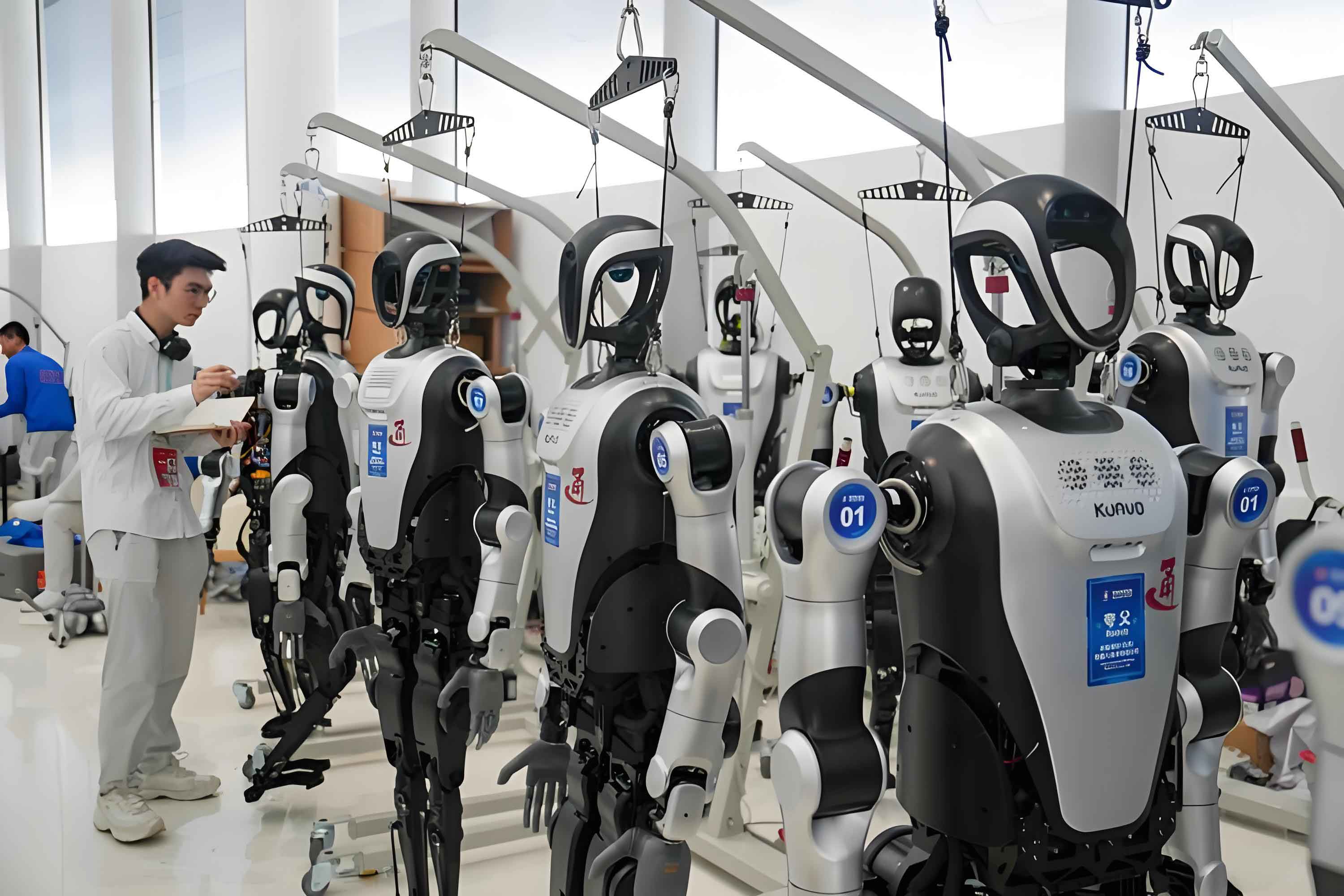
This image of a humanoid robot undergoing quality inspection reminds me that even the most mundane setting can be transformed into a content opportunity. The careful bending of joints, the calibration of force sensors, the repeated latch-testing of a hand—these are moments in which state-of-the-art precision becomes visible. I have advised robotics firms to create “inspection diaries” with time-lapse footage, narrated by engineers who describe what they are testing and why. This behind-the-scenes content serves two purposes: it humanizes the engineers, and it proves that the humanoid robot is held to rigorous standards. In an age of information asymmetry, such transparency builds an invaluable reservoir of trust.
Content creation must also follow the principle of “show, don’t tell” for humanoid robots. Rather than saying “the robot has a payload capacity of 30 kilograms,” film it carrying a fully loaded suitcase up a staircase. Rather than claiming it has “natural gait,” record a slow-motion comparison of a human and a humanoid robot walking side by side. These visual evidences become the raw material for all downstream PR. I often produce a “mother video”—a single high-quality master film—from which all other clips are derived. This master may cost more, but it ensures a coherent visual identity for the humanoid robot brand. It also makes the work of social media managers faster and more consistent.
Another important content category is educational explainers that address fundamental questions: What is a humanoid robot? Why does it need two legs if wheels are more efficient? How does it avoid falling? Each question is an opportunity to build a relationship with the audience based on intellectual engagement. I have seen animated whiteboard videos explaining the inverted pendulum model of dynamic walking outperform flashy product trailers in terms of long-term recall. The strength of such content is its timelessness; it remains relevant as the humanoid robot evolves. A library of well-crafted educational content also helps journalists who need background information, reducing the risk of misinformation.
Finally, user-generated content is a goldmine for humanoid robot PR. When a factory worker films a humanoid robot assisting them, that video carries a credibility that corporate marketing cannot match. The PR team should therefore encourage—and even remunerate—employees, customers, and enthusiasts to share their own moments with the robot. Contests such as “Best Robot Dance on Instagram” or “Most Creative Use of a Humanoid Robot at Home” generate a continuous stream of authentic content. This crowdsourced content serves as social proof: if ordinary people are playing with humanoid robots, the technology must be safe, accessible, and fun.
| Content Format | Primary Communication Objective | Ideal Platform | Typical Material Needed |
|---|---|---|---|
| Long-form article | Deep understanding, SEO lead generation | LinkedIn, Medium, company blog | Technical data, expert quotes |
| Viral video | Emotional resonance, sharing | YouTube Shorts, TikTok, Instagram Reels | High-visual-impact footage |
| Infographic | Simplified data communication | Pinterest, Twitter, presentations | Charts, icons, statistics |
| Interactive simulation | Hands-on experience, engagement | Websites, industry booths | 3D models, rudimentary controls |
| Podcast appearance | Thought leadership, verbal nuance | Apple Podcasts, Spotify | Spokesperson availability |
Media Relations and Editorial Advocacy
Despite the rise of social media, established media outlets remain powerful gatekeepers of credibility. A positive article in a reputable technology journal can influence investors, regulators, and corporate purchasers more deeply than a thousand social media likes. For this reason, public relations must maintain a robust media relations program specifically focused on humanoid robots. This involves pitching story angles that go beyond the immediate product launch. For example, after a humanoid robot passes a safety milestone, the PR team can approach media with the angle “new safety protocols for humanoid robots in shared workspaces.” This type of story positions the company as a thought leader rather than a self-interested seller.
I have developed a media tiering system for humanoid robot campaigns. Tier One includes outlets that shape the global technological discourse—generalist news agencies, leading business magazines, and science journals. Tier Two comprises specialized robotics and AI media, trade publications, and analyst blogs. Tier Three covers local media, tech vloggers, and vertical community newsletters. For Tier One, the story must be about societal impact, such as how humanoid robots can address labor shortages. For Tier Two, it can be a detailed technical deep dive into actuator design. For Tier Three, the angle may be a local company’s deployment of humanoid robots to create jobs or enhance training. Each tier requires a customized press kit—not just a single press release.
Press releases themselves should conform to a “pyramid of information” structure: the most important news in the first paragraph, supporting quotes and statistics in the second, and background information in the third. For a humanoid robot announcement, I recommend including a media assets package with high-resolution photographs, b-roll video, a fact sheet summarizing key dimensions and capabilities, and a list of potential interview questions with answers. This reduces the work for journalists and increases the likelihood of accurate coverage. I also advise clients to pre-approve a few engineers as spokespeople who can speak to the humanoid robot’s technical aspects without revealing trade secrets.
Beyond reactive pitching, proactive editorial advocacy is crucial. This means building long-term relationships with journalists who regularly cover humanoid robots. Invite them to beta-test the robot, interview the engineers, and follow the development process. When a humanoid robot fails in a trial, being honest with a trusted journalist can lead to a nuanced story of “lessons learned” rather than a sensational headline of “robot catastrophe.” I have seen this trust pay off repeatedly. A senior journalist once called me directly when she saw a leaked video of a humanoid robot falling, and I was able to give her the full context of environmental conditions and software adjustments. Her article turned a potential scandal into an instructive case study.
Media advocacy also extends to thought leadership by publishing bylined articles under the names of executives. These articles can cover topics such as “Why humanoid robots must be regulated,” “The future of human-robot in factories,” or “Ethical guidelines for autonomous machines.” The humanoid robot brand becomes associated with wisdom and responsibility, not merely with technology. I have written such pieces for many CTOs and CEOs, and the result is often a flurry of speaking invitations and government advisory roles. That is the hidden payoff of media relations: it opens doors that cannot be opened by direct sales.
| Media Tier | Representative Outlets (Generic) | Preferred Story Angle | Success Metric |
|---|---|---|---|
| Tier 1 | International news agencies, mainstream business press | Societal transformation, investment trend | Front-page or top-section placement |
| Tier 2 | Tech reviews, robotics industry magazines | Technical breakthroughs, comparative analysis | Detailed, mostly accurate specifications |
| Tier 3 | Regional media, enthusiast forums | Local deployment, human-interest stories | Quotes from community members |
Social Media Engagement and Word-of-Mouth Propagation
Social media is the arena where public opinion about the humanoid robot is forged fastest. A well-executed social strategy can create a virtuous cycle of attention, validation, and investment. I have observed that the most successful humanoid robot brands do not treat social media as a broadcasting channel; they treat it as a conversation. They reply to comments, ask questions, and acknowledge failure. This conversational approach makes the humanoid robot feel approachable. The moment a brand defends itself with corporate jargon, it loses the trust of the platform’s community. Therefore, I always instruct my clients to adopt a “human voice” when representing a humanoid robot: playful, curious, and transparent.
One of the most effective mechanisms in social media is the challenge. For example, a “Humanoid Robot Dance Challenge” can go viral rapidly, with users mimicking the robot’s moves and then posting their own versions. This user-generated content provides enormous organic reach because each participant brings their own follower network. The math of viral propagation can be captured by the basic reproduction number:
$$
R_0 = p \cdot \bar{k}
$$
where \(R_0\) is the number of new people exposed per content item, \(p\) is the average probability that an exposed person shares the content, and \(\bar{k}\) is the average number of followers of a sharer. When \(R_0 > 1\), the campaign grows exponentially. The humanoid robot’s visual distinctiveness gives it an inherent advantage: it is more interesting to share than a typical product photo. To maximize \(p\), I advise designing content that is “showing-off” friendly—where the sharer appears creative or informed. For instance, a user who posts “I programmed a humanoid robot to my favorite song” feels proud, not like an advertiser.
Community management should also include dedicated social listening. Tools that track sentiment spikes and emerging hashtags allow PR teams to respond rapidly. If a viral video shows a humanoid robot malfunctioning in a café, the PR team should not ignore it. Instead, they should post a graceful response: “We saw the video! That was an unexpected test of our fall-protection algorithms. Here’s how we turned it into a learning moment.” Such a reply demonstrates maturity and can flip the sentiment. I have used this approach many times, and it consistently reduces the negative impact of a mishap. The humanoid robot industry must accept that accidents will happen; what matters is the story we tell about them.
User interaction features—polls, quizzes, ask-me-anything sessions—can also generate valuable data for product development. Suppose a social media poll reveals that 70% of respondents want a humanoid robot for elder care rather than household chores. That insight becomes a strategic guide for future PR campaigns and even for engineering priorities. I have seen companies adjust their humanoid robot roadmaps based on social media feedback collected during a viral campaign. This is PR acting as a sensor for the whole organization. The same sensor can detect early signs of ethical concerns, allowing the company to address them before they metastasize into a crisis.
| Social Media Platform | Primary User Base | Best Use for Humanoid Robot PR | Example Interactive Tactic |
|---|---|---|---|
| Professionals, decision makers | Thought articles, industry partnerships | Live Q&A with CTO | |
| TikTok / Reels | General public, youth | Stunts, choreography, humor | Dance challenge |
| X (formerly Twitter) | Journalists, tech enthusiasts | Real-time updates, direct dialogue | Trending hashtags, polls |
| YouTube | Deep community, educators | Long-form documentaries, tutorials | Weekly series on robot development |
| Visual discovery users | Aesthetics, design highlights | Photo contests, stories |
Corporate Social Responsibility and Public Welfare
The humanoid robot industry cannot survive in a bubble of commercial transaction. It needs a social licence to operate—the informal permission from the public to continue its activities. Public welfare initiatives are among the most direct ways to obtain this licence. I have seen humanoid robot companies organize children’s robot exhibitions in underserved communities. These events are not product fairs; they are educational experiences. Children learn how a humanoid robot’s sensors enable it to “see” obstacles, how its motors imitate muscles, and how programming gives it behavior. By the time the children leave, they have a positive association with humanoid robots as instruments of discovery rather than instruments of surveillance.
Such educational outreach has a multiplier effect. Children tell their parents, parents post photos on social media, teachers incorporate the experience into their lesson plans, and local media cover the event. The PR value far exceeds the cost of staging the demonstration. In my experience, the most effective educational programs involve hands-on interaction: letting a child press a button to make a humanoid robot wave, or allowing a teenager to guide it through an obstacle course with a tablet. These are moments of personal agency, creating a memorable bond with the humanoid robot.
Public welfare can also focus on vulnerable populations. A humanoid robot developed for rehabilitation can be donated to public hospitals, enabling low-income patients to access cutting-edge therapy. The PR story should be built around patient testimonials and clinician experiences. For example, a stroke survivor may say, “The humanoid robot’s steady hand helped me relearn how to move my arm without fear.” Such statements are extraordinarily powerful because they illustrate tangible human benefit. They also neutralize the fear that humanoid robots are only built for rich corporations or military uses.
Another dimension is supporting environmental causes. A humanoid robot could be deployed in a wildlife reserve to monitor poaching trails, or in a coastal cleanup to remove debris. These uses align the humanoid robot with the values of sustainability. I have designed campaigns where the humanoid robot became an ambassador for ocean conservation, appearing in videos that show it carefully lifting plastic waste from a beach. The contrasting image of advanced technology cleaning up the mess of human society resonates with audiences who are environmentally conscious. It also reframes the humanoid robot as a solution to, not a cause of, contemporary problems.
Finally, corporate social responsibility should include internal practices. The humanoid robot company itself should demonstrate ethical treatment of its workforce, transparent governance, and environmental responsibility in manufacturing. Public relations can communicate these commitments through annual sustainability reports and third-party audits. When the humanoid robot brand is associated with a moral high ground, it is far more difficult for critics to attack. I have learned that the public is remarkably forgiving of technological limitations when they perceive the company as genuinely trying to do good. Thus, public welfare is not a side activity—it is at the very core of the humanoid robot’s brand strategy.
| Welfare Initiative | Target Population | Humanoid Robot Role | PR Outcome |
|---|---|---|---|
| School science roadshows | Primary/secondary students | Interactive learning demonstrator | Positive future opinion leaders |
| Rehabilitation center donations | Stroke patients, injury victims | Physical therapy assistant | Brand associated with healing |
| Disaster simulation training | Rescue workers | Victim simulation, hazard inspection | Image of safety and preparedness |
| Elder care companionship programs | Isolated seniors | Conversation and fall detection | Compassionate brand perception |
Innovative Strategic Directions for the Future of Humanoid Robot PR
Toward an Open and Multi-Dimensional Ecosystem
As the humanoid robot industry matures, its PR strategy must evolve from promoting individual products to nurturing the entire innovation ecosystem. One of the most promising directions is the creation of open-source platforms. When a humanoid robot developer releases its simulation environment, gait libraries, or manipulation algorithms under an open license, it invites a global community of contributors. The role of PR in this context is to orchestrate visibility and recognition—for example, by hosting developer conferences where contributors present their enhancements to the world. I have seen how open-source projects around humanoid robots generate a halo effect, strengthening the lead company’s reputation as a benefactor of innovation rather than a proprietary gatekeeper.
The ecosystem value can be expressed as:
$$
\text{Ecosystem Value} = \sum_{d \in D} \text{Value}(d) + \gamma \cdot \text{Community Multiplier}
$$
where \(D\) is the set of all user-contributed developments, \(\text{Value}(d)\) is the worth of each contribution, and \(\gamma\) measures the strength of community interactions. Public relations can increase the community multiplier by celebrating non-coders too—artists who designed robot skins, educators who developed curricula, hobbyists who built attachments. Each contributor becomes an advocate for the humanoid robot. The open platform creates a sense of collective ownership that radically reduces resistance to adoption.
Another strategic pillar is the development of a comprehensive “typical application case library.” Rather than scattered success stories, the industry needs a searchable repository of humanoid robot deployments across verticals, each with standardized metrics: task completion rate, time savings, cost-to-benefit ratio, and worker satisfaction. PR professionals can present this library as a living dashboard—an authoritative source that analysts, journalists, and customers use to understand the humanoid robot landscape. I personally believe that such a library, accessible through a visually appealing interactive website, would be a game-changer. It would transform humanoid robot marketing from a shouting match to a clear-eyed comparison of verifiable outcomes.
In addition, the industry must actively cultivate a favorable opinion climate. This involves engaging with intellectual communities, think tanks, and policy forums to shape how the humanoid robot is conceptualized in public discourse. For instance, instead of accepting the frame “robots replace jobs,” PR should champion the frame “robots restore balance to the labor market.” This requires ongoing statistical evidence: how many new jobs are created in robot maintenance, AI training, and system integration? How much productivity growth can be redistributed to shorten working hours? These are not just political questions; they are narrative questions. PR must provide the language, the metaphors, and the data visualizations that make the optimistic story plausible.
Finally, the ecosystem perspective demands a shift in how success is measured. Rather than focusing on a single humanoid robot unit sold, PR should track the number of active partners, the volume of open-source downloads, the number of certified integrators, and the breadth of vertical applications. These metrics tell the story of a growing ecosystem—a story that attracts investors and talent. In my advisory work, I have helped companies redefine their quarterly PR goals around ecosystem health rather than just media impressions. This change is not always easy, because traditional managers love vanity metrics. But the long-term irrelevance of the humanoid robot depends on building a universe of interdependent actors, not a lonely product line.
| Ecosystem Initiative | PR Action | Target Metric | Benefit for Humanoid Robot Brand |
|---|---|---|---|
| Open source release | Developer hackathon, showcase | # of external commits | Reputation as innovation hub |
| Application case library | Data storytelling, interactive map | # of documented verticals | Credibility and decision support |
| Policy roundtables | White papers, expert testimonies | # of regulatory references | Shaping national roadmaps |
| Standardization consortia | Joint press statements | # of adopted safety standards | Market certainty |
Multi-Layer Communication and Precision Segmentation
The future of humanoid robot PR lies increasingly in precision. A single global message cannot satisfy a mining engineer, a geriatric caregiver, and a teenage gamer. I have advocated for a multi-layer communication strategy that adapts the brand story to the psychological needs of each audience segment. For industrial customers, the humanoid robot must appear as a pragmatic investment with calculable returns. For end consumers, it should appear as an accessible helper with a warm personality. For policymakers, it must be a strategic technology requiring supportive infrastructure. These are not contradictory messages; they are facets of the same prism. PR’s skill is in aligning these facets to avoid confusion.
One way to implement precision segmentation is through dynamic content optimization. Using data from social media, search engines, and customer relationship management systems, PR teams can tailor their messaging according to inferred preferences. The mathematical representation of this optimization can be written as:
$$
\max_{\theta_1, \dots, \theta_G} \sum_{g=1}^{G} N_g \cdot \mathbb{E}[ \text{Engagement}_g | \theta_g ]
$$
where \(G\) is the number of audience segments, \(N_g\) is the size of segment \(g\), and \(\theta_g\) is the message vector for that segment. Machine learning models can predict the engagement that a given message will produce, allowing the PR team to continuously refine its content. For example, if an analysis shows that consumers in urban areas respond to stories about humanoid robots as “city concierges,” the PR team can prioritize that narrative in urban digital campaigns. By contrast, rural audiences might be more drawn to agricultural applications. The same humanoid robot can therefore be many things to many people without losing coherence.
Multi-layer communication also implies working simultaneously with different levels of opinion leaders. Mega-influencers can generate awareness, but micro-influencers in specific niches—such as nurses, warehouse managers, or special education teachers—engender trust. I have designed campaigns where a humanoid robot manufacturer sponsored a network of nursing home staff members to share their real experiences with the robot. These authentic voices were more persuasive than celebrity endorsements. In the humanoid robot space, competence is argued through evidence, not fame. The PR team must therefore map the “trust chain” for each segment, identifying who the public looks to for guidance about new technologies.
Cross-industry collaboration extends this multi-layer approach. By partnering with educational institutions, fashion labels, sports events, or museums, the humanoid robot enters cultural contexts that enhance its emotional resonance. For instance, a humanoid robot that appears in a contemporary dance performance is no longer a machine; it is an artist. A humanoid robot that helps students in remote villages access virtual labs becomes a symbol of equal opportunity. These collaborations produce content that can be distributed through the partner’s channels, exponentially widening the reach. The humanoid robot brand is gradually embedded in the fabric of culture, making it less alien and more familiar.
In my practice, I have found that the most successful multi-layer campaigns start with a clear “narrative hierarchy.” At the base is the foundational story—”humanoid robots augment human capability.” From this story, we derive layer-specific versions: for engineers, “augmenting capability means precise force control”; for caregivers, “augmenting capability means helping seniors stay independent”; for financial analysts, “augmenting capability means productivity growth.” Each version uses different logos, case studies, and proof points. But they all share the same emotional core. This consistency is what prevents the humanoid robot brand from fragmenting into contradictory identities.
| Audience Segment | Primary Concern | Humanoid Robot Narrative | Preferred Channel | Key Performance Indicator |
|---|---|---|---|---|
| Industrial buyers | Return on investment, reliability | The zero-defect worker | LinkedIn, industry conferences | Inquiry rate, pilot requests |
| Healthcare providers | Patient safety, staff relief | The gentle assistant | Medical journals, hospital expos | Clinical trial participation |
| Consumer households | Lifestyle convenience, privacy | The friendly companion | Instagram, TikTok | Sales pre-orders, app downloads |
| Policy makers | Job impact, public safety | The responsible innovation | Policy forums, white papers | Regulatory sandbox inclusion |
| Students/educators | Learning outcomes, curiosity | The inspiring mentor | YouTube, school partnerships | Curriculum integration requests |
Blending Physical and Virtual Communication Frontiers
The next decade will see an increasing convergence between physical humanoid robots and their digital avatars. The PR implications are profound. A humanoid robot can now appear simultaneously at a trade show in Shanghai, a lecture in Berlin, and a vaccination center in rural Africa—through a network of virtual representations and telepresence units. This blurring of physical and digital realms allows the humanoid robot’s presence to be ubiquitous, but it also requires new communication protocols. PR professionals must craft experiences that are consistent across all touchpoints: a user interacting with the robot’s avatar in a smartphone app should feel the same personality as someone shaking its physical hand.
One of the most exciting frontiers is the virtual humanoid robot as an influencer or public figure. These digital beings can post on Instagram, respond to fan comments, and even appear in augmented reality filters. For example, a humanoid robot’s virtual twin may host a weekly talk show, interviewing guests from science and pop culture. This fictional persona develops a fanbase, and when the physical humanoid robot finally launches, it already has a devoted audience. I have been involved in projects where the virtual persona was used to test narrative concepts before committing to physical prototypes, saving resources and reducing risk. The virtual domain acts as a sandbox for humanoid robot PR.
The immersion level of virtual interactions can be quantified as:
$$
\text{Immersion} = \frac{\text{Interactive Deepness} \times \text{Emotional Connectedness}}{\text{Perceived Artificiality}}
$$
where perceived artificiality is reduced by using natural language processing and responsive animations. When immersion reaches a critical threshold, users begin to experience what media psychologists call “parasocial presence”—they feel as if they know the humanoid robot personally. This feeling is an enormous asset for public relations, because it converts passive observers into loyal advocates. I have seen users write long letters of encouragement to a virtual humanoid robot, send birthday wishes, and even create fan art. The humanoid robot is no longer a product; it is a beloved character.
At the same time, PR must be careful about the ethical dimensions of virtualization. If a virtual humanoid robot behaves in ways that mislead users—promising capabilities that the physical robot does not have—trust will be destroyed. I recommend that all virtual experiences be clearly labelled as “early previews” and that they include mechanisms for users to provide feedback to the development team. The virtual humanoid robot should act as a conduit for two-way communication, not a deceptive sales tool. By maintaining transparency in the virtual space, we protect the credibility of the physical humanoid robot.
Furthermore, virtual formats enable interactive storytelling that adapts to user choices. In a “choose your own adventure” experience, a user might guide a humanoid robot through a disaster response scenario, choosing how to prioritize tasks. Each choice creates a unique narrative, deepening the user’s engagement. The data gathered from thousands of choices can reveal public priorities for humanoid robot applications. This is public relations acting as a collective listening instrument. The humanoid robot industry can use such insights to adjust its technological and ethical compass. I see this as the ultimate fusion of communication, technology, and human-centered design.
| Virtual Frontier | Humanoid Robot Form | Interaction Type | PR Benefit |
|---|---|---|---|
| Metaverse platform | 3D avatar | Exploration, socializing | Global accessibility, brand extension |
| Social media influencer | Rendered character | Commentary, storytelling | Cult-like fanbase, cultural relevance |
| Telepresence robot | Physical remote unit | Remote presence, task execution | Demonstrates utility beyond geography |
| Mobile AR app | Overlay in real world | Educational games, product preview | Practical, immersive learning |
Ethical Foresight and Crisis Preparedness
No discussion of the humanoid robot’s future can ignore the ethical labyrinth. The more capable these machines become, the more urgent the questions: Who is liable if a humanoid robot causes injury? How can we prevent its data collection from being misused? What happens to people whose jobs are transformed? Public relations must take a leadership role in answering these questions before a scandal forces a defensive response. My approach centers on the creation of an “ethics first” framework, embedded in all PR communications. This framework begins with a published ethical charter, co-signed by the C-suite, that explicitly states the humanoid robot company’s commitments to safety, fairness, transparency, and dignity.
The risk preparedness for ethical crises can be modeled as:
$$
R = \frac{\text{Anticipatory Vigilance} \times \text{Response Speed}}{\text{Trust Deficit}}
$$
where the trust deficit is the gap between what the public expects and what they perceive the company to deliver. Public relations can reduce the trust deficit by maintaining continuous dialogue, publishing ordinary transparency reports, and proactively disclosing both successes and flaws. For a humanoid robot manufacturer, this might mean announcing the result of a failed field test along with the corrective action. Such candour is unusual, but it is exactly what builds extraordinary trust. I have seen a company earn international respect by openly sharing a “bug report” of their humanoid robot’s software, including the minor injuries it caused to a human during an accidental collision, and then showing the design changes made in response.
Dynamic monitoring is another essential component. PR teams must deploy sentiment analysis and ethnography to identify emerging ethical concerns before they become viral hashtags. For example, if discussions in online forums increasingly focus on “humanoid robot dependence” in children, the PR team should launch an educational campaign about healthy parent-child-robot relationships. If the concern is about surveillance, the team should release an animated explainer on how the humanoid robot stores and purges data. Monitoring must be paired with rapid decision-making: the team should have a pre-approved crisis response playbook with clear spokespeople, to ensure a response within hours, not days.
Finally, PR must create spaces for multi-stakeholder ethical deliberation. I have organized “Ethics Cafés” where humanoid robot developers sit with philosophers, disability rights activists, union representatives, and religious leaders. These conversations are intense but necessary. The policies and communications that emerge from them are far more attuned to society’s variety than any white paper written behind closed doors. The humanoid robot industry cannot claim to be ethical simply by consulting a chatbot; it must involve real human beings with divergent perspectives. Public relations provides the platform, the facilitation, and the dissemination of these dialogues. In doing so, it ensures that the humanoid robot is not just an engineering marvel, but a socially legitimate technology.
| Ethical Risk Scenario | Prevention Dialogue | Public Relations Response | Long-term Strategy |
|---|---|---|---|
| Privacy invasion via sensors | Publish data flow maps | Transparent demonstration of local processing | Obtain design-specific certifications |
| Physical safety in human interaction | Share injury case studies and safety studies | Release safety videos, issue recall notices if needed | Open safety standard participation |
| Job displacement fears | Publish workforce augmentation reports | Highlight new job categories | Partner with training institutions |
| Autonomous decision-making concerns | Explain human-in-the-loop control | Show human commander override interfaces | Develop governance framework |
Conclusion: The Communication Imperative for Humanoid Robots
The journey of the humanoid robot from laboratory to living room is not determined solely by faster chips or smarter algorithms. It is determined by how well we explain its purpose, how gracefully we handle its mistakes, and how deeply we integrate it into the stories we tell about our future. Public relations, at its best, is not spin or manipulation. It is the discipline of forging shared meaning between technology and society. In this article, I have argued that the humanoid robot needs PR to overcome the uncanny valley, to translate complex capabilities into emotionally resonant value, and to convene the ecosystem that will sustain its growth. I have also shared practical pathways—from content creation to media relations, from social engagement to public welfare—that have proven effective in real campaigns.
The road ahead is filled with unknowns. The humanoid robot industry will face regulatory changes, technological discontinuities, and shifting public moods. But the PR profession is well equipped to navigate such turbulence. By engaging in ethical foresight, we can anticipate crises before they erupt. By building open ecosystems, we can foster rather than stifle innovation. By embracing virtual frontiers, we can reach new audiences in surprising ways. And by always returning to the fundamental question—how does this humanoid robot improve the human experience?—we can keep our communications anchored in genuine value.
I often tell my clients that the humanoid robot is the ultimate test of communication. It challenges us to explain autonomy without making it frightening, to demonstrate intelligence without making it arrogant, and to show power without forgetting gentleness. The humanoid robot, after all, is our mirror. It reflects our ambition and our anxiety. Public relations must polish that mirror so that what we see is not a monster, but a familiar companion—a being built from silicon and steel that nevertheless carries a spark of our own creativity.
As I look to the future, I am optimistic. I have witnessed moments when a humanoid robot’s clumsy dance made a whole conference laugh, when its six-fingered hand painted a flower, when its voice said “thank you” in sign language. These small interactions, broadcast through impeccable PR, accumulate into a powerful narrative of acceptance. The humanoid robot is gradually ceasing to be an “it” and becoming a “thou.” That anthropomorphic shift is not just a linguistic trick; it is a social transformation. And PR is the handmaiden of that transformation.
It is my hope that this article provides both a conceptual framework and a practical toolkit for the PR community working with humanoid robots. The journey will not be linear, and there will be setbacks. But we are at the dawn of a new relationship between human and machine. If we craft our communications with honesty, creativity, and empathy, the humanoid robot will not merely be accepted—it will be embraced as one of the most meaningful innovations of our age. That is the ultimate goal of every public relations practice, and the opportunity that stands before us now.