
In the past few months, I have observed a significant shift in the global robotics ecosystem. The humanoid robot is no longer a laboratory curiosity; it is becoming a strategic pillar of the intelligent economy. The combination of artificial intelligence, advanced sensors, high-performance actuators, and reliable connectivity has created a rare window of opportunity. A humanoid robot can walk into a factory, handle medical instruments, assist elderly people, and operate in dangerous environments. The phrase “humanoid robot” now represents both embodied intelligence and future productivity.
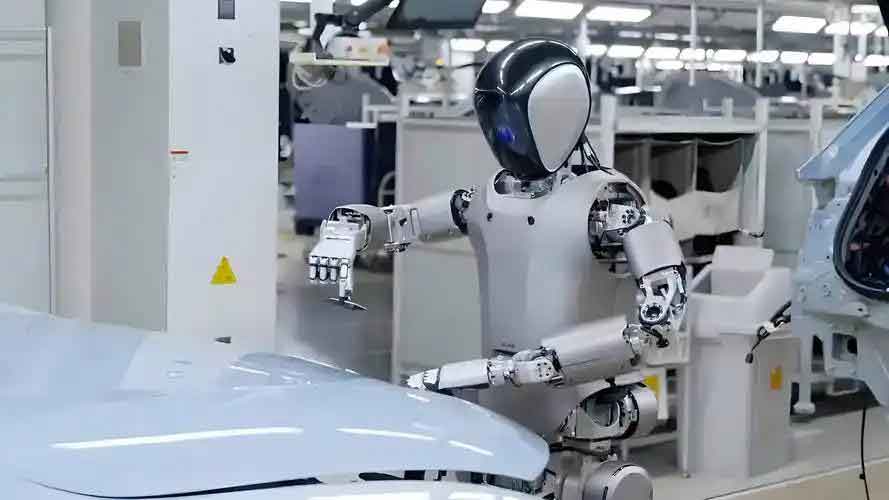
At the national policy level, the 2025 government work report emphasizes the “Artificial Intelligence Plus” campaign. It calls for the development of intelligent connected vehicles, AI-enabled phones and computers, intelligent robots, and intelligent manufacturing equipment. Among these, the humanoid robot is unique because it requires the convergence of cognitive science, neuroscience, mechanical engineering, electrical engineering, and modern AI. From my perspective, this is a clear signal: policymakers and industry leaders are beginning to treat the humanoid robot as an essential carrier of new quality productive forces. Telecom enterprises, in particular, must pay close attention to this new wave because every humanoid robot will rely on data, communication, computing power, and intelligent services that telecom companies are best positioned to provide.
The Critical Breakthrough Period for the Humanoid Robot Industry
I believe the humanoid robot industry has entered a decisive phase. Multiple forces are converging at the same time: large language models are advancing rapidly, edge computing is becoming more powerful, sensor costs are declining, and policy support is growing. The humanoid robot is not simply a mechanical machine with artificial intelligence. It is a physical agent that can perceive, reason, decide, act, and learn in a dynamic world. It can work in factories, hospitals, schools, warehouses, and homes. It can also perform tasks that are dangerous, repetitive, or physically demanding for human beings.
From an economic perspective, the humanoid robot contains enormous market value. One Chinese research institute predicts that by 2045, the global humanoid robot market could exceed 10 trillion yuan. A global investment bank has also revised its forecast upward: by 2035, the market could reach at least 38 billion US dollars, and under ideal technological breakthroughs, it could reach 154 billion US dollars. Another global consulting firm estimates that after full commercialization, the total global market space for humanoid robots could be as high as 120 trillion yuan. These are not negligible numbers. They indicate that the humanoid robot will become one of the largest hardware-software-service platforms in the world.
In my view, the humanoid robot will accelerate the transition of society into the “AI+” era. In the past, artificial intelligence lived in servers and smartphones. With a humanoid robot, AI can enter the physical world. The humanoid robot can interact with humans through natural language, visual gestures, and physical collaboration. It can perform household chores, accompany elderly people, assist doctors, and operate machines. It is exactly the kind of technology that can support new quality productive forces across thousands of industries and millions of homes.
From Data to Behavior: The Humanoid Robot Capability Leap
I see the humanoid robot as a major evolution of artificial intelligence. Traditional AI models are usually trained on static datasets. They recognize objects, generate text, or recommend content. A humanoid robot, however, must handle real-world uncertainty. It needs to walk on uneven ground, avoid obstacles, grasp objects, and understand human emotions. This requires three major capabilities.
The first capability is environmental interaction and perception. A humanoid robot uses cameras, lidar, microphones, tactile sensors, and inertial measurement units to perceive the world. It can see a cup, hear a command, feel the weight of a tool, and sense the temperature of a room. Through “embodiment,” the humanoid robot builds a natural connection between cognition, reasoning, decision-making, and action.
The second capability is dynamic adaptation. Traditional AI models follow fixed rules or learned distributions. A humanoid robot, by contrast, must respond to unseen situations in real time. If a chair is moved, the humanoid robot must adjust its path. If a person interrupts a task, the humanoid robot must pause and respond. This is a fundamental shift from static intelligence to dynamic, embodied intelligence.
The third capability is autonomous evolution. Traditional AI often requires offline retraining. A humanoid robot should learn from its own experience. It can observe the result of an action, update its internal model, and improve its performance on the next attempt. In other words, the humanoid robot can continuously update its skills during its operational lifecycle. This is no longer just automation; it is self-improvement.
| Aspect | Traditional AI | Humanoid Robot |
|---|---|---|
| Environment | Virtual or controlled | Unstructured physical world |
| Learning method | Offline training | Online adaptation and lifelong learning |
| Sensing ability | Digital input | Multimodal embodied perception |
| Decision output | Predictions or text | Physical action and manipulation |
| Evolution path | Retraining with new data | Dynamic skill update from experience |
I often describe this transformation with a simple formula:
$$
\text{Intelligence}_{\text{humanoid robot}} = \text{Perception} \times \text{Cognition} \times \text{Action}
$$
If any of these three factors is zero, the humanoid robot cannot function usefully. This is why the industry must combine hardware breakthroughs, software algorithms, and communication infrastructure.
The Expanding Market Space of the Humanoid Robot
I believe the market opportunity for the humanoid robot can be modeled using compounding growth. Let \(M_0\) be the current market size, \(g\) the annual growth rate, and \(t\) the number of years. Then the future market size is:
$$
M(t) = M_0 \times (1 + g)^t
$$
The compound annual growth rate, or CAGR, is another valuable metric. If \(M_{\text{start}}\) and \(M_{\text{end}}\) are the market sizes at the beginning and end of \(n\) years, then:
$$
CAGR = \left( \frac{M_{\text{end}}}{M_{\text{start}}} \right)^{\frac{1}{n}} – 1
$$
Using this approach, I can summarize the major market forecasts for the humanoid robot as follows.
| Time Horizon | Market Size Forecast | Source Type |
|---|---|---|
| 2035 | 38 billion USD, base case | Global investment bank |
| 2035 | 154 billion USD, ideal technology case | Global investment bank |
| 2035 | About 30% of global market in China | Global investment bank |
| 2045 | Global whole-machine market over 10 trillion yuan | Chinese research institute |
| After full commercialization | Up to 120 trillion yuan global market | Global consulting firm |
The CAGR estimate of around 94% for the next decade is extraordinary. Very few industries can sustain that level of growth. However, the humanoid robot starts from a low base, and it benefits from rapid improvements in AI models, actuator technology, battery density, and manufacturing processes. I expect the market to expand through multiple waves. The first wave will be industrial applications. The second wave will be commercial services. The third wave will be home and personal services. The largest segment, in my view, will eventually be family services.
Household scenarios such as cleaning, cooking assistance, elderly care, and child companionship will become increasingly feasible as the humanoid robot matures. One securities research report predicts that family scenarios could account for 25% to 57% of the total humanoid robot market. I believe the true figure may be close to 50% in the long run. Let \(S_{\text{family}}\) represent the family service market and \(M_{\text{total}}\) the total humanoid robot market. Then:
$$
S_{\text{family}} = \alpha \times M_{\text{total}}, \quad \alpha \in [0.25, 0.57]
$$
The value of \(\alpha\) will depend on robot prices, reliability, safety standards, and user trust. As the population ages and the demand for caregiving increases, the family segment will grow even faster.
Why the Humanoid Robot Accelerates the “AI+” Era
I see the humanoid robot as the bridge between digital intelligence and physical action. In smart manufacturing, the humanoid robot can handle assembly, inspection, material handling, and machine operation. In smart logistics, it can load and unload trucks, sort packages, and move goods in warehouses. In healthcare, it can assist nurses, deliver medicines, and support rehabilitation training. In security and emergency response, it can enter dangerous areas and perform rescue operations. In homes, it can provide elderly care, emotional companionship, cleaning, and educational services.
The reason the humanoid robot is so powerful is that it uses the human form. Human environments are designed for human beings. Doors, stairs, chairs, tools, and appliances are all built for human hands and bodies. A humanoid robot can operate in these environments without requiring major changes to infrastructure. It has two arms, two legs, and a head-like sensor array. This embodiment gives it a significant advantage over fixed industrial robots or special-purpose machines.
From an economic value perspective, I can express the benefit of the humanoid robot through productivity improvement. Suppose a task takes a human worker \(H\) hours per day. A humanoid robot can work \(R\) hours per day with a quality rate \(Q_r\). The net productivity contribution is:
$$
\Delta P = \frac{R \times Q_r}{H \times Q_h}
$$
In many tasks, the humanoid robot may be slower than a human at first. But it can work longer, it can be deployed in dangerous environments, and it can be trained across multiple sites. Over time, the performance ratio will improve.
DeepSeek and the Algorithmic Breakthrough for the Humanoid Robot
Another major development is the rapid emergence of powerful open-source large language models. In recent years, I have followed the release of the DeepSeek model series, including the V2, V3, and R1 models. These models became famous because they combine open-source distribution, high performance, and low training cost. For the humanoid robot industry, this is strategically important because the software algorithms of the humanoid robot need a major upgrade.
A humanoid robot can be thought of as having a “brain” and a “cerebellum.” The brain handles semantic understanding, task planning, and human interaction. The cerebellum handles motor control, balance, and movement coordination. Traditional models struggle to do both efficiently. The DeepSeek series has introduced several innovations that improve both the brain and the cerebellum of the humanoid robot.
The first innovation is the mixture of experts architecture, or MoE. The model uses fine-grained experts and generalist experts. Through dynamic routing and expert sharing, it can activate only the most relevant parameters for a given task. This reduces computation while preserving performance. In many benchmarks, this approach improves inference speed by roughly four times.
The second innovation is multi-head latent attention, or MLA. This mechanism compresses key-value cache, reducing storage requirements and computational complexity. For a humanoid robot, this means that a smaller onboard processor can run a more powerful model. The computational efficiency can improve by two to four times.
The third innovation is mixed-precision training using FP8. By replacing traditional FP16 or FP32 operations with FP8, the model can reduce computing overhead by about 50%. This also reduces memory bandwidth demand. For humanoid robot developers, the implication is clear: advanced algorithms no longer require massive centralized data centers. They can be adapted for edge devices and eventually for the robot itself.
| Algorithm Innovation | Technical Mechanism | Impact on Humanoid Robot |
|---|---|---|
| Mixture of Experts | Fine-grained experts, generalist experts, dynamic routing | Inference speed up to 4 times faster |
| Multi-head Latent Attention | KV cache compression | 2–4 times higher computation efficiency |
| FP8 Mixed Precision Training | Lower precision computation | About 50% less computing overhead |
| Bidirectional Pipeline Parallelism | 16-way and 64-way parallelism | Less communication, breaks hardware bottleneck |
Let me express the inference speedup with a simple equation. Let \(T_{\text{baseline}}\) be the inference time of a conventional dense model, and \(T_{\text{DeepSeek}}\) be the inference time of the optimized model. Then:
$$
\text{Speedup} = \frac{T_{\text{baseline}}}{T_{\text{DeepSeek}}} \approx 4
$$
Similarly, the training cost reduction can be represented as:
$$
C_{\text{training, optimized}} \approx 0.5 \times C_{\text{training, baseline}}
$$
This is a game changer for the humanoid robot industry. Many humanoid robot companies do not have the ability to train extremely large models from scratch. With cheap, efficient, and open-source models, they can focus on robot-specific data, reinforcement learning, and embodied skill acquisition. The cost-performance curve of the humanoid robot software is being reconstructed before our eyes.
The Humanoid Robot Industry Chain and Competitive Landscape
The humanoid robot industry chain is becoming more complete, even though large-scale commercialization is still some years away. From my perspective, the chain can be divided into three core modules: perception, interaction, and motion control.
The perception module includes sensors, cameras, lidar, microphones, and tactile sensors. These components act like the eyes, ears, and skin of the humanoid robot. They collect raw data from the environment and turn it into information for the brain.
The interaction module includes speech recognition, semantic understanding, image recognition, AI algorithms, and large language models. These form the “brain” of the humanoid robot. They allow the robot to understand commands, plan tasks, and communicate with humans.
The motion control module includes servo motors, reducers, controllers, joints, and actuators. This is the “muscles and limbs” of the humanoid robot. It executes the decisions made by the brain and interacts with the physical world. Motion control is a perfect example of deep integration between software and hardware.
| Module | Core Components | Human Analogy | Primary Function |
|---|---|---|---|
| Perception | Sensors, lidar, cameras, IMU, tactile sensors | Eyes, ears, skin | Environmental awareness |
| Interaction | Speech recognition, LLMs, AI algorithms | Brain | Decision-making, semantic understanding |
| Motion Control | Servo motors, reducers, controllers, joints | Muscles, limbs | Physical movement and manipulation |
The participants in the humanoid robot industry can be divided into three broad categories. The first category is technology giants. They focus on software, cloud computing, AI models, and ecosystem building. Some of them use the humanoid robot to extend their current product boundaries. Others develop robots for internal operations and efficiency improvement.
The second category is professional humanoid robot manufacturers. They focus on robot body design, integration, and full-stack development. They often cooperate with upstream component suppliers and downstream application providers. This group includes leading robotics companies around the world.
The third category is hardware suppliers. They focus on reducers, servo motors, controllers, visual sensors, force sensors, and other core components. They provide parts for technology giants and professional robot makers. Their competitive position depends on precision manufacturing, cost control, and supply chain reliability.
| Participant Type | Main Focus | Competitive Strategy |
|---|---|---|
| Technology Giants | AI models, cloud platforms, software ecosystem | Extend product boundary or improve internal operations |
| Professional Robot Makers | Robot body, full-stack integration | Vertical integration, innovation, brand building |
| Hardware Suppliers | Core components, sensors, actuators | Manufacturing excellence, cost efficiency, precision |
The competitive landscape is also evolving. In basic hardware components, the competitive structure is relatively stable. In software and AI algorithms, many players are still competing. I expect the software segment to transition from “hundreds of flowers blooming” to a more concentrated structure. Companies with strong data advantages, ecosystem resources, and capital will emerge as winners.
I can use the concentration ratio to describe this trend. For the top \(n\) firms, the concentration ratio is:
$$
CR_n = \frac{\sum_{i=1}^{n} R_i}{R_{\text{total}}}
$$
If \(CR_n\) is low, the market is fragmented. If \(CR_n\) rises over time, the head effect is strengthening. In the humanoid robot industry, I expect the software and platform layers to show a rising \(CR_n\) over the next decade.
Key Bottlenecks: Compute, Algorithm, and Data
Despite the progress, I believe the humanoid robot industry still faces three major bottlenecks: computing power, algorithm generalization, and physical-world data.
The first bottleneck is computing power. A humanoid robot needs to process massive amounts of sensor data in real time. It must see, hear, feel, plan, and act within milliseconds. This imposes strict requirements on the underlying computing system. For onboard compute, the humanoid robot must balance performance, power consumption, size, and cost. The energy constraint is especially severe in battery-powered robots. Let \(P_{\text{total}}\) be the total power budget of the humanoid robot. Then:
$$
P_{\text{total}} = P_{\text{compute}} + P_{\text{actuator}} + P_{\text{sensor}} + P_{\text{communication}}
$$
If the compute module consumes too much power, the robot will overheat or have very short operating time. Therefore, edge computing and cloud offloading become essential. The total latency from sensing to action can be written as:
$$
L_{\text{total}} = L_{\text{sensor}} + L_{\text{network}} + L_{\text{compute}} + L_{\text{actuation}}
$$
For safety-critical tasks, this total latency must be bounded:
$$
L_{\text{total}} \le L_{\text{critical}}
$$
Even with advanced 5G networks, not all tasks can be offloaded to the cloud. Some control loops must run on the robot itself. This is why telecom operators need to build a cloud-edge-device computing architecture that supports both high-performance training and low-latency inference.
The second bottleneck is algorithm generalization. Current robot algorithms work well in structured environments. In the laboratory, a humanoid robot can learn to grasp a specific object. But in a cluttered home or a busy factory, unexpected situations occur. The algorithm must be robust to changes in lighting, object shape, human behavior, and task requirements. This requires a deeper understanding of physical laws, including mechanics, friction, gravity, and thermal dynamics. I believe the next generation of humanoid robot algorithms will combine data-driven learning with physical reasoning models.
Mathematically, the goal can be expressed as minimizing a combined loss function:
$$
\min_{\theta} \mathbb{E}_{s \sim \rho_{\pi}} \left[ \mathcal{L}_{\text{task}}(\theta; s) + \lambda \mathcal{L}_{\text{physics}}(\theta; s) \right]
$$
Here, \(\mathcal{L}_{\text{task}}\) represents the task-specific error, and \(\mathcal{L}_{\text{physics}}\) represents the violation of physical constraints. The parameter \(\lambda\) controls the weight of physics knowledge. A humanoid robot trained with this objective can generalize better in the real world.
The third bottleneck is data. Traditional large language models can be trained with data from the internet. A humanoid robot, however, needs data from the physical world. It needs multimodal data that includes vision, sound, touch, proprioception, and motor commands. This data is expensive to collect, difficult to annotate, and highly complex to process. In many cases, data collection requires a real robot to perform tasks over long periods of time.
Data silos also remain a serious problem. Many organizations collect data only in their own specific environments. They do not share data because of privacy concerns, security risks, or commercial competition. This leads to duplicated effort and wasted resources. Let \(D_{\text{shared}}\) be the amount of shared data and \(D_{\text{total}}\) the total amount of physical-world data collected. The sharing ratio is:
$$
U_{\text{data}} = \frac{D_{\text{shared}}}{D_{\text{total}}} \times 100\%
$$
In many parts of the humanoid robot industry, \(U_{\text{data}}\) is still very low. I believe telecom operators can help solve this problem by building trusted data platforms, privacy-preserving data exchanges, and secure cloud storage systems.
The Strategic Role of Telecom Enterprises in the Humanoid Robot Industry
From my perspective, telecom enterprises are not outsiders in the humanoid robot industry. On the contrary, they are indispensable infrastructure providers. A humanoid robot is a mobile, connected, intelligent cyber-physical device. It needs seamless communication, massive data storage, powerful computing, and secure service management. All of these are core capabilities of the telecom industry.
I see four strategic roles for telecom enterprises. The first role is communication network support. Using 5G, 5G-A, and future 6G networks, telecom operators can provide ultra-high-speed, low-latency, and highly reliable connections for humanoid robots. In a smart factory, multiple humanoid robots can share positional data and work progress in real time. In remote surgery, a doctor can control a humanoid robot through a 5G network with minimal delay. The network reliability should meet extremely high standards:
$$
A_{\text{network}} \ge 99.999\%
$$
The second role is data management service. Humanoid robots produce enormous volumes of multimodal data. Telecom operators have extensive experience in data collection, transmission, storage, and analysis. They can create specialized data collection modules for robot sensors. They can build robot data storage platforms that manage training data and operational logs. They can also use big data analytics to optimize robot performance. The required storage capacity can be estimated as:
$$
S_{\text{total}} = N_{\text{robots}} \times D_{\text{daily}} \times T_{\text{retention}}
$$
Where \(N_{\text{robots}}\) is the number of robots, \(D_{\text{daily}}\) is the daily data volume per robot, and \(T_{\text{retention}}\) is the number of days data is kept. As the humanoid robot population grows, this storage demand will explode.
The third role is computing power support. Telecom operators can build a cloud-edge-end integrated computing network. In central data centers, they can provide massive computing resources for model training. At the edge, they can deploy small computing nodes close to factories, hospitals, and homes. This reduces latency and improves reliability. The formula for effective computing efficiency is:
$$
\text{Efficiency} = \frac{\text{Useful AI operations}}{\text{Total energy consumption}}
$$
By optimizing the placement of computing resources, telecom operators can help humanoid robots achieve high intelligence at lower energy cost.
The fourth role is ecosystem cooperation. Telecom enterprises can cooperate with robot manufacturers, universities, research institutes, and software developers. They can build innovation centers, incubation platforms, and open laboratories. They can also contribute to standard setting, security testing, and interoperability verification. A healthy ecosystem will increase the overall value of the humanoid robot industry.
| Telecom Role | Key Actions | Value Delivered to Humanoid Robot |
|---|---|---|
| Network Support | 5G, 5G-A, 6G, edge connectivity | Ultra-reliable low-latency communication |
| Data Management | Data collection, storage, analysis, sharing platform | Breaking data silos and enabling training |
| Compute Support | Cloud-edge-device computing network | Low-latency inference and scalable training |
| Ecosystem Building | Partnerships, incubation, standards, security | Faster commercialization and innovation |
Network Infrastructure for the Humanoid Robot
Let me discuss the network dimension in greater detail. The humanoid robot is, by nature, a mobile device. It moves between rooms, buildings, and even cities. It must maintain continuous connectivity while moving. This is why telecom network coverage and mobility management are so important.
One of the key network metrics for the humanoid robot is end-to-end latency. In teleoperation, a human operator sends commands to the robot, and the robot returns video and sensory information. The round-trip latency must be low enough for real-time control. For 5G ultra-reliable low-latency communication, the one-way latency target can be expressed as:
$$
L_{\text{one-way}} \le 5 \text{ ms}
$$
For future 6G networks, the target may be even lower. Low latency enables high-precision remote control, collaborative robot teams, and cloud-based intelligence. High bandwidth is also important because a humanoid robot equipped with multiple cameras and tactile sensors can generate data rates of several gigabits per second. Let \(B_{\text{required}}\) be the required bandwidth and \(R_{\text{sensor}}\) the sensor data rate. Then:
$$
B_{\text{required}} \geq \sum_{i=1}^{N_{\text{sensor}}} R_{\text{sensor}, i}
$$
The telecom network must also provide deterministic quality of service, not just best-effort connectivity. This means network slices for robot control, data training, and software updates should be separated according to latency and reliability requirements.
Edge Computing and the Humanoid Robot Brain
In my view, the humanoid robot brain will increasingly be distributed across three levels. The cloud will handle large-scale model training and fleet learning. The edge will perform inference for tasks that are too urgent for the cloud. The device itself will execute real-time motor control and reflex-like behaviors.
Let me define the total inference cost as the sum of cloud, edge, and device costs:
$$
E_{\text{end-to-end}} = E_{\text{cloud}} + E_{\text{edge}} + E_{\text{device}}
$$
For a real-time humanoid robot task, the edge inference time must satisfy:
$$
L_{\text{edge}} \ll L_{\text{cloud}} + L_{\text{backhaul}}
$$
Telecom operators are uniquely positioned to deploy edge nodes close to humanoid robot application sites. A factory can have an on-premise edge server. A hospital can have an edge node in the basement. A community can have a shared edge cluster for elderly-care robots. This will make the humanoid robot more responsive, more reliable, and more private.
Data as the Fuel for the Humanoid Robot
I often compare data to fuel for the humanoid robot. Without high-quality data, even the best algorithms cannot perform well. The humanoid robot needs data from multiple modalities. It needs visual data, audio data, tactile data, depth data, and motion data. It also needs data about the task context and human preferences. The total data generation rate of a modern humanoid robot can be written as:
$$
D_{\text{rate}} = \sum_{m \in \mathcal{M}} R_m
$$
Where \(\mathcal{M}\) is the set of sensing modalities and \(R_m\) is the data rate of each modality. If a humanoid robot operates for \(T\) hours per day, the daily data volume is:
$$
D_{\text{daily}} = D_{\text{rate}} \times T
$$
Telecom operators can help by building a robot data backbone. This backbone would include secure data pipelines, data lake storage, data annotation services, and federated learning platforms. Federated learning is especially important because it allows multiple humanoid robots to learn from each other without sharing raw private data. The federated learning objective can be written as:
$$
\min_{w} \sum_{k=1}^{K} \frac{n_k}{n} \mathcal{L}_k(w)
$$
Here, \(K\) is the number of clients or robots, \(n_k\) is the data size on client \(k\), and \(\mathcal{L}_k(w)\) is the local loss. Telecom networks provide the wide-area connectivity needed to coordinate this distributed learning process.
Customized Computing Services for the Humanoid Robot
I believe telecom operators should offer customized computing services for different stages of the humanoid robot lifecycle. In the research and development stage, humanoid robot companies need massive GPU clusters for model training. They also need simulation environments for reinforcement learning. In the deployment stage, they need edge inference services with low latency and predictable throughput.
The relationship between computing resources and model performance can be described by the scaling law:
$$
L(N, D) = A N^{-\alpha} + B D^{-\beta} + E
$$
Where \(N\) is the number of model parameters, \(D\) is the amount of training data, and \(A, B, \alpha, \beta, E\) are constants. As models become larger and data becomes richer, the loss decreases. Telecom operators can provide the underlying compute elasticity to support this scaling.
At the same time, the telecom operator must consider energy consumption. A humanoid robot trained in the cloud may consume a lot of electricity. But the energy cost of running inference on the robot itself is even more constrained by battery capacity. Therefore, telecom operators should optimize the trade-off between cloud computing and edge computing. The optimal offloading ratio can be modeled as:
$$
\min_{x} \left( x \cdot C_{\text{cloud}} + (1-x) \cdot C_{\text{edge}} + L(x) \right)
$$
Where \(x\) is the percentage of computation offloaded to the cloud, and \(L(x)\) is the latency cost caused by data transmission. For each humanoid robot task, there is an optimal value of \(x\). As networks improve, the optimal value will shift toward the cloud.
The Humanoid Robot Security and Trust Challenge
As the humanoid robot becomes more connected, security becomes a central concern. A humanoid robot is not just a computer; it is a physical machine that can cause harm if controlled by malicious actors. Therefore, telecom operators must provide security solutions at multiple levels.
The first level is network security. Encryption, mutual authentication, and device identity management should be standard for all humanoid robot connections. The second level is data security. Training data and operational data must be protected from theft, leakage, and tampering. The third level is physical safety. The humanoid robot should have fail-safe mechanisms that stop its motion when communication is lost. The safety integrity level can be represented as:
$$
SIL = f(\text{reliability}, \text{fault tolerance}, \text{diagnostic coverage})
$$
I believe telecom operators can develop a “humanoid robot security shield” that combines secure SIM/eSIM modules, zero-trust network access, edge security gateways, and cloud monitoring. This will increase public trust and accelerate adoption.
Practical Suggestions for Telecom Enterprises
After analyzing the humanoid robot industry from multiple angles, I have identified five practical suggestions for telecom enterprises.
First, build a dedicated network service product for the humanoid robot. This product should include connectivity, edge computing, device management, and location services. It should offer guaranteed latency, dedicated bandwidth, and interoperability with robot operating systems. Telecom operators should publish clear service-level agreements for humanoid robot applications.
Second, create an open data platform for humanoid robot training and evaluation. The platform should support multimodal data upload, storage, annotation, sharing, and simulation. It should also support federated learning and privacy-preserving computation. By making high-quality data available to the ecosystem, telecom operators can accelerate innovation.
Third, deploy edge AI nodes in industrial parks, hospitals, and smart communities. These nodes should be equipped with AI accelerators, real-time operating systems, and robot-specific interfaces. The edge node should be able to run large language models in quantized form. For example, an edge server can run a 7-billion-parameter model with:
$$
\Phi_{\text{memory}} \approx 7 \times 10^9 \times 2 \text{ bytes} \approx 14 \text{ GB}
$$
With FP8 quantization, the memory requirement becomes around:
$$
\Phi_{\text{memory, FP8}} \approx 7 \text{ GB}
$$
This is feasible for modern edge servers. Thus, the humanoid robot can access a powerful model without relying solely on the cloud.
Fourth, establish a humanoid robot ecosystem alliance. The alliance should include component suppliers, software developers, robot integrators, universities, and standards bodies. Telecom operators should act as the orchestrator, not just the network provider. They can organize hackathons, pilot projects, and technical training programs.
Fifth, invest in 6G research for digital-twin and embodied intelligence. The humanoid robot will need even lower latency, more deterministic networking, and integrated sensing and communication in the future. Telecom operators should work with manufacturers to define 6G requirements from the humanoid robot perspective. A digital twin of the humanoid robot can be synchronized with the physical robot using:
$$
\text{Twin Synchronization Error} = \| \Theta_{\text{physical}} – \Theta_{\text{virtual}} \|
$$
If the synchronization error remains small, remote monitoring, training, and control become more reliable. This will unlock new applications in dangerous industries, disaster response, and complex manufacturing.
The Future Path of the Humanoid Robot Industry
Looking ahead, I expect the humanoid robot industry to evolve along a clear path. In the near term, industrial scenarios will lead the market. Factories and warehouses have well-defined tasks, controlled environments, and a high tolerance for imperfect interaction. The humanoid robot can demonstrate value by reducing labor costs and improving consistency.
In the medium term, commercial service scenarios will expand. Hospitals, shopping malls, airports, hotels, and elderly care facilities will begin deploying humanoid robots. These environments require better speech interaction, navigation, and safety. As the humanoid robot becomes more reliable, users will become more comfortable.
In the long term, home service will become the largest market. The aging population, rising labor costs, and increasing demand for quality of life will drive growth. A family may use a humanoid robot for cleaning, cooking, caregiving, tutoring, and companionship. When the price of a humanoid robot falls below that of a car and the service quality reaches a certain level, mass adoption will occur.
The humanoid robot will also have a profound impact on the telecom industry itself. The number of connected humanoid robots may exceed the number of smartphones in certain high-value segments. Each robot will have multiple network connections, high data consumption, and continuous cloud interaction. The revenue opportunity for telecom operators is enormous. I believe that every new humanoid robot activated will create a recurring revenue stream for network services, data storage, edge computing, and security management.
| Stage | Primary Scenario | Key Requirements | Market Share Potential |
|---|---|---|---|
| Near Term | Intelligent manufacturing, logistics | Reliability, precision, safety | Moderate, fast growth |
| Medium Term | Medical assistance, commercial services | Interaction, trust, safety | Expanding |
| Long Term | Family services, elderly care | Affordability, emotional interaction | 25%–57% of total market |
How Telecom Operators Can Win in the Humanoid Robot Era
In my opinion, telecom operators must change their mindset. They must stop thinking of themselves as pure connectivity providers. Instead, they should become “embodied intelligence service operators.” The humanoid robot is the ultimate endpoint for communication, computing, and data. It will demand a new type of network that integrates sensing, communication, computing, and control.
Let me propose a high-level architecture. The architecture has four layers: the robot device layer, the network layer, the edge/cloud intelligence layer, and the service application layer. The telecom operator participates in all four layers, but its greatest value is in the middle two layers.
The network layer should be based on flexible network slicing. Each slice can meet different service requirements. For example, a remote surgery slice may require extremely low latency and high reliability. A data training slice may require high bandwidth and high throughput. A software update slice may require low cost and wide coverage.
The edge/cloud intelligence layer should provide unified computing resources. The telecom operator can run a multi-access edge computing platform that supports inference, simulation, and digital twin functions. The platform should be open to third-party developers. It should include APIs for speech understanding, vision recognition, path planning, and motion generation.
Mathematically, the total value created by the telecom operator in the humanoid robot ecosystem can be represented as:
$$
V_{\text{telecom}} = V_{\text{network}} + V_{\text{data}} + V_{\text{compute}} + V_{\text{security}} + V_{\text{ecosystem}}
$$
If the telecom operator only provides network connectivity, then \(V_{\text{telecom}} = V_{\text{network}}\). But if it provides data, compute, and platform services, the total value becomes several times larger. I strongly encourage telecom enterprises to pursue the full value stack.
Collaboration and Ecosystem Development
No single company can build the humanoid robot industry alone. I believe collaboration is essential. Telecom operators should establish strategic cooperation agreements with robot manufacturers, artificial intelligence companies, sensor suppliers, cloud platform providers, and industry users. Each partner brings unique strengths. The telecom operator brings network coverage, data infrastructure, computing resources, and customer relationships.
Telecom operators should also cooperate with universities and research institutes. Basic research in humanoid robot control, multimodal perception, and human-robot interaction is still evolving. By sponsoring laboratories and research projects, telecom operators can stay at the cutting edge.
I also believe that standards are critical. The humanoid robot needs common interfaces for communication, command execution, data exchange, and safety. Telecom operators can lead the development of robot-related network standards. For example, they can define how a humanoid robot registers to the network, how it signals emergency conditions, and how it receives prioritized bandwidth during critical tasks.
The concept of network-of-robots can be expressed as:
$$
G_{\text{robot}} = (R, E)
$$
Where \(R\) is the set of humanoid robots and \(E\) is the set of communication links between robots, edge nodes, and cloud platforms. The telecom network determines the topology, capacity, and reliability of \(E\). By optimizing this graph, telecom operators can improve the coordination and performance of entire robot fleets.
The Economic and Social Impact of the Humanoid Robot
The economic impact of the humanoid robot goes far beyond robot sales. It will create new jobs in robot maintenance, algorithm training, data annotation, and remote supervision. It will also transform existing jobs in manufacturing, logistics, healthcare, and elder care. The humanoid robot is not just a substitute for human labor; it is a complement that extends human capabilities.
For example, a human worker can supervise five humanoid robots in a factory. The worker handles exceptions, quality control, and maintenance, while the robots perform repetitive tasks. The effective labor capacity is:
$$
C_{\text{effective}} = N_{\text{humans}} \times N_{\text{robots per human}} \times U_{\text{robot}}
$$
Where \(U_{\text{robot}}\) is the utilization rate of each humanoid robot. If \(N_{\text{robots per human}}\) increases from 1 to 5, the effective capacity rises significantly. This will lead to a major increase in industrial productivity.
Socially, the humanoid robot can improve the quality of life for elderly people. With an aging population, many countries face a shortage of caregivers. A humanoid robot can remind patients to take medicine, detect falls, call emergency services, and provide companionship. It can also help people with disabilities perform daily tasks independently. The total social welfare gain can be enormous.
Challenges That Still Must Be Overcome
I would be misleading if I did not mention the remaining challenges. The humanoid robot is still expensive. The cost of high-torque actuators, precision reducers, and powerful processors remains high. The robot’s battery life is still too short for many applications. The speech and vision systems still make mistakes in noisy or unstructured environments. The robot’s safety systems are not yet mature enough for unrestricted home use. And the public is still uncertain whether they can trust a humanoid robot with sensitive tasks.
These challenges, however, are not impossible to solve. I have seen rapid progress in the past few years. The cost of lidar has fallen dramatically. The performance of servo motors has improved. Large language models have become smaller and more efficient. Edge AI accelerators are now available in low-power packages. The humanoid robot industry is following a similar pattern to the smartphone industry around 2005: the hardware is still imperfect, but the trajectory is clear.
Let me summarize the key technology roadblocks and potential telecom solutions in the following table.
| Bottleneck | Nature of Problem | Telecom Solution |
|---|---|---|
| Compute | High performance and low power | Cloud-edge-device computing architecture |
| Algorithm | Generalization and physical reasoning | Distributed AI model training and federated learning |
| Data | Physical world scarcity and data silos | Open data platform, secure sharing, storage |
| Network | Mobility and latency | 5G slicing, 6G research, edge coverage |
| Security | Physical safety and cyber attacks | Zero-trust security, encrypted communication |
A Call to Action
From my perspective, the humanoid robot is one of the most important industrial opportunities of the next twenty years. The convergence of artificial intelligence, robotics, and telecommunications will reshape the global economy. The humanoid robot will become the largest physical intelligent terminal ever created. If telecom enterprises respond early, they can capture a central position in this new ecosystem.
I strongly believe that telecom operators should begin now. They should create internal teams dedicated to the humanoid robot market. They should design network products with robot-specific service-level agreements. They should build edge computing facilities near future robot deployment zones. They should launch open data platforms and ecosystem funds. They should also cooperate with policymakers to develop regulations for the safe deployment of the humanoid robot.
In the future, every humanoid robot will have a digital identity, a secure communication module, an intelligent edge connection, and a cloud-based training profile. Telecom operators will manage those connections. They will compute the robot’s location, stream its sensor data, update its AI models, and protect it from cyber attacks. This is not a distant dream. It is a practical strategy that can begin today.
The humanoid robot industry will not wait. Technology is advancing quickly, capital is flowing in, and policy support is growing. The critical breakthrough period is already here. I am convinced that telecom enterprises that embrace the humanoid robot will help define the next era of intelligent services. They will also create enormous value for themselves and for society.
In conclusion, I see the humanoid robot as the ultimate test of our ability to combine digital intelligence with physical action. It requires the best of artificial intelligence, the best of mechanical engineering, and the best of communication networks. The humanoid robot is not just a product. It is a platform for the future of work, life, and human-machine collaboration. I believe we are ready to build it together.