
Contemporary artificial intelligence research is undergoing a profound paradigm shift. For much of its history, the dominant framework treated intelligence as a computational and representational achievement: symbols are manipulated according to formal rules, internal models stand in for the world, and cognition is understood as information processing that can be abstracted from any particular physical substrate. In this classical picture, the body is often reduced to a peripheral device. It supplies input, executes output, and otherwise remains outside the real work of thinking. The humanoid robot challenges that picture in a direct and unavoidable way. When a machine is designed to stand, walk, balance, reach, grasp, gesture, speak, and act in environments built for human bodies, the question of embodiment can no longer be postponed. The humanoid robot becomes a test case for whether artificial intelligence can move from computation to embodied participation.
The shift is not merely technical. It raises ontological and epistemological questions about what intelligence is, what a body does, and how meaning is generated. The classical computational-representational paradigm assumes that intelligence can be detached from material form. Embodied cognition, by contrast, argues that intelligence emerges from the continuous coupling of an agent and its environment. On this view, cognition is rooted in sensory-motor loops, morphological constraints, proprioceptive feedback, and environmental affordances. The humanoid robot is therefore more than a machine with a human-like shape. It is a site where philosophy, cognitive science, robotics, and artificial intelligence converge. It asks whether a humanoid robot can acquire a genuinely embodied form of intelligence, or whether it remains a functional simulation that approximates the external shape of human cognition without touching its lived and meaning-generating foundations.
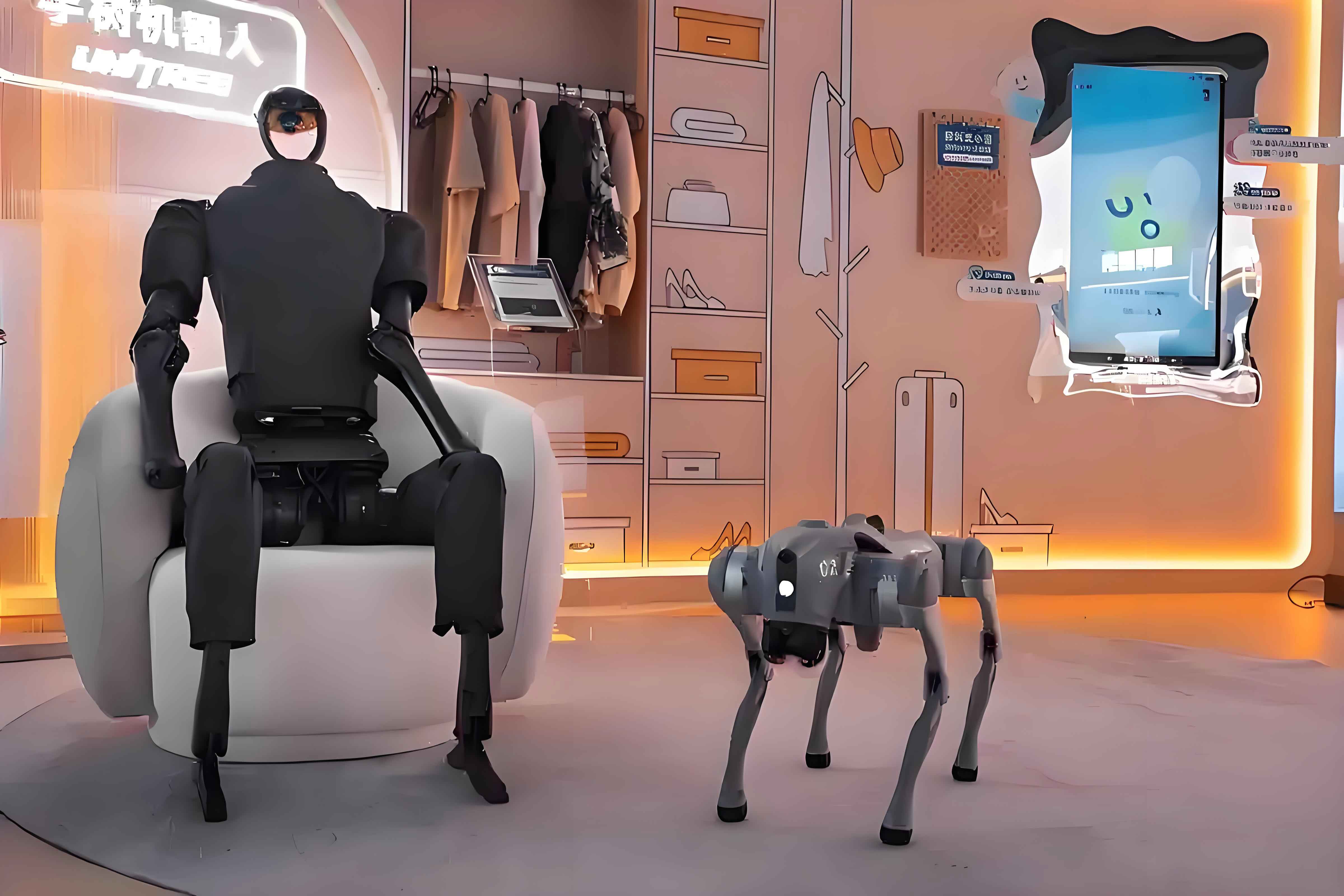
The rise of the humanoid robot is often presented as an engineering milestone. Yet its deeper significance lies in the way it exposes the limits of non-embodied artificial intelligence. Traditional artificial intelligence models can perform impressive feats of calculation, pattern matching, and language manipulation. They can also fail in ordinary perceptual tasks that human beings perform without deliberation. This failure is not simply a matter of insufficient data or computing power. It reflects a deeper mismatch between a disembodied computational architecture and the embodied, situated, and interactive character of human cognition. The humanoid robot brings that mismatch into view because it must operate in the same messy world that human beings inhabit. It must cope with uncertainty, ambiguity, physical contingency, social expectation, and the constant need to adjust action to context. The humanoid robot thus becomes a concrete arena for testing whether embodiment is an optional feature of intelligence or a constitutive condition of it.
- From Non-Embodied to Embodied Paradigms in Cognitive Science
Cognitive science emerged in the mid-twentieth century as a multidisciplinary field spanning philosophy, psychology, neuroscience, artificial intelligence, and linguistics. Its central concern can be understood as a contemporary version of an old philosophical question: how is knowledge possible? The answers varied, but the dominant paradigms from the 1960s onward shared a powerful assumption. Computationalism, symbolism, representationalism, and cognitivism differed in emphasis, yet they generally treated cognition as representation. The mind was understood as a system that processes information, and the body was treated as a sensorimotor interface rather than as a constitutive part of cognition. These traditions can be grouped together as non-embodied approaches.
Computationalism was the classic expression of this tradition. It held that cognition is essentially symbol manipulation and that thought can be formalized through a Turing-style computational model. The physical symbol system hypothesis, associated with Allen Newell and Herbert Simon, gave this view a strong formulation: intelligence is sufficient when a system can manipulate formal symbols according to rules. On this account, cognition is rule-governed information processing, and its basic units are semantically interpretable symbols. Whether the system is a human brain or a digital computer, it can be abstracted as an algorithmic device.
Connectionism challenged the formal-logical architecture of computationalism. It rejected the idea that cognition can be reduced to explicit symbol manipulation and instead described cognition as patterns of activation and weight change in neural networks. The cognitive system became a parallel distributed system capable of pattern recognition and dynamic change over time. Connectionism emphasized emergence: higher-level cognitive capacities are not directly encoded but arise from nonlinear interactions among lower-level units. Artificial neural networks grew from this tradition, seeking to capture the non-rule-like and non-symbolic aspects of human cognition.
Yet connectionism did not fully escape the non-embodied paradigm. It still treated cognition as information processing inside the head, and it still treated the body as an input-output channel rather than as a constitutive basis of cognition. Cognitivism, likewise, understood cognition as the rule-governed manipulation of internal representations. Representationalism defined cognition as the capacity to process internal symbol systems, with formal logical precision as its theoretical guarantee. Despite their differences, these paradigms preserved a core assumption: cognition is representation. The body was marginalized, ignored, or treated as a mere vehicle.
The limitations of this approach became increasingly visible when researchers tried to explain everyday perception, action control, and complex social behavior. In the 1980s, embodied cognition emerged as a critical alternative. It reopened the question of how cognition relates to the body and the world. A landmark critique came from Hubert Dreyfus, whose work drew on Martin Heidegger and Maurice Merleau-Ponty. Dreyfus argued that classical artificial intelligence, especially symbol-based systems, made a fundamental mistake by reducing cognition to information processing governed by context-free rules. He rejected the analogy that the brain is a computer. For Dreyfus, cognitive capacities are not grounded in symbolic representation alone. They are rooted in the body’s ongoing and dynamic practical relation with the world.
In this view, higher-order cognitive abilities such as reasoning, logical operations, language, and conceptual manipulation are not self-sufficient. They depend on lower-order, non-representational, pre-reflective bodily capacities. Human intelligence is grounded in how the body skillfully copes with a world. This claim posed a radical challenge to non-embodied cognitive science. If cognition is rooted in bodily experience, situated embedding, and skillful coping, then the thesis that cognition is representation loses its claim to universality and explanatory sufficiency.
Pattern recognition offers a useful example. It is often treated as a basic cognitive capacity: the ability to integrate, classify, and interpret structured information from the environment. In traditional artificial intelligence, pattern recognition is frequently reduced to logical computation, with precise inputs, rule-based processing, and stable outputs. Yet such models often struggle in real-world perceptual tasks. Human perception operates within an open, ambiguous, and inexhaustible background. What a person sees is not an isolated object in an objective world. It emerges as a figure from a background through the intertwining of context and bodily experience. This phenomenological structure of perception cannot be fully reconstructed by a logical program.
Dreyfus therefore criticized the classical input-processing-output model for ignoring the constitutive role of embodiment and situation. In his account, pattern recognition is not a static transfer of information. It is a generative process based on continuous interaction between body and world. Through sensory-motor systems, an agent responds, adjusts, and adapts within an environment, allowing meaning structures to form dynamically. This process is characterized by pre-reflective and operative intentionality. Before explicit representation, the body has already generated meaning through action in context. Perception is not a passive mapping of an external world. It is a result of the body acting in the world.
A related insight came from the collaborative work of computer scientist Oliver Selfridge and psychologist Ulric Neisser. They attempted to improve digital computers in pattern recognition by introducing heuristic rules. They hoped that a computer could not only respond passively to input but also actively generate recognition hypotheses, thereby simulating certain anticipatory mechanisms of human cognition. In the process, they recognized that formal logic and algorithmic models cannot fully reproduce the vague anticipation on which human cognition depends. When facing complex, ambiguous, or incomplete information, human beings still perceive and judge effectively because they rely on experience, background knowledge, and expectations about the environment. This ability is not built on explicit rules. It is a dynamic, situated form of understanding.
Selfridge and Neisser therefore pointed toward a deeper point. Human pattern recognition does not depend only on sensory input processing. It also depends on experiential schemas and predictive capacities interwoven with that input. Vague anticipation allows human beings to maintain flexibility and sensitivity in uncertain and ambiguous situations. If artificial systems are to achieve similar generality and adaptability, they must move beyond symbolism and formal logic. They must rethink the deep coupling among body, perception, and action. This is the context in which embodied cognition became a powerful research paradigm. Researchers returned to phenomenological insights about the body, perception, and the world while also engaging empirical work in cognitive science, neuroscience, and artificial intelligence. The result was a framework that challenged traditional views of mind and offered new foundations for building more complex and adaptive artificial systems. The humanoid robot is one of the most visible expressions of this ambition.
- The Three Dimensions of Embodied Intelligence
The turn from non-embodied to embodied cognition is not only a change of research fashion. It is a transformation at the ontological and epistemological levels. Embodied cognition holds that intelligence is not a mechanism inside the brain or a formal logical structure. It emerges from the continuous sensory-motor cycles through which an agent and environment interact. This process is embodied, extended, and situation-dependent. Its occurrence and maintenance are rooted in an embodied situation: a body-environment system constituted by morphological constraints, proprioceptive feedback, and environmental affordances.
This means that the body does not merely limit possible actions. It also participates in meaning generation in a pre-reflective and non-representational way. An agent can perceive, judge, and act in the world not because of abstract reasoning alone, but because the body has formed pre-intentional perceptual regulation within a specific environment. Intelligence should therefore be understood as something that emerges from the body’s dealings with a situation, not as something stored in a closed internal system. Embodied cognition emphasizes both the dependence of cognition on the body and the capacity of the cognitive system to continuously reconstruct its own states during real-time, action-oriented interaction.
The paradigm shift challenges the epistemological foundations of artificial intelligence and pushes it toward a deeper ontological reflection. What form of embodiment can constitute the condition for the emergence of intelligence? How does the dynamic coupling between agent and environment shape cognition through perception, meaning, and interaction? To address these questions, it is useful to distinguish three dimensions of embodied intelligence: sensory-motor embodiment as the basis of cognition, situated embodiment as a mechanism of meaning generation, and interactive embodiment as an interaction paradigm. These dimensions are not isolated modules. They interweave and jointly constitute embodied intelligence as a dynamic and generative structure. They also point toward the ontological future of artificial intelligence and the specific challenges faced by the humanoid robot.
- Sensory-Motor Embodiment as the Basis of Cognition
Sensory-motor embodiment is the most basic dimension of embodied cognition. It emphasizes that cognition originates in sensory-motor loops between agent and world, with the body as the interface and medium. Merleau-Ponty argued that the body is not a passive receiver of sensory input. It possesses an original perceptual structure and is already present in the world. The intentional body coordinates with its surroundings through pre-reflective patterns of perception and action, thereby achieving knowledge and transformation of the world.
In artificial systems, traditional models often assume that perception, action, and cognition can be separated into modules. They neglect the central role of the body. Embodied cognition stresses the constitutive role of bodily morphology in intelligent behavior. In artificial intelligence practice, this idea appears in Rodney Brooks’s work on behavior-based robotics and the subsumption architecture. Brooks proposed replacing the traditional perception-modeling-planning pipeline with layered behaviors such as obstacle avoidance and navigation. Each layer is subordinate to lower-level sensory-motor behaviors. Although this architecture cannot by itself support higher cognitive functions, it established a bottom-up embodied path and laid an experimental foundation for understanding the body’s role in cognition.
Following Brooks’s pioneering approach, Rolf Pfeifer and Josh Bongard developed the idea of morphological computation. They argued that certain aspects of intelligence can be realized intrinsically by a robot’s body structure and physical dynamics, reducing dependence on a central computational system. Helmut Hauser and colleagues explored how a robot’s body can participate in computational processes through feedback mechanisms and enable complex behavioral regulation. They emphasized that physical properties of the body are not merely properties of actuators. They are components of computation and can work with control systems to achieve more efficient behavioral control. These results show that intelligence is not simply the passive reception and internal processing of external information. It depends heavily on an agent’s ability to manage relations between perceptual change and action. This perspective provides both biological plausibility for cognition and engineering pathways and philosophical support for embodied artificial intelligence.
For the humanoid robot, sensory-motor embodiment is not an abstract ideal. It is a daily engineering reality. A humanoid robot must coordinate vision, balance, touch, force control, and limb movement in real time. When a humanoid robot walks across uneven ground, climbs stairs, or recovers from a push, it cannot rely only on a central planner that calculates every variable in advance. It must use the physical dynamics of its body, feedback from joints and sensors, and rapid adjustments of posture. The humanoid robot therefore illustrates how body structure can offload part of the cognitive burden and how sensory-motor coupling can generate adaptive behavior. The humanoid robot is not merely a computer with legs. It is a physical system whose morphology shapes what it can perceive, how it can act, and what kind of intelligence can emerge.
- Situated Embodiment as a Mechanism of Meaning Generation
Sensory-motor embodiment reveals the body as a mechanism of cognition, but it is not enough to explain how intelligent action becomes meaningful. Situated embodiment emphasizes that intelligent behavior is embedded in specific physical and social situations. Cognitive structures and goals depend on the covariation between an agent and a particular situation. Meaning is not imposed by an internal representation alone. It arises through the agent’s active engagement with an environment that offers possibilities and constraints.
James Gibson’s ecological psychology and his concept of affordance provide a foundation for situated embodiment. Gibson argued that objects in the environment have direct meaning for an agent. A step is climbable. A handle is graspable. This structure of meaning is not bestowed by representation. It is coupled to the bodily capacities of the agent. Situated embodiment therefore poses a double challenge for artificial intelligence systems. On one hand, the system must perceive and adapt to its environment. On the other hand, it must couple its actions to structural changes in the environment and, in that process, generate meaning about itself and the world.
Recent work in neurorobotics, associated with Jeffrey Krichmar and others, has attracted increasing attention. Krichmar argues that a genuinely intelligent system must possess neural structures coupled with situated interaction. It must be able to construct action and cognitive structures dynamically in complex situations through biologically inspired learning and adaptation. One advantage of neurorobotics is its capacity for a smooth transition from simulation to the real world. Through neural plasticity and learning mechanisms, a robot can develop adaptive and self-organizing action patterns without relying entirely on preprogrammed instructions. This mechanism mimics how biological brains regulate environmental input and allows a robot to cope better with complex and changing real-world environments. However, such research still faces major challenges. Much current work focuses on low-level neural mechanisms, such as visual cortical encoding or prefrontal action selection. There is still a lack of research on integrative mechanisms that cross levels.
The humanoid robot makes situated embodiment especially salient. A humanoid robot is often intended to operate in environments designed for human bodies: factories, hospitals, shopping malls, schools, offices, and homes. These environments are not fully codified or predictable. They are open, noisy, ambiguous, and socially textured. A humanoid robot must understand not only explicit commands but also context. It must recognize when a request is vague, when a path is blocked, when a human is hurried, when a tone of voice changes meaning, or when an object is relevant to a task. In one account, the humanoid robot Pepper, developed by SoftBank Robotics, appeared in a shopping mall in Santa Clara, California. Pepper interacted with customers, learned their needs, and helped them find products. Even when a customer said something ambiguous such as wanting to try a particular pair of shoes, Pepper could combine visual input, voice analysis, object recognition, and situational context to infer which shoes were meant. This kind of mechanism goes beyond static semantic networks. It pushes semantic understanding from context-free abstract representation toward situation-driven multimodal meaning construction. When working with humans, Pepper also used sensors to perceive environmental changes and machine learning algorithms to adjust routes dynamically, demonstrating adaptability to application contexts.
Cloud Ginger, a humanoid robot presented by CloudMinds, illustrates another dimension of situated embodiment. According to the source analysis, the humanoid robot is about 1.4 meters tall and capable of natural language communication, cross-scene task execution through a cloud brain, and autonomous path planning in complex environments such as shopping malls and hospitals. It can avoid dynamic obstacles and adjust its behavior according to user needs through joint control and real-time monitoring and decision systems. These capacities do not stem from a single centralized plan. They emerge from the interaction among perception, action, context, and continuous feedback. The humanoid robot thus becomes a concrete implementation of sensory-motor, situated, and interactive embodiment. It also becomes a redefinition of the traditional robot, because its intelligence is not located only in a computational core but distributed across body, environment, and ongoing adjustment.
- Interactive Embodiment as an Interaction Paradigm
Unlike situated embodiment, which focuses on coupling between an agent and an environment, interactive embodiment focuses on how agents, including artificial agents and human beings, jointly construct meaning, form norms, and establish consensus through interaction. This is the highest-level expression of embodied intelligence. Its theoretical roots can be traced to Edmund Husserl’s account of pair-appearances and Merleau-Ponty’s concept of intercorporeality.
In the phenomenological tradition, intersubjective interaction is not merely an exchange of information between two closed subjects. The other is a subject who has inner experience just as I do, and together we participate in a field of meaning that constitutes a shared experience of we. Husserl argued that all objective truth and all possible conditions of existence and meaning become possible only within a transcendental intersubjective horizon. Following Husserl, Merleau-Ponty developed intercorporeality as a bodily basis of intersubjective structure. The other is not constructed through mind reading or inference. The other is present in an original perceptual experience. Through bodily perception, a subject becomes aware of the other, and the other appears to the subject in embodied perception. Intersubjectivity is therefore not only a precondition for meaning. It is a perceptual structure woven through bodily interaction and response.
This static structural orientation, however, remains insufficient when confronted with the generation of meaning in complex interaction. Hanne De Jaegher and Ezequiel Di Paolo extended the phenomenological view of intersubjectivity by proposing participatory sense-making. They moved intersubjective interaction from structural perception to the dynamic generation of embodied cognitive processes. They argued that what emerges in intersubjective interaction is not simple information exchange. It is a higher-level dynamic autonomous system with its own capacity for evolution, self-organization, and regulation. This system can feed back into and shape the perceptual content and cognitive states of both interactants. Cognition is therefore not only the coupling of an agent’s action with an environment. It is also a coordinative structure between subjects. Through mutual adjustment and mutual normativity, subjects achieve a kind of consistency.
In artificial system design, interactive embodiment means that intelligence is expressed not only in environmental response but also in the capacity for joint participation in social situations. This involves more than sensor or actuator feedback. It involves bodily posture, rhythm of action, spatial arrangement, and other non-linguistic coordinative structures. It also requires an artificial intelligence system to display legibility and negotiability during interaction. These are preconditions for the socialization of embodied artificial intelligence.
This line of thought has been taken up in human-robot interaction research. Cynthia Breazeal has emphasized that emotion can regulate a robot’s response thresholds, such as attention focus, and can also regulate motivational systems such as exploration or avoidance. She proposed an emotion-driven behavioral architecture that allows a robot to display a degree of emotional consistency and purposeful action in social situations, thereby promoting coherence and trust in human-robot interaction. Tony Belpaeme and colleagues, in research on social robots, argued that the effectiveness of human-robot interaction depends not only on the efficiency of information transfer. It depends on the ability to establish emotional connection and embodied co-presence, thereby strengthening the quality of interaction and its effect on cognitive generation.
Interactive embodiment thus points toward a key turn. A genuinely embodied artificial intelligence must not only have movement and perception. It must also be able to participate with other intelligent agents and human beings in the shared construction of meaning. For the humanoid robot, this is especially demanding. A humanoid robot that interacts with people must manage gaze, gesture, timing, personal space, and turn-taking. It must be understandable and negotiable. It must not merely execute commands. It must participate in a social field. The humanoid robot therefore becomes a test of whether artificial systems can move from tool-like operation to embodied social participation. The humanoid robot is not only a machine that acts in the world. It is a machine that may be drawn into the world of shared meaning.
Embodied dimension Primary claim Representative concepts Relevance to the humanoid robot Sensory-motor embodiment Cognition begins in pre-reflective sensory-motor loops between body and world. Operative intentionality; subsumption architecture; morphological computation; feedback. A humanoid robot must coordinate limbs, balance, touch, and vision in real time rather than only execute symbolic plans. Situated embodiment Meaning arises through an agent’s active coupling with a specific physical and social situation. Affordance; neurorobotics; adaptive learning; context-sensitive action. A humanoid robot must operate in open, noisy, and ambiguous human environments and adjust behavior to context. Interactive embodiment Meaning is jointly constructed through embodied interaction among agents. Intercorporeality; participatory sense-making; emotional architecture; legibility and negotiability. A humanoid robot must coordinate gaze, gesture, timing, and social norms to participate in shared meaning with humans. Although these three dimensions are distinguished for analytical clarity, they are not independent functional modules. They jointly constitute embodied intelligence as a dynamic and generative whole. Sensory-motor coupling provides a pre-reflective basis for action and roots cognition in bodily experience. Situated embodiment ensures dynamic coupling between cognitive processes and environmental structures, granting action openness and adaptability through sensitivity to affordances and context. Interactive embodiment extends the boundaries of cognition, transforming intelligence from a single-agent generative mechanism into a process in which multiple agents jointly construct meaning. These dimensions interweave and reveal that intelligence is not the product of a static, closed computational process. It is a continuous becoming, embedded in relations among body, environment, and others.
- Sensory-Motor Embodiment as the Basis of Cognition
- The Humanoid Robot as a Redefinition of the Traditional Robot
The previous analysis shows that embodied intelligence challenges the basic assumptions of traditional artificial intelligence and profoundly affects its practical pathways. In recent years, the humanoid robot has become a model of convergence among mechanical engineering, cognitive science, electronic engineering, and artificial intelligence. It is not only a testing ground for moving embodied intelligence from theory to practice. It is also an important object of philosophical inquiry into the nature of intelligence, embodiment, and cognitive generation.
Merleau-Ponty argued that the body is not a pure physical device. It is a field of meaning generation and a structure through which the subject’s relation to the world appears. This raises a difficult question. Can the body of a humanoid robot carry an autonomous structure of meaning? Or does the humanoid robot assume continuity between biological intelligence and machine intelligence? To address this question, it is necessary to examine how the humanoid robot redefines the traditional robot and under what conditions it might constitute an embodied existence for artificial intelligence. Such inquiry touches not only the boundaries of technology but also the ontological status and future form of artificial systems.
Unlike traditional artificial intelligence based on abstract symbol manipulation, the humanoid robot, empowered by large models, imitates human body structure, perception, and interaction. It enters environments designed for human beings, such as manufacturing, social services, and special operations, to perform complex tasks and achieve more general and adaptive intelligent performance. If classified by form, current mainstream humanoid robots can be divided into wheeled humanoid robots, which use wheeled drive and emphasize tactile sensors and dexterous hand manipulation; half-body legged humanoid robots, which emphasize leg movement; and full-body humanoid robots, which possess four limbs and various sensing capacities and adapt to multiple complex tasks in open environments. If classified by application scenario and primary function, humanoid robots can be divided into special-operation humanoid robots, industrial humanoid robots, medical humanoid robots, entertainment humanoid robots, public-service humanoid robots, and home-service humanoid robots.
In 2023, Atlas, introduced by Boston Dynamics, demonstrated fluid and natural walking, standing up, and 180-degree rotation of the head and waist. It displayed an unprecedented capacity for dynamic bodily balance. In 2024, Cloud Ginger represented a high level of embodied intelligence implementation. The humanoid robot, about 1.4 meters tall, not only possessed natural language communication and cross-scene task execution through a cloud brain. It could also use 18 degrees of freedom in joint control and a real-time monitoring and decision system to autonomously plan walking paths in complex environments such as shopping malls and hospitals, avoid dynamic obstacles, and dynamically adjust its behavior according to user needs. These humanoid robots are no longer machines in the traditional sense. By embedding the latest artificial intelligence technologies in physical entities, they possess coordinated coupling between a brain and a body and ultimately interact with the environment through physical action. They are not only concrete implementations of sensory-motor, situated, and interactive embodiment. They are also a redefinition of the traditional robot.
First, traditional artificial intelligence emphasizes discrete input and central processing and neglects how bodily form constrains and regulates information processing. A humanoid robot, by contrast, is mainly composed of a brain, a cerebellum, and a body. Through morphological computation, it shows that intelligence is not only a brain technology centered on large models. It is also a dynamic regulatory process distributed across body and environment. For the humanoid robot, the body is the carrier and foundation of all human-like functions. It is responsible for dynamic and precise bodily movement and integrates actuators, chips, sensors, and new materials. Among these, actuators are most central. They include rotary actuators, linear actuators, and end effectors. Rotary actuators are mainly used at joints such as wrists and knees to execute precise motion control. Linear actuators are often installed in upper arms, thighs, and elbows to complete extension, pushing, pulling, and other linear movements. End effectors are mainly used in hands and feet and have moved from traditional grippers to multi-fingered dexterous hands. When Atlas jumps, performs a backflip, or dynamically avoids obstacles, it does not rely on a central processor to calculate every variable precisely. It relies on its mechanical structure to exploit inertia, balance, and feedback. This demonstrates tight coupling between limb morphology and motor function and highlights the capacity of bodily structure itself to process part of the information.
Second, traditional robots usually complete tasks only in codified and predictable finite situations. The humanoid robot, however, can operate in an open, noisy, uncertain, and ambiguous real world. Pepper, developed by SoftBank Robotics, appeared in a shopping mall in Santa Clara, California, and interacted with customers to understand their needs and help them find products. Even when a customer said something vague such as wanting to try a particular pair of shoes, Pepper could combine visual input, voice tone analysis, object recognition, and current context to determine which shoes were meant among many in a display. This mechanism goes beyond static semantic networks and pushes semantic understanding from context-free abstract representation toward situation-driven multimodal semantic construction. When working with humans, Pepper also used sensors to perceive changes in the environment and machine learning algorithms to dynamically adjust routes, showing adaptability to application scenarios.
Third, the revolutionary development of the humanoid robot forces us to abandon a purely instrumental view of robots and their interaction with humans. Traditional instrumental views of technology presuppose a dualism between subject and tool. They emphasize the subject’s domination, control, and transformation of the tool. In traditional human-machine interaction, humans externalize their will into an object through the use of a tool in order to solve a problem. The humanoid robot, however, is no longer a cold machine. It can trigger human emotional experience and aesthetic response through interaction. A social robot such as Furhat can use high-resolution animation and real-time facial expression to establish a basic interactive rhythm with humans and to achieve complex interactive behaviors such as orientation regulation and attention guidance in multi-user situations. This shows the potential of interactive embodiment to go beyond individual cognitive mechanisms. In such human-robot interaction, human cognitive ability is not only extended by the presence of an intelligent agent. New possibilities for action are created. Moreover, through interaction between human and intelligent agent, a fused understanding of the world and self is formed. Together with the intelligent agent, human beings create a new technological environment and learn, understand, and handle relations of mutual penetration and mutual construction with the intelligent agent.
Through deep embedding of sensory-motor, situated, and interactive embodiment, the humanoid robot offers artificial intelligence a new paradigm of decentralization and interactive generation. It also fundamentally redefines the concept of the robot. Traditional robots are usually viewed as controllable mechanical agents that rely on preset algorithms to complete tasks in closed systems. The design of the humanoid robot takes embodiment as its core. Its intelligence no longer originates merely in formal logical reasoning. It forms through dynamic interaction among the humanoid robot, situations, and others. In other words, the formation of artificial intelligence is no longer only the result of model computation. It is an embedded, participatory, and collaborative process of generation.
In this sense, the humanoid robot is not only a technical iteration of the traditional robot. It is a challenge to and reconstruction of its philosophical foundations. It suggests that the body is not merely an executor of thought. It is a condition for the generation of cognition. The environment is not merely a background for intelligence. It is a field of cognitive co-construction. The other is not merely an object of interaction. It is a participant in meaning generation. This redefinition forces further reflection on the ontological status of intelligence and liberates it from an implicit cognitivist framework, bringing it into an embodied ontological horizon.
- Engineering Advances and Persistent Difficulties
At the same time, the current state of humanoid robot research exposes a series of practical difficulties in embodied intelligence. From the perspective of engineering implementation, the humanoid robot still faces high computational costs and technical bottlenecks in motion coordination, context understanding, and multimodal perception. A humanoid robot must integrate many sensors, actuators, control loops, and learning systems. It must maintain balance while moving, manipulate objects while perceiving human intention, and adapt to unexpected changes while preserving safety. These demands place enormous pressure on real-time computation, energy use, mechanical robustness, and system integration.
From the perspective of social interaction, it remains difficult to truly embed the humanoid robot in complex human emotional experience and ethical structures. A humanoid robot may recognize a facial expression or a vocal tone, but recognition is not the same as participating in a shared emotional world. Trust, empathy, and long-term cooperation require more than accurate classification. They require histories, norms, commitments, and mutual expectations. A humanoid robot must be legible and negotiable, but it must also avoid manipulating or deceiving human beings through superficial emotional displays. The more human-like the humanoid robot becomes, the more urgent these concerns become.
From the perspective of theoretical construction, how to unify phenomenological description and formal modeling of artificial systems remains a major challenge for cognitive science. Phenomenology describes lived bodily experience, pre-reflective intentionality, and the emergence of meaning. Formal modeling describes mechanisms, representations, algorithms, and control architectures. These two languages are not easily translated into each other. The humanoid robot stands at their intersection. It demands both a philosophical account of embodiment and an engineering account of implementation. It exposes the tension between the lived body and the modeled body, between meaning and mechanism, between participation and computation.
These difficulties are not accidental. The humanoid robot triggers a profound shift in the research paradigm of intelligence. Its significance lies not in minor technical adjustments but in the reshaping of philosophical and scientific horizons. Research on the humanoid robot is therefore not only a path toward a more human-like intelligent technology. It is also a philosophical reflection on what intelligence is, what a body is, what the relation between human beings and the world is, and what risks accompany human-machine interaction. The humanoid robot is a mirror in which inherited assumptions about mind, body, and machine become visible.
- Ethical and Ontological Alerts
With the paradigm shift, embodiment has become a core issue in artificial intelligence research. By distinguishing sensory-motor, situated, and interactive dimensions, it becomes possible to show that intelligence is not derived from abstract computation detached from the body. It is rooted in the dynamic process of continuous coupling between an agent and its environment. This dynamic process fundamentally depends on the mutual construction among the agent’s capacity for action, perceptual structure, and meaning generation.
The humanoid robot, as an artificial intelligence device with human-like morphological features, highlights the constitutive role of the body in intelligence by simulating human bodily structure and function. It displays a kind of bionic capacity of sensory-motor systems and approaches the external form of human intelligence in action planning, situational adaptation, and interaction. Yet morphological approximation cannot guarantee the realization of embodied intelligence. Although the body of the humanoid robot may possess formal completeness, it still differs fundamentally from human embodied cognition in the coordination of structure and function and in the openness of meaning construction.
This difference in technical realization points not only to engineering difficulty but also to a deeper philosophical problem: whether the body of the humanoid robot is sufficient to carry the structural conditions of embodied existence in the phenomenological sense. From a phenomenological perspective, the body is not only a mechanism of cognition. It is also a transcendental structure of meaning generation and world disclosure. Although current humanoid robot technology achieves a degree of simulation of human movement and perceptual interaction, this functional simulation cannot touch the transcendental structure contained in bodily experience or the inner generative relation between body and world.
In this sense, the humanoid robot is not the completed form of embodied intelligence. As a frontier form of embodied intelligence research, it has significant practical value and revolutionary meaning. Its philosophical significance, however, does not lie in how far it can copy human embodied intelligence. It lies in the way it exposes the theoretical limits of non-embodied cognitive research and forces further reflection on the ontological presuppositions of intelligence. As an artificial experimental apparatus at the intersection of phenomenology and engineering, the humanoid robot reveals an irreducible structural tension among body, intelligence, and world. It also calls for sustained ethical vigilance regarding the possibilities of artificial life.
Such vigilance is not a rejection of the humanoid robot. It is a condition for responsible development. A humanoid robot that enters human environments must be designed with attention to privacy, autonomy, safety, transparency, and the vulnerability of human users. It must not exploit human tendencies to anthropomorphize. It must not create false expectations of understanding or care. It must not hide the boundaries between simulation and experience. At the same time, the humanoid robot can help human beings understand those boundaries more clearly. By encountering a machine that looks like us but is not us, we are forced to ask what matters about being embodied, being situated, and being together in a shared world.
- Conclusion: The Humanoid Robot as a Phenomenological and Engineering Experiment
The movement from non-embodied to embodied artificial intelligence is one of the most consequential developments in contemporary cognitive science and robotics. The classical paradigm treated intelligence as computation over representations and treated the body as an optional interface. Embodied cognition rejects that reduction. It argues that intelligence emerges from sensory-motor coupling, situated meaning generation, and interactive participation. The humanoid robot is a privileged case for exploring this claim because it must act in human environments with a body-like structure. It cannot remain only a symbol processor. It must balance, perceive, move, adapt, communicate, and coordinate with others.
The humanoid robot therefore redefines the traditional robot in at least three ways. It shifts intelligence from a centralized computational core to a distributed system of brain, body, and environment. It shifts action from closed, predictable tasks to open, ambiguous, and socially textured situations. It shifts the robot from a controllable tool to a potential participant in shared meaning. These shifts are not merely technical. They alter the ontology of the artificial agent. They suggest that embodiment is not an accessory to intelligence but a condition of its possibility.
Yet the humanoid robot also reveals the limits of current approaches. Functional simulation of human movement and perception does not automatically produce lived bodily experience. Morphological similarity does not guarantee the pre-reflective and meaning-generating structure of human embodiment. The humanoid robot can approximate the external form of human intelligence while remaining fundamentally different in its inner organization, its relation to the world, and its openness to meaning. This difference should not be treated as a temporary engineering gap alone. It is a philosophical clue about the nature of embodied existence.
The humanoid robot is thus not the final achievement of embodied intelligence. It is a frontier, a laboratory, and a mirror. It shows that artificial intelligence cannot be fully understood apart from the body, the situation, and interaction. It shows that the body is not merely an executor of thought but a condition of cognition. It shows that the environment is not merely a background but a field of co-constitution. It shows that the other is not merely an object but a participant in meaning. The humanoid robot brings these insights into engineering practice while also exposing the structural tension among body, intelligence, and world. Its future will depend not only on advances in actuators, sensors, and models but also on how seriously researchers take the phenomenological and ethical dimensions of embodiment. The humanoid robot is therefore more than a machine that resembles a human being. It is a question about what it means for intelligence to have a body, to inhabit a world, and to meet another agent within that world.