
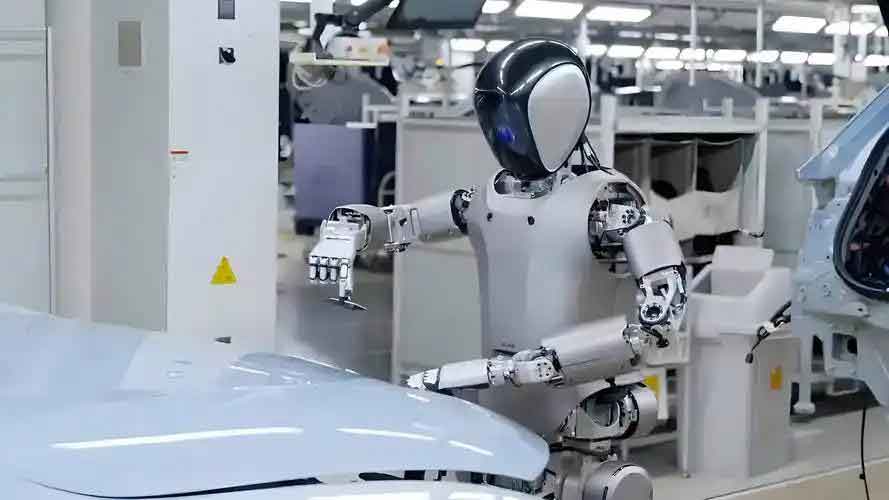
On August 26, the State Council Information Office held a press conference under the theme of starting the 15th Five-Year Plan and accelerating new industrialization. The conference outlined deployments across emerging industries, artificial intelligence development, governance of irrational competition, and the upgrading of intelligent terminals. Among the most prominent signals was the ministry’s intention to advance the iteration of intelligent terminals such as the humanoid robot and brain-computer interface, while expanding standards and product catalogues for artificial intelligence terminals.
The Ministry of Industry and Information Technology, which is responsible for industrial planning and information technology development, used the occasion to present a broad vision for the 15th Five-Year Plan period. That vision includes optimizing the industrial structure, cultivating emerging pillar industries, laying out future industries, strengthening key core technology breakthroughs, and linking industrial upgrading with consumer demand. The humanoid robot appeared repeatedly in the discussion, both as a symbol of artificial intelligence integration into the real economy and as a product category expected to benefit from policy support, standards development, and large-scale application scenarios.
1. New Industrialization Agenda Places Emerging Industries at the Center
The press conference made clear that the 15th Five-Year Plan period will be a critical window for China’s new industrialization strategy. The Ministry of Industry and Information Technology will coordinate the transformation and upgrading of traditional industries, the cultivation and expansion of emerging industries, and the forward-looking layout of future industries. The aim is to preserve and develop a complete industrial system while creating new growth engines.
According to the presentation, the ministry will accelerate the building of six emerging pillar industries: integrated circuits, aerospace, biomedicine, low-altitude economy, new energy storage, and intelligent robots. At the same time, it will promote future industries such as quantum technology, biomanufacturing, hydrogen and nuclear fusion energy, brain-computer interfaces, embodied intelligence, and sixth-generation mobile communications, or 6G, so that they become new growth points for the economy.
These six emerging pillar industries are not isolated sectors. They overlap with advanced manufacturing, digital infrastructure, artificial intelligence, new materials, and high-end equipment. The humanoid robot, for example, draws on advances in integrated circuits, sensors, artificial intelligence algorithms, precision machinery, new energy storage, and advanced materials. In this sense, the humanoid robot serves as a practical test of how multiple emerging industries can converge into a single product ecosystem.
Xin Guobin, vice minister of the Ministry of Industry and Information Technology, said the ministry will take coordinated steps to push traditional industries toward higher value, expand emerging industries, and make forward-looking arrangements for future industries. The goal is to maintain the integrity and resilience of the industrial system while improving its competitiveness.
The conference also referenced earlier estimates by Zheng Shanjie, director of the National Development and Reform Commission. Zheng said at an economic-themed press conference during the National People’s Congress session in March that the output value related to the six emerging pillar industries had already approached 6 trillion yuan in 2025. By 2030, that figure is expected to double or more, expanding to more than 10 trillion yuan.
2. Technology Breakthroughs and Demonstration Bases Form the Backbone
Yao Jun, director of the Planning Department of the Ministry of Industry and Information Technology, outlined how the ministry intends to promote the growth of emerging industries. He said the ministry will adopt extraordinary measures and pursue full-chain breakthroughs in key core technologies. The priority fields include integrated circuits, industrial mother machines, high-end instruments and meters, basic software and industrial software, advanced materials, and biomanufacturing.
The objective is to achieve decisive breakthroughs in these areas. That language reflects a policy emphasis not only on incremental progress but also on removing bottlenecks that constrain the wider industrial system. For the humanoid robot sector, such breakthroughs matter because humanoid robot development depends on high-performance chips, precision components, advanced control software, lightweight materials, and reliable energy storage.
Yao Jun also said the ministry will create national demonstration bases for emerging industry development. These bases will focus on key areas such as next-generation information technology, new energy, new materials, intelligent connected new energy vehicles, robots, biomedicine, high-end equipment, and aerospace. The intention is to build benchmarks that can lead the development of emerging industries.
By 2035, the ministry aims to cultivate around 100 demonstration parks that have radiation and driving effects in industrial cluster development, collaborative innovation, ecosystem optimization, and governance improvement. It also aims to cultivate around 1,000 demonstration enterprises that are leading in product development, technological innovation, business model innovation, and management efficiency.
In addition, the ministry will carry out large-scale application demonstrations for new manufacturing technologies, new products, and new scenarios. It will accelerate the cultivation of major application scenarios such as 5G plus, artificial intelligence plus, robot plus, industrial internet plus, and BeiDou plus. These scenarios are expected to provide real-world demand for intelligent products, including the humanoid robot, and to help companies move from laboratory prototypes to commercial deployment.
Su Jian, a professor at the School of Economics at Peking University, offered an assessment of the growth targets. He noted that moving the output value of the six industries from nearly 6 trillion yuan to more than 10 trillion yuan corresponds to a compound annual growth rate of about 11 percent. If the goal is to double the value, the required rate would be around 15 percent, roughly two to three times the GDP growth target of 4.5 percent to 5 percent for the year. He said the target appears high but is supported by evidence.
3. Sector Data Shows Momentum Across Integrated Circuits, Aerospace and Robotics
The press conference provided concrete examples of momentum in the first half of the year. In integrated circuits, output by industrial enterprises above a designated size increased by 23.1 percent year on year. In the second quarter, integrated circuit production reached monthly historical highs for three consecutive months. That performance illustrates the scale and pace of expansion in a sector that is foundational for artificial intelligence, smart terminals, and the humanoid robot.
In aerospace, the C919 large passenger aircraft has been delivered cumulatively 41 units, with safe flight hours exceeding 130,000. The Long March 10B carrier rocket successfully completed its first launch and recovery mission, marking a major breakthrough in reusable rocket technology. These achievements reinforce the broader industrial upgrading agenda and show how advanced manufacturing capabilities can support new industries.
In intelligent robotics, the conference noted that for every 10 humanoid and quadruped intelligent robots sold globally, 8 are produced in China. This single data point highlights China’s role in the global supply chain for humanoid robot and quadruped robot production. It also explains why the humanoid robot is treated as a strategic product category in the new industrialization plan, not merely as a consumer gadget.
| Area | Reported Development or Policy Signal |
|---|---|
| Integrated circuits | Output by industrial enterprises above designated size rose 23.1 percent year on year in the first half of the year. In the second quarter, production set monthly historical highs for 3 consecutive months. |
| Aerospace | The C919 large passenger aircraft has been delivered cumulatively 41 units, with safe flight hours exceeding 130,000. The Long March 10B carrier rocket completed its first launch and recovery mission, a breakthrough for reusable rocket technology. |
| Intelligent robots | For every 10 humanoid and quadruped intelligent robots sold globally, 8 are produced in China. |
| Emerging pillar industries | Integrated circuits, aerospace, biomedicine, low-altitude economy, new energy storage, and intelligent robots are identified as emerging pillar industries for the 15th Five-Year Plan period. |
| Future industries | Quantum technology, biomanufacturing, hydrogen and nuclear fusion energy, brain-computer interfaces, embodied intelligence, and 6G are identified as future industries. |
| Artificial intelligence terminals | The ministry will promote iteration of intelligent terminals such as the humanoid robot and brain-computer interface, expand artificial intelligence terminal standards, and form an artificial intelligence terminal product catalogue. |
4. Artificial Intelligence Foundations Continue to Expand
The press conference described China’s artificial intelligence industry as vibrant and full of highlights, contributing strong intelligent momentum to economic growth. The foundations of the industry are being strengthened. By the end of June, the scale of intelligent computing power reached 2,185 EFLOPS, and more than 70 large computing corridors had been built around computing hubs.
On the application side, artificial intelligence has basically run through the entire chain of research and development design, production manufacturing, quality inspection, and operation and maintenance. Through real-scenario training, robots have entered an operation mode in scenarios such as production manufacturing, emergency rescue, and catering services. This is a significant step because it shows that artificial intelligence and robotics are moving from demonstration projects into practical work environments.
On the governance side, nearly 200 key artificial intelligence standards have been developed. The Ministry of Industry and Information Technology is organizing multiple cities to carry out artificial intelligence ethics review and service practice. The recently released International Artificial Intelligence Ethics Governance Action Plan has also received positive responses from many countries. These governance efforts are meant to create a framework in which artificial intelligence, intelligent terminals, and the humanoid robot can develop in a trusted and orderly manner.
Xin Guobin described the supply-side approach for artificial intelligence during the 15th Five-Year Plan period as focusing on building a solid technology foundation. The ministry will support research and development of key technologies such as high-end training chips and multimodal algorithms. It will tackle frontier technologies such as brain-inspired intelligence and world models. It will also promote the iteration of intelligent terminals such as the humanoid robot and brain-computer interface. In addition, it will develop products such as intelligent mining machinery, agricultural machinery, and intelligent medical devices to better meet the needs of various industries.
5. Humanoid Robot and Brain-Computer Interface Terminals Move to the Fore
The phrase intelligent terminal was repeated throughout the press conference, and the humanoid robot was one of the most frequently cited examples. The Ministry of Industry and Information Technology will promote the iteration of intelligent terminals such as the humanoid robot and brain-computer interface. It will also continue to expand the coverage of artificial intelligence terminal standards, provide enterprises with directions for benchmarking and compliance, and accelerate the formation of an artificial intelligence terminal product catalogue to guide public consumption decisions.
The emphasis on the humanoid robot reflects a broader policy logic. Artificial intelligence needs physical form and commercial channels to deliver value at scale. A humanoid robot is not only a machine. It is a platform that combines perception, decision-making, motion control, energy management, human-machine interaction, and cloud or edge intelligence. When the humanoid robot enters manufacturing, logistics, emergency response, service, or household environments, it generates data that can feed back into algorithm improvement. That feedback loop can then pull demand for upstream chips, sensors, displays, batteries, and advanced materials.
The humanoid robot also illustrates why the ministry is pairing artificial intelligence development with intelligent terminal standards. Without standards, the market may be crowded with products that claim intelligence but deliver limited capability. With standards, enterprises can know what level of intelligence they are targeting, consumers can compare products more confidently, and regulators can support quality upgrading. The humanoid robot, as a highly complex intelligent terminal, benefits from clear grading and evaluation frameworks.
Brain-computer interfaces are another intelligent terminal category highlighted in the plan. They represent a frontier area where biology, medicine, electronics, artificial intelligence, and materials science intersect. The ministry’s intention to promote iteration of such terminals suggests that policy attention is not limited to conventional consumer electronics. It extends to advanced medical devices, human augmentation, and new forms of human-machine interaction that may eventually complement or reshape how humanoid robot systems are controlled and used.
The conference also linked intelligent terminals to products for specific industries. Intelligent mining machinery, agricultural machinery, and intelligent medical devices were specifically mentioned. These products show that the intelligent terminal concept is broader than phones, glasses, or wearable devices. It includes any product that embeds artificial intelligence to improve function, safety, efficiency, or user experience. The humanoid robot is one part of this landscape, but it is a highly visible and strategically important part.
6. Electronic Information Manufacturing and Smart Terminal Standards Expand
Liu Yulin, director of the Information and Communication Development Department of the Ministry of Industry and Information Technology, also discussed artificial intelligence terminals when addressing the electronic information manufacturing sector. He said that during the 15th Five-Year Plan period, the ministry will accelerate the development of emerging technologies and product transformation and upgrading.
The ministry will speed up the industrialization process of space computing, virtual reality, Micro LED, silicon-based OLED, and new batteries. It will push electronic information products toward intelligent, green, and integrated development. The goal is to improve the supply of high-end electronic products that satisfy people’s needs. These technology directions are closely related to intelligent terminals. A humanoid robot, for example, requires advanced displays, compact and efficient batteries, high-performance computing, and increasingly natural human-machine interaction. Brain-computer interface devices also require advances in microelectronics, materials, and signal processing.
Liu Yulin said the ministry will continue to expand the coverage of artificial intelligence terminal standards, provide enterprises with directions for benchmarking and compliance, and accelerate the formation of an artificial intelligence terminal product catalogue to provide guidance for public consumption decisions. This standards-plus-catalogue approach is expected to become a practical policy tool for the intelligent terminal market, including products such as the humanoid robot.
He also said that during the 15th Five-Year Plan period, the ministry will work with relevant departments to promote the application of consumer electronic products in scenarios such as education and training, home elderly care, and sports health. It will continue to collect typical cases of audiovisual systems and smart sports. It will accelerate the integrated development of consumer electronic products with vertical fields and innovate diversified consumption scenarios. It will support display technology in playing a greater role in digital cultural tourism, smart healthcare, education and training.
These application scenarios matter for the humanoid robot because they create adjacent markets for sensors, displays, batteries, voice interaction, and artificial intelligence services. A humanoid robot designed for home elderly care may share components and software platforms with consumer electronics and medical devices. A humanoid robot used in education and training may rely on the same display and interaction technologies that support smart education products. The more these scenarios develop, the broader the supply chain and service ecosystem for the humanoid robot becomes.
7. Three Meanings Behind the Intelligent Terminal Push
Su Jian said the Ministry of Industry and Information Technology’s repeated emphasis on the concept of the intelligent terminal carries three layers of meaning.
- The terminal is the last mile for artificial intelligence to land in the real economy. Chips, algorithms, and models are supply-side inputs. Only when they are placed into phones, glasses, humanoid robot, mining machinery, and medical devices can they generate revenue, employment, and data feedback. That feedback can in turn pull demand for upstream chips, displays, and batteries.
- The approach plays to strengths and avoids weaknesses. China still has gaps in frontier large models and advanced manufacturing processes, but it has clear advantages in complete machine manufacturing, supply chains, and a super-large market. Focusing on terminals uses manufacturing and market advantages to absorb technology shortcomings. On-device intelligence can also reduce dependence on cloud computing power.
- Standards plus catalogue will become a new policy tool. In May, the national standard titled Artificial Intelligence Terminal Intelligence Grading divided terminal intelligence into L1 to L4. This standard can curb pseudo-intelligence marketing, provide guidance for trade-in programs and consumption upgrading, and connect industrial upgrading with domestic demand expansion.
These three points help explain why the humanoid robot appears so often in the policy discussion. The humanoid robot is a terminal in the sense that it is a complete product that incorporates artificial intelligence. It is also a manufacturing-intensive product that leverages supply chain strengths. And it is a product category that can benefit from standards, grading, catalogues, and consumer or industrial demand policies. In this framework, the humanoid robot is not only a technology demonstration. It is a bridge between artificial intelligence innovation and large-scale industrialization.
8. New Energy Vehicle Competition and Industrial Governance
The press conference also addressed irrational competition in the new energy vehicle industry. Xin Guobin said these are key problems that must be tackled with greater force during the 15th Five-Year Plan period. To that end, the ministry has studied and formulated the Intelligent Connected New Energy Vehicle Industry Development 15th Five-Year Plan. The aim is to promote sustained high-quality development of the industry through plan guidance, departmental coordination, and policy support.
Although the discussion focused on new energy vehicles, the governance theme has wider relevance. Emerging industries such as intelligent robots and the humanoid robot may also face risks of disorderly expansion, duplicated investment, price wars, or exaggerated marketing if they grow rapidly without coordinated standards and policy guidance. The ministry’s emphasis on planning, coordination, and standards suggests that it intends to shape emerging industries toward healthy competition rather than unchecked fragmentation.
The reference to irrational competition also connects to the intelligent terminal agenda. If artificial intelligence terminals, including the humanoid robot, are promoted without clear standards, consumers and industrial buyers may struggle to distinguish genuine capability from marketing claims. The development of artificial intelligence terminal standards and a product catalogue is therefore not only a technical exercise. It is also a market governance measure intended to protect users, support responsible companies, and guide investment toward real innovation.
9. Application Scenarios Link Industrial Upgrading with Consumption
The press conference repeatedly connected supply-side innovation with demand-side application. The ministry will carry out large-scale application demonstrations for new manufacturing technologies, new products, and new scenarios. It will accelerate major application scenarios such as 5G plus, artificial intelligence plus, robot plus, industrial internet plus, and BeiDou plus. These scenarios are expected to create demand for intelligent products and provide testing grounds for new technologies.
For the humanoid robot, application scenarios are essential. A humanoid robot may be tested in manufacturing lines, emergency rescue operations, catering services, mining environments, agricultural work, medical care, education, and home services. Each scenario imposes different requirements for safety, reliability, dexterity, battery life, communication, and human-machine interaction. Real-world deployment helps companies improve the humanoid robot through feedback that cannot be fully simulated in a laboratory.
The consumer side is equally important. The ministry plans to promote consumer electronic products in education and training, home elderly care, and sports health. It will continue to collect typical cases for audiovisual systems and smart sports. It will support display technology in digital cultural tourism, smart healthcare, education and training. These efforts expand the market for intelligent terminals and create a broader ecosystem of components, software, content, and services. A humanoid robot intended for home elderly care could benefit from the same policy push that supports smart health and home-based services.
By linking industrial upgrading with consumption upgrading, the ministry is trying to create a dual engine for emerging industries. On one side, technological breakthroughs and demonstration bases improve supply capacity. On the other side, standards, catalogues, trade-in programs, and application scenarios stimulate demand. The humanoid robot sits at the intersection of these two forces. It is a high-technology industrial product, but it can also become a consumer or service product in the future.
10. Outlook for the 15th Five-Year Plan Period
The press conference sent a clear message that the 15th Five-Year Plan period will be a period of accelerated new industrialization. The Ministry of Industry and Information Technology will focus on optimizing the industrial structure, building emerging pillar industries, laying out future industries, and achieving decisive breakthroughs in key core technologies. It will use demonstration bases, application scenarios, standards, and product catalogues as policy instruments.
Within this agenda, the humanoid robot is more than a single product. It is a test case for how integrated circuits, artificial intelligence, advanced materials, new energy storage, sensors, and high-end manufacturing can be combined. It is also a test case for how standards and catalogues can guide market development. The ministry’s intention to promote iteration of intelligent terminals such as the humanoid robot and brain-computer interface indicates that policy support will continue across the research, development, manufacturing, application, and governance stages.
The humanoid robot also illustrates the importance of supply chain strength. The fact that 8 out of every 10 humanoid and quadruped intelligent robots sold globally are produced in China shows that the country already has a substantial manufacturing base in this field. Policy attention can help that base move up the value chain, improve core components, develop software ecosystems, and create internationally competitive products.
At the same time, the ministry is aware of the need to avoid irrational competition. The new energy vehicle experience shows that rapid growth can bring price wars, duplicated investment, and market disorder. For the humanoid robot and other intelligent terminals, early attention to standards, ethics, safety, and interoperability may help reduce similar risks. The development of artificial intelligence ethics review and service practices in multiple cities, along with nearly 200 artificial intelligence key standards, provides part of that governance foundation.
The 15th Five-Year Plan period will therefore be defined by both ambition and coordination. The ambition is visible in the target of expanding the six emerging pillar industries from nearly 6 trillion yuan in 2025 to more than 10 trillion yuan by 2030. The coordination is visible in the emphasis on plan guidance, departmental collaboration, policy support, demonstration parks, demonstration enterprises, and large-scale application scenarios. The humanoid robot will be one of the most visible symbols of whether this combination succeeds.
11. Key Takeaways at a Glance
- The Ministry of Industry and Information Technology will advance intelligent terminals such as the humanoid robot and brain-computer interface during the 15th Five-Year Plan period.
- Six emerging pillar industries are integrated circuits, aerospace, biomedicine, low-altitude economy, new energy storage, and intelligent robots.
- Future industries include quantum technology, biomanufacturing, hydrogen and nuclear fusion energy, brain-computer interfaces, embodied intelligence, and 6G.
- The output value of the six emerging pillar industries approached 6 trillion yuan in 2025 and is expected to exceed 10 trillion yuan by 2030.
- Integrated circuit output by industrial enterprises above designated size rose 23.1 percent year on year in the first half of the year, with monthly historical highs for 3 consecutive months in the second quarter.
- The C919 large passenger aircraft has been delivered cumulatively 41 units, with safe flight hours exceeding 130,000. The Long March 10B carrier rocket completed its first launch and recovery mission.
- For every 10 humanoid and quadruped intelligent robots sold globally, 8 are produced in China.
- By the end of June, intelligent computing power reached 2,185 EFLOPS, and more than 70 large computing corridors had been built around computing hubs.
- Nearly 200 artificial intelligence key standards have been developed. The ministry is organizing artificial intelligence ethics review and service practice in multiple cities.
- The ministry will expand artificial intelligence terminal standards and accelerate the formation of an artificial intelligence terminal product catalogue to guide public consumption decisions.
- The national standard Artificial Intelligence Terminal Intelligence Grading, released in May, divides terminal intelligence into L1 to L4.
- The Intelligent Connected New Energy Vehicle Industry Development 15th Five-Year Plan was formulated to address irrational competition and promote high-quality development.
- The ministry will cultivate around 100 demonstration parks and around 1,000 demonstration enterprises by 2035 in emerging industry fields.
- Major application scenarios include 5G plus, artificial intelligence plus, robot plus, industrial internet plus, and BeiDou plus.
| Category | Identified Sectors or Products | Policy Direction |
|---|---|---|
| Emerging pillar industries | Integrated circuits, aerospace, biomedicine, low-altitude economy, new energy storage, intelligent robots | Accelerate development, build demonstration bases, pursue full-chain technology breakthroughs, and create application scenarios. |
| Future industries | Quantum technology, biomanufacturing, hydrogen and nuclear fusion energy, brain-computer interfaces, embodied intelligence, 6G | Make forward-looking arrangements so these sectors become new growth points. |
| Intelligent terminals | Humanoid robot, brain-computer interface, intelligent mining machinery, agricultural machinery, intelligent medical devices | Promote iteration, expand standards, form product catalogues, and support applications across industries. |
| Electronic information priorities | Space computing, virtual reality, Micro LED, silicon-based OLED, new batteries | Accelerate industrialization and push products toward intelligent, green, and integrated development. |
| Consumer and vertical applications | Education and training, home elderly care, sports health, digital cultural tourism, smart healthcare | Expand consumption scenarios and integrate consumer electronics with vertical fields. |
The policy direction outlined at the press conference places the humanoid robot within a larger effort to combine artificial intelligence, advanced manufacturing, and market demand. The humanoid robot is expected to benefit from breakthroughs in integrated circuits, software, materials, and energy storage. It is also expected to benefit from standards, catalogues, application demonstrations, and consumer or industrial demand policies. The same is true for brain-computer interfaces, which represent another frontier intelligent terminal with potential applications in healthcare, human-machine interaction, and advanced manufacturing.
As the 15th Five-Year Plan period begins, the Ministry of Industry and Information Technology has positioned new industrialization as a comprehensive strategy. It covers traditional industry upgrading, emerging industry expansion, future industry cultivation, artificial intelligence governance, intelligent terminal standards, and competition policy. The humanoid robot appears throughout this strategy because it embodies many of the plan’s central themes: technological innovation, supply chain strength, real-world application, standards development, and international competitiveness.
The coming years will show how quickly these policy intentions translate into products, standards, and markets. What is already clear is that the humanoid robot and brain-computer interface are no longer treated as distant concepts. They are part of the intelligent terminal agenda, and they are tied to the broader goal of accelerating new industrialization while keeping competition rational and innovation grounded in real economic value.