
For most people, the humanoid robot is no longer an unfamiliar idea. In the past few years, whenever a humanoid robot appeared at a large exhibition, gala, sports event, or technology show, it often became a source of attention. The humanoid robot could sing, dance, box, greet guests, and make coffee. It seemed able to perform almost any simple social or entertainment task. These demonstrations helped the public become familiar with the humanoid robot, but they also raised a question: what can the humanoid robot actually do when the lights go down and the stage is removed?
If those earlier abilities were sometimes viewed as flashy displays, then the humanoid robot entering a home to do chores has made more people feel that science fiction is becoming reality. The distance between saying “I can dance” and saying “I can help you work” may appear to be only one sentence. Behind that sentence, however, lies a collective leap in artificial intelligence, machine vision, motion control, force sensing, and embodied intelligence. The humanoid robot is no longer only a machine that performs. It is becoming a machine that acts, understands, and assists.
2026 is the opening year of the 15th Five-Year Plan. Embodied intelligence has been clearly listed by the national government as a future industry to be cultivated. It is becoming an important carrier for new quality productive forces and for connecting digital intelligence with physical manufacturing scenarios. At the same time, the Ministry of Industry and Information Technology continues to promote the implementation of standards for the humanoid robot industry. Various regions are accelerating pilot applications in real industrial settings. The robot industry is moving from showing its strength on an exhibition stage to going into the field and doing real work.
How exactly is the humanoid robot completing this super evolution from dancing to doing chores? The answer is not a single breakthrough. It is a combination of better bodies, stronger brains, richer sensing, more reliable control, and more realistic testing environments. The humanoid robot is moving from a spectacle to a tool, and from a tool to a potential partner in daily life and production.
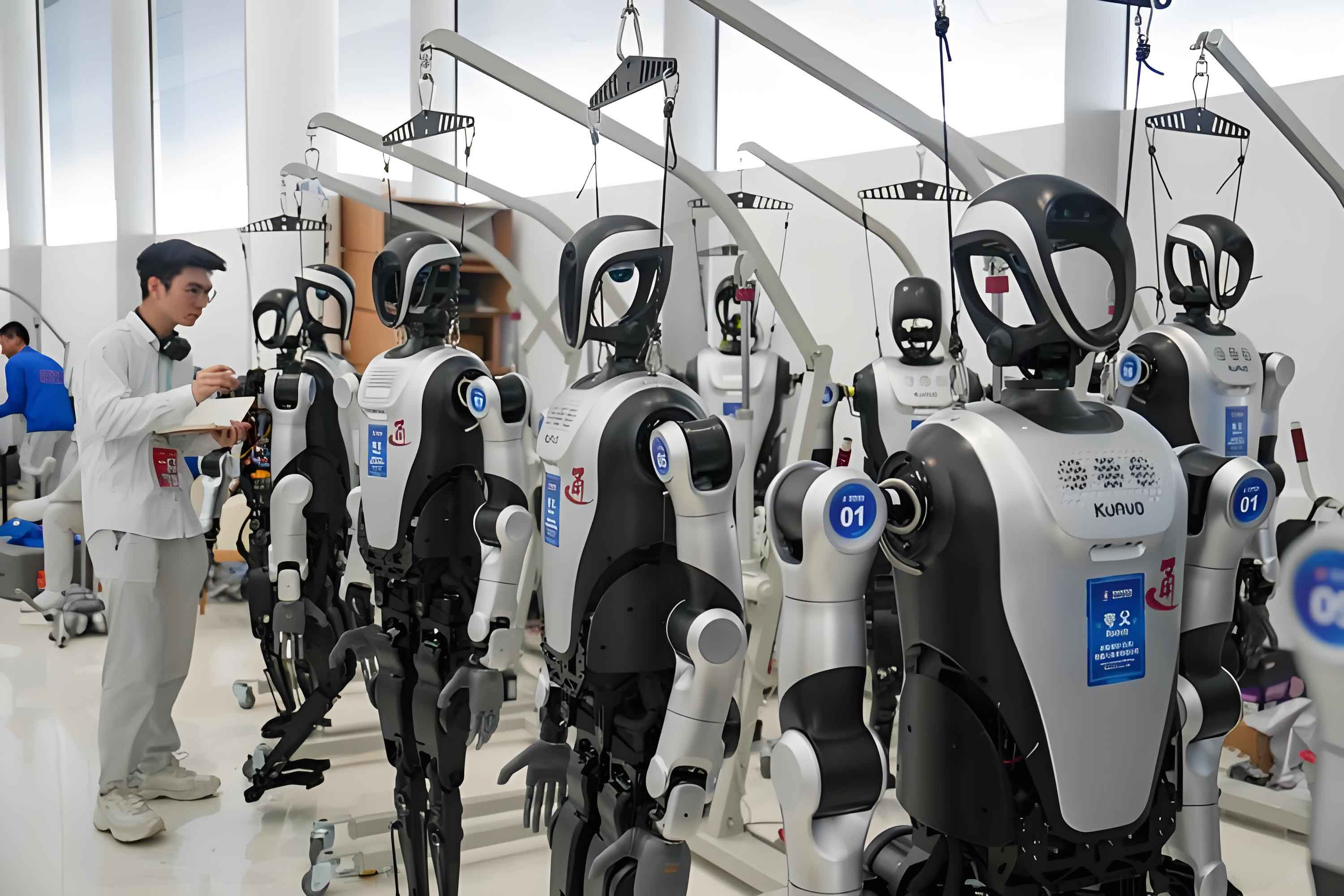
1. From Performance to Productivity: The Humanoid Robot Starts to Do Real Work
Last year, a visit to Unitree Technology offered a clear picture of the industry’s early public image. At that time, Unitree’s humanoid robot had just appeared at the Spring Festival Gala and later attracted considerable attention through boxing matches. The development of technology is always accompanied by controversy. Some online commenters said, “This is just a remote-controlled toy.” Unitree did not respond directly. Instead, the company focused on research and development. Wang Xingxing, founder and CEO of Unitree Technology, said directly that performance and sports are relatively easy scenarios to implement. Unitree’s goal, however, is to let the humanoid robot do more work with actual value.
Helping people do things has always been the ultimate destination of the humanoid robot and the goal pursued by many manufacturers. At the 2026 World Robot Conference held in August, the humanoid robots brought by various companies became more pragmatic. To be able to do things, they displayed a wide range of capabilities. The humanoid robot was no longer only a performer. It was presented as a worker, an assistant, and a potential household helper.
Unitree Technology’s nearly 3-meter-tall giant manned mecha looked like a Gundam from anime. Zhizheng Robotics tidied up household chores on site. Zibianliang Robotics folded clothes and then leisurely watered flowers. Hikrobot put on an apron to simulate a fast-food employee, taking orders and placing meal boxes. These demonstrations were not isolated stunts. They pointed toward a broader shift in the humanoid robot industry: the humanoid robot is being asked to complete tasks, not just attract crowds.
“The most direct feeling from attending WRC this time is that the exhibition direction has changed significantly. Companies are focusing on the humanoid robot doing things and completing tasks, emphasizing a real improvement in productivity,” said Hu Luhui, founder of Zhizheng AI. For example, their newly self-developed humanoid robot TR6 is more flexible than the previous generation. Relying on a multi-camera visual fusion and force-sensing system, it can be applied in various complex working environments and can accurately identify irregular materials and complex objects.
“In the industry, the focus may have been on the body and the cerebellum in the past. Now the main bottleneck and main direction for deployment have shifted to the brain, that is, the understanding ability of artificial intelligence large models,” Hu Luhui said. He believes that the family is regarded as one of the ultimate target scenarios for the humanoid robot. It can greatly improve human quality of life and lifestyle. “The humanoid robot will play diversified roles in the family, similar to a nanny, solving many life problems beyond travel. It is expected to become the largest industry in human history.”
That vision is ambitious, but it also explains why the humanoid robot has become a central topic in embodied intelligence. The humanoid robot is not merely a robot with a human-like shape. It is a platform that combines mobility, manipulation, perception, and decision-making. If the humanoid robot can understand a home, it can also understand a factory. If the humanoid robot can adapt to a kitchen, it can also adapt to a warehouse, a hospital, a restaurant, or a construction site. The humanoid robot is therefore both a product category and a test of general-purpose artificial intelligence in the physical world.
2. From Machine to Human: The Humanoid Robot Still Needs Stronger Generalization
However, for the humanoid robot to truly become an all-around butler, it is clearly not that easy. On August 20, Wang Xingxing said in a speech at the 2026 World Robot Conference that the biggest bottleneck in the robot industry is currently that the generalization ability of embodied intelligence is not enough. This statement applies directly to the humanoid robot. The humanoid robot may perform well in a controlled demonstration, but it still struggles when the world changes around it.
What is generalization ability? Simply put, the humanoid robot cannot only do standard answers. If it is trained to “see plate A, put plate A into the dishwasher,” it may complete the task beautifully. But if today it is replaced by plate B, or the dishwasher’s position is moved, the kitchen lighting changes, and a cup is placed nearby, the humanoid robot may suddenly be a little unable to do it. The task has changed only slightly from a human perspective. For the humanoid robot, however, the entire scene may appear new and uncertain.
Why does this happen? Because the real world is never a standardized examination room. The humanoid robot must learn to respond to changing circumstances in different environments. A household is full of variation. Objects are placed in different positions. Floors have different textures. Lighting changes throughout the day. People move unpredictably. Pets enter the room. Chairs are pushed in or pulled out. A humanoid robot that cannot generalize will require constant reprogramming, which is not practical for ordinary users.
“At present, the generalization ability of the humanoid robot is not enough. It is mainly reflected in three points: generalization of the body, generalization of the task, and generalization of the environment. The humanoid robot still lacks a true understanding of the physical world,” Hu Luhui said. Generalization of the body means the humanoid robot must adapt to different hardware configurations, joint limits, and sensing arrangements. Generalization of the task means the humanoid robot must transfer skills from one task to another. Generalization of the environment means the humanoid robot must operate in new rooms, new factories, and new social settings.
What is the bottleneck? It is that the current AI model’s input and output are not aligned enough with the humanoid robot. It looks like only a little bit short, but in reality it is a huge gap from can do to do well. A model may recognize an object in an image, but the humanoid robot needs to know how to approach it, how much force to apply, how to avoid collisions, and when to stop. A model may understand a sentence, but the humanoid robot needs to turn that sentence into a sequence of safe physical actions. This alignment problem is one of the central challenges for the humanoid robot.
One answer to this problem may be the world model. In recent years, the main schools of AI models are VLA models and world models. VLA stands for vision-language-action. It connects what the humanoid robot sees, what it is told, and what it does. A world model takes a different approach. It attempts to build an internal representation of how the world works and how it changes over time.
“VLA is I have seen it, so I know. The world model is I reason, so I know. Its generalization ability and causal reasoning ability are stronger, and it does not purely rely on having seen to know,” Hu Luhui said. For the humanoid robot, this distinction matters. A humanoid robot that only relies on past examples may fail when a new object appears. A humanoid robot that can reason about cause and effect may be able to infer that a cup should be held by the handle, that a full container should be moved slowly, or that a fragile object should not be squeezed too hard.
Next, what really needs to accelerate development is the brain of the humanoid robot. Only when the humanoid robot truly understands the world can it accomplish something that seems simple but is actually extremely difficult. Picking up a towel, folding a shirt, loading a dishwasher, or preparing a simple meal may be easy for a human. For the humanoid robot, each task requires perception, planning, control, and real-time adaptation. The humanoid robot must not only see the world. It must understand what the world means for action.
| Generalization Challenge for the Humanoid Robot | What It Means | Why It Matters |
|---|---|---|
| Body generalization | The humanoid robot must adapt across different bodies, joints, sensors, and hardware limits. | A skill learned on one humanoid robot may not transfer directly to another humanoid robot. |
| Task generalization | The humanoid robot must move beyond one fixed task and reuse skills in new tasks. | A humanoid robot that can only fold one type of shirt is not a general-purpose helper. |
| Environment generalization | The humanoid robot must operate in new rooms, lighting conditions, layouts, and social settings. | Homes and factories are not standardized, so the humanoid robot must handle variation. |
| Model alignment | AI model inputs and outputs must align with the physical actions of the humanoid robot. | Understanding an instruction is not the same as safely executing it in the real world. |
| Causal reasoning | The humanoid robot needs world models that support reasoning, not only pattern recognition. | A reasoning humanoid robot can adapt when conditions change instead of failing immediately. |
3. Zhejiang and Hangzhou Accelerate the Humanoid Robot Ecosystem
Some people say that for a long time, humans building robots resembled the story of Pygmalion: first shaping the body to be more and more like a human, and then hoping that one day it will truly come alive. When can it come alive? To achieve this goal, governments at all levels are working hard. The humanoid robot is no longer only a laboratory challenge. It is becoming an industrial policy priority, an investment target, and a regional economic opportunity.
The recommendations for the 15th Five-Year Plan mention forward-looking layout of future industries. They promote quantum technology, biomanufacturing, hydrogen and nuclear fusion energy, brain-computer interfaces, embodied intelligence, and sixth-generation mobile communications as new economic growth points. The humanoid robot sits at the intersection of several of these fields. It depends on artificial intelligence, advanced manufacturing, new materials, sensors, and communication. The humanoid robot is therefore not only a machine. It is a convergence point for multiple future industries.
As early as 2017, Zhejiang issued the “Robot+” Action Plan, becoming the first province in the country to propose a “Robot+” policy. Since 2024, Zhejiang has successively issued several special policies to provide targeted guidance for the development of the humanoid robot and embodied intelligence industries. These policies have promoted the gradual improvement of the policy system for the embodied intelligence humanoid robot industry. The humanoid robot has moved from a concept to a policy-supported industrial direction.
In Hangzhou, more than 700 robot-related enterprises have gathered. In 2025, the output value of the embodied intelligence industrial cluster reached 106.8 billion yuan. Among them, the domestic market share in the quadruped robot and humanoid robot fields accounted for 80 percent and 50 percent respectively. Hangzhou is building a complete industrial chain covering complete machine manufacturing, core components, software algorithms, and scenario applications. This full chain is important for the humanoid robot because the humanoid robot requires many specialized parts, including actuators, reducers, sensors, controllers, batteries, and software systems.
From January to June 2026, Zhejiang’s artificial intelligence core industry revenue reached 429.6 billion yuan, a year-on-year increase of 25.6 percent. At present, the province’s core artificial intelligence enterprises have increased to 2,080, initially forming a full industrial chain pattern covering chips, large models, intelligent agents, and application services. This growing artificial intelligence base supports the humanoid robot in several ways. Chips provide computing power. Large models provide understanding and reasoning. Intelligent agents provide task planning. Application services connect the humanoid robot to real user needs.
“In the future, we will insist on taking artificial intelligence as the core variable for winning the future, accelerate the creation of an internationally competitive intelligent economy industrial cluster, and strive to achieve 1.2 trillion yuan in provincial artificial intelligence core industry revenue by 2030,” said Yan Xi’an, deputy director of the Zhejiang Provincial Development and Reform Commission. For the humanoid robot, this target signals long-term support. The humanoid robot is not a short-term exhibition trend. It is part of a broader strategy to build an intelligent economy.
“The recent listing of Unitree Technology has also given entrepreneurs in the humanoid robot field great confidence,” Hu Luhui said. Whether it is the forward-looking layout at the national level or Zhejiang’s strong investment in artificial intelligence, both have laid a solid foundation for the development of the humanoid robot industry. Talent and capital have poured in. “It is very much like the surging development momentum of the Internet ten years ago.” This comparison suggests that the humanoid robot may follow a path from early experimentation to rapid commercialization, although the technical barriers remain high.
| Indicator | Data |
|---|---|
| Zhejiang artificial intelligence core industry revenue, January to June 2026 | 429.6 billion yuan |
| Year-on-year growth | 25.6 percent |
| Core artificial intelligence enterprises in Zhejiang | 2,080 |
| Robot-related enterprises in Hangzhou | More than 700 |
| Hangzhou embodied intelligence industrial cluster output, 2025 | 106.8 billion yuan |
| Domestic market share in quadruped robots | 80 percent |
| Domestic market share in humanoid robots | 50 percent |
| Zhejiang artificial intelligence core industry revenue target by 2030 | 1.2 trillion yuan |
4. The Practical Path of the Humanoid Robot: From Exhibition Hall to Household
The humanoid robot is moving from the exhibition hall to the household. This transition is not only about walking more steadily or moving more gracefully. It is about usefulness. The humanoid robot must be able to complete tasks that save time, reduce effort, or improve safety. In the past, the humanoid robot could sing, dance, box, greet guests, and make coffee. Those abilities demonstrated balance, coordination, and controllability. But the real test is whether the humanoid robot can handle unstructured tasks: cleaning a table, sorting laundry, loading a dishwasher, picking up irregular objects, and adapting to new rooms.
At WRC 2026, the message was clear: the humanoid robot is being judged by what it can do, not only by how human it looks. Unitree Technology’s giant manned mecha showed that the humanoid robot can be powerful and scalable. Zhizheng Robotics showed that the humanoid robot can handle household chores. Zibianliang Robotics showed that the humanoid robot can fold clothes and water flowers. Hikrobot showed that the humanoid robot can take orders and place meal boxes in a fast-food setting. Each demonstration pointed to a different slice of the future market for the humanoid robot.
For the family, the humanoid robot is expected to take on repetitive chores. It may help with cleaning, organizing, laundry, and simple cooking. It may also provide companionship and assistance for older adults or people with limited mobility. To do this, the humanoid robot must combine perception, decision-making, and action. It must understand not only objects but also human intent. A humanoid robot that can fold clothes must know which clothes belong together. A humanoid robot that can water flowers must know which plants need water and how much. A humanoid robot that can assist a person must know when to help and when to stay out of the way.
For industry, the humanoid robot is being tested in pilot applications. Factories and warehouses are often more structured than homes, but they still present complex challenges. The humanoid robot must work safely near people and machines. It must handle tools, parts, and materials. It must operate for long hours and recover from errors. Standardization by the Ministry of Industry and Information Technology supports interoperability, safety, and quality. Industrial real-world pilots help the humanoid robot learn from real constraints. These pilots are essential because a humanoid robot that works in a laboratory may fail in a factory if it has not experienced noise, vibration, variable lighting, and human traffic.
The humanoid robot also needs a strong supply chain. A complete industrial chain covering complete machine manufacturing, core components, software algorithms, and scenario applications is important. Hangzhou’s ecosystem illustrates this. The humanoid robot depends on high-performance actuators, precise reducers, force sensors, visual sensors, edge computing chips, and large models. If any part of the chain is weak, the humanoid robot cannot reach practical reliability. The humanoid robot is therefore both a product and a system integration challenge.
5. The Brain Race: Why the Humanoid Robot Needs World Models
The next stage of competition for the humanoid robot is likely to focus on the brain. In the past, much attention was given to the body and the cerebellum. The body determines how strong, fast, and stable the humanoid robot can be. The cerebellum-like control system determines how smoothly the humanoid robot moves. But Hu Luhui points out that the main bottleneck and main direction for deployment have shifted to the brain, that is, the understanding ability of artificial intelligence large models. The humanoid robot must understand the world before it can act reliably in the world.
VLA models and world models represent two major approaches. VLA models connect vision, language, and action. They allow the humanoid robot to map a visual scene and a language instruction to an action. For example, a person might say, “Put the red cup on the table into the box.” A VLA model can help the humanoid robot recognize the cup, understand the instruction, and generate a movement plan. VLA models are powerful because they can learn from large amounts of data and generalize across many tasks.
World models take a different path. A world model aims to build an internal representation of how the world changes. For the humanoid robot, this means it can simulate outcomes, reason about cause and effect, and adapt when conditions change. If the humanoid robot has a world model, it may be able to predict that a glass will break if dropped, that a door will open if the handle is turned, or that a stack of plates will fall if pushed too hard. This kind of reasoning is important for generalization. The humanoid robot cannot rely only on having seen every possible situation. It must be able to reason about new situations.
If the humanoid robot only memorizes patterns, it will fail in a new kitchen. If the humanoid robot can reason, it can transfer skills. The humanoid robot that learned to fold a shirt may be able to fold a towel. The humanoid robot that learned to load a dishwasher may be able to load a washing machine. The humanoid robot that learned to avoid a chair may be able to avoid a box. This transfer ability is the difference between a specialized machine and a general-purpose humanoid robot.
Hu Luhui’s point about AI model input and output alignment is central. The model must not only understand an instruction. It must produce outputs that the humanoid robot can execute safely and effectively. The humanoid robot has joints, limits, sensors, and physical dynamics. A language model may produce a perfect sentence, but the humanoid robot needs a trajectory. A vision model may detect an object, but the humanoid robot needs a grasp. The gap between digital understanding and physical action is where much of the difficulty lies.
Wang Xingxing’s point about generalization is equally important. The humanoid robot must generalize across bodies, tasks, and environments. This is not a small engineering problem. It is a fundamental challenge in embodied intelligence. The humanoid robot must learn from limited data, adapt in real time, and recover from failure. The humanoid robot must also do this safely, because it operates near people and valuable objects. The brain of the humanoid robot must therefore combine scale, reasoning, and robustness.
6. The Humanoid Robot and the Future of Embodied Intelligence
2026 is the opening year of the 15th Five-Year Plan. Embodied intelligence is listed as a future industry. The humanoid robot is one of the most visible expressions of embodied intelligence. It brings artificial intelligence into the physical world. It turns data into motion, language into action, and perception into assistance. The humanoid robot is not only a robot with a human shape. It is a test of whether intelligent systems can understand and operate in the messy, unpredictable, physical world.
The humanoid robot has already moved through several stages. First, it was a research platform. Then it became a performance machine. Now it is becoming a practical tool. The humanoid robot can dance, box, and greet guests. It can also fold clothes, water flowers, take orders, and place meal boxes. The next stage is reliability. The humanoid robot must work consistently in real homes and real factories. It must handle variation, recover from errors, and interact safely with people.
The humanoid robot will not reach this stage through hardware alone. It needs better brains, better world models, and better alignment between AI models and physical action. The humanoid robot also needs supportive policies, standards, supply chains, and pilot applications. Zhejiang and Hangzhou are building this ecosystem. National policy is providing direction. Companies such as Unitree Technology, Zhizheng AI, Zibianliang Robotics, and Hikrobot are testing different applications. Investors and entrepreneurs are watching the humanoid robot field with growing confidence.
From “what can I do” to “what can I truly do for you,” the humanoid robot is undergoing a real super evolution. The humanoid robot is learning to move beyond performance and into productivity. The humanoid robot is learning to move beyond standard answers and into generalization. The humanoid robot is learning to move beyond remote control and into autonomy. The humanoid robot is learning to move beyond the exhibition hall and into the household, the factory, the warehouse, and the service economy.
The future of the humanoid robot will depend on whether the industry can solve the hardest problems in embodied intelligence. The humanoid robot must understand the physical world. The humanoid robot must reason about cause and effect. The humanoid robot must adapt to new environments. The humanoid robot must align digital intelligence with physical action. If these challenges are solved, the humanoid robot may become one of the most important technologies of the coming decade. If they are not solved, the humanoid robot may remain an impressive demonstration. The direction is clear: the humanoid robot is moving from dancing to working, and from working to truly helping people.
- The humanoid robot is shifting from entertainment and performance toward practical tasks.
- The humanoid robot still faces major bottlenecks in body, task, and environment generalization.
- The humanoid robot needs stronger brains, including VLA models and world models.
- The humanoid robot benefits from standards, industrial pilots, and regional ecosystems.
- The humanoid robot is becoming a central platform for embodied intelligence and future industry development.