
The shift of humanoid robots from machines that can perceive their surroundings to machines that can perform real work depends on far more than artificial intelligence and software. It depends on three essential physical capabilities: reliable sensing, robust joints, and dexterous hands. These capabilities are delivered by sensors, integrated joint modules, and dexterous hands, the components that determine how capable, stable, and useful humanoid robots can become in real-world settings.
The year 2026 is widely viewed by industry participants as the first year of mass production for humanoid robots. As humanoid robots move faster from small-batch trials toward larger-scale deployment, the component industry is facing a new set of challenges. Higher shipment volumes, stricter performance requirements, and the need for greater cost efficiency are converging at the same time. Component makers are therefore under pressure to improve reliability, expand production capacity, and reduce costs without compromising quality.
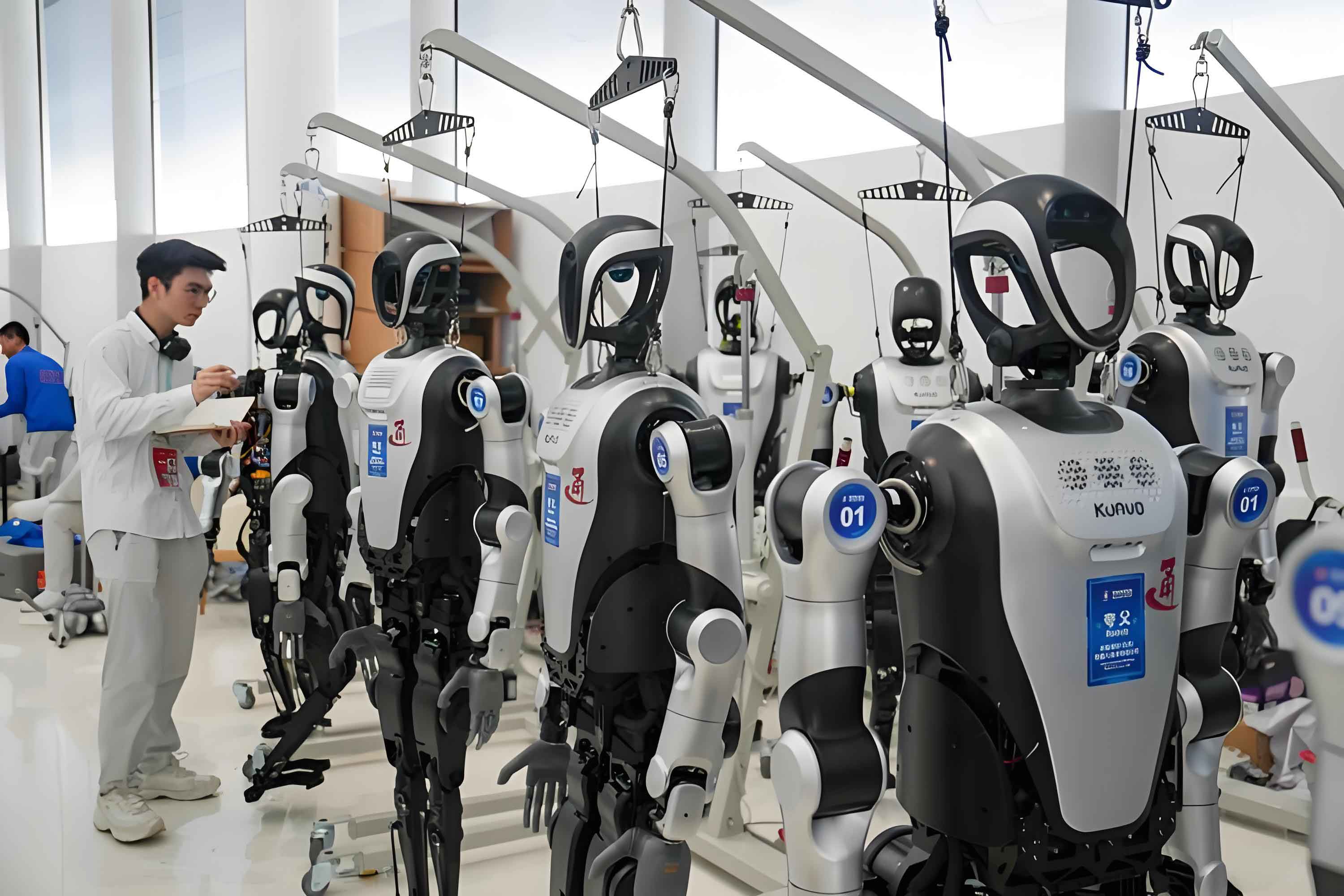
At the recently concluded 2026 World Robot Conference, sensor companies, integrated joint module developers, and dexterous hand makers appeared in force. Their exhibits showed that the component layer of the humanoid robots supply chain is becoming more crowded, more competitive, and more technically ambitious. The displays also offered a clear signal that demand for humanoid robots is no longer limited to laboratories and demonstrations. It is beginning to reach industrial users, logistics operators, and personal users.
-
Component Innovation Takes Center Stage at the 2026 World Robot Conference
The 2026 World Robot Conference became a showcase for the parts that give humanoid robots their sense of touch, their strength, and their manual skill. Kunwei Technology introduced its HRS humanoid series six-axis force sensor, designed specifically for the wrists and ankles of humanoid robots. The sensor has a thinnest section of only 10 millimeters, a specification that matters because humanoid robots require compact components that can fit into joints and limbs without adding excessive bulk.
Paxini presented a foot-sole multi-dimensional tactile sensor. The sensor is intended to help humanoid robots understand different environments and adjust accordingly. For humanoid robots, the foot is not merely a support structure. It is a sensing platform that must detect uneven ground, changes in pressure, and variations in surface conditions. A foot-sole tactile sensor can help humanoid robots maintain balance and adapt their gait when they move from one environment to another.
Beijing Lingzu Times introduced an integrated joint module with a peak torque of up to 35 newton meters and a total weight of only 450 grams. That combination of torque and lightweight design is significant for humanoid robots because joints must be powerful enough to support movement and payloads while remaining light enough to preserve energy efficiency and agility. Excessive weight in joints can reduce battery life, slow movement, and increase mechanical stress elsewhere in the body.
Yinshi Robotics released a 24-degree-of-freedom tendon-rope hybrid-driven dexterous hand. The hand integrates proximity sensing, tactile sensing, and depth vision. This combination suggests that dexterous hands are moving beyond simple gripping and toward more advanced interaction with objects. For humanoid robots to work in assembly, logistics, household assistance, and other complex environments, their hands must be able to identify objects, judge distance, modulate force, and adapt to different shapes and materials.
Company or Organization Component Introduced Key Specification or Feature Relevance to Humanoid Robots Kunwei Technology HRS humanoid series six-axis force sensor Designed for wrists and ankles; thinnest section 10 millimeters Supports force control and compact integration in humanoid robots Paxini Foot-sole multi-dimensional tactile sensor Helps humanoid robots understand different environments and adapt Improves balance, ground sensing, and environmental adjustment Beijing Lingzu Times Integrated joint module Peak torque up to 35 newton meters; total weight 450 grams Provides lightweight strength for humanoid robots joint systems Yinshi Robotics 24-degree-of-freedom tendon-rope hybrid dexterous hand Integrates proximity sensing, tactile sensing, and depth vision Enables more advanced manipulation for humanoid robots The presence of so many component exhibits at a single event reflects a broader shift in the humanoid robots industry. In earlier phases, much of the attention focused on the complete machine. Today, the component layer is attracting equal interest because the performance of humanoid robots is increasingly limited by the quality of sensors, joints, and hands. Even the most advanced control algorithms cannot compensate for weak hardware. If a humanoid robot cannot feel force accurately, cannot move its joints smoothly, or cannot grip objects reliably, its usefulness will remain constrained.
The conference also demonstrated that component suppliers are no longer treating humanoid robots as a speculative future market. They are developing product lines, presenting specifications, and positioning themselves for volume orders. That shift is important because mass production requires standardized, repeatable, and cost-effective components. Custom-built prototypes can support research, but they cannot support thousands or tens of thousands of humanoid robots rolling off production lines.
-
Shipment Growth Sends Demand Signals Through the Supply Chain
Shao Yuanxin, founder and chief operating officer of Beijing Lingzu Times, said that the increase in component exhibits indicates that the entire market demand is becoming larger. When shipments of complete humanoid robots increase, related orders and deliveries follow, which in turn drives component companies to expand production. This is a straightforward but powerful dynamic: the success of humanoid robots at the complete-machine level creates demand for components at the upstream level.
Shao also noted that complete-machine companies are imposing increasingly strict requirements on components. That pressure is not necessarily negative. It is forcing component companies to innovate, improve quality, and strengthen their technical capabilities. In a market where humanoid robots must operate reliably across many scenarios, component suppliers cannot rely on incremental improvements alone. They must develop better materials, more precise manufacturing processes, and more robust testing regimes.
The relationship between component performance and shipment growth is mutually reinforcing. Better components make humanoid robots more capable, which expands the range of viable applications. More applications lead to higher shipment volumes, which generate more revenue and data for component makers. That revenue can then be reinvested in research and development, leading to further performance improvements. This cycle is now beginning to accelerate.
A report titled the 2026 Humanoid Robot Industry Development Report stated that in the first half of 2026, China’s humanoid robot shipments exceeded 40,000 units, with the global share rising to 97 percent. The report also said that the humanoid robot industry has formed a complete supply chain manufacturing capability, from key chips and components to complete machines. This represents a dual leap in quality, efficiency, and industrial capacity.
That supply chain capability matters because humanoid robots are complex systems. They require chips for perception and control, sensors for force and touch, joint modules for movement, dexterous hands for manipulation, batteries for power, and software for coordination. If any part of the chain is weak, the entire system suffers. The fact that the industry has built capabilities from chips to complete machines suggests that humanoid robots are moving closer to industrial-scale production.
However, scale also exposes weaknesses. A component that performs well in a laboratory may fail in a factory, warehouse, or home. A sensor that works for hundreds of cycles may not survive millions of cycles. A joint module that is easy to assemble in small batches may be difficult to manufacture consistently in large volumes. These are the challenges that component suppliers must address as humanoid robots enter mass production.
-
Six-Axis Force Sensors Cross a Market Threshold
The growth in humanoid robot shipments is being transmitted along the supply chain, and six-axis force sensors provide a clear example. As humanoid robots are deployed in industrial assembly, warehousing logistics, and personal user scenarios, force control is shifting from an optional feature to a necessary capability. Humanoid robots that interact with objects and environments must be able to measure force in multiple directions, not just detect contact.
In industrial assembly, for example, a humanoid robot may need to insert a part into a fitting, tighten a screw, or apply a specific amount of pressure without damaging the object. In warehousing logistics, it may need to pick up boxes of different weights and shapes while maintaining stability. In personal user scenarios, it may need to handle fragile items, assist with daily tasks, or operate near people safely. All of these tasks require accurate force sensing.
The 2026 China Humanoid Robot Six-Axis Force Sensor Market Research Report, released at the end of August, showed that in 2025 the total usage of six-axis force sensors in China’s humanoid robots reached about 13,200 units. This was the first time the figure exceeded 10,000 units. The market size was about 330 million yuan, entering the 100-million-yuan level. These figures indicate that six-axis force sensors are no longer a niche component for a handful of prototypes. They are becoming a volume product.
The same report stated that in 2025, the top three companies in this field were all domestic manufacturers, with a combined share of 92.8 percent. That concentration suggests that domestic suppliers have established a strong position in the six-axis force sensor market for humanoid robots. It also indicates that the supply chain for this critical component is becoming more localized, which can improve responsiveness, reduce logistics risks, and support cost reduction.
From 2026 to 2027, as the penetration rate of complete humanoid robots rises rapidly and industrial scenario models adopt force-control configurations in batches, six-axis force sensors for humanoid robots are expected to maintain multiple-fold year-on-year growth. That forecast is grounded in the growing demand for force control across application scenarios. It also reflects the improving maturity of domestic sensor suppliers.
Indicator 2025 Data Significance for Humanoid Robots Total usage of six-axis force sensors in China’s humanoid robots About 13,200 units First time exceeding 10,000 units; indicates volume adoption Market size About 330 million yuan Entered the 100-million-yuan level Top three suppliers All domestic manufacturers; combined share 92.8 percent Shows strong domestic presence in a critical component Expected growth period 2026 to 2027 Multiple-fold year-on-year growth expected as penetration rises The rise of six-axis force sensors also shows how component demand can scale quickly once humanoid robots enter new scenarios. A single humanoid robot may require multiple force sensors, depending on its design. Sensors may be placed in wrists, ankles, and other joints. As humanoid robots become more capable, the number and quality of sensors per unit may increase. That creates a multiplier effect: even modest growth in complete-machine shipments can generate substantial growth in sensor demand.
For component makers, this multiplier effect is both an opportunity and a challenge. It offers a larger addressable market, but it also demands higher production capacity, tighter quality control, and faster delivery. If a sensor supplier cannot meet the requirements of complete-machine companies, it may lose market share to competitors. The six-axis force sensor market is therefore likely to remain competitive, even as domestic suppliers hold a strong position.
-
Domestic Substitution Pushes Complete-Machine Costs Lower
The scale-up of component production and the acceleration of domestic substitution are also affecting the cost structure of complete humanoid robots. Historically, core robot components were dominated by overseas products. That dependence limited the ability of domestic complete-machine companies to control costs and customize designs. As domestic component suppliers improve their capabilities, complete-machine companies gain more options and more bargaining power.
Lower component costs can lead to lower complete-machine prices, which in turn can expand the market. Unitree Technology recently reduced the official price of its bipedal humanoid robot R1 from 39,900 yuan to 29,900 yuan. That price reduction is a visible sign of how competition and domestic supply chain development are pushing costs downward.
According to information disclosed in the company’s prospectus for the STAR Market, the average unit price of its humanoid robots fell from 593,400 yuan in 2023 to 166,400 yuan in 2025. That is a substantial decline over a short period. It reflects improvements in design, manufacturing, component sourcing, and economies of scale. It also suggests that humanoid robots are moving from expensive research platforms toward more commercially viable products.
Company or Product Earlier Price or Average Unit Price Later Price or Average Unit Price Implication for Humanoid Robots Unitree Technology bipedal humanoid robot R1 39,900 yuan 29,900 yuan Shows visible price reduction at the product level Unitree Technology humanoid robots average unit price 593,400 yuan in 2023 166,400 yuan in 2025 Indicates rapid cost decline across humanoid robots Cost reduction is not only about making humanoid robots cheaper. It is about making them accessible to more customers and more use cases. A humanoid robot that costs hundreds of thousands of yuan may be limited to research institutes, large manufacturers, and demonstration projects. A humanoid robot that costs tens of thousands of yuan can be considered by small and medium-sized enterprises, service providers, and eventually individual users.
Domestic substitution also reduces supply chain risk. When critical components are available from local suppliers, complete-machine companies can respond more quickly to design changes, demand shifts, and customization requests. They can also collaborate more closely with suppliers on performance improvements. That kind of collaboration is difficult when components are sourced from distant overseas vendors with long lead times and limited flexibility.
However, cost reduction cannot come at the expense of quality. Humanoid robots must operate safely around people and in industrial environments. A cheap sensor that fails under load, a joint that wears out quickly, or a hand that cannot grip reliably will damage the reputation of the entire industry. Component suppliers must therefore pursue cost reduction alongside reliability improvement. The two goals are not always compatible, but they must be balanced.
-
Stability and Capacity Elasticity Become Critical Tests
Despite the progress in component performance and domestic substitution, the component industry still faces significant challenges. Shao Yuanxin noted that the application scenarios for complete humanoid robots are extremely rich. Ensuring that components remain stable across different scenarios is not easy. A component that performs well in a controlled factory environment may behave differently in a warehouse, outdoors, or a home.
Temperature, humidity, dust, vibration, electromagnetic interference, and human interaction can all affect component performance. Humanoid robots may encounter uneven floors, moving obstacles, and unpredictable objects. They may be asked to work continuously for long periods. Components must be able to handle these variations without frequent failure or calibration.
Shao also said that component companies need to have production capacity elasticity to respond to rapid increases or decreases in downstream orders. This is a difficult requirement. Building too much capacity can lead to underutilization and financial losses. Building too little capacity can lead to missed orders and lost market share. Component suppliers must therefore forecast demand carefully, design flexible manufacturing lines, and maintain strong relationships with complete-machine companies.
Capacity elasticity is especially important in a young and fast-changing market. Humanoid robot designs are still evolving. A component that is in high demand today may be replaced by a new design tomorrow. A company that has invested heavily in a single product line may struggle if the market shifts. Flexibility in production, sourcing, and design is therefore a competitive advantage.
The biggest challenge for the component industry is not a single technological breakthrough, according to Zhang Tianyi, associate researcher at the Institute of Automation, Chinese Academy of Sciences, and chief executive officer of Zhongke Guiji. He believes the challenge is balancing product stability, cost control, and mass production elasticity. These three factors must be addressed together, not sequentially. A component that is stable but too expensive will not sell. A component that is cheap but unreliable will not last. A component that is reliable and affordable but cannot be produced in volume will not support mass production.
This balance requires coordination across the entire value chain. Component suppliers, complete-machine manufacturers, research institutions, and end users must work together. Feedback from real-world deployment should inform component design. Component specifications should be aligned with complete-machine requirements. Production planning should reflect demand forecasts. Without this coordination, progress will be slower and more expensive.
-
Durability Gap in Dexterous Hands Exposes Component Bottlenecks
As humanoid robots enter more scenarios, component durability increasingly determines the performance of the complete machine. Zhang Tianyi pointed to dexterous hands as an example. Current dexterous hand products generally have a lifespan in the tens of thousands of cycles. However, industrial continuous operation scenarios require millions or even tens of millions of cycles. The gap is one to two orders of magnitude.
That gap is significant. A dexterous hand that can operate for tens of thousands of cycles may be suitable for demonstrations, research, and light use. But industrial customers expect equipment to operate continuously for long periods with minimal maintenance. If a hand fails after a relatively short period, it can interrupt production, increase maintenance costs, and reduce confidence in humanoid robots.
Zhang believes the lifespan bottleneck is mainly concentrated in key components such as drive motors and tactile sensors. These components directly determine the lifespan and reliability of the entire hand. If a drive motor wears out, the hand loses its ability to move. If a tactile sensor degrades, the hand loses its ability to feel. Both outcomes limit the usefulness of humanoid robots in demanding applications.
Improving durability requires advances in materials, mechanical design, manufacturing precision, and testing. It also requires a better understanding of how components fail in real-world use. Accelerated life testing can help, but it must be validated against actual operating conditions. Component suppliers and complete-machine companies need to collect field data, analyze failure modes, and feed those insights back into design.
Durability is not only a technical issue. It is also an economic one. If a dexterous hand must be replaced frequently, the total cost of ownership rises. That makes humanoid robots less attractive to industrial customers. Conversely, if a hand can operate reliably for millions of cycles, it can justify a higher upfront price. Durability therefore affects both market acceptance and pricing power.
The same logic applies to other components. Joint modules, force sensors, tactile sensors, and power systems must all meet durability requirements that vary by application. A humanoid robot used for light household tasks may not need the same durability as one used in a factory. But as humanoid robots move into more demanding environments, durability standards will rise across the board.
-
Mass-Production Elasticity and the Long Road to Household Adoption
The pace of humanoid robot adoption also depends on the mass production capability of components. Zhang Tianyi used dexterous hands again as an example. Although shipments are in a rapid ramp-up phase, it will still take five to ten years of continuous iteration for dexterous hands to truly enter thousands of households. That timeline reflects both technical and economic challenges.
Household adoption requires more than a functional hand. It requires a hand that is safe, quiet, durable, affordable, and easy to maintain. It must be able to handle a wide variety of objects, from dishes and clothing to tools and packages. It must operate reliably in unstructured environments where lighting, clutter, and human behavior are unpredictable. These requirements are much more demanding than those of a controlled industrial cell.
Mass production elasticity is essential for meeting these requirements. If demand for humanoid robots suddenly increases, component suppliers must be able to scale up production quickly. If demand shifts toward a new design, they must be able to adapt. If demand slows, they must avoid excessive inventory and idle capacity. This kind of flexibility is difficult to achieve in a capital-intensive manufacturing environment.
Zhang believes the biggest challenge for the component industry is not a single technological breakthrough. It is the balance among product stability, cost control, and mass production elasticity. These three factors are interconnected. Improving stability may increase cost. Reducing cost may reduce stability. Increasing production elasticity may require investment that raises costs. Managing these trade-offs requires close collaboration between upstream and downstream players.
For complete-machine companies, component suppliers are not just vendors. They are partners in product development. Early involvement of component suppliers can help complete-machine companies design products that are easier to manufacture, maintain, and upgrade. It can also help component suppliers anticipate demand and invest in the right capacity.
For component suppliers, complete-machine companies provide valuable feedback from real-world use. That feedback can reveal failure modes, performance gaps, and opportunities for improvement. It can also help component suppliers prioritize research and development. In a fast-moving market, this kind of collaboration can be a source of competitive advantage.
-
Industrial Deployment Will Test the Entire Humanoid Robots Supply Chain
Industrial deployment is likely to be the first major test for the humanoid robots supply chain. Factories and warehouses offer clear tasks, measurable performance requirements, and economic incentives for automation. They also impose harsh conditions on components. Humanoid robots in these environments may need to work multiple shifts, handle heavy objects, and operate alongside human workers.
Force control is especially important in industrial settings. Humanoid robots must be able to apply the right amount of force when assembling parts, packaging products, or moving materials. Six-axis force sensors provide the data needed for this control. Without accurate force sensing, humanoid robots may damage objects, fail to complete tasks, or create safety risks.
Dexterous hands are also critical in industrial deployment. Many industrial tasks require complex manipulation, such as picking up small parts, inserting connectors, or using tools. A simple gripper may be sufficient for some tasks, but a dexterous hand can handle a wider range of objects and movements. As dexterous hands become more durable and affordable, their use in industrial humanoid robots is likely to expand.
Integrated joint modules determine how humanoid robots move and how much payload they can carry. Lightweight, high-torque joints can improve energy efficiency and agility. They can also reduce the overall weight of the robot, which in turn reduces the demands on other components. Advances in joint modules therefore have system-wide benefits.
Industrial customers will evaluate humanoid robots on uptime, maintenance cost, cycle time, and return on investment. Component reliability directly affects all of these metrics. A failed sensor, joint, or hand can stop a production line. That makes durability and stability essential for commercial success.
As industrial deployments grow, component suppliers will need to provide strong technical support, spare parts, and service networks. They will also need to meet quality standards that may be stricter than those in research environments. This transition from prototype supplier to industrial partner is a major step for many component companies.
-
Cost Reduction, Localization, and Performance Form a New Competitive Triangle
The humanoid robots industry is now competing on three fronts at once: cost reduction, domestic localization, and performance improvement. These three goals can reinforce each other, but they can also conflict. Localization can reduce logistics costs and lead times, but it may require investment in new production lines. Cost reduction can expand the market, but it may pressure suppliers to cut corners. Performance improvement can differentiate products, but it may increase prices.
Component suppliers that can manage this triangle effectively will be well positioned for growth. They will need to invest in research and development while also improving manufacturing efficiency. They will need to work with domestic suppliers while also learning from global best practices. They will need to meet the strict requirements of complete-machine companies while also anticipating future needs.
Complete-machine companies also have a role to play. They can help component suppliers by providing clear specifications, stable demand forecasts, and constructive feedback. They can also support joint development projects that share risks and rewards. In a young industry, this kind of collaboration can accelerate progress for everyone.
Investors and policymakers may also influence the trajectory of the component industry. Support for research and development, manufacturing upgrades, and supply chain localization can help component suppliers scale up. However, long-term success will depend on commercial viability. Components must be sold at prices that customers are willing to pay and produced at costs that suppliers can sustain.
The growth of humanoid robots is not guaranteed to be linear. There may be periods of rapid expansion followed by consolidation. Component suppliers must be prepared for both. They need the financial strength to invest during growth periods and the flexibility to adjust during slowdowns. They also need the technical depth to remain relevant as designs evolve.
-
What the Next Phase of Humanoid Robots Will Require from Components
The next phase of humanoid robots development will require components that are not only high-performance but also production-ready. A component that works in a laboratory is not enough. It must be manufacturable at scale, consistent in quality, and cost-effective. It must also be supported by documentation, testing data, and after-sales service.
Sensors must become more accurate, more durable, and more integrated. Six-axis force sensors will need to maintain precision over millions of cycles. Tactile sensors will need to cover larger areas and detect finer contact information. Vision systems will need to work alongside tactile and force sensing to support complex manipulation.
Joints must become more efficient, more powerful, and lighter. Integrated joint modules will need to combine motors, reducers, encoders, and controllers in compact packages. They must also be easy to assemble and maintain. Thermal management will become more important as humanoid robots operate for longer periods.
Dexterous hands must close the durability gap. Current products generally last tens of thousands of cycles, while industrial applications require millions or tens of millions of cycles. Drive motors and tactile sensors are key bottlenecks. Advances in these components will determine how quickly dexterous hands can move from limited use to widespread deployment.
Production capacity must become more elastic. Demand for humanoid robots may rise quickly in some segments and slow in others. Component suppliers must be able to adjust output without sacrificing quality or incurring excessive costs. This requires flexible manufacturing systems, strong supplier networks, and disciplined inventory management.
Collaboration across the value chain will be essential. Complete-machine companies, component suppliers, research institutions, and end users must share information and align incentives. The challenges facing humanoid robots are too complex for any single company to solve alone. The industry needs coordinated progress in sensors, joints, hands, materials, manufacturing, and software.
Component Area Current Challenge Required Direction for Humanoid Robots Sensors Need stability across diverse scenarios; force control becoming essential Higher accuracy, durability, integration, and domestic supply Joint modules Need high torque with low weight and reliable mass production Lightweight, powerful, efficient, and easy to manufacture Dexterous hands Lifespan generally tens of thousands of cycles; industrial needs millions or more Longer life in drive motors and tactile sensors; lower cost Production capacity Orders can rise or fall quickly Elastic capacity, flexible manufacturing, strong supply networks The first year of mass production for humanoid robots is not an endpoint. It is a starting point. It marks the transition from demonstration to deployment, from prototype to product, and from small-batch trial to larger-scale use. That transition will be shaped by the component industry. If sensors, joints, and dexterous hands improve quickly enough, humanoid robots will become more capable and more affordable. If they do not, the pace of adoption will slow.
The challenges are clear: stability, durability, cost control, and mass production elasticity. The opportunities are equally clear: growing demand, domestic substitution, and expanding applications. Component suppliers that can balance these factors will help determine how quickly humanoid robots move into factories, warehouses, homes, and everyday life.
For now, the humanoid robots industry is watching the component layer closely. The next breakthroughs may not come from a single headline-grabbing robot. They may come from a thinner force sensor, a lighter joint module, a longer-lasting dexterous hand, or a more flexible production line. Those advances will decide whether humanoid robots can truly scale, and whether the first year of mass production becomes the beginning of a durable new industry.