
At the 2026 World Robot Conference, Zhao Tongyang, founder and CEO of Zhongqing Robotics, offered one of the clearest timelines yet for the next phase of humanoid robots. In an interview, Zhao said the true “ChatGPT moment” for embodied intelligence could arrive within three years. In about five years, he added, more and more families will begin using humanoid robots. The prediction places humanoid robots at a critical transition point: the machines can already run, jump, and perform certain kinds of work, but they have not yet reached the scale, reliability, and cost structure required for mass adoption.
Zhao’s view is not a simple promise that humanoid robots will soon become common household products. It is a framework for measuring progress. The “ChatGPT moment” refers to the point when a technology crosses from exploration into large-scale application and then accelerates across an entire industry. For humanoid robots, that moment would require hardware, software, data, supply chains, and business models to align. The question is no longer whether humanoid robots can perform impressive demonstrations. The question is when humanoid robots can perform useful work reliably, repeatedly, and at a cost that customers can justify.
The context for Zhao’s forecast is an industry moving quickly from technical display toward commercial deployment. Humanoid robots are being tested in factories, warehouses, service environments, and early home-use experiments. Investors, manufacturers, and technology companies are watching shipment forecasts, cost curves, and application benchmarks. Each of these signals matters because humanoid robots must satisfy two very different tests at the same time: they must be technically capable, and they must be economically rational.
1. A Five-Year Horizon for Humanoid Robots in Homes
Zhao’s most direct consumer-facing prediction concerns the home. He said that in about five years, more and more families will begin to truly use humanoid robots. That does not mean every household will have a humanoid robot within five years, nor does it mean humanoid robots will instantly replace existing home appliances or human labor. It means the early adoption phase for household humanoid robots could begin within that period.
The home is a difficult environment for humanoid robots. Compared with a factory, a home is less structured. Objects are in different places. Floors, stairs, furniture, pets, children, and daily routines create endless variation. A humanoid robot in the home must understand messy spaces, handle fragile objects, respond safely to people, and operate over long periods without constant supervision. Those requirements are far more demanding than a controlled demonstration. Yet the home is also the market with perhaps the greatest long-term potential, because it combines volume, repetition, and emotional attachment.
Zhao said his first judgment when he entered the industry ten years ago was that humanoid robots must ultimately enter the home. In his view, only the household market has a sufficiently high ceiling and a sufficiently large market space. He also suggested that future humanoid robots will not be merely “tool people” that execute tasks. They may gradually become intelligent companions within the family. That shift would change the value proposition of humanoid robots from simple task automation to ongoing interaction, assistance, and personalization.
The five-year timeline for humanoid robots in the home is therefore best understood as the beginning of a broader adoption curve. Early households may use humanoid robots for specific tasks, such as fetching objects, monitoring spaces, assisting with routines, or providing companionship. Over time, if reliability improves and costs continue to fall, humanoid robots could take on more complex roles. The transition will depend less on a single breakthrough and more on the accumulation of many improvements.
2. A Three-Year Window for the ChatGPT Moment in Embodied Intelligence
Zhao’s second timeline concerns the technology itself. He said that the true “ChatGPT moment” for embodied intelligence could arrive within three years. Embodied intelligence refers to artificial intelligence that can perceive, reason, and act in the physical world. For humanoid robots, embodied intelligence is the bridge between movement and meaning. A humanoid robot may be able to walk across a room, but embodied intelligence allows it to understand why it should walk, where it should go, what it should pick up, and how to adapt when something changes.
The comparison with ChatGPT is useful because it highlights a shift from narrow capability to broad usability. Before the ChatGPT moment for language models, many systems could generate text, answer questions, or complete specific tasks. After that moment, the technology became broadly accessible, rapidly improvable, and widely integrated into products and workflows. A similar moment for humanoid robots would mean that embodied intelligence becomes reliable enough and general enough to support many applications without custom engineering for every single task.
Zhao’s three-year window does not mean that humanoid robots will solve every physical task within three years. It means the industry may reach a point where the pace of deployment accelerates because the underlying intelligence becomes more capable, more adaptable, and more scalable. That would affect humanoid robots in factories, warehouses, commercial spaces, and eventually homes. It would also affect the investment case, because customers would no longer need to believe in a distant future. They could see humanoid robots performing useful work in real environments.
The path to that moment is not automatic. Humanoid robots must combine advances in perception, planning, control, manipulation, mobility, safety, and human-robot interaction. They must also collect enough real-world data to improve. Each deployment can generate learning, but only if the humanoid robots are reliable enough to stay deployed. This creates a feedback loop: better humanoid robots lead to more use, more use leads to more data, and more data leads to better humanoid robots. The ChatGPT moment for embodied intelligence would be the point when that loop begins to spin quickly.
3. Morgan Stanley Raises Its China Humanoid Robots Forecast
The commercial expectations around humanoid robots are also rising. Morgan Stanley again raised its forecast for China’s humanoid robot shipments. The firm increased its 2026 shipment forecast from 28,000 units to 50,000 units. It also expects shipments to reach 446,000 units by 2030, corresponding to a compound annual growth rate of 106% from 2025 to 2030. Morgan Stanley said commercial validation, policy support, and supply chain feedback all indicate that the adoption speed of humanoid robots in China is accelerating.
| Forecast Item | Earlier Expectation | Revised Expectation | Time Frame |
|---|---|---|---|
| China humanoid robots shipments | 28,000 units | 50,000 units | 2026 |
| China humanoid robots shipments | Not provided in the available information | 446,000 units | 2030 |
| Compound annual growth rate for humanoid robots | Not provided in the available information | 106% | 2025 to 2030 |
The revised forecast is significant because it reflects more than optimism. It suggests that humanoid robots are moving from concept validation to measurable commercial activity. Shipment numbers are not the only indicator of success, but they show whether manufacturers, suppliers, and customers are willing to commit resources. When forecasts are raised, it often means that earlier assumptions about demand, production capacity, or component availability are being reconsidered.
Policy support can also play a role in the adoption of humanoid robots. Governments and industrial planners may view humanoid robots as a strategic technology because they sit at the intersection of artificial intelligence, advanced manufacturing, robotics, and supply chain development. Supply chain feedback matters as well. If component suppliers are receiving more orders, expanding capacity, and reducing prices, that can make humanoid robots more affordable. Commercial validation closes the loop: if customers see value, they buy; if they buy, suppliers invest; if suppliers invest, costs fall; if costs fall, more customers buy.
Still, the forecast also shows how early the market remains. A shipment level of 50,000 humanoid robots in 2026 is meaningful for an emerging industry, but it is small compared with mature technology markets. The expected growth to 446,000 units by 2030 is rapid, yet it still implies that humanoid robots will not be everywhere overnight. The forecast describes a fast-scaling niche becoming a larger industry, not a sudden transformation of every workplace and home.
4. Revenue Growth Shows an Early Surge, Not Yet a Full Breakout
Zhao pointed to another sign of momentum: over the past three years, many companies have seen annual revenue grow at five times or even ten times. If growth continues at such rates, he said, that itself can already be called the beginning of a major outbreak. The phrase “major outbreak” is important because it distinguishes between rapid growth from a small base and true mass production.
For humanoid robots, revenue growth can come from several sources. Companies may sell research platforms, pilot systems, industrial units, or service robots. They may generate revenue from software, maintenance, training, or integration. Early revenue growth is encouraging because it shows that customers are willing to pay for humanoid robots in some form. However, rapid percentage growth from a small base can be misleading if the absolute numbers remain limited.
Zhao made that distinction clear. In his view, the real “major outbreak” has not yet arrived. He said that in his mind, a company producing hundreds of thousands or even millions of humanoid robots per year would represent a true major outbreak. At present, the industry as a whole is still at the ten-thousand-unit scale. Reaching the scale of the automobile industry will take time. That comparison is useful because automobiles require massive supply chains, standardized production, safety systems, dealer and service networks, and consumer financing. Humanoid robots will need similar foundations before they can reach comparable volumes.
The current stage for humanoid robots is therefore best described as early industrialization. The technology is no longer only in laboratories, but it is not yet in mass production. Companies are learning how to build humanoid robots reliably, how to deploy them safely, and how to support them in the field. Each of those capabilities must mature before annual output can rise from tens of thousands to hundreds of thousands or millions.
5. Commercialization Becomes the Critical Gate for Humanoid Robots
To move from rapid growth to true large-scale expansion, humanoid robots must cross the commercialization threshold. Zhao said that it is now finally possible to calculate the ROI, or return on investment, for humanoid robots. That development is important because ROI turns a technology from an interesting experiment into a business decision. If a humanoid robot can perform work at a cost lower than the value it creates, then adoption can be justified on financial grounds.
Zhao said that after two or three years of rapid development, embodied intelligence is moving from technical exploration toward deployment. In some scenarios, such as sorting, the efficiency and accuracy of humanoid robots are approaching human levels. This does not mean humanoid robots have reached the ideal state of general-purpose intelligence. It means they are beginning to acquire the ability to be deployed and to make money in specific tasks.
The distinction between specific and general capability is central to the commercialization of humanoid robots. A humanoid robot that can sort objects in a warehouse may not be able to cook dinner, care for an elderly person, or repair a machine. But if sorting is valuable, repetitive, and difficult to staff, then a humanoid robot that performs sorting well can still create a strong business case. Commercialization often begins with narrow, high-value tasks before expanding to broader ones.
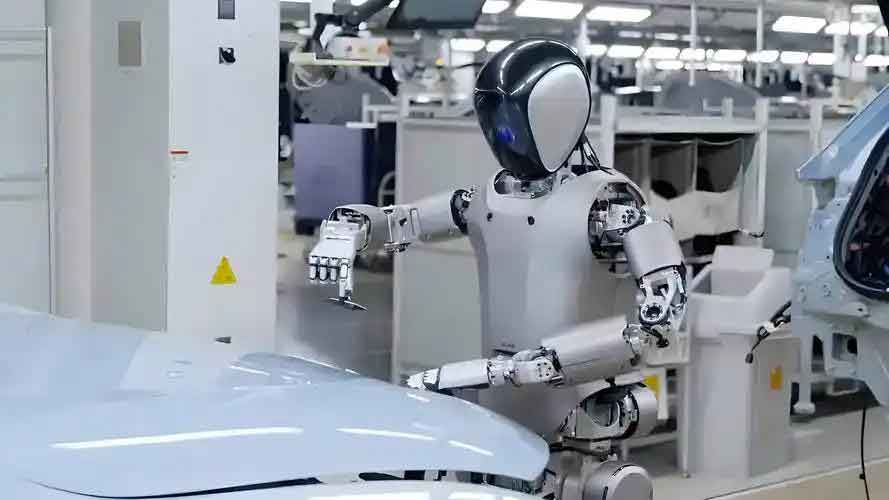
That pattern is common in automation. Early industrial robots were not general-purpose humanoid robots. They performed specific tasks in controlled environments. Over time, they became more capable, more flexible, and more integrated. Humanoid robots may follow a similar path, but with a broader ambition. Their human-like form could allow them to use tools and spaces designed for people, reducing the need to rebuild entire environments around the robot. If that advantage can be combined with acceptable cost and reliability, humanoid robots could address a wide range of tasks.
Commercialization also requires trust. A customer must believe that a humanoid robot will not damage products, injure workers, or create costly downtime. Trust is built through consistent performance, safety systems, transparent data, and service support. For humanoid robots, trust may be even more important than raw capability. A machine that is slightly slower but highly reliable may be more valuable than a faster machine that frequently fails.
6. Cost Declines Reshape the Economics of Humanoid Robots
The business case for humanoid robots is improving because costs are falling. Zhao said that the cost of humanoid robots has been declining every year. About three years ago, a robot capable of entering a factory or home might have cost more than one million yuan. Now the cost has fallen to around 100,000 yuan, and in some cases it can be below 100,000 yuan. That is a dramatic change in a relatively short period.
| Cost Area | Earlier Level | Recent Level | Change |
|---|---|---|---|
| Humanoid robots capable of entering factories and homes | More than 1 million yuan | About 100,000 yuan or below | Major decline |
| Ball screws | Price from about three years earlier | About one-tenth of that price | Fell to one-tenth |
| Reducers | Earlier price levels | At least half lower | Down at least 50% |
Component prices are a key part of the cost story. Zhao said that prices for components such as ball screws have fallen to about one-tenth of their level from roughly three years ago. Reducer prices have generally fallen by at least half. These components are critical to motion, precision, and durability in humanoid robots. When their prices fall, the total cost of a humanoid robot can fall as well.
As the scale of the humanoid robot industry expands, Zhao expects further room for cost reduction. That expectation is consistent with the logic of manufacturing learning curves. When production volumes rise, suppliers can spread fixed costs across more units. They can invest in more efficient tooling and automation. They can negotiate better prices for raw materials. They can improve yields and reduce waste. Each improvement can lower the cost of humanoid robots and make new applications economically viable.
Lower costs do not automatically create mass adoption. A humanoid robot must still deliver value. But cost reduction changes the threshold. If a humanoid robot costs more than one million yuan, only a small number of high-value applications can justify the investment. If the cost falls to around 100,000 yuan or below, many more applications become possible. In factories, warehouses, retail, hospitality, healthcare support, and eventually homes, the ROI calculation becomes more attractive.
7. Movement Control Advances, but the Industry Scores Humanoid Robots at 60
At the 2026 World Robot Conference, Zhongqing Robotics attracted significant attention with combat demonstrations. Zhao acknowledged that some capabilities, such as high-speed running, have essentially surpassed human ability. That shows that motion control for humanoid robots has reached a good level. However, he also said the industry is still far from the level he truly wants. If he had to give a score, he said the entire industry could currently receive only about 60 points.
| Capability Area | Current Status | Remaining Challenge |
|---|---|---|
| Overall movement control for humanoid robots | About 60 points | About 40 points still to improve |
| High-speed running | Generally exceeds human capability | Other capabilities remain underdeveloped |
| Fine and smooth operation | Still developing | Need greater precision and fluidity |
| Long-cycle operation | Still developing | Need error-free performance over long periods |
The remaining 40 points are not a minor detail. They concern whether humanoid robots can be more precise, more smooth, and more reliable over long periods. A humanoid robot that can run quickly may still struggle to handle delicate objects, adapt to unexpected obstacles, or operate for days without failure. For commercial and household use, those capabilities matter enormously. A factory may tolerate a robot that moves slowly, but it will not tolerate a robot that stops unexpectedly or makes repeated errors.
Zhao said that motion control for humanoid robots is far from finished. That assessment is a reminder that impressive demonstrations are only one stage of development. The public may see humanoid robots running, jumping, or fighting, but the harder work is often invisible. It involves improving actuators, sensors, control algorithms, thermal management, battery life, and failure recovery. It also involves making humanoid robots safe around people, which is especially important for home use.
The 60-point score should therefore be interpreted as a sign of both progress and opportunity. It confirms that humanoid robots have moved beyond basic mobility. It also shows that the industry has substantial technical work ahead. The companies that can close the remaining gap may be the ones that turn humanoid robots from impressive machines into dependable products.
8. Resource Allocation Shows Where Humanoid Robots Are Being Commercialized
Although Zhongqing Robotics has frequently demonstrated combat and movement capabilities, Zhao said that 80% to 90% of the company’s resources remain focused on commercial, industrial, and home application scenarios. Robot combat events account for roughly 10% of the company’s internal effort. That allocation reveals where the company believes the real long-term value lies.
| Application Area | Share of Zhongqing Robotics Resources |
|---|---|
| Commercial, industrial, and home scenarios | 80% to 90% |
| Robot combat events | About 10% |
Combat events can be useful for demonstrating motion control, balance, durability, and rapid response. They attract attention and show what humanoid robots can do in extreme conditions. But they are not the primary market. The primary market is work. Commercial and industrial customers need humanoid robots that can perform tasks, reduce costs, improve safety, or address labor shortages. Home customers need humanoid robots that can assist with daily life, provide companionship, and operate safely around family members.
The resource allocation also highlights the difference between spectacle and substance. A humanoid robot that can fight in a competition may generate headlines, but a humanoid robot that can sort packages, inspect equipment, or help a person with limited mobility may generate sustainable revenue. Zhao’s comments suggest that the industry is increasingly focused on the latter. The combat demonstrations are a showcase, while the commercial, industrial, and home scenarios are the business.
For humanoid robots, the path to scale will likely run through multiple application layers. Industrial and commercial deployments can provide early revenue, operational data, and reliability improvements. Home deployments can provide long-term volume and deeper engagement. If companies can use industrial and commercial learning to improve home robots, they may be able to shorten the timeline for household adoption. If they focus only on demonstrations, they may miss the harder but more valuable work of productization.
9. The Home Is Still the Long-Term Destination for Humanoid Robots
Zhao’s long-term view of humanoid robots remains centered on the home. He said that when he began working in the industry ten years ago, his first judgment was that humanoid robots must ultimately enter the family. Only the household market, in his view, has a high enough ceiling and a large enough market space. That belief explains why he sees the home as the ultimate destination even while current commercialization focuses on industrial and commercial use.
The household market for humanoid robots could be enormous because homes are everywhere and daily needs are continuous. A humanoid robot in the home might assist with cleaning, organizing, cooking, monitoring, elder care, child interaction, and entertainment. It might also serve as an intelligent companion that learns preferences and provides emotional support. The more capable humanoid robots become, the more roles they could play. However, the home is also the hardest environment to master because safety, trust, and personalization are essential.
Zhao suggested that future humanoid robots will not be only task-executing tools. They may gradually become intelligent partners within the family. That vision raises important questions about design, privacy, ethics, and human relationships. A humanoid robot that lives in a home will collect data, interact with vulnerable people, and influence daily routines. Those issues will need to be addressed alongside technical performance. The companies that succeed in the home market may be those that combine capability with trust.
The five-year timeline for more families using humanoid robots should be seen in this context. Early home use may be limited to specific tasks and specific households. It may begin with robots that assist with simple chores or provide companionship. Over time, as humanoid robots become safer, more capable, and less expensive, adoption could broaden. The home market will not open all at once. It will open gradually as humanoid robots prove themselves in real daily life.
10. What Must Happen Next for Humanoid Robots
The next phase for humanoid robots depends on several interconnected developments. The first is reliability. Humanoid robots must operate for long periods without frequent failures. The second is capability. They must handle a wider range of objects, environments, and tasks. The third is cost. They must become affordable enough for more customers. The fourth is safety. They must be trusted around people, especially in homes. The fifth is scale. Manufacturers must be able to produce humanoid robots in large volumes with consistent quality.
These developments are not independent. Better reliability can lead to more deployments, which can generate more data and improve capability. Improved capability can broaden the market, which can increase production volume and reduce cost. Lower cost can make humanoid robots accessible to more customers, which can further increase volume. Safety and trust can accelerate adoption by reducing regulatory and social friction. If these loops work together, the humanoid robot industry can grow rapidly. If one part lags, it can slow the entire system.
Zhao’s timeline of three years for the ChatGPT moment in embodied intelligence and five years for more families using humanoid robots implies that progress will be uneven. Some applications will mature earlier. Industrial and commercial humanoid robots may scale before home humanoid robots. Specific tasks may become reliable before general-purpose assistance. The overall market may grow quickly while individual products still face limitations. That is normal for an emerging technology.
The industry’s challenge is to avoid overpromising while still investing for the future. Humanoid robots have captured public imagination because they resemble people and can perform human-like actions. But the real test is whether they can create value in everyday settings. The companies that focus on ROI, reliability, and customer needs may be better positioned than those that focus only on impressive demonstrations.
11. Key Indicators to Watch in Humanoid Robots
For observers tracking humanoid robots, several indicators will reveal whether the industry is moving toward mass adoption. Shipment forecasts are one indicator, because they show expected demand and production capacity. Cost trends are another, because they determine the economic feasibility of humanoid robots. Component prices, such as ball screws and reducers, can signal supply chain maturity. Deployment data from factories, warehouses, and commercial spaces can show whether humanoid robots are actually working. Home adoption, even in small numbers, can show whether humanoid robots are ready for less structured environments.
| Indicator | Current Signal for Humanoid Robots | Why It Matters |
|---|---|---|
| Shipment forecasts | 2026 China forecast raised to 50,000 units; 2030 expected at 446,000 units | Shows expected demand and scaling potential |
| Revenue growth | Many companies growing 5 times or 10 times annually over the past three years | Shows early commercial traction, though from a small base |
| Cost of humanoid robots | From more than 1 million yuan to about 100,000 yuan or below | Improves ROI and expands addressable applications |
| Component prices | Ball screws fell to about one-tenth; reducers down at least half | Signals supply chain learning and scale |
| Movement control | Industry scored at about 60 points | Shows progress but also remaining reliability and precision gaps |
| Application focus | 80% to 90% of Zhongqing Robotics resources on commercial, industrial, and home use | Indicates where long-term value is expected |
The most important indicator may be deployment duration. A humanoid robot that works for an hour in a demonstration is different from a humanoid robot that works for months in a factory. Long-duration deployment tests reliability, maintainability, and integration. It also creates the data needed to improve humanoid robots. As more humanoid robots remain in service, the industry can learn faster and refine its products.
Another indicator is the range of tasks that humanoid robots can perform without custom programming. General-purpose capability is difficult, but even partial generalization can be valuable. If a humanoid robot can be moved from one sorting task to another, or from one warehouse to another, with minimal reconfiguration, its economic value increases. The ChatGPT moment for embodied intelligence would represent a step change in that kind of adaptability.
12. Conclusion: Humanoid Robots Between Demonstration and Daily Life
Humanoid robots are entering a new phase. They can run, jump, and perform certain jobs. They are attracting investment, government attention, and public interest. Costs are falling, components are becoming cheaper, and shipment forecasts are rising. Some humanoid robots are already approaching human-level efficiency and accuracy in tasks such as sorting. The industry is growing quickly, and revenue at many companies has expanded at five times or ten times annually over the past three years.
Yet the true breakout has not arrived. The industry is still at the ten-thousand-unit scale. A real mass market would require companies to produce hundreds of thousands or millions of humanoid robots per year. Movement control may deserve only about 60 points out of 100, with precision, smoothness, and long-cycle reliability still needing improvement. The home market, which has the highest long-term ceiling, remains difficult because it demands safety, adaptability, and trust.
Zhao Tongyang’s forecast places humanoid robots on a clear timeline. Within three years, embodied intelligence could reach its own “ChatGPT moment.” In about five years, more and more families could begin using humanoid robots. Those predictions do not guarantee success, but they provide a framework for the industry. The next few years will show whether humanoid robots can move from demonstration to daily life, from impressive capability to reliable service, and from early revenue growth to true mass production. If they do, humanoid robots may become one of the defining technologies of the coming decade.