
HANGZHOU, China — A collaborative engineering practice platform for embodied intelligence robotics has been built under a university-enterprise partnership led by the Polytechnic Institute of Zhejiang University and supported by Zhejiang University’s National Excellent Engineer College. The platform is designed to address major gaps in embodied intelligence robotics education, including insufficient platform support for full-chain experiments, limited resource collaboration between universities and enterprises, and weak training in real-robot engineering practice. Over nearly 3 years, the platform has developed an integrated system covering basic practical training, scientific research, and proof-of-concept validation, while also creating a project-based operating mechanism and a progressive teaching model oriented toward simulation-to-reality transfer, commonly known as Sim2Real.
The development of embodied intelligence has accelerated rapidly with advances in generative artificial intelligence and end-to-end vision-language-action control algorithms. Technologies such as ChatGPT and DeepSeek have demonstrated the potential of large models, while embodied intelligence robots are increasingly viewed as a key carrier for moving artificial intelligence from virtual spaces into the physical world. This technological shift is reshaping industrial forms and creating new demands for engineering talent. In higher education, however, experimental teaching and laboratory construction in embodied intelligence robotics still face structural challenges. Many practice platforms rely primarily on small teaching devices, making it difficult to support training across the full chain of perception, decision-making, and execution. University-enterprise resource collaboration is often shallow, with enterprise projects, industrial data, and application scenarios insufficiently integrated into teaching. Practical teaching also needs stronger support for engineering capability and technology transformation capability. These issues constrain the improvement of excellent engineering talent training in the field of embodied intelligence.
To respond to these challenges, the National Excellent Engineer College of Zhejiang University and related enterprises jointly built an engineering practice platform for embodied intelligence robots. The platform is intended to serve experimental teaching, technology research and development, engineering training, and achievement validation. It promotes a transition from knowledge transmission to comprehensive engineering practice, guided by industrial cases, robotics system capability training, and multi-link collaborative training. It also responds to the national strategic demand for artificial intelligence and the need for interdisciplinary, practical talent in embodied intelligence.
1. Platform Architecture and Hardware Resource Design
The platform was designed to overcome common problems in traditional laboratories, such as an overemphasis on theory and isolated units rather than practice and integrated systems. Its overall structure is described as “1 center and 2 platforms,” bringing together an embodied intelligence proof-of-concept center, an embodied intelligence practical training platform, and an embodied intelligence research and development platform. These three components operate collaboratively around the goal of training excellent engineers.
The practical training platform mainly undertakes practical teaching and engineering training. It provides practical results and talent support to the proof-of-concept center. The research and development platform mainly carries out key technology research and algorithm innovation. It provides technical results and algorithm support to the proof-of-concept center. The proof-of-concept center acts as the core hub, undertaking scenario testing, engineering prototype validation, and small-batch trial production. It also feeds scenario feedback, engineering problems, and demand traction back into practical teaching and research and development iteration. This forms a closed loop of practical training, research and development, validation, and feedback. The overall architecture is illustrated below.
After nearly 3 years of construction, the 3 types of platforms have clear divisions of labor and complementary functions. Together, they form a support system that combines embodied intelligence robotics practical teaching, research and development, and engineering. The platform’s software and hardware resources and teaching staff development are summarized in the following table.
| Construction dimension | Indicator name / unit | Value | Description |
|---|---|---|---|
| Site conditions | Research and experimental site area / m² | 4,000 | Indoor area |
| Platform architecture | Practical training platforms / units | 1 | Equipped with industrial robots, small 4-legged robots, wheeled robots, 3D design workstations, and 3D printers |
| Platform architecture | Research and development platforms / units | 1 | Equipped with industrial-grade 4-legged robots, wheel-legged robots, humanoid robots, and motion capture instruments |
| Platform architecture | Proof-of-concept centers / units | 1 | Conducts proof of concept, small-batch production validation, and scenario application testing |
| Instruments and equipment | Total equipment / sets | 70 | — |
| Instruments and equipment | Total equipment value | 15 million RMB | — |
| Teaching staff | Internal teachers / persons | 14 | — |
| Teaching staff | Enterprise mentors / persons | 14 | External student mentors |
| Teaching staff | Industry experts / persons | 50 | Participate in teaching and practical training guidance |
| Practical teaching support | Courses covered / courses | 9 | Supports advanced engineering cognition and practice, machine vision and its applications, artificial intelligence manufacturing technology, intelligent control technology, and other courses, totaling 9 courses |
| Practical teaching support | Open hours / hours | 1,500 | Annual average |
| Cooperation foundation | Partner enterprises / enterprises | 20 | Includes large state-owned enterprises, central enterprises, research institutes, and leading private enterprises in the industry |
The platform is functionally organized into 3 levels: teaching and practical training, scientific research and development, and proof-of-concept validation. The practical training platform is equipped with small 4-legged robots, wheeled robots, 6-axis collaborative robotic arms, and 3D printing equipment. Internal teachers and industry experts provide teaching staff and instructional guidance. It mainly serves course teaching, practical training, and competition training. The research and development platform is equipped with industrial-grade 4-legged robots, wheel-legged robots, humanoid robots, and perception equipment. Internal teachers, enterprise mentors, and industry experts provide research and project guidance. It mainly serves research and development, project training, and achievement output. The proof-of-concept center relies on the equipment conditions and technical foundation of the research and development platform, combined with application scenarios and test environments, to carry out proof of concept, application testing, and achievement transformation. Through the university-enterprise co-construction mechanism, the platform has formed a full-time and part-time teaching team composed of internal teachers, enterprise mentors, and industry experts.
2. Practical Training Platform: Building Cross-Domain Integrated Basic Skills
The practical training platform consists of a hardware foundation layer, a practical project layer, and a capability goal layer. This structure forms a progressive system from equipment configuration to project training and then to capability development.
The hardware foundation layer is equipped with industrial robots, small 4-legged robots, RGB-D depth cameras, 6-axis force/torque sensors, LiDAR, and dexterous end effectors. These devices provide hardware support for practical teaching. The practical project layer organizes teaching around robot system modeling and motion control, visual servoing system integration, admittance control and compliant operation, simultaneous localization and mapping, autonomous navigation and human following for 4-legged robots, joint debugging of typical scenario systems, and comprehensive engineering practice. The capability goal layer corresponds to the cultivation of students’ abilities in perception and control, system integration, engineering debugging, scenario realization, and cross-domain practice.
Relying on this layered system, the platform’s training content covers key technical chains from low-level joint control to high-level navigation planning. This lays a foundation in experimental skills and engineering practice for students to later carry out complex research and development. The practical training platform is therefore not merely a collection of devices. It is a structured environment in which embodied intelligence concepts are translated into hands-on engineering tasks. Students learn how perception, planning, control, and execution interact in embodied intelligence systems, and they encounter the practical constraints that appear when algorithms are deployed on physical robots.
3. Research and Development Platform: Supporting Key Technology Research for the “Brain” and “Cerebellum”
The research and development platform consists of a hardware foundation layer, a key technology research and development layer, and a scientific research capability goal layer. This structure forms a progressive system from equipment support to technology research and development and then to capability cultivation.
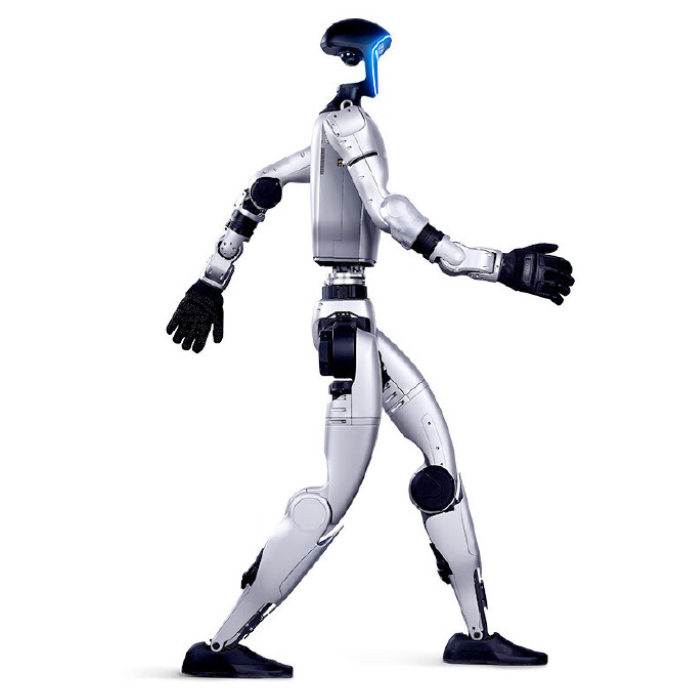
The research hardware foundation layer is equipped with “Jueying” 4-legged robots, “Shanmao” wheel-legged robots, “Wukong” humanoid robots, and high-precision motion capture and other research equipment. These provide experimental conditions for the development, testing, and validation of key algorithms in embodied intelligence.
The key technology research and development layer organizes research training and project tackling around 2 core capabilities of embodied intelligence robots: the “brain” and the “cerebellum.” The “brain” direction focuses on open-environment semantic understanding, multimodal perception and decision-making, and vision-language-action strategies. It emphasizes environment perception, task planning, and autonomous decision-making methods based on vision-language models and large language models. The “cerebellum” direction focuses on deep reinforcement learning gait generation, complex terrain adaptation, and whole-body coordinated motion control. It emphasizes high-dynamic motion control methods for robots and carries out testing and system validation.
The scientific research capability goal layer aims to cultivate students’ abilities in algorithm development, system validation, intelligent decision-making, task planning, and frontier technology research. The research and development platform thus serves as a bridge between classroom learning and engineering innovation. It allows students and researchers to work on embodied intelligence problems that require both theoretical understanding and practical system integration. The platform supports the development of algorithms that can later be transferred to the proof-of-concept center for validation under realistic and extreme conditions.
4. Proof-of-Concept Center: Middle-Test Validation and Closed-Loop Iteration for Extreme Conditions
The proof-of-concept center was built through a university-enterprise co-construction mechanism. It addresses the need for middle-test validation of embodied intelligence systems under extreme environments and complex working conditions. It forms a collaborative operation model in which enterprises provide complete machine platforms and test scenarios, while universities are responsible for algorithm research and development, system analysis, and collaborative validation. The center also promotes the transformation of validation results into teaching resources and application solutions.
The center’s operation logic follows a path of basic support, project validation, achievement output, and application feedback. The validation foundation layer relies on high-end 4-legged robots, wheel-legged robots, and other validation platforms. It combines complex environmental scenarios such as snow, sand, water wading, and high-temperature strong light with boundary working conditions such as high impact, high vibration, high load, and long-term operation. This creates a foundation for testing and performance evaluation. The enterprise side mainly provides test sites, complete machines, and engineering validation conditions. The university side mainly provides data collection, condition monitoring, performance evaluation, and problem analysis support.
The validation project layer organizes 2 types of tasks around key technology achievements formed by the embodied intelligence research and development platform: algorithm and system validation projects, and hardware and reliability validation projects. The former focuses on complex terrain perception and localization, high-dynamic motion control, multimodal perception fusion, autonomous decision-making and task execution closed loops, and complete machine joint debugging. The latter mainly targets key components such as joint motors, reducers, and perception modules, carrying out thermal attenuation, impact resistance, failure boundary, disturbance rejection performance, and long-term stability tests.
The validation output layer further forms boundary validation reports and test data, optimized system solutions, transferable key technology modules, university-enterprise collaborative project results, and practical training cases and teaching resources. These results are fed back to enterprises and universities in the application and feedback stage. For enterprises, they can be used for product performance optimization, scenario risk identification, key module validation, and engineering decision support, promoting technology tackling and achievement transformation. For universities, they can be used for research problem refinement, experimental case and course resource development, and graduate engineering practice capability training, further feeding back into the construction of the embodied intelligence practical training platform.
The proof-of-concept center continuously carries out robot joint debugging and boundary testing around typical environments such as extreme cold snow, soft sand, rain and water wading, and high-temperature strong light. This forms comprehensive validation capabilities for complex scenario adaptability, extreme working condition stability, and key module reliability, providing support for proof-of-concept project implementation and achievement application transformation.
5. Operating Mechanisms and University-Enterprise Collaboration Guarantee System
To ensure efficient platform operation and deep integration of university and enterprise resources, the center has built a systematic operating mechanism around organizational management, resource sharing, project implementation, and achievement feedback. Under bidirectional participation of universities and enterprises, the platform has formed a “dual mainline” operating framework. The first mainline uses organizational co-construction and resource sharing to build the university-enterprise collaborative relationship. The second mainline uses a project closed loop of “enterprise proposes tasks, teachers and students solve problems, solutions are validated, and achievements are fed back.” The following sections elaborate on organizational management, project operation, and achievement iteration.
5.1. Organizational Management and Two-Way Resource Sharing Mechanism
The platform has established a leading group jointly participated in by universities and enterprises. It forms a “dual-leader system” organizational structure jointly led by a university chief scientist and an enterprise chief technology officer. This realizes collaborative coordination between research orientation and industrial needs. In terms of resource allocation, enterprises open robot body low-level interfaces, industrial scenario datasets, and test environments to cooperative projects. Universities rely on experimental platforms, research equipment, and theoretical research advantages to provide technical support and research and development guarantees. Through this mechanism, the platform gradually forms a resource allocation model of collaborative sharing among multiple factors: equipment, data, scenarios, and knowledge.
This organizational design is important for embodied intelligence because the field requires both long-term scientific exploration and rapid engineering iteration. Embodied intelligence systems must operate in the physical world, where sensor noise, dynamic disturbances, hardware limitations, and real-time constraints cannot be ignored. By combining university research strengths with enterprise engineering conditions, the platform creates a setting in which embodied intelligence algorithms can be developed, tested, and refined under realistic constraints.
5.2. Problem-Driven Mechanism: Enterprise Proposes Tasks and Teachers and Students Solve Problems
The platform has built a project operation mechanism of “enterprise proposes tasks, teachers and students solve problems, solutions are validated, and achievements are fed back.” Practical training and research topics mainly come from enterprise engineering needs and key technical bottlenecks. Examples include navigation without GPS in complex industrial scenarios and fine operation of humanoid robot dexterous hands. Teacher-student teams carry out collaborative tackling under the guidance of dual mentors composed of internal mentors and enterprise mentors. They complete solution design, algorithm development, system joint debugging, and validation around the tasks. This mechanism strengthens the authenticity and engineering constraints of practical training content, enabling students to effectively improve engineering practice and technological innovation capabilities under the traction of real problems.
For embodied intelligence education, this problem-driven approach is especially valuable. It exposes students to the gap between laboratory demonstrations and industrial deployment. Students must consider reliability, maintainability, safety, and efficiency, not only algorithmic accuracy. They also learn how to communicate with enterprise mentors, understand application requirements, and convert vague industrial needs into measurable engineering tasks. The platform thus supports the development of embodied intelligence talent with both theoretical depth and practical judgment.
5.3. Achievement Feedback and Closed-Loop Iteration Mechanism
On the basis of project implementation, the platform has established an achievement feedback and continuous iteration mechanism. For algorithm models, system solutions, and engineering modules that have completed phased validation, internal mentors and enterprise mentors jointly evaluate them and propose optimization suggestions based on application scenario needs. Relevant achievements are incorporated into the enterprise test validation process to support technology iteration and scenario implementation. They are also transformed into practical training cases, course content, and research topics. This forms a closed loop in which projects originate from enterprises, research is completed on the platform, achievements are fed back to scenarios, and experience is retained in teaching. This mechanism effectively promotes the organic connection among project implementation, achievement validation, and teaching transformation.
The closed-loop feedback mechanism also strengthens the sustainability of the platform. Each project does not end with a single demonstration. Instead, its results become inputs for future teaching and research. Problems encountered in the field become new research questions. Successful methods become reusable teaching cases. Failed attempts become valuable lessons for risk identification. In this way, the platform continuously accumulates embodied intelligence knowledge and engineering experience.
6. Sim2Real-Oriented Practical Teaching Organization Model
To solve problems in embodied intelligence system development, such as high trial-and-error costs, high risk of equipment damage, and difficulty in transferring simulation results to real machines, the platform relies on a computing cluster composed of GPU servers, parallel computing nodes, and data storage systems, as well as a virtual simulation platform centered on Isaac Sim, Gazebo, and MuJoCo. It has built a progressive practical teaching organization model oriented toward simulation-to-reality transfer, or Sim2Real. In teaching implementation, the model is divided into 3 stages: basic training, comprehensive training, and engineering validation. It also runs through a continuous improvement closed loop of data feedback and iterative optimization. This forms a complete practical teaching path from virtual simulation to system integration and then to engineering scenario validation.
6.1. Basic Training Stage: Algorithm Introduction and System Cognition in Virtual Simulation Environments
The basic training stage aims to cultivate students’ system cognition and basic development capabilities in a low-cost, low-risk manner. In virtual simulation environments, students call robot unified robot description format models and scenario resources provided by the platform. They carry out algorithm training in laser SLAM mapping and localization, global and local path planning, and dynamic obstacle avoidance. By adjusting physical parameters, sensor configurations, and control strategies, students can quickly complete preliminary validation of algorithm logic. They understand the basic relationships among robot motion control, environmental perception, and task execution, consolidating their foundation in low-level control and system development.
This stage is particularly important for embodied intelligence because it allows students to explore the consequences of design choices without risking expensive hardware. They can test how changes in sensor noise, terrain friction, or control gains affect robot behavior. They can also learn the structure of embodied intelligence systems before moving to physical robots. The virtual environment provides a safe space for repeated experimentation, which is essential for building intuition about embodied intelligence.
6.2. Comprehensive Training Stage: System Integration and Decision Development for Embodied Intelligence
After completing basic capability training, teaching enters the stage of system integration and upper-level decision development. This stage is organized around the perception, understanding, planning, and execution chain of embodied intelligence robots. Students use multimodal large models, vision-language-action models, and other methods to carry out integrated development of perception modules, semantic understanding modules, and task planning modules. Through environment understanding, task decomposition, and behavior decision training under open instructions, students gradually develop the ability to expand from single control algorithm development to embodied autonomous intelligent system design.
This stage reflects the core challenge of embodied intelligence: integrating multiple modules into a coherent system that can act in the real world. Students must not only write algorithms but also define interfaces, manage data flows, handle uncertainty, and evaluate system-level performance. They learn how language, vision, and action can be connected in embodied intelligence systems. They also confront the limitations of current models and the need for engineering trade-offs. The comprehensive training stage thus bridges basic simulation skills and full real-robot validation.
6.3. Engineering Verification Stage: Sim2Real Transfer and Joint Debugging in Engineering Scenarios
In the engineering verification stage, students rely on 4-legged, wheel-legged, and other robot prototypes provided by the platform. They combine domain randomization and other Sim2Real transfer methods to deploy policy models trained in simulation environments onto physical prototypes. They then carry out joint debugging and validation in engineering scenarios. Training content includes outdoor unstructured terrain traversal, simulated substation inspection scenario operations, and motion and perception collaborative testing in complex obstacle environments. Through task execution and system joint debugging in engineering scenarios, students can intuitively understand the differences between simulation environments and real machine systems in dynamics, sensor noise, latency, and environmental disturbances. They improve their engineering debugging and system optimization capabilities.
This stage is where embodied intelligence becomes most concrete. Students observe how a policy that performs well in simulation may fail on hardware because of unmodeled dynamics, communication delays, or sensor degradation. They learn to diagnose these failures and to adjust models, controllers, and system architectures. The engineering verification stage also exposes students to the practical realities of deploying embodied intelligence in industrial and outdoor environments, including safety, reliability, and maintenance considerations.
6.4. Continuous Improvement Teaching Loop: Data Feedback and Iterative Optimization
During engineering scenario validation, the platform collects real-time operation data such as joint torque, posture deviation, and perception latency. Through comparative analysis of real machine and simulation data, differences between the simulation model and the real system can be identified. Control parameters, perception models, and task strategies are then iteratively optimized accordingly. Typical problems, parameter tuning methods, and system optimization experience formed during validation are organized into standardized teaching cases and added to subsequent simulation training and comprehensive practical training. This forms a continuous optimization closed loop of “training implementation, engineering verification, data feedback, and iterative improvement.”
This teaching model expands embodied intelligence robotics experimental teaching from single algorithm training to a progressive engineering practice process that connects simulation training, system integration, validation, and feedback optimization. It builds a practical teaching system guided by real problems, supported by engineering scenarios, and centered on capability progression. The model also supports the accumulation of embodied intelligence teaching resources. As more projects are completed, the platform can reuse validated cases, data sets, and debugging methods, improving the efficiency and quality of future training.
7. Construction Results and Application Demonstration
Over the past 3 years, the platform has achieved phased results in experimental teaching, teaching reform, research organization, achievement transformation, and social service. These results indicate that the university-enterprise collaborative construction model has good implementation effects in resource integration, practical education, and technology transformation. The platform’s operating results are summarized in the following table.
| Result category | Indicator name / unit | Value | Support carrier | Description |
|---|---|---|---|---|
| Teaching support | Students served / person-times | 1,000 | Practical training platform | Annual average |
| Teaching support | Practical training projects / projects | 24 | Practical training platform | Includes basic robot skill operation, motion control experiments, environmental perception, autonomous navigation, human following, system integration training, and scenario task validation |
| Teaching reform | Course achievements / courses | 2 | Practical training platform | Provincial excellent graduate courses |
| Teaching reform | Teaching reform projects / projects | 2 | Practical training platform | Provincial level |
| Research output | Papers / papers | 30 | Research and development platform | — |
| Research output | Patents / patents | 15 | Research and development platform | Applications filed |
| Research output | Standards / standards | 1 | Research and development platform | — |
| Research output | Research projects / projects | 20 | Research and development platform | Includes major projects |
| Innovation competition | Competition awards / awards | 8 | Research and development platform | Provincial level or above |
| Achievement transformation | Proof-of-concept projects / projects | 3 | Proof-of-concept center | — |
| Social service | Visitors received / person-times | 1,200 | Proof-of-concept center | Annual average |
| Comprehensive impact | Provincial and ministerial awards or above / awards | 1 | Research and development platform, proof-of-concept center | Zhejiang Provincial Science and Technology Progress First Prize |
7.1. Improved Experimental Teaching Support and Talent Training Results
Since its completion, the platform has served more than 1,000 students from inside and outside the university each year on average. It stably supports the operation of 24 comprehensive experimental projects and has formed a practical teaching support system covering basic training, comprehensive training, and engineering validation. Relying on the joint university-enterprise construction mechanism, the platform has established a diversified mentor team and invited nearly 100 frontline industry experts to participate in course teaching, project guidance, and engineering practice training. This enhances the connection between practical teaching and industrial needs.
Courses opened on the platform, such as Intelligent Industrial Robots and Advanced Engineering Cognition and Practice, were selected as provincial excellent graduate courses. The platform also approved 2 provincial teaching reform projects. Through project training and competition practice, students’ abilities in complex engineering problem analysis, system integration development, and engineering scenario debugging have been improved. In recent years, student teams supported by the platform have won 8 awards in competitions such as the Unmanned Ground Systems Challenge and the Zhongguancun Bionic Robot Competition.
These results show that embodied intelligence education benefits from sustained platform support. Embodied intelligence is not a purely theoretical subject. It requires students to build, test, and debug physical systems. The platform provides the infrastructure and mentorship needed for this kind of learning. It also creates opportunities for students to work on real problems that matter to industry.
7.2. Research Output and Achievement Transformation Results
Around directions such as robot perception, decision-making, and control, the platform has continuously supported research tackling and technology validation. In recent years, the platform has supported the formation of 30 papers, 15 patent applications, and 1 group standard. It has cumulatively supported 20 research projects, including National Key Research and Development Program projects and major national defense special projects. This has provided good support for research organization and student research training.
The platform has implemented 3 proof-of-concept projects, promoting the extension of some research results from laboratory validation to engineering applications. The platform team led the drafting of the Technical Standard for Quadruped Robot Inspection in Industrial Scenarios. Related results won the Zhejiang Provincial Science and Technology Progress First Prize. This reflects the platform’s comprehensive effectiveness in technology tackling, standardization work, and achievement transformation.
For embodied intelligence, this combination of research and transformation is essential. Advances in embodied intelligence often depend on iterative cycles between algorithm development and physical testing. The platform enables these cycles by providing both research equipment and real-world validation environments. It also helps researchers identify which laboratory results are ready for industrial application and which require further development.
7.3. Industry Demonstration and Social Service Results
Relying on the industry-education integration foundation in the field of embodied intelligence, the platform carries out achievement displays, technical exchanges, and practical training for governments, universities, and enterprises. It has gradually formed an industry demonstration effect. In recent years, the platform has continuously served large state-owned enterprises, central enterprises, and regional technology-based enterprises. It receives more than 1,200 visiting delegations each year on average. It has played a demonstrative role in embodied intelligence robotics practical teaching platform construction, engineering case display, and university-enterprise collaborative education.
The platform’s social service role also extends beyond demonstration. It provides a meeting point for industry and academia to discuss embodied intelligence challenges. Enterprises can present real needs. Universities can present research capabilities. Students can see how their training connects to industrial practice. This kind of interaction supports the development of an embodied intelligence ecosystem in which education, research, and application reinforce one another.
8. Existing Problems and Improvement Directions
The platform’s operation has achieved phased results, but some problems remain in deepening industry-education integration and improving sustainable operation capability.
The first problem is that goal orientation in university-enterprise collaboration still needs further unification. Universities focus on theoretical research, academic output, and talent training, while enterprises focus more on system stability, development efficiency, and application implementation. At present, the teacher evaluation system does not sufficiently recognize process-oriented engineering investment such as platform construction, system joint debugging, and engineering guidance. This affects teachers’ enthusiasm for continuous participation in practical teaching.
The second problem is that the mechanism for accumulating and transforming engineering practice experience still needs improvement. The platform accumulates a large amount of engineering experience in debugging, system integration, and project tackling, such as parameter tuning, typical fault handling, and hardware debugging specifications. However, related content has not yet been systematically retained as standardized cases and teaching resources. This is not conducive to experience reuse and knowledge accumulation.
To address these issues, the platform will continue to advance from 3 aspects: organizational mechanism, resource construction, and collaborative ecology. First, it will explore a teacher evaluation and incentive mechanism oriented toward industry-education integration practice, increasing the recognition of engineering teaching investment in assessment. Second, it will accelerate the construction of a standardized engineering case library, experimental project packages, and industrial data resources, promoting the transformation of engineering experience into shared teaching resources. Third, it will improve the mechanisms for university-enterprise collaboration, resource sharing, and achievement transformation, enhancing the platform’s high-quality and sustainable operation capability.
These improvement directions are closely related to the long-term development of embodied intelligence education. Embodied intelligence is a fast-moving field, and teaching content must be continuously updated. Industry needs change, hardware platforms evolve, and algorithms advance. A sustainable platform must therefore be able to absorb new knowledge, retain practical experience, and share resources across partners. The proposed improvements aim to strengthen these capabilities and to ensure that the platform remains useful for future cohorts of students and research projects.
9. Conclusion
With the rapid development of embodied intelligence robotics technology, experimental teaching in universities has placed higher demands on platform support capability, engineering scenario coverage, and collaborative education mechanisms. The National Excellent Engineer College of Zhejiang University, together with industry and enterprises, jointly built an engineering practice platform for embodied intelligence robots. It constructed a practical teaching architecture of “1 center and 2 platforms” and formed a progressive practical teaching model oriented toward Sim2Real. This effectively connects theoretical teaching, system development, and complex engineering practice.
Practice shows that under the background of new engineering, the construction of experimental teaching platforms should not be limited to the expansion of space and equipment. Instead, it should face engineering problems and coordinate platform co-construction, project traction, dual-teacher collaboration, and mechanism guarantees. This forms a practical education system that balances teaching, research, and industrial needs. The exploration provides a reference for experimental teaching reform and industry-education integration platform construction in artificial intelligence, robotics, and related interdisciplinary fields.
The platform’s experience suggests that embodied intelligence education requires more than isolated courses or short-term projects. It requires an integrated environment where students can repeatedly move between simulation and reality, where enterprises can contribute real scenarios and data, and where research results can be validated and transformed. By combining practical training, research and development, and proof-of-concept validation, the platform creates a continuous pipeline from learning to innovation. This pipeline supports the cultivation of engineers who understand both the theoretical foundations of embodied intelligence and the practical realities of deploying embodied intelligence systems in the physical world.