
In 2026, the humanoid robot has moved from the edge of technology exhibitions into the center of industrial strategy. The shift is being driven by embodied intelligence, a field that connects artificial intelligence with physical action, allowing machines to perceive, decide, move, and work in real environments. The humanoid robot is no longer merely a symbol of technical ambition. It is becoming a platform for manufacturing, logistics, hospitality, elderly care, and public services. Cities are competing to attract companies, talent, capital, and application scenarios, but the emerging consensus is that no single city can dominate every link of the humanoid robot value chain. The more practical route is complementarity: technology sources working with application markets, research centers working with factories, and component suppliers working with system integrators.
China has become the most active manufacturing and application market for the humanoid robot. In the first half of 2026, shipments of the humanoid robot in China exceeded 40,000 units. Full-year unit production is expected to surpass 100,000 units, and China’s share of global humanoid robot output is expected to rise to 97 percent. Those figures reflect both the speed of product iteration and the scale of industrial deployment. They also explain why local governments are moving quickly. Hunan Province issued its implementation opinions on accelerating the intelligent robot industry in August 2026, emphasizing differentiated regional development and coordinated industrial capacity. Changsha is positioned as the province’s technology source and innovation leader for intelligent robots. The question is no longer whether Changsha should enter the humanoid robot race, but how it can build an ecosystem that turns scientific strength, manufacturing depth, and consumer markets into durable industrial advantage.
A cross-regional review of Shanghai and Changsha offers a useful lens. Shanghai concentrates research institutions, talent, capital, and high-density supply chains. Changsha offers large-scale manufacturing scenarios, engineering machinery, consumer markets, and a growing cluster of specialized robot companies. The two cities are not rivals in a zero-sum contest. They are potential partners in a longer value chain. For the humanoid robot, the decisive competition is not only about a single algorithm or a single component. It is about ecosystem density, scenario access, data circulation, talent supply, capital patience, and the ability to move from prototypes to repeatable products. The experience of Shanghai’s Zhangjiang Robot Valley, Jinqiao, and several leading companies shows how proximity can accelerate innovation. The experience of Changsha’s manufacturers and robot firms shows how real-world industrial pain points can become the starting point for globally competitive products.
1. A New Industrial Race Takes Shape Around the Humanoid Robot
The humanoid robot has changed rapidly. Earlier generations could repeat fixed motions with limited perception. Current systems can run, jump, avoid obstacles, fold clothes, prepare drinks, transfer materials, and work in teams. In sports tests, robot performance has begun to exceed human records in selected events. In factories, some humanoid robot systems operate for long hours without interruption. In hotels and restaurants, service robots handle delivery, cleaning, and guest support. In elderly care, robotic systems are being tested for companionship, monitoring, and daily assistance. These applications do not mean that the humanoid robot has solved every technical problem. They do mean that the market is beginning to see credible use cases, measurable returns, and repeatable deployment paths.
Capital has noticed. Investors are looking beyond demonstration videos and asking about unit economics, reliability, maintenance, data collection, and supply-chain maturity. Local governments are also asking sharper questions. They want to know which parts of the humanoid robot value chain can be localized, which scenarios can be opened first, and which companies can become chain leaders. The humanoid robot is therefore not only a technology story. It is an industrial policy story, a talent story, and a regional coordination story. The cities that succeed will be those that can connect research to production, production to scenarios, and scenarios to data. That data, in turn, must feed back into models, components, and system design.
Hunan’s policy direction reflects this understanding. The province has emphasized regional differentiation rather than homogeneous competition. Changsha is expected to serve as the technology source and innovation leader, while other areas can focus on manufacturing, components, testing, and application deployment. The humanoid robot ecosystem requires many specialized capabilities: actuators, reducers, sensors, vision systems, motion control, operating systems, large models, simulation platforms, safety certification, and after-sales service. No city can excel in all of them at once. The more realistic strategy is to identify strengths, fill critical gaps, and connect to national and global resources. For Changsha, the strongest assets are not abstract ambitions. They are concrete industrial scenarios, a deep manufacturing base, and a growing group of companies that already sell robotic products in demanding environments.
The humanoid robot also creates a new test for urban industrial policy. Subsidies and land incentives can attract projects, but they cannot by themselves build an ecosystem. Companies need customers, test beds, data, standards, talent, and suppliers. They need fast iteration cycles. They need a regulatory environment that allows controlled experimentation while protecting safety. They need public platforms that reduce the cost of testing and validation. The humanoid robot is a complex system product, so the quality of the surrounding ecosystem matters as much as the quality of a single firm. That is why the experience of Shanghai’s high-density clusters is relevant, and why Changsha’s scenario depth is equally important.
2. Shanghai’s Ecosystem Density Turns Proximity Into Speed
Shanghai is one of China’s leading sources of embodied intelligence innovation. Its advantage is not only the presence of research universities and technology companies. It is the density of the cluster. In Zhangjiang Robot Valley, more than 100 embodied intelligence companies are gathered in close proximity. The exhibition area covers nearly 2,000 square meters and displays live robot operation data, supply-chain mapping, and application demonstrations. The humanoid robot is presented not as an isolated product but as the visible tip of a complex industrial system. Components, software, testing, data services, and integration are all part of the same local network.
A robot named Lingxi offers a practical illustration of how far interaction has progressed. Lingxi is 1.3 meters tall, weighs 27 kilograms, and has joints that can rotate 360 degrees. It can dance, run, answer questions quickly, and interact with visitors in a natural style. Such demonstrations are often dismissed as marketing, but they reveal progress in perception, motion control, speech interaction, and system integration. The humanoid robot must operate in human spaces, which means it must understand human commands, navigate cluttered environments, and respond safely. The ability to perform these tasks in a public exhibition setting is a small but meaningful signal of maturity.
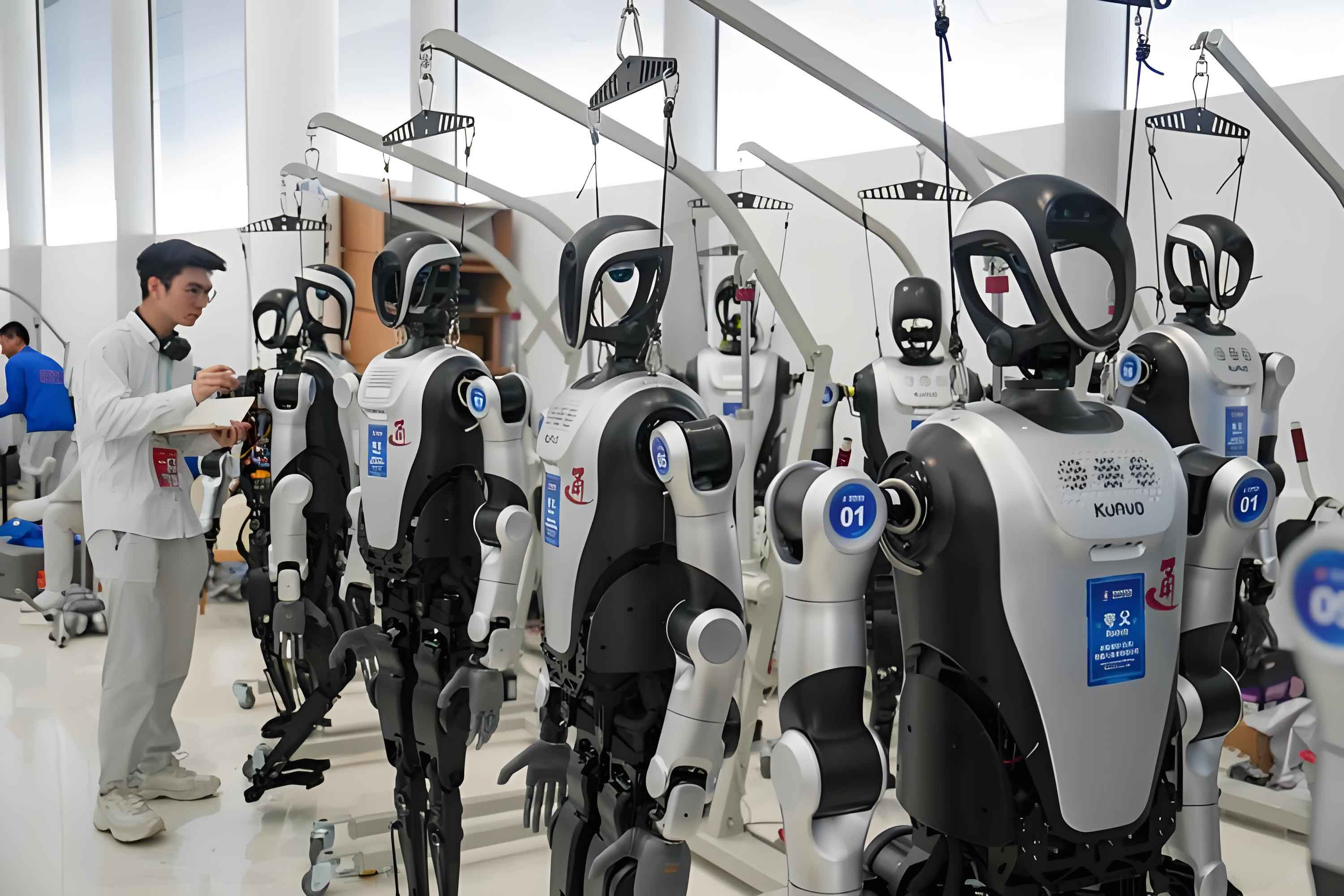
The more important lesson from Zhangjiang is the speed created by proximity. The local supply-chain platform is designed to achieve one-day matching, three-day prototyping, and one-week trial production. That kind of response time changes the economics of innovation. When engineers can meet face to face, when a missing component can be sourced nearby, and when a test can be scheduled quickly, the cost of failure falls. The humanoid robot development process involves thousands of small iterations. Faster iteration means faster learning. Faster learning means better products. The cluster therefore creates a compounding advantage that is difficult to replicate through isolated incentives.
Zhangjiang also benefits from shared testing infrastructure. The National and Local Joint Humanoid Robot Innovation Center, operated by a humanoid robot company, has opened heterogeneous training grounds to upstream and downstream enterprises. Companies can conduct product testing, precision validation, data collection, and simulation training in shared facilities. This reduces the capital burden on individual firms and accelerates the creation of common standards. The humanoid robot industry needs such platforms because real-world data is expensive to collect and difficult to standardize. Shared facilities can improve data quality, safety, and comparability. They can also help smaller companies participate in the ecosystem without building every capability in-house.
The density of Shanghai’s cluster does not mean that every company should do everything. It means that specialization can thrive. A firm can focus on vision, another on dexterous hands, another on reducers, another on motion planning, and another on complete systems. The humanoid robot is a system of systems. Its performance depends on the integration of mechanical design, electronics, control software, artificial intelligence, and application knowledge. A dense cluster allows each specialist to improve its module while relying on partners for complementary capabilities. That is why the phrase “upstairs and downstairs are upstream and downstream” captures more than convenience. It describes a production model in which collaboration is built into the physical layout of the district.
| Indicator | Reported figure | Relevance to the humanoid robot ecosystem |
|---|---|---|
| China humanoid robot shipments, first half of 2026 | More than 40,000 units | Shows early commercial scale for the humanoid robot |
| China full-year humanoid robot unit production expectation, 2026 | More than 100,000 units | Signals rapid capacity expansion |
| China’s expected share of global humanoid robot output | 97 percent | Reflects manufacturing concentration |
| Zhangjiang Robot Valley embodied intelligence companies | More than 100 | Demonstrates cluster density |
| Zhangjiang supply-chain response target | One-day matching, three-day prototyping, one-week trial production | Compresses the humanoid robot iteration cycle |
| Qinglang service robot deployment | More than 100,000 units in over 70 countries and 600 cities | Shows commercial service experience relevant to the humanoid robot |
| VisionBit steel-plate sorting market position | More than 80 percent domestic market share | Illustrates scenario-specific leadership |
| Changsha humanoid robot-related enterprises | More than 300 | Indicates an emerging local ecosystem |
| Zoomlion five-year embodied robot deployment plan | 1,000 to 2,000 units | Provides a large industrial testbed for the humanoid robot |
The Shanghai model also shows that the humanoid robot cluster must be connected to national and global markets. Local density is useful, but it is not sufficient. Companies in Zhangjiang are already thinking about cross-regional partnerships. They understand that Shanghai can serve as a technology source while other regions provide manufacturing scale, application scenarios, and market access. This is a more mature view than simply seeking to keep every part of the value chain inside one city. The humanoid robot industry is too broad for that. The winners will be those that build strong nodes in a wider network.
3. Commercial Service and Industrial Scenarios Define the Humanoid Robot Business Case
Shanghai’s Qinglang Intelligent Technology offers a grounded view of how service robots create value. The company began 16 years ago in a 70-square-meter unfinished space with RMB 200,000 in starting capital. It has grown into a leading commercial service robot company with more than 100,000 units shipped and operations in more than 70 countries and 600 cities. Its experience matters for the humanoid robot because it shows how service scenarios can be standardized, scaled, and exported. The company’s laboratory functions as a robot school. Wheeled robots pick up dirty laundry and transport supplies. A general-purpose humanoid robot identifies clothing, folds it, and supports laundry workflows. Engineers record data and adjust parameters alongside the machines.
This approach reflects a practical philosophy. The humanoid robot does not need to replace every task at once. It can be introduced where the task is repetitive, physically demanding, or difficult to staff. Hotels, restaurants, hospitals, and elderly care facilities offer structured environments with clear service processes. They also generate large amounts of operational data. That data can be used to improve perception, manipulation, and scheduling. Qinglang’s leaders see Hunan’s tourism, catering, hotel, and elderly care markets as highly compatible with the company’s core business. The humanoid robot can therefore enter through service scenarios that already have demand, rather than waiting for a perfect general-purpose machine.
Siasun, based in Shanghai’s Jinqiao area, presents a different but equally important path. The company released China’s first collaborative robot in 2015 and its first dual-arm collaborative robot in 2016. In 2019, its robots appeared on a national celebration float and played music with children. Siasun’s leadership argues that the correct framing is not “robot plus industry” but “industry plus robot.” The starting point should be the problem that industry needs to solve. If a task is dangerous, repetitive, or beyond human endurance, then the humanoid robot or a specialized robotic system should be designed around that task. This user-driven approach is more likely to produce reliable products than a technology push that begins with a robot and then searches for a market.
Siasun has focused on the semiconductor supply chain, where stability, precision, and自主可控 are essential. The company spent six years on research and validation and obtained strict TUV functional safety certification. Its core components and operating system are fully self-developed. This level of vertical integration is difficult and expensive, but it creates defensibility in high-end industrial markets. The humanoid robot can learn from this experience. In industrial settings, safety certification, reliability, and maintainability are not secondary features. They are entry requirements. A humanoid robot that cannot operate safely alongside workers or maintain precision over long periods will not be adopted, regardless of how impressive its demonstration videos are.
Siasun’s leadership sees Hunan as a strong application market. The proposed link between Shanghai and Hunan is not simply a transfer of machines. It is a connection between technology sources and application scenarios. Shanghai can generate new technologies and business models. Hunan can provide markets, test beds, and engineering feedback. Capital and information can flow in both directions. Siasun also aims to become a platform company that links application scenarios with new technologies and ecosystem partners. That platform logic is important for the humanoid robot. No single company can solve all integration challenges. A platform can connect component suppliers, software developers, system integrators, and end users. It can also reduce the cost of customization and accelerate deployment.
4. Changsha’s Manufacturing Base Provides a Distinctive Humanoid Robot Testbed
Changsha’s strongest advantage is not a slogan. It is the depth of its manufacturing base. In a Sany heavy-industry workshop, VisionBit has deployed an intelligent steel-plate cutting, sorting, and palletizing line. Robotic arms equipped with high-precision 3D vision systems identify, grasp, cut, classify, and stack irregular steel parts. The process runs without human intervention. This is a demanding environment for any robot. Steel parts vary in shape, weight, and surface conditions. The system must perceive accurately, plan grasps, avoid collisions, and maintain throughput. VisionBit’s solution was launched globally in 2019 and became the company’s seed product. It now holds more than 80 percent of the domestic market for steel-plate sorting equipment and has accumulated more than RMB 600 million in sales.
VisionBit’s growth illustrates how Changsha’s industrial scenarios can nurture a humanoid robot ecosystem. The company started with a concrete pain point in heavy manufacturing. It did not begin with a general-purpose humanoid robot. It began with a specific task that required vision, manipulation, and system integration. Over time, those capabilities can be extended. In 2026, VisionBit introduced a bipedal walking welding robot designed for complex construction sites. The system breaks the limits of fixed workstations and is expected to enter shipyard training during the year. This is a clear example of scenario-driven evolution. The humanoid robot form factor becomes useful when the environment demands mobility, adaptability, and human-like reach.
VisionBit was incubated with support from Changsha’s Liuzhi Action program, which provided RMB 200,000 in early funding. The amount was modest, but the timing and trust mattered. The company has since become a national-level specialized and innovative “little giant” enterprise and has the potential to become a local chain leader in embodied intelligence. Its structure is also instructive. The headquarters is in Changsha, where the company focuses on scenario deployment, engineering iteration, and industrial scale. A research center in Shanghai’s robot industrial park focuses on frontier algorithms and intelligent control. The company also has branches in multiple domestic and international locations. This creates a model in which Shanghai supports advanced research, Hunan supports engineering deployment, and global markets support growth.
The Shanghai research center has only 30 to 40 people, but a significant share are graduate researchers from leading universities. Competition for top talent in Shanghai is intense, with doctoral-level specialists in high demand. For VisionBit, the center is a talent bridge. It allows the company to access algorithm and control expertise that is scarce in the local market. At the same time, Changsha offers advantages that Shanghai cannot easily match: rich industrial conditions, lower engineering costs, and direct access to large manufacturing customers. The challenge is to strengthen the local talent pool in high-end algorithms and frontier robotics, attract more science and technology capital, and support promising embodied intelligence companies with a complete ecosystem.
VisionBit’s leadership has recommended that Changsha focus on cultivating benchmark chain-leader companies. A strong chain leader can attract upstream and downstream suppliers, form a closed-loop industrial cluster, and retain more of the industrial value locally. The company completed a B++ financing round in the hundred-million-yuan range in June 2026, with participation from a national SME Hunan sub-fund and a Changsha municipal investment vehicle. The investment signals local commitment to supporting homegrown robot companies. For the humanoid robot, such financial backing is important because product cycles are long, certification is costly, and customer validation takes time. Patient capital is a competitive advantage.
Changsha is also home to large enterprises that have already entered the intelligent robot race. Lens Technology and Zoomlion have made early布局 in intelligent manufacturing and robotics. At the 2026 World Robot Conference in Beijing, Zoomlion displayed a bipedal humanoid robot, a wheeled robot, a quadruped robot dog, and self-developed joint modules. The products attracted attention for their stable performance and flexible motion. Zoomlion has accumulated more than ten years of industrial scenario data, and a group of humanoid robot systems is being trained on production lines. The company acknowledges that the humanoid robot’s single-unit work efficiency has not yet fully surpassed human workers. However, continuous operation for 22 hours can replace hazardous, heavy, and repetitive jobs. Industrial scenarios are expected to reach scale within three years.
Zoomlion’s humanoid robot factory is scheduled to be completed and put into operation by the end of 2026. The company plans to deploy 1,000 to 2,000 embodied intelligence robots in its Smart Industrial City over the next five years. This is a significant commitment. It provides the humanoid robot supply chain with a real customer, a real production environment, and a real data stream. Changsha’s elderly care and livelihood scenarios also create long-term space for service robots. The combination of industrial and consumer scenarios is a distinctive advantage. It allows the humanoid robot to be tested in demanding factory conditions while also learning from human-centered service environments.
5. The Local Ecosystem Is Forming but Critical Gaps Remain
According to an innovation map compiled by the Changsha Productivity Promotion Center, Changsha has more than 300 humanoid robot-related enterprises. The city has begun to form a collaborative ecosystem covering “eyes, brain, and hands,” meaning perception, decision-making, and manipulation. Hunan Xiangjiang New Area, Changsha Economic and Technological Development Zone, Yuhua Economic Development Zone, Liuyang Economic Development Zone, and Wangcheng Economic Development Zone are among the core carrying areas. This distribution reflects the city’s industrial geography. Different zones have different strengths in manufacturing, electronics, software, and application scenarios. If these strengths are coordinated, they can support a broader humanoid robot supply chain.
However, the ecosystem still has bottlenecks. Core links lag behind industry leaders, and the city lacks a chain-leader company with strong ecosystem influence. This is a common challenge in emerging industries. Many companies can develop individual modules or solutions, but few can integrate the full system, set standards, and coordinate suppliers. The humanoid robot requires exactly that kind of integration. Without a chain leader, local companies may remain fragmented. They may sell components to external integrators rather than capturing more value locally. They may also struggle to access large-scale testing data and customer feedback. Changsha has responded by establishing service task forces for quasi-chain-leader companies and increasing support for land, financing, listing, and talent. The policy direction is correct, but execution will determine the outcome.
The humanoid robot ecosystem also needs a stronger public testing and data infrastructure. Real-world data collection is expensive. Factories are reluctant to open production lines to untested robots. Safety and reliability requirements are high. A shared platform can reduce these barriers. It can provide controlled environments for testing, standardize data formats, and validate safety protocols. It can also help smaller companies demonstrate their products to large customers. Shanghai’s shared training grounds offer a useful reference. Changsha can build similar platforms around its strongest scenarios: engineering machinery, automotive parts, electronics, food processing, hotels, hospitals, and elderly care. Each scenario generates different data and requires different performance standards. A portfolio of test beds would be more valuable than a single generic facility.
6. From Competition to Complementarity in the Humanoid Robot Economy
The most important lesson from the cross-regional review is that the humanoid robot industry is still in an early stage. The technical route is not fixed. The business model is not settled. The winning applications are not fully known. This creates a window of opportunity, but it also creates a risk of wasteful competition. If every district tries to build the same full-stack cluster, resources will be spread too thin. If every city tries to attract the same handful of companies, incentives will escalate without producing durable capacity. The more effective approach is to build differentiated nodes and connect them into a regional industrial belt. Each area can play to its strengths. Together, they can form a more complete ecosystem.
Shanghai and Hunan illustrate this logic. Shanghai is a technology source. It has universities, research institutes, talent, capital, and dense supplier networks. Hunan is an application market and engineering base. It has large manufacturing enterprises, real production scenarios, lower engineering costs, and growing consumer demand. The two sides can form a “source plus carrier” relationship. Shanghai can generate new technologies and business models. Hunan can test, refine, and scale them. Data and feedback can flow back to Shanghai. Capital and talent can flow in both directions. This is not a one-way transfer. It is a mutual reinforcement of innovation and deployment.
Scenarios are the best investment promotion tool for the humanoid robot. Companies are not looking for generic support. They are looking for customers with real problems, data access, and a willingness to co-develop. The most successful robot companies focus on a narrow scenario first, build a benchmark, and then generalize. Qinglang began with commercial service. Siasun began with collaborative industrial robots and semiconductor applications. VisionBit began with steel-plate sorting. Each company built depth before breadth. Changsha can apply the same logic. Instead of asking what kind of humanoid robot the city can build, it should ask which local industries are willing to open their pain points, data, and test beds. Those industries can become the launch customers for a local humanoid robot ecosystem.
Government can play a catalytic role by organizing demand. It can encourage core manufacturing enterprises to open selected scenarios and data to qualified robot companies. It can create common standards for safety, interoperability, and data exchange. It can fund shared testing platforms and certification support. It can also use public procurement to create initial markets for promising products. These measures are more useful than scattered subsidies because they reduce the uncertainty that prevents companies from investing. The humanoid robot needs real deployment to improve. Real deployment requires trust. Trust can be built through transparent testing, shared standards, and successful reference cases.
Talent and the soft environment are long-term competitiveness factors. VisionBit’s early experience with Liuzhi Action shows that timely support can build trust. The amount was small, but the signal was important. Changsha can deepen cooperation with the National University of Defense Technology, Central South University, Hunan University, and other local institutions. It can create long-cycle evaluation and fault-tolerance mechanisms that fit the nature of frontier research. The humanoid robot requires researchers who can work across mechanics, electronics, control, perception, and artificial intelligence. It also requires engineers who understand factory floors, service workflows, and safety standards. A talent strategy must therefore combine university research with industrial training. It must attract senior talent while also building a pipeline of young engineers.
Chain leaders and global market access are also essential. A leading company or a major research center can anchor the ecosystem. It can set technical requirements, train suppliers, and create a demand pool. Changsha should continue to attract leading humanoid robot companies and their research centers. It should also support local quasi-chain leaders with dedicated service teams. The issues that matter most are land, financing, listing, talent, and market access. These are practical bottlenecks, not abstract policy goals. At the same time, local companies must think globally. Qinglang sells to more than 70 countries. Siasun’s overseas orders exceed 20 percent and are growing. VisionBit is building a global market system. The humanoid robot is a global product category. Local deployment must be connected to national resources and international markets.
7. A Humanoid Robot Strategy With Local Character and Global Ambition
The emerging humanoid robot economy does not require every city to become a copy of Shanghai, Beijing, or Shenzhen. Changsha does not need to compete on general-purpose large models or try to match every core component supplier in the Yangtze River Delta. It can build on its own strengths. Engineering machinery offers complex, high-value scenarios for mobility, manipulation, and safety. Consumer markets offer hotels, restaurants, retail, healthcare, and elderly care. Cultural and media resources offer opportunities for human-robot interaction, entertainment, and public education. Universities offer research depth in control, computing, and materials. These assets can be combined into a distinctive humanoid robot ecosystem.
The humanoid robot should be understood as a long-term platform, not a short-term showcase. The industry will experience cycles of enthusiasm and consolidation. Some companies will fail. Some technical routes will be abandoned. Some applications will prove harder than expected. That is normal for a frontier industry. The cities that succeed will be those that maintain patient capital, stable policy, and open collaboration. They will avoid overpromising. They will invest in testing, standards, and talent. They will create an environment where engineers can fail quickly, learn, and try again. They will also connect local scenarios to global markets so that local companies can achieve scale beyond a single city.
A humanoid robot cluster needs a visible center of gravity. It can be a district with laboratories, testing grounds, component suppliers, system integrators, and application showrooms. It can host competitions, exhibitions, and developer communities. It can provide shared services for safety certification, data labeling, simulation, and intellectual property. It can also serve as a meeting point between local manufacturers and global technology providers. Shanghai’s Zhangjiang shows how physical density can create innovation speed. Changsha can create its own version of density by focusing on the scenarios where it has unique advantages. The goal is not to replicate every feature of another city. The goal is to build a node that others need to connect to.
The humanoid robot also raises important questions about work, safety, and social acceptance. In factories, robots can take over hazardous and repetitive tasks. In services, they can support staff during labor shortages. In elderly care, they can assist with monitoring and companionship. But deployment must be designed around human needs. A robot that is technically capable but socially awkward will not be widely adopted. A robot that collects data without clear governance will face resistance. A robot that is too expensive to maintain will not scale. These non-technical factors are part of the ecosystem. Changsha’s cultural and media strengths could help create more natural human-robot interaction and public understanding. That is a soft power advantage that is often overlooked.
8. The Road Ahead for Changsha and the Humanoid Robot Supply Chain
The evidence from Shanghai and Changsha points to a clear conclusion. The humanoid robot race is not a single sprint. It is a long industrial build-out. Shanghai’s strength lies in ecosystem density, research talent, capital, and technology generation. Changsha’s strength lies in manufacturing scenarios, engineering capability, application markets, and a growing base of specialized companies. The two sides can complement each other. Shanghai can serve as a technology source. Hunan can serve as an application carrier and engineering base. Companies can locate frontier research where talent is concentrated and deploy engineering teams where scenarios are rich. This division of labor can reduce costs, accelerate iteration, and expand markets.
For Changsha, the priority is to turn scattered advantages into a coherent system. That means identifying a small number of high-value scenarios and opening them to robot companies. It means building shared testing and data platforms. It means supporting quasi-chain leaders with patient capital and targeted services. It means strengthening university-industry collaboration in robotics, control, perception, and artificial intelligence. It means attracting leading humanoid robot companies and their research centers while also nurturing local suppliers. It means connecting local firms to national standards bodies and global markets. Most importantly, it means maintaining consistency over time. The humanoid robot will not be built in a single budget cycle.
The humanoid robot industry also needs a realistic view of timing. Some industrial applications can scale within three years. Service applications may take longer. General-purpose household humanoid robot may take even longer. The city should therefore pursue a portfolio approach. It can support near-term industrial deployments, medium-term service pilots, and long-term research. It can use industrial scenarios to generate revenue and data while using public platforms to support higher-risk innovation. It can encourage companies to focus on specific tasks rather than claiming general intelligence too early. This pragmatic approach is more likely to produce sustainable companies than a rush to demonstrate a humanoid robot in every possible setting.
The most valuable resource in the humanoid robot economy may be trust. Manufacturers must trust robots enough to let them work on valuable production lines. Workers must trust robots enough to collaborate safely. Consumers must trust robots enough to use them in daily life. Investors must trust companies enough to provide long-term capital. Governments must trust the market enough to allow experimentation while maintaining safety. Building trust requires transparency, standards, certification, and successful reference cases. It also requires a willingness to learn from failure. A city that can create this trust environment will attract companies and talent. A city that only offers subsidies will struggle to retain them.
Changsha has a credible opportunity. It has real industrial scenarios, a strong manufacturing base, a growing humanoid robot-related enterprise cluster, and access to national research and talent networks. It also has a clear strategic direction: become a technology source and innovation leader for Hunan’s intelligent robot industry. The next step is execution. The city can learn from Shanghai’s cluster model, but it should not try to become a copy of Shanghai. It can learn from Beijing’s event-driven ecosystem, but it should not rely only on conferences. It can build on its own strengths in engineering machinery, consumer services, culture, and media. The humanoid robot should be integrated into these strengths, not separated from them.
The humanoid robot economy will reward cities that combine patience with speed. Patience is needed for research, certification, and market development. Speed is needed for prototyping, testing, and iteration. The two are not contradictory. They can be designed into the same system. Shared platforms can speed up testing. Stable policy can support long-term research. Open scenarios can accelerate learning. Global partnerships can expand markets. Local culture can shape human-robot interaction. When these elements come together, a city can build a humanoid robot ecosystem that is both distinctive and competitive.
For Changsha, the goal should not be to win a headline or to claim leadership in every technical field. The goal should be to build a durable industrial soil where the humanoid robot can work, learn, and improve. That soil requires suppliers, customers, data, talent, capital, standards, and public trust. It requires cooperation between Shanghai and Hunan, between large enterprises and startups, between universities and factories, and between local policy and global markets. The humanoid robot is a powerful symbol of the new industrial age, but it is also a practical tool. Its value will be measured by the work it performs, the problems it solves, and the ecosystem it supports. Changsha has the scenarios, the manufacturing depth, and the strategic intent. With disciplined execution and open collaboration, it can turn those assets into a meaningful position in the humanoid robot economy.