
A chief scientist at the National and Local Co-built Humanoid Robot Innovation Center has called on the humanoid robot industry to rethink its value proposition through the industrial logic of consumer electronics, arguing that the humanoid robot should be treated not merely as an industrial tool but as a next-generation super terminal capable of entering homes, interacting with people in the physical world and reshaping the relationship between humans and digital intelligence. Jiang Lei, chief scientist of the center, made the proposal at the Future Industry Conference in a keynote speech titled “The Next Stop for Humanoid Robots: Consumer-Electronics-Level Super Terminal.” He said the humanoid robot industry should use open-source models to break through three major barriers: scarce data, high costs and a fragmented ecosystem. He also proposed a public-version machine route suited to China’s industrial conditions, with the aim of accelerating the humanoid robot’s entry into family life.
- Humanoid robot as the next-generation super terminal
Jiang noted that the industry currently pays close attention to the pace of industrial deployment of the humanoid robot, but industrial application is only a middle stage in the broader evolution of the sector, not the final destination. Reviewing the evolution of computing terminals, he described a progression from mainframe computers that occupied entire machine rooms, to personal computers that required specialized environments, and then to smartphones that became widely used by the general public. Each generation of super terminal, in his view, reconstructed the way people interacted with the digital world. If the smartphone carries today’s entire digital world, then the humanoid robot, which can enter the physical world and interact deeply with people, is positioned to become the next trillion-level super terminal after the personal computer, the mobile phone and the intelligent vehicle.
According to Jiang, the humanoid robot industry is now at a key turning point: the shift from “manually written programs” to “autonomous skill learning.” Traditional robots rely on code written line by line by human engineers and do not possess autonomous learning capabilities. The core feature of the new generation of humanoid robots is their ability to learn human lifestyles and ways of thinking, achieving autonomous skill iteration. This, he argued, is the core explosive point that gives the humanoid robot the potential to become a super terminal. The significance of this shift is not limited to hardware improvement or motion control. It concerns the humanoid robot’s ability to accumulate experience, adapt to new environments and continuously upgrade its capabilities through software, which is central to the consumer electronics logic of a super terminal.
Jiang further defined what a “consumer-electronics-level super terminal” means. In his description, it is an integrated hardware and software device with a general-purpose body and a general-purpose brain. It should possess the attributes of an embodied device with continuously upgradable software, usability for everyone and an affordable price. The five core attributes of the super terminal are general, intelligent, interactive, connected and consumer. Hardware is only a small part of the value of a super terminal; the five attributes represent the core opportunity points of the industrial chain. This framing places the humanoid robot in a broader consumer electronics context rather than treating it solely as a specialized machine for factories or commercial settings.
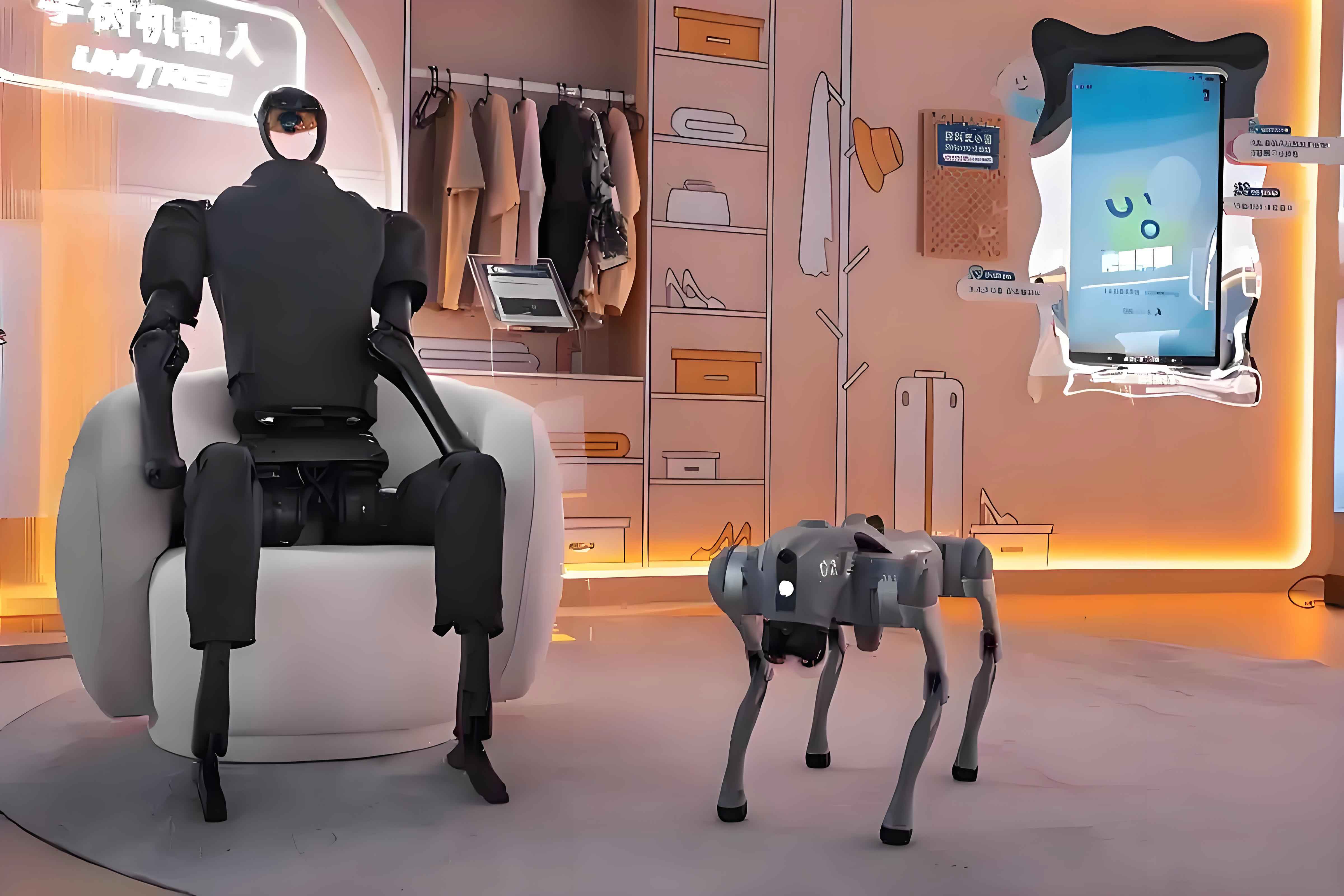
Taking the interactive attribute as an example, Jiang said the humanoid robot currently cannot achieve natural interaction with people and does not yet possess the ubiquitous connectivity capability of a mobile phone. These shortcomings, however, also indicate enormous industrial space. He forecast that the annual shipment volume of the humanoid robot in 2026 is expected to reach 100,000 units, with products gradually penetrating various industries and everyday life. For the scale of the industry, Jiang offered an intuitive judgment logic: the market size of the humanoid robot will be “the shipment volume of mobile phones multiplied by the price range of automobiles multiplied by the exponential growth of AI,” and when combined with the explosive effect of the token economy, it will form another giant consumer market in human history. The statement underlines the view that the humanoid robot should be evaluated not only by current unit sales but by its potential to become a mass-market terminal with software, services and ecosystem value.
- Open source identified as the core solution for industrial scale
Jiang acknowledged that moving from laboratory prototypes to a consumer-level super terminal still requires the humanoid robot industry to cross three core thresholds: data scarcity, high cost and ecosystem fragmentation. If these thresholds are not broken, the humanoid robot will remain at the exhibition stage and will not become a true mass-market product. The challenge is therefore not simply one of technological capability. It is also a challenge of industrial organization, cost structure, data governance and ecosystem building. The humanoid robot must be made usable, affordable and connected if it is to realize the super terminal vision.
| Indicator | Figure or Timeline | Context |
|---|---|---|
| Humanoid robot shipment forecast for 2026 | 100,000 units | Jiang Lei’s forecast for annual humanoid robot shipments as products penetrate industries and daily life. |
| Cost reduction achieved within one year | RMB 200,000 range | The Chinese humanoid robot industry has explored a localized cost-reduction path. |
| Possible product price in 2026 | RMB 10,000-level humanoid robot | A potential milestone in the humanoid robot industry’s cost-reduction trajectory. |
| Potential entry-level price | RMB 1,999 | If the humanoid robot replicates the breakout logic of self-balancing scooters, this price level could trigger market volume. |
| Open-source developers in China | 2.27 million | Data cited from the OpenAtom Open Source Foundation as a foundation for open-source humanoid robot development. |
| Humanoid robot market stock supported | 3 million units | Jiang said this scale could be reached before the humanoid robot enters industrial scenarios on a large scale. |
| Home entry timeline without organized research | 15 to 20 years | A possible timeline if systemic problem sorting and organized research are lacking. |
| Accelerated home entry timeline | 5 years, or even 3 years | A potential timeline through organized research and breakthroughs in family-scenario problem lists. |
The first threshold is data scarcity. Jiang described data as the “oil” of the embodied intelligence era. At present, however, a large amount of research and development resources remains concentrated on motors, models and even the token level, and has not yet truly shifted toward a data-driven research and development paradigm. In his view, if research and development work is still not centered on data, it will be difficult to support a genuine breakthrough in embodied intelligence. Data will be the core entry point for future industrial competition. For the humanoid robot, the ability to learn skills, adapt to households and interact naturally depends on diverse, high-quality and accessible data. Without data openness and data circulation, the humanoid robot will struggle to move beyond limited demonstrations.
The second threshold is high cost. Jiang said the Chinese humanoid robot industry is exploring a cost-reduction path with more localized characteristics. The industry has already achieved a cost reduction to the RMB 200,000 range within one year, and in 2026 there may even be a RMB 10,000-level humanoid robot product. If the industry can replicate the breakout logic of self-balancing scooters and produce an entry-level humanoid robot at the RMB 1,999 level, it will trigger true market volume. The logic is straightforward: the humanoid robot must move from a high-cost engineering prototype to an affordable consumer product. Cost reduction is not only a matter of supply chain maturity; it is also a precondition for the humanoid robot to become a super terminal rather than a niche industrial device.
The third threshold is ecosystem fragmentation. Jiang noted that many companies still maintain a closed research and development mindset, treating training grounds, data and technology as core assets that they are unwilling to open. This leads to industrial fragmentation and duplicated construction. Meanwhile, leading global humanoid robot companies have begun to open-source all drawings and code, expanding industrial influence through open ecosystems. Jiang suggested that domestic companies should at least launch one open-source product, and that company founders should communicate directly with users in an open manner, building an open rather than fragmented industrial ecosystem. For the humanoid robot, ecosystem openness is not simply a technical choice; it is a way to reduce duplicated investment, accelerate standardization and enlarge the pool of developers and users.
In his view, the common answer to the three thresholds is open source, specifically data open source, drawing open source and ecosystem open source. He pointed to the development of generative artificial intelligence as an example. Only recently, the industry was still debating the route choice between open source and closed source; today, open source has become a core competitiveness of China’s artificial intelligence industry. According to data from the OpenAtom Open Source Foundation, China already has 2.27 million open-source developers. Such a large developer group will support the humanoid robot in reaching a market stock of 3 million units, a scale that may be achieved even before the humanoid robot enters industrial scenarios on a large scale. The argument places open source at the center of the humanoid robot’s scaling path: open data can enrich training and evaluation, open drawings can lower entry barriers, and an open ecosystem can attract more participants to solve common problems.
- From public-version machine to home entry and human-robot symbiosis
Referring to the rise of China’s mobile phone industry, Jiang described a path that started with public-version machines, went through a stage of widespread entry-level phones and eventually produced a group of leading consumer electronics brands. Different from the development logic of Europe and the United States, he proposed that the humanoid robot should also follow a public-version machine development path, one that better fits the current industrial conditions of China’s humanoid robot sector. The public-version machine route is not a low-end compromise, but an industrial organization method: it can provide a common hardware foundation, reduce repeated development, support differentiated innovation and allow more companies to participate in the humanoid robot ecosystem.
Jiang said the Chinese humanoid robot industry has already moved to the center of the world stage, and the public-version machine route is the correct choice consistent with national conditions. In addition to hardware public versions, the humanoid robot also needs a dedicated operating system. The operating system is important because the humanoid robot is not simply a mechanical body. It must coordinate perception, motion, interaction, connectivity and software upgrades. A dedicated operating system can provide a common platform for developers and users, allowing the humanoid robot to evolve through software updates and ecosystem applications, much like a smartphone or personal computer.
On the direction of industrial deployment, Jiang believes that the humanoid robot will certainly enter various industries in the future, but at the current stage the most core industrial direction is entry into the family. He pointed out that without systematic problem sorting and organized scientific research tackling, it may take 15 to 20 years for the humanoid robot to enter the home. However, relying on China’s large market scale, talent pool and industrial coordination capability, and through organized sorting and breakthroughs of the problem list for family scenarios, it is possible to achieve the goal of humanoid robot entry into the family in 5 years or even 3 years. This timeline contrast is significant. It suggests that the pace of home entry depends not only on technological breakthroughs but also on how the industry organizes research, defines household scenarios and coordinates supply chains.
The new generation of humanoid robot should not be merely a tool to replace human labor, but should become a “silicon-based partner” for humans. Jiang said humanity should promote the common progress of technology and ecosystems with a more open perspective and breadth of mind, and jointly build a better future of human-robot symbiosis. In this vision, the humanoid robot is not a distant scientific fantasy but a potential consumer electronics-level super terminal that combines general hardware, general intelligence, natural interaction, ubiquitous connectivity and affordable consumption. The humanoid robot would be expected to learn human lifestyles, support daily tasks, provide companionship and connect with digital services while remaining accessible to ordinary users.
The proposal places the humanoid robot at the intersection of several industrial trends: the maturation of artificial intelligence, the cost reduction of hardware, the expansion of open-source software and the search for new consumer electronics categories. Jiang’s argument is that the humanoid robot should not be viewed only as a robotics product with a high price and limited use cases. It should be viewed as a super terminal whose value will be shaped by software upgrades, developer ecosystems, user interaction and mass-market affordability. The humanoid robot industry therefore faces a dual task. It must continue to advance hardware and motion capabilities, while also building the data, software and ecosystem foundations needed for a consumer-level device.
For the humanoid robot, data openness may determine the speed of skill learning. Cost reduction may determine whether the humanoid robot can enter ordinary households. Ecosystem openness may determine whether the industry can avoid fragmentation and duplicate construction. Jiang’s public-version machine proposal connects these three issues. A common hardware foundation and dedicated operating system could lower the barrier for companies, while open data and open drawings could enlarge the developer base. The humanoid robot would then have a better chance to move from limited prototypes to a scalable product category. The logic is similar to the evolution of personal computers and smartphones, where hardware, operating systems, applications and developer communities reinforced one another.
The humanoid robot’s home entry also raises a broader set of questions that the industry must organize around. Family scenarios are diverse, dynamic and personal. The humanoid robot must interact safely with people, understand household environments and adapt to changing tasks. These requirements make data collection and scenario definition especially important. Jiang’s emphasis on an organized problem list for family scenarios suggests that the humanoid robot industry needs a systematic approach rather than isolated demonstrations. If the industry can define common problems, share data and develop public-version hardware and software platforms, the humanoid robot may be able to shorten the path from laboratory to home.
The humanoid robot as a super terminal also implies a different competitive landscape. Hardware alone may not be enough. The five attributes of general, intelligent, interactive, connected and consumer suggest that the humanoid robot will require capabilities across mechanics, artificial intelligence, user experience, communications and cost control. Companies that focus only on a single component may miss the larger opportunity. At the same time, the humanoid robot industry needs open collaboration because no single company is likely to solve all the data, cost and ecosystem challenges alone. The open-source route proposed by Jiang is therefore both an industrial strategy and a risk-sharing mechanism.
Jiang’s forecast that the humanoid robot shipment volume in 2026 may reach 100,000 units provides a near-term reference point, but his larger argument is about the long-term category. The humanoid robot is presented as the next trillion-level super terminal after the personal computer, mobile phone and intelligent vehicle. That claim rests on the idea that the humanoid robot can enter the physical world and interact with people in ways that existing terminals cannot. If the humanoid robot can learn human lifestyles, upgrade through software and connect with digital services, it may create a new interface between humans and artificial intelligence. The humanoid robot would then be more than a machine; it would be a platform.
The open-source path also has implications for China’s humanoid robot industry. With 2.27 million open-source developers, according to the OpenAtom Open Source Foundation, China has a large talent pool that could contribute to the humanoid robot ecosystem. Jiang’s reference to a market stock of 3 million humanoid robots before large-scale industrial deployment suggests that consumer and developer adoption may precede full industrial maturity. The humanoid robot could first develop in households, developer communities and specialized scenarios, then expand into broader industrial applications. This sequence would differ from the traditional path of industrial robots, which often entered factories before reaching consumers.
The public-version machine route may also help the humanoid robot industry address the cost threshold. If common hardware platforms and shared components are available, companies can reduce repeated investment and focus on differentiated software, services and applications. A dedicated operating system could provide a common foundation for humanoid robot developers, similar to the role of operating systems in personal computers and smartphones. The combination of public hardware and a dedicated operating system could make the humanoid robot more modular, more upgradeable and more affordable. It could also support a wider range of products at different price points, from entry-level humanoid robot models to higher-end devices.
At the same time, the humanoid robot industry must manage expectations. Jiang’s timeline of 15 to 20 years for home entry without organized research shows that the challenge is substantial. The accelerated timeline of 5 years or even 3 years depends on organized problem sorting, research breakthroughs and industrial coordination. The humanoid robot must meet safety, reliability, usability and affordability requirements before it can become a mass-market home device. The industry’s ability to define family scenarios, share data and build open ecosystems will be critical. The humanoid robot cannot succeed as a collection of isolated prototypes; it needs a scalable industrial system.
The vision of the humanoid robot as a “silicon-based partner” adds a social dimension to the industrial discussion. Jiang’s proposal suggests that the humanoid robot should not be designed only to replace labor, but to support humans in daily life. That distinction matters for product design, interaction and trust. A humanoid robot that is safe, natural to interact with and continuously upgradable may be more readily accepted in homes. The humanoid robot as a partner also implies that the device should learn from human behavior and adapt to individual needs, which again underscores the importance of data and software ecosystems.
In the end, the humanoid robot debate is shifting from whether the technology can work to how the industry can scale it. Jiang’s speech presents a comprehensive framework: define the humanoid robot as a consumer-electronics-level super terminal; cross the thresholds of data, cost and ecosystem through open source; follow a public-version machine route with a dedicated operating system; and prioritize home entry through organized research. The humanoid robot is thus positioned at the center of a new industrial race, one that combines artificial intelligence, advanced manufacturing, open-source software and consumer markets. The humanoid robot may not arrive all at once, but the direction proposed at the Future Industry Conference gives the industry a clear set of strategic choices to debate, test and refine.