
SHANGHAI, October 13, 2026 — Aishida has unveiled its first fully self-developed wheeled humanoid robot, the ASD-D3, at the 2026 Aishida Ecosystem Partner Conference, marking a new stage in the Taizhou-based manufacturer’s push into embodied intelligence. The conference, held at Shanghai Intelligent Valley under the theme “Embodied Ecosystem & Deploying the Future,” also saw the official inauguration of the Aishida Intelligent Valley Embodied Intelligence Innovation Center. Industrial robots, quadruped robots, and humanoid robot products were displayed together, demonstrating the company’s ambition to build a full-chain capability spanning core components, complete-machine manufacturing, scenario deployment, and channel promotion.
The debut of the ASD-D3 humanoid robot was the central product announcement of the event. According to the company, the robot is Aishida’s first fully self-developed, all-scenario wheeled humanoid robot and represents the company’s ability to integrate research and development, manufacturing, and commercial deployment in the humanoid robot sector. The launch also signals that Aishida, a company historically known for cookware manufacturing and later for industrial robots, is now positioning itself as a full-stack player in the humanoid robot and broader embodied intelligence market.
1. Aishida Opens Embodied Intelligence Innovation Center and Unveils ASD-D3 Humanoid Robot
The newly inaugurated Aishida Intelligent Valley Embodied Intelligence Innovation Center is designed as a core carrier of the company’s embodied intelligence strategy. It focuses on core technology research and development as well as scenario innovation, with the aim of accelerating the transformation of innovation results into deployable products. The center sits within the broader Shanghai Intelligent Valley footprint, where Aishida is also accelerating construction of a 10,000-unit embodied robot intelligent production base. Once operational, that production base is expected to further release large-scale capacity for complete machines and core components, forming an integrated space for “research and development plus mass production.”
The humanoid robot ASD-D3 is presented as a practical outcome of that integrated approach. Aishida said the robot is intended for multiple scenarios, including industrial operations, unmanned retail, and home services. The company also emphasized that the humanoid robot benefits from more than 40 years of precision manufacturing experience and industrial robot technology accumulation, giving it a notable cost-performance advantage and laying a foundation for the large-scale commercial deployment of humanoid robot products.
At the conference, Aishida displayed a product matrix that extends beyond a single humanoid robot model. Industrial robots, quadruped robots, and humanoid robot platforms were shown together, reflecting the company’s intention to build a portfolio that can serve different operational requirements. The company’s manufacturing operations now cover wheeled humanoid robots, biped humanoid robots, and quadruped robots, while its component capabilities include reducers, joint modules, precision structural parts, and OEM/ODM services. This combination is important because the humanoid robot industry requires not only advanced algorithms and perception systems but also reliable hardware, precision manufacturing, and scalable supply chains.
Aishida’s humanoid robot strategy is also closely tied to its broader embodied intelligence architecture. The company said it has established a full-stack self-developed system with five core capability layers under independent control. Its ASD-VLA vertical model has already been applied in retail, home, community, and industrial scenarios. By linking the ASD-D3 humanoid robot with these capability layers, Aishida is seeking to demonstrate that its humanoid robot development is not limited to a single prototype but is part of a wider effort to build reusable technology, manufacturing capacity, and deployment experience.
2. ASD-D3 Humanoid Robot Combines Wheeled Mobility With Practical Payload and Computing
The ASD-D3 humanoid robot is a wheeled humanoid robot with 28 degrees of freedom and a single-arm payload of 7 kg. It is equipped with a four-wheel high-speed mobile chassis with a maximum speed of 1.5 m/s. For perception, the humanoid robot uses a vision-radar fused perception system, and it carries a 275 TOPS intelligent computing platform. A dual-battery configuration supports endurance of up to about 6 hours. According to Aishida, these specifications allow the humanoid robot to adapt to industrial operations, unmanned retail, home services, and other diversified scenarios.
The design choices behind the ASD-D3 humanoid robot reflect a practical approach to commercial deployment. Wheeled mobility can provide stable movement and efficient coverage in structured environments, while the humanoid robot’s upper-body configuration supports manipulation and interaction tasks. The 7 kg single-arm payload is relevant for many industrial and retail handling tasks, and the 1.5 m/s maximum speed gives the humanoid robot the ability to move efficiently within stores, factories, and service environments. The vision-radar fused perception system is intended to support navigation and environmental understanding, while the 275 TOPS computing platform provides the processing headroom needed for embodied intelligence workloads.
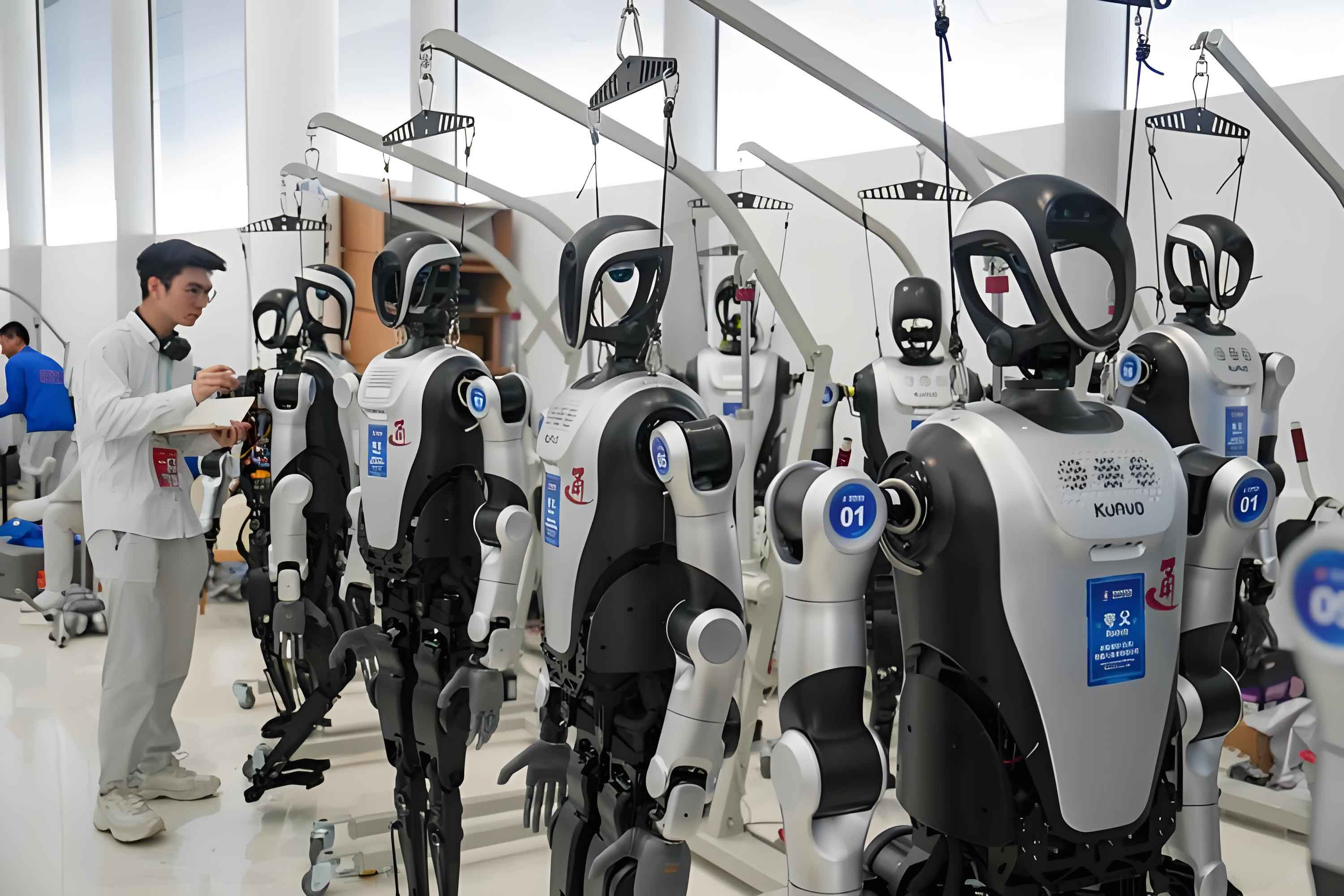
The dual-battery configuration and endurance of up to about 6 hours are also significant for the humanoid robot’s commercial use. In retail and industrial settings, operational continuity is a key requirement, and a humanoid robot that can remain active across extended shifts can reduce the need for frequent recharging. Aishida’s emphasis on endurance, payload, perception, and computing suggests that the ASD-D3 humanoid robot is being positioned as a working platform rather than a demonstration-only device. The company’s stated aim is to support scalable commercial deployment of the humanoid robot across multiple scenarios.
| Product | Configuration | Key specifications | Intended applications |
|---|---|---|---|
| ASD-D3 | Wheeled humanoid robot | 28 degrees of freedom; single-arm payload of 7 kg; four-wheel high-speed mobile chassis with maximum speed of 1.5 m/s; vision-radar fused perception system; 275 TOPS intelligent computing platform; dual-battery configuration with endurance of up to about 6 hours | Industrial operations, unmanned retail, home services, and other diversified scenarios |
| ASD-S2 | Biped humanoid robot | 31 degrees of freedom | Scientific research and development and embodied intelligence algorithm validation |
The ASD-D3 humanoid robot also illustrates how Aishida is seeking to differentiate its offer. Instead of treating the humanoid robot as a purely research-oriented platform, the company is linking the product to specific commercial scenarios and to its existing precision manufacturing base. Aishida said the humanoid robot’s cost-performance advantage is significant, thanks to more than 40 years of precision manufacturing accumulation and industrial robot technology experience. That combination is intended to support the humanoid robot’s transition from technical validation to broader commercial use.
For the humanoid robot sector, the ASD-D3 launch is notable because it brings together mobility, manipulation, perception, computing, and endurance in a single wheeled humanoid robot platform. The humanoid robot market has increasingly focused on whether products can perform useful work over sustained periods. Aishida’s presentation of the ASD-D3 humanoid robot addresses that question by emphasizing practical payload, speed, battery life, and scenario fit. The company is not presenting the humanoid robot as a standalone novelty but as part of an integrated system that includes manufacturing, core components, model capabilities, and deployment channels.
3. Manufacturing and R&D Network Supports Humanoid Robot Scale-Up
Aishida has formed a coordinated layout of four major component and complete-machine manufacturing bases in Shenzhen, Shanghai, Taizhou, and Jiashan. This network supports the company’s full-chain capabilities, from core components and complete-machine manufacturing to scenario deployment and channel promotion. For the humanoid robot business, the manufacturing footprint is important because humanoid robot production requires consistent quality across reducers, joint modules, precision structural parts, and final assembly. Aishida’s OEM/ODM capabilities in these areas give it a broader role in the humanoid robot supply chain than a company that only assembles final products.
The 10,000-unit embodied robot intelligent production base under construction inside Shanghai Intelligent Valley is another key element of the company’s humanoid robot scale-up plan. Aishida said the base will further release large-scale capacity for complete machines and core components after it is put into operation. By combining research and development with mass production in one integrated space, the company aims to shorten the path from humanoid robot innovation to manufacturing and deployment. This is particularly relevant for the humanoid robot industry, where product iteration often depends on close coordination between engineering teams, component suppliers, and production lines.
| Dimension | Details |
|---|---|
| Innovation platform | Aishida Intelligent Valley Embodied Intelligence Innovation Center, unveiled at the 2026 Aishida Ecosystem Partner Conference |
| Manufacturing footprint | Four major component and complete-machine manufacturing bases in Shenzhen, Shanghai, Taizhou, and Jiashan |
| Production scale-up | 10,000-unit embodied robot intelligent production base under accelerated construction inside Shanghai Intelligent Valley |
| Core components | Reducers, joint modules, precision structural parts, and OEM/ODM capabilities |
| Product scope | Wheeled humanoid robot, biped humanoid robot, quadruped robot, and industrial robot products |
| Research and development system | Full-stack self-development with five core capability layers under independent control; ASD-VLA vertical model applied in retail, home, community, and industrial scenarios |
| Commercial validation | Aibao humanoid robot deployed in 100 stores across 63 cities in September 2026; three-day large-scale operation drove store sales up 39% year on year; first unmanned retail warehouse launched; community public welfare tours and factory intelligent inspection validation advanced |
The company’s full-stack self-developed system is central to its humanoid robot ambitions. Aishida said its five core capability layers are under independent control, and its ASD-VLA vertical model has already been applied in retail, home, community, and industrial scenarios. This matters for the humanoid robot business because embodied intelligence requires the integration of perception, decision-making, motion control, and task execution. A humanoid robot that can operate in real environments must combine hardware reliability with software intelligence. Aishida’s stated capability structure is intended to support that combination across its humanoid robot product lines.
In manufacturing terms, Aishida’s component capabilities in reducers, joint modules, and precision structural parts are directly relevant to humanoid robot performance. Joint modules and reducers affect motion precision, durability, and cost, while precision structural parts influence weight, strength, and assembly quality. By controlling these capabilities in-house or through coordinated manufacturing bases, Aishida aims to support both quality and cost control for its humanoid robot products. The company’s OEM/ODM capability also suggests that it may serve broader humanoid robot industry demand beyond its own branded products.
The combination of a full-stack research and development system, multiple manufacturing bases, and a large-scale production base under construction gives Aishida a broad industrial foundation for humanoid robot commercialization. The company is not relying on a single product launch. Instead, it is building an integrated system in which the humanoid robot platform, core components, model capabilities, and production capacity reinforce one another. That approach is likely to be important as competition in the humanoid robot sector shifts from prototype demonstrations to deployment at scale.
4. Product Matrix Covers Wheeled, Biped, Quadruped, and Industrial Robots
Alongside the ASD-D3 humanoid robot, Aishida also presented the ASD-S2 biped humanoid robot. The ASD-S2 has 31 degrees of freedom and is intended for scientific research and development and embodied intelligence algorithm validation. The presence of both a wheeled humanoid robot and a biped humanoid robot shows that Aishida is pursuing a product matrix rather than a single form factor. Wheeled humanoid robots can offer stability and efficiency in structured commercial environments, while biped humanoid robots provide a platform for research into legged locomotion and more complex embodied intelligence algorithms.
The company’s manufacturing operations cover wheeled humanoid robots, biped humanoid robots, and quadruped robots, as well as industrial robots. This full-category product scope allows Aishida to address different use cases and technology validation needs. Industrial robots can support manufacturing automation, quadruped robots can operate in mobile inspection and other challenging environments, and humanoid robot platforms can serve retail, service, and industrial tasks. By presenting these products together, Aishida is positioning itself as a provider of multiple robotic form factors under a shared embodied intelligence strategy.
The ASD-S2 biped humanoid robot is particularly relevant for research and algorithm validation. Biped humanoid robot platforms are often used to test balance, locomotion, motion planning, and embodied intelligence algorithms. The 31 degrees of freedom provide a broad range of motion for research teams and developers. While the ASD-D3 humanoid robot is oriented toward commercial scenarios, the ASD-S2 humanoid robot supports the company’s technology development pipeline. Together, the two humanoid robot platforms illustrate how Aishida is combining near-term deployment with longer-term research and development.
The broader product matrix also has implications for the humanoid robot ecosystem. A company that can supply industrial robots, quadruped robots, wheeled humanoid robots, and biped humanoid robots can accumulate experience across different sensing, control, and deployment environments. That experience can feed back into humanoid robot development. For example, industrial robot experience can inform reliability and precision, quadruped robot experience can inform mobile autonomy, and retail deployment experience can inform human interaction and service workflows. Aishida’s multi-product approach is therefore not simply a display of breadth but a way to build overlapping capabilities for the humanoid robot market.
Aishida’s product strategy also reflects the practical reality of the humanoid robot industry. Different scenarios require different trade-offs between mobility, stability, payload, endurance, and cost. A wheeled humanoid robot may be better suited to flat indoor environments and commercial operations, while a biped humanoid robot may be more suitable for research and environments that require legged mobility. By maintaining multiple humanoid robot platforms, Aishida can address a wider range of customer requirements and technology development goals. The company’s full-category manufacturing base in Shenzhen, Shanghai, Taizhou, and Jiashan provides the industrial foundation for that multi-platform strategy.
5. Storefront Deployment Gives Humanoid Robot Commercial Validation
Aishida’s humanoid robot strategy has already moved into real-world commercial validation. In September 2026, the Aibao humanoid robot was deployed in 100 stores across 63 cities. According to the company, a three-day large-scale practical operation drove store sales up 39% year on year. The first unmanned retail warehouse was also launched during the same period, while community public welfare tours and factory intelligent inspection scenario validation continued to advance. These deployments provide the company with operational data and scenario experience that can inform future humanoid robot development.
The storefront deployment is significant because it tests the humanoid robot in customer-facing environments. Retail stores require human interaction, product handling, navigation, and reliable operation over extended periods. A humanoid robot operating in a store must be able to move safely, interact with customers, and support sales or service tasks. The reported 39% year-on-year increase in store sales during the three-day operation is a commercial indicator that Aishida is using to demonstrate the humanoid robot’s potential. It does not prove that the humanoid robot alone caused the increase, but it shows that the deployment was integrated into a sales environment and produced a measurable business result.
The first unmanned retail warehouse extends the humanoid robot’s validation into a different environment. Warehouses require efficient movement, inventory-related tasks, and coordination with other systems. The humanoid robot’s ability to operate in such settings is important for the broader logistics and retail ecosystem. Meanwhile, community public welfare tours and factory intelligent inspection validation show that Aishida is testing the humanoid robot across public service and industrial scenarios. These varied environments help the company gather experience in navigation, task execution, human interaction, and operational reliability.
- Retail deployment: The Aibao humanoid robot operated in 100 stores across 63 cities in September 2026.
- Sales impact: A three-day large-scale practical operation drove store sales up 39% year on year, according to the company.
- Unmanned retail: The first unmanned retail warehouse was launched alongside the storefront deployment.
- Community and industrial validation: Community public welfare tours and factory intelligent inspection scenario validation continued to advance.
These deployment efforts are important for the humanoid robot industry because they shift the conversation from technical capability to operational value. A humanoid robot must be able to work reliably in real environments, where lighting, crowds, obstacles, and task variability can affect performance. By deploying the Aibao humanoid robot in stores, warehouses, community activities, and factory inspection scenarios, Aishida is building a practical feedback loop. The company can use that feedback to improve the ASD-D3 humanoid robot and future humanoid robot platforms.
The commercial validation also supports Aishida’s broader ecosystem strategy. Retail stores, warehouses, community organizations, and factories are not isolated deployment points. They are part of a network of scenarios that can generate data, demonstrate value, and attract partners. For a humanoid robot company, early deployments can help build customer confidence and create reference cases. Aishida’s decision to present these deployments alongside the ASD-D3 humanoid robot launch suggests that the company wants to show that its humanoid robot strategy is already connected to real operational environments.
6. Three Strategic Leaps and Ecosystem Alliance Point to Full-Stack Humanoid Robot Strategy
Aishida’s entry into the humanoid robot market is the result of a long strategic evolution. The company began as a cookware manufacturer, deepened its industrial foundation, and then acquired Qianjiang Robotics to enter the industrial robot sector. It has now moved fully into embodied intelligence. This represents three strategic leaps: from cookware manufacturing to industrial robots, and then to embodied intelligence and humanoid robot development. Each stage has added capabilities that are relevant to the current humanoid robot strategy, including precision manufacturing, motion control, robotics engineering, and scenario deployment.
The acquisition of Qianjiang Robotics gave Aishida experience in industrial robot technology and manufacturing. That experience is now being applied to humanoid robot development. Industrial robots require precise motion control, reliable components, and rigorous quality management, all of which are relevant to humanoid robot platforms. Aishida’s more than 40 years of precision manufacturing experience adds another layer of capability, particularly in structural parts, assembly, and cost control. The combination of these backgrounds helps explain why the company is pursuing a full-stack humanoid robot strategy rather than focusing only on software or a single component.
At the conference, Aishida also launched the “Embodied Ecosystem & Deploying the Future” Ecosystem Partner Alliance. The alliance is intended to unite upstream and downstream partners across the industrial chain and promote integrated collaboration in technology research and development, complete-machine manufacturing, scenario deployment, and market empowerment. The goal is to create a full-stack empowerment platform for embodied intelligence and accelerate the industry’s transition from single-point technical validation to large-scale industrial deployment. For the humanoid robot sector, such an alliance can help address the complex coordination required across components, software, manufacturing, and end-user scenarios.
The alliance concept is closely aligned with the humanoid robot market’s needs. Humanoid robot commercialization requires cooperation among component suppliers, software developers, system integrators, deployment partners, and customers. No single company can easily cover every layer of the humanoid robot value chain at scale. By establishing an ecosystem partner alliance, Aishida is seeking to create a collaborative structure that can support its own humanoid robot products while also attracting external partners. The alliance’s focus on technology research and development, manufacturing, scenario deployment, and market empowerment reflects the multi-dimensional nature of humanoid robot commercialization.
Aishida’s full-stack strategy combines product development, core component manufacturing, complete-machine production, scenario validation, and ecosystem collaboration. The ASD-D3 humanoid robot is the most visible product expression of that strategy, but it is supported by the innovation center, the four manufacturing bases, the 10,000-unit production base under construction, the five core capability layers, and the ASD-VLA vertical model. The company’s three strategic leaps provide the historical and industrial context for this approach. Aishida is not entering the humanoid robot sector as a newcomer without manufacturing depth. It is building on decades of precision manufacturing and industrial robotics experience to pursue a larger role in embodied intelligence.
7. Outlook: Humanoid Robot Competition Moves Toward Deployment and Industrial Scale
The humanoid robot industry is increasingly focused on deployment and industrial scale. Prototypes and demonstrations remain important, but customers and partners are looking for humanoid robot platforms that can perform useful work, operate reliably, and be manufactured at consistent quality. Aishida’s announcement reflects this shift. The company presented a humanoid robot with specific payload, speed, perception, computing, and endurance specifications, while also highlighting manufacturing capacity, core component capabilities, and commercial deployments. This combination is intended to show that the humanoid robot is part of an industrial system rather than an isolated research project.
The ASD-D3 humanoid robot’s specifications suggest a practical orientation. A 28-degree-of-freedom wheeled humanoid robot with a 7 kg single-arm payload, 1.5 m/s maximum speed, vision-radar fused perception, 275 TOPS computing, and up to about 6 hours of endurance is designed to address real operational requirements. The wheeled platform can support stable movement in structured environments, while the humanoid robot’s upper body can handle manipulation and interaction tasks. The ASD-S2 biped humanoid robot with 31 degrees of freedom complements this by providing a platform for research and algorithm validation. Together, the two humanoid robot platforms cover both commercial deployment and technology development needs.
Aishida’s manufacturing footprint and production plans are equally important for the humanoid robot outlook. The four manufacturing bases in Shenzhen, Shanghai, Taizhou, and Jiashan provide a distributed industrial foundation, while the 10,000-unit embodied robot intelligent production base under construction is intended to support large-scale output. The company’s capabilities in reducers, joint modules, precision structural parts, and OEM/ODM services give it a broader role in the humanoid robot supply chain. As the humanoid robot market grows, the ability to manufacture core components and complete machines at scale will be a major differentiator.
The commercial validation of the Aibao humanoid robot in 100 stores across 63 cities, the reported 39% year-on-year sales increase during the three-day operation, the first unmanned retail warehouse, and the community and factory inspection validations all point to a strategy of learning through deployment. These deployments do not eliminate the challenges facing the humanoid robot industry, but they provide real-world experience that can inform product improvement. Aishida’s humanoid robot development is therefore connected to operational feedback, not only laboratory testing. That connection is likely to be valuable as the company prepares the ASD-D3 humanoid robot for broader commercial use.
The launch of the Ecosystem Partner Alliance adds another dimension to Aishida’s humanoid robot strategy. Humanoid robot commercialization requires coordination across technology, manufacturing, deployment, and market development. An alliance can help align partners around shared standards, scenarios, and business models. Aishida’s stated goal is to build a full-stack empowerment platform for embodied intelligence and accelerate the transition from single-point technical validation to large-scale industrial deployment. If successful, this approach could strengthen the company’s position in the humanoid robot value chain and support the wider adoption of humanoid robot products in retail, industry, homes, and communities.
Overall, Aishida’s 2026 Ecosystem Partner Conference marked a clear statement of intent. The company unveiled the ASD-D3 humanoid robot, inaugurated its embodied intelligence innovation center, showcased a full-category robot portfolio, highlighted its manufacturing and research and development network, and presented commercial deployment results. The humanoid robot is no longer only a future concept for Aishida; it is now part of a broader industrial strategy that connects precision manufacturing, core components, embodied intelligence models, scenario deployment, and ecosystem collaboration. As competition in the humanoid robot sector intensifies, Aishida’s ability to turn these capabilities into reliable, scalable, and commercially viable humanoid robot products will determine how far its third strategic leap can go.