
Research on lower-limb motion control and stability for the humanoid robot has moved a significant step closer to practical dynamic walking, according to a comprehensive study focused on how a bipedal machine can maintain balance while shifting between support and swing phases. The work examines the full control chain of the humanoid robot, from kinematic modeling and gait planning to model predictive control, ground reaction force optimization, and joint-level robust tracking. Rather than treating stable walking as a single control problem, the research separates the challenge into two tightly connected questions: how the humanoid robot should place its feet and move its center of mass, and how the machine should regulate contact forces and joint torques when the body is continuously disturbed by inertia, contact switching, and ground interaction.
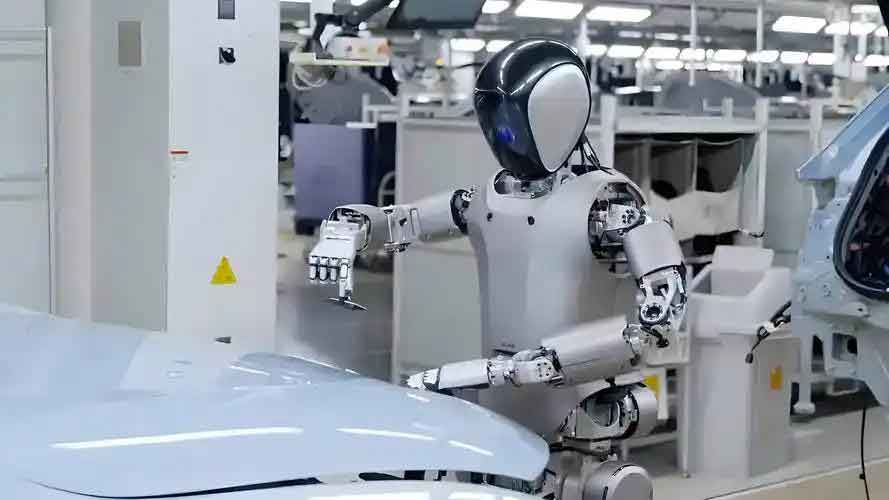
The research is positioned within the rapid international expansion of humanoid robot technology. In recent years, humanoid robot platforms have moved from laboratory demonstrations into public view, industrial trials, and service-oriented experiments. The study notes that the humanoid robot is no longer judged only by its appearance or by isolated joint movements; it is increasingly evaluated by whether it can stand, walk, recover balance, and execute tasks in unstructured environments. That shift places lower-limb control at the center of humanoid robot development, because the legs must simultaneously support the body, absorb contact shocks, generate forward motion, and preserve posture stability. For a humanoid robot to be useful outside a controlled laboratory, its walking controller must handle continuous changes in contact conditions without losing balance.
The research agenda is therefore both mechanical and algorithmic. It begins with a simplified but rigorous model of the humanoid robot lower limb, then builds a stability framework around the zero moment point and the support polygon, and finally introduces force-based control through model predictive control. The study also proposes a robust controller for joint motors to improve trajectory tracking precision. The overall message is that stable humanoid robot walking is not achieved by a single controller but by a layered architecture: a kinematic layer that defines feasible motion, a gait layer that shapes foot trajectories and center-of-mass movement, a dynamic control layer that optimizes contact forces, and a joint-level layer that ensures the commanded motion is executed with sufficient accuracy.
1. Humanoid Robot Development Creates a Need for More Reliable Lower-Limb Control
The study places the humanoid robot within a broader technological trajectory that stretches from early bipedal machines to modern electrically driven platforms. Early humanoid robot research demonstrated that bipedal walking was possible, but many of those systems depended on pre-planned motions and tightly controlled environments. Later humanoid robot platforms introduced dynamic balance, stair climbing, and more natural interaction, while recent developments have accelerated with improvements in actuators, embedded computing, inertial sensing, and model-based control. The result is a new phase in humanoid robot development in which machines are expected to walk with greater speed, adapt to uneven ground, and recover from disturbances.
At the same time, the humanoid robot remains a difficult control object. It is an underactuated system with a floating base, meaning that the body cannot be moved directly by joint commands alone. Instead, the humanoid robot changes its motion through contact forces with the ground. When one foot is in contact, the support leg must carry the body while the swing leg moves forward. When both feet are in contact, the machine must distribute forces between two contact points and prepare for the next support transition. Every change in contact introduces a new dynamic condition, and every change in body posture alters the relationship between joint motion and foot placement. This makes the humanoid robot a system in which kinematics, dynamics, and contact mechanics cannot be separated for long.
The research responds to this challenge by treating the lower limbs as the primary control domain. The upper body is modeled as a rigid body to reduce complexity and to isolate the stability problem. This simplification does not deny the importance of upper-body motion; rather, it creates a focused testbed for the lower-limb control problem. If a humanoid robot cannot maintain stable lower-limb behavior, upper-body coordination becomes secondary. The study therefore concentrates on the mechanical structure of the legs, the derivation of forward and inverse kinematics, the construction of the Jacobian matrix, the modeling of foot contact forces, and the design of controllers that can translate desired body and foot motion into joint torques.
- The humanoid robot is treated as a floating-base system whose motion depends on ground contact.
- The lower limbs are modeled with four joints per leg, including hip, knee, and ankle motion.
- The upper body is simplified as a rigid body to isolate lower-limb stability.
- Kinematic and dynamic models are linked through the Jacobian and contact force mapping.
- The control architecture is layered to separate gait generation, force optimization, and joint tracking.
2. Kinematic Modeling Establishes the Motion Foundation for the Humanoid Robot
The first technical stage of the research constructs a kinematic model of the humanoid robot lower limb. The study uses a modified Denavit-Hartenberg convention to describe the relationship between joint angles and foot position. This modeling choice is important because the humanoid robot lower limb contains multiple rotational joints and rigid links, and small errors in coordinate definition can propagate into large errors in foot placement. The modified convention reduces ambiguity in the kinematic chain and provides a consistent framework for both forward and inverse solutions.
The kinematic model includes a world coordinate frame, a body coordinate frame, and a set of joint frames along each leg. The floating-base characteristic is handled by introducing a virtual six-degree-of-freedom connection between the world frame and the body frame. This allows the humanoid robot to be analyzed as a system whose body pose and joint motion are coupled. The forward kinematics derive the foot position from joint angles, while the inverse kinematics derive joint angles from a desired foot position. The study examines both analytical and numerical inverse solutions, including geometric methods and iterative Jacobian-based methods. The analytical solution provides insight into the relationship between leg geometry and joint angles, while the numerical solution offers a general approach that can handle constraints and avoid singular configurations.
The Jacobian matrix is then derived to relate joint velocities to foot velocities. This relationship is essential for the humanoid robot because it connects planned Cartesian foot motion with the joint-level commands required to execute that motion. The Jacobian also supports force mapping: if a desired contact force is known at the foot, the corresponding joint torques can be computed through the transpose of the Jacobian. The study further models the foot-ground contact force and considers different contact representations. A simplified contact model is selected that allows the humanoid robot to perform pitch and roll motion without introducing unnecessary constraints. This contact model becomes a foundation for the later force-based controller.
| Technical Area | Reported Detail in the Humanoid Robot Study |
|---|---|
| Kinematic modeling | Modified Denavit-Hartenberg model for the humanoid robot lower limb, including forward and inverse kinematics. |
| Floating-base treatment | Virtual six-degree-of-freedom connection between the world frame and the body frame. |
| Velocity mapping | Jacobian matrix relating joint velocities to foot linear velocity and supporting force mapping. |
| Contact modeling | Foot-ground contact force model with a simplified representation suitable for dynamic walking. |
| Simulation validation | MATLAB-based kinematic simulation used to verify forward and inverse solutions. |
The kinematic analysis also addresses the relationship between the body frame and the world frame. For a humanoid robot, the foot may be controlled in the body frame, but stability is evaluated in the world frame. The study therefore derives transformations that map foot position from the body frame to the world frame using the body orientation and position. This is a necessary step for gait planning because the humanoid robot must place its feet relative to the ground, not merely relative to its own torso. The kinematic model thus provides the geometric language that later sections use to describe walking, balance, and contact.
3. Stability Criteria and Gait Planning Define How the Humanoid Robot Should Walk
The research then turns to stability. For a humanoid robot, stability is not a static property that can be guaranteed once and then ignored. It is a dynamic condition that must be maintained throughout the walking cycle. The study introduces two stability concepts. The first is the projection of the center of gravity onto the support polygon. This criterion is useful for static or quasi-static conditions, where the humanoid robot moves slowly enough that inertial effects can be neglected. If the vertical projection of the center of gravity remains inside the polygon formed by the contact points, the humanoid robot can remain standing without tipping.
The second concept is the zero moment point, which is more suitable for dynamic walking. The zero moment point is the point on the ground where the horizontal moment of the ground reaction force becomes zero. For the humanoid robot to remain dynamically stable, the zero moment point should remain within the support polygon. This criterion captures the effect of inertia and contact force distribution, and it is widely used in bipedal walking control. The study explains that the center of gravity projection and the zero moment point coincide only in special cases, such as when the humanoid robot is standing still. During walking, the center of gravity may move outside the support polygon while the zero moment point remains inside, allowing the humanoid robot to maintain balance through controlled acceleration and contact force.
Gait planning is presented as the process that turns stability requirements into motion trajectories. The study divides the walking cycle into starting, periodic walking, and stopping stages. It further separates the support phase from the swing phase. In the support phase, one or both feet contact the ground and carry the body. In the swing phase, one leg moves forward while the other supports the humanoid robot. The study considers both single-support and double-support conditions and notes that double support occupies only a short portion of the walking cycle. The control system must therefore switch smoothly between contact states without causing abrupt changes in force or posture.
- Static stability is evaluated through the center-of-gravity projection inside the support polygon.
- Dynamic stability is evaluated through the zero moment point inside the support polygon.
- The walking cycle is divided into starting, periodic walking, and stopping stages.
- Support and swing phases alternate, with short double-support transitions.
- Foot trajectory and center-of-mass motion must be coordinated to preserve balance.
Two gait planning methods are examined. The first uses a six-order Bézier curve to generate smooth foot trajectories. The curve is defined by control points that shape position, velocity, and acceleration. By selecting control points appropriately, the humanoid robot can achieve smooth lift-off and landing, reducing impact and avoiding sudden acceleration changes. The study reports a simulation example with a step length of 85 mm, a step height of 35 mm, and a swing phase time of 1 s. The resulting position, velocity, and acceleration curves show that the Bézier approach can produce continuous and smooth foot motion suitable for the humanoid robot swing leg.
The second method uses a linear inverted pendulum model to plan center-of-mass motion. In this model, the humanoid robot is simplified as a point mass connected to the support foot by a massless leg. The center of mass moves at a constant height, and the ground reaction force passes through the center of mass. The study extends the model from two dimensions to three dimensions and derives the relationship between center-of-mass acceleration and the zero moment point. The linear inverted pendulum model provides an efficient way to estimate body velocity and predict future foot placement. The research ultimately combines the two ideas: the linear inverted pendulum model supports velocity estimation and foot placement prediction, while the Bézier curve generates smooth vertical and swing trajectories with adjustable phase timing.
4. Virtual Model Control Offers an Initial Route to Humanoid Robot Dynamic Walking
Before introducing model predictive control, the study examines virtual model control as a more intuitive force-based strategy for the humanoid robot. Virtual model control creates virtual mechanical components, such as springs and dampers, at selected points of the robot. The resulting virtual forces are then mapped to joint torques through the Jacobian. For a humanoid robot, this approach can be used to support the body, guide the swing leg, and regulate posture during walking. The appeal of virtual model control is its direct physical interpretation: the controller behaves as if the humanoid robot were supported by virtual forces that pull or push the body toward a desired state.
The study develops virtual model control for both single-support and double-support phases. In single support, one leg carries the body while the other swings forward. The support leg must generate vertical force to hold the body and horizontal force to regulate forward motion. The swing leg must follow a planned trajectory without disturbing the support leg. In double support, both legs contact the ground, and the controller must distribute virtual forces between them. The study derives the mapping from virtual forces and moments to joint torques and analyzes the underactuated constraint at the ankle. A state machine is designed to switch between support phases based on foot contact and body motion.
However, the study also identifies the limitations of virtual model control for the humanoid robot. Although the method can produce walking-like motion, it does not explicitly optimize ground reaction forces, and it has difficulty adjusting body posture when disturbances occur. The humanoid robot may appear to walk, but the quality of balance and the ability to recover from perturbation remain limited. This finding motivates the transition to model predictive control, which can incorporate contact force constraints and predict future system behavior over a finite horizon.
5. Model Predictive Control Improves Force Regulation for the Humanoid Robot
The study then investigates model predictive control as a more capable framework for the humanoid robot. Model predictive control uses a system model to predict future states, solves an optimization problem over a finite horizon, and applies only the first control input before repeating the process. This rolling optimization structure allows the humanoid robot to respond to changing conditions while respecting physical constraints. The research examines two model predictive control strategies. The first optimizes the center-of-mass trajectory based on the zero moment point criterion. The second optimizes ground reaction forces during the support phase and uses PD control for the swing leg. After simulation comparison, the study selects the force-based strategy because it offers better disturbance rejection and adaptability to uneven conditions.
The center-of-mass trajectory approach treats the zero moment point as a controlled output and uses a preview control structure to track a desired zero moment point reference. The study derives a discrete state-space model and evaluates standard and improved preview algorithms. The improved algorithm accounts for accumulated zero moment point error and performs better when the preview time is short. Simulation results show that preview time affects tracking performance, but beyond a certain point additional preview time provides limited benefit. Although this method can generate stable walking, the study finds that it is relatively stiff and less effective when the humanoid robot encounters disturbances or more complex terrain.
The force-based model predictive control approach represents the humanoid robot as a single rigid body with mass and inertia. The controller optimizes contact forces and moments at the feet while respecting friction cone constraints, normal force limits, and torque limits. The dynamics are expressed as a linear relationship between body acceleration, angular momentum change, and contact forces. The controller then solves a quadratic programming problem over the prediction horizon. The resulting contact forces are mapped to joint torques through the Jacobian. For the swing leg, a Cartesian PD controller tracks the desired foot trajectory, creating a virtual spring-damper behavior at the foot.
- Model predictive control predicts future humanoid robot states over a finite horizon.
- Force-based optimization regulates ground reaction forces during the support phase.
- Friction cone constraints prevent foot slip during humanoid robot walking.
- Normal force limits maintain contact between the foot and the ground.
- Swing-phase PD control tracks the desired foot trajectory in Cartesian space.
- Quadratic programming solves the constrained force optimization problem.
The study explains that the force-based controller has a practical advantage for the humanoid robot: it directly handles the contact forces that determine balance. Instead of relying only on position tracking, the controller can adjust the distribution of forces between the feet and respond to changes in body state. The swing leg is controlled separately because it is not in contact with the ground and therefore does not contribute to the force optimization. This separation simplifies the control problem while preserving the essential dynamics of walking. The support leg maintains balance, and the swing leg follows a smooth trajectory generated by the gait planner.
6. Robust Joint Control Strengthens Humanoid Robot Trajectory Tracking
At the joint level, the study proposes a model-based robust controller to replace conventional PD control for the humanoid robot motors. The motivation is straightforward: even if the gait planner and force optimizer generate excellent commands, the humanoid robot will not achieve accurate motion if the joint motors cannot track those commands precisely. Joint friction, load variation, parameter uncertainty, and external disturbance can all degrade tracking performance. A robust controller is designed to maintain stability and performance across a range of uncertain conditions rather than relying on a single nominal model.
The controller is developed from the dynamics of a permanent magnet synchronous motor with a reducer. The motor model includes electrical and mechanical dynamics, and the controller accounts for viscous friction, Coulomb friction, and load torque. The discontinuous sign function in the friction model is approximated by a hyperbolic tangent function to avoid numerical issues. The study then formulates a general uncertain mechanical system and derives a robust control law with nominal compensation, initial-condition compensation, and uncertainty compensation. Stability analysis shows that the control error is uniformly bounded and ultimately bounded, and simulation results indicate fast response, low overshoot, and good tracking of step and sinusoidal references.
The robust controller is also tested on a single-joint motor platform. Step response and sinusoidal tracking experiments compare the robust controller with PID control. The reported results show that the robust controller responds faster, produces smaller overshoot, and achieves lower trajectory tracking error. These results are important for the humanoid robot because joint-level precision affects the entire control chain. A small joint tracking error can become a foot placement error, and a foot placement error can become a stability disturbance. By improving joint tracking, the robust controller helps the humanoid robot execute the gait and force commands more faithfully.
7. Simulation and Prototype Experiments Validate the Humanoid Robot Control Architecture
The research validates the proposed control architecture through both simulation and physical experiments. MATLAB is used for kinematic verification and control algorithm development, while MuJoCo is used for dynamic simulation of the humanoid robot. The simulation environment allows the researchers to test static standing, dynamic walking, and controller parameters before deploying them to the physical prototype. The humanoid robot prototype has 17 degrees of freedom, including four degrees of freedom per leg, four per arm, and one at the waist. The leg joints are driven by M107 joint motors with a maximum torque of 360 N·m, a maximum pull equivalent of 10000 N at a 3.5 cm lever arm, hollow-shaft design, and dual encoders. The control system uses a distributed architecture with a central monitoring platform, an algorithm processor, a motion solver, and joint-level drivers, with a reported 1 ms control cycle for real-time communication.
In the static standing experiment, the humanoid robot is commanded to maintain a bent-knee posture. This posture lowers the center of mass and provides a stable initial condition for later walking. Simulation results show that the body attitude angles settle quickly after a small initial oscillation. Joint angles follow the desired values, joint velocities remain near zero with acceptable noise, and joint torques remain within reasonable limits. The physical prototype experiment shows similar behavior: body posture changes only slightly over the test period, joint angle errors remain very small, and joint torques stay balanced between the left and right legs. These results confirm that the position-velocity-torque control mode can hold the initial posture of the humanoid robot with sufficient stability.
The dynamic walking experiment builds on the static posture. The model predictive controller is deployed to regulate support-phase forces, while the swing leg follows a planned trajectory. Simulation results show that body attitude angles remain within a normal range and joint torques stay within reasonable bounds. In the physical experiment, the humanoid robot walks on a flat indoor surface while encoder and torque sensor data are recorded. The inertial measurement unit provides body attitude angles. The reported data show that joint torques remain acceptable and body attitude angles stay within a normal range, with some larger variation in yaw that may be related to sensor sensitivity. Overall, the experiment demonstrates that the humanoid robot can achieve stable dynamic walking with the proposed control architecture.
| Validation Stage | Platform | Reported Purpose | Observed Outcome |
|---|---|---|---|
| Kinematic verification | MATLAB | Check forward and inverse kinematics for the humanoid robot lower limb. | Model behavior is consistent with the derived kinematic equations. |
| Static standing | MuJoCo and physical humanoid robot | Maintain a bent-knee initial posture using position, velocity, and torque control. | Body attitude and joint states settle quickly and remain stable. |
| Dynamic walking | MuJoCo and physical humanoid robot | Combine model predictive control for support forces with swing-leg tracking. | Walking is achieved with acceptable body attitude and joint torque behavior. |
| Joint tracking | Single-joint motor platform | Compare robust control with PID for step and sinusoidal references. | Robust control shows faster response, smaller overshoot, and lower tracking error. |
The experiments also reveal where further work is needed. The robust controller was validated on a single-joint motor platform but was not fully tested in dynamic walking on the humanoid robot because of hardware platform constraints. The upper body was treated as a rigid body, so the influence of arm and torso motion on lower-limb stability was not included in the dynamic walking controller. These limitations do not undermine the main results, but they define a clear path for future humanoid robot research. Whole-body control, learning-based gait generation, and more extensive hardware validation are natural next steps.
8. Key Contributions for Humanoid Robot Stability Research
The study makes several contributions to humanoid robot lower-limb control. It provides a complete kinematic model that connects joint space, body space, and world space. It introduces stability criteria that are appropriate for both static and dynamic conditions. It compares Bézier curve gait planning with linear inverted pendulum planning and combines their strengths. It evaluates virtual model control and explains why force-based model predictive control is more suitable for dynamic balance. It proposes a robust joint controller that improves trajectory tracking. Finally, it validates the overall architecture on simulation and physical platforms, showing that the humanoid robot can stand stably and walk dynamically with the proposed control structure.
- A layered humanoid robot control architecture connects kinematics, gait planning, force optimization, and joint tracking.
- Zero moment point and support polygon criteria provide a practical basis for humanoid robot balance assessment.
- Six-order Bézier curves generate smooth swing-foot trajectories for the humanoid robot.
- Three-dimensional linear inverted pendulum modeling supports velocity estimation and foot placement prediction.
- Force-based model predictive control improves ground reaction force regulation for the humanoid robot.
- Robust joint control enhances trajectory tracking precision and disturbance rejection.
- Simulation and prototype experiments demonstrate stable standing and dynamic walking behavior.
9. Outlook: Humanoid Robot Research Moves Toward Whole-Body and Learning-Enabled Control
The research concludes with a forward-looking view of humanoid robot development. The humanoid robot is expected to remain a major direction in robotics because its form factor is compatible with human environments and tools. However, the control problem will become more demanding as humanoid robot platforms move from flat-ground walking to stairs, slopes, uneven terrain, and physically interactive tasks. Future work can extend the current lower-limb controller to whole-body control, where arm motion, torso rotation, and leg motion are coordinated to maintain balance and execute tasks. The upper body can no longer be treated only as a rigid mass when the humanoid robot carries loads, manipulates objects, or recovers from large disturbances.
Another direction is learning-based control. The current study relies on model-based methods, which offer interpretability and physical consistency but require careful modeling and parameter tuning. Reinforcement learning and other data-driven methods could complement model-based control by learning gait patterns, contact policies, or recovery behaviors from simulation and real-world data. A hybrid approach may be particularly promising for the humanoid robot: model-based control provides safety and structure, while learning improves adaptability and reduces manual tuning. The study also suggests that the robust joint controller should be tested in full dynamic walking once the hardware platform supports it, so that joint-level improvements can be evaluated in the complete humanoid robot control loop.
The broader significance of the work is that it treats stable walking as an integrated systems problem. The humanoid robot is not controlled by a single algorithm but by a sequence of models and controllers that transform a desired walking behavior into joint torques. Kinematics defines what is possible, gait planning defines what is desired, stability criteria define what is acceptable, model predictive control defines how contact forces should be distributed, and joint control defines how accurately the commands are executed. When these layers operate together, the humanoid robot can stand, shift its weight, swing its legs, and maintain balance. The research therefore offers a structured reference for future humanoid robot platforms that require robust lower-limb motion control and reliable dynamic stability.
As humanoid robot technology continues to mature, the ability to walk stably will remain a foundational capability. The study shows that progress depends on more than stronger actuators or faster processors. It depends on models that capture the essential dynamics of the humanoid robot, controllers that respect contact constraints, and validation that moves from simulation to physical hardware. The humanoid robot of the next generation will need to combine these elements with whole-body coordination and adaptive learning. The lower-limb control framework described in this research provides a practical starting point for that next stage of humanoid robot development.