
At the National Speed Skating Oval, known as the Ice Ribbon in Beijing, the second World Humanoid Robot Games has come to a close after drawing attention from across the global robotics community. The event brought together 666 teams from 16 countries on six continents, with the number of participating teams rising by 138 percent compared with the previous edition and the number of humanoid robot units quadrupling. More than 2,000 humanoid robot units competed in the same venue, creating a major window for observing the development of the global humanoid robot industry.
The scale of the event was notable not only because of the number of teams and humanoid robot units involved, but also because of the range of events and the level of public engagement. Humanoid robot athletes competed in running, football, gymnastics, weightlifting, street dance, sports dance, martial arts, pitch-pot, table tennis, free combat, tug of war and obstacle races, among other events. The second edition of the World Humanoid Robot Games demonstrated that the humanoid robot is moving from laboratory demonstration toward competitive testing, industrial validation and public understanding.
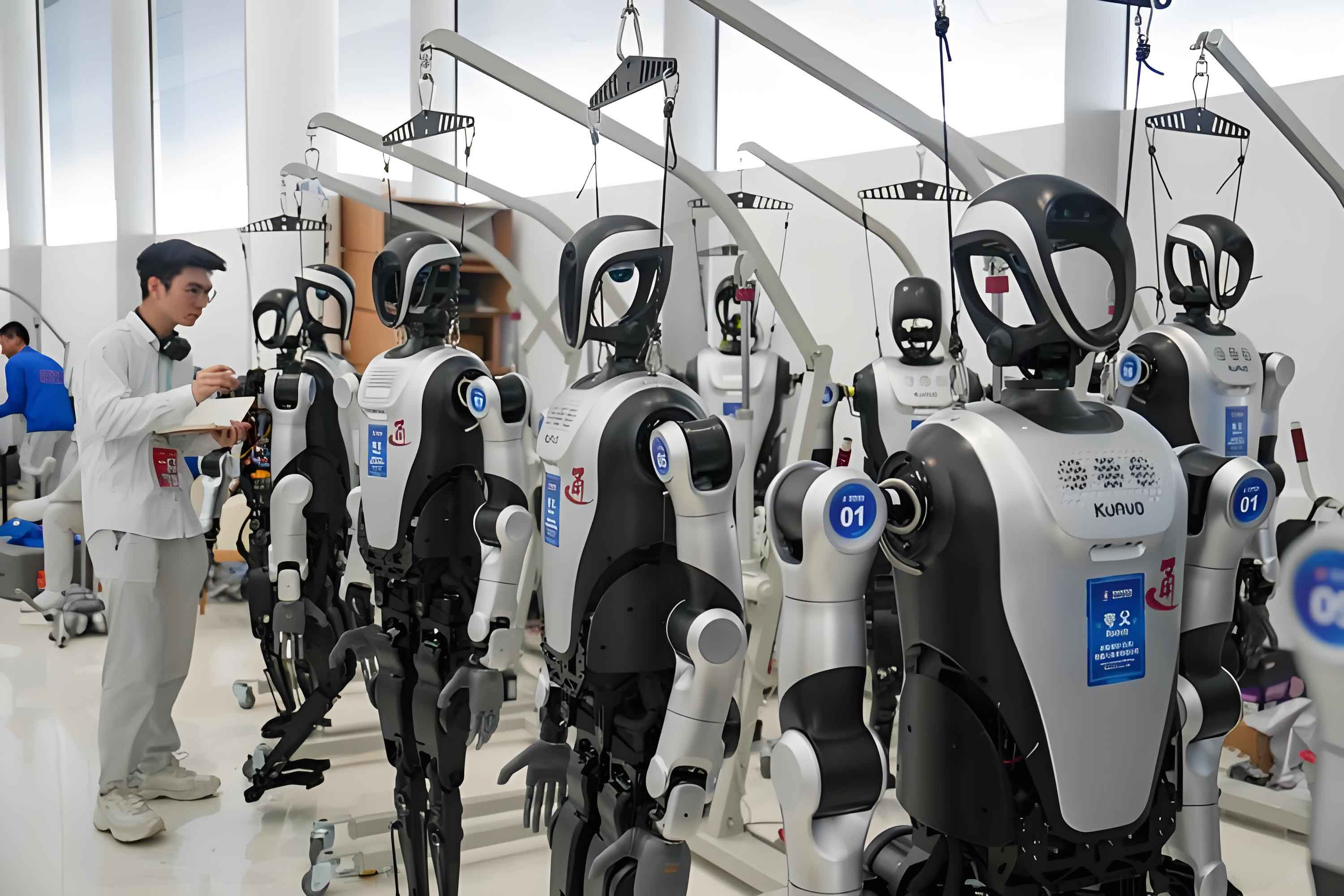
- A Larger Humanoid Robot Stage and a Broader Competitive Field
The second World Humanoid Robot Games attracted 666 teams from 16 countries across six continents, and more than 2,000 humanoid robot units took part in the competitions. The event reported that the number of teams increased by 138 percent from the previous edition, while the number of humanoid robot units quadrupled. These figures show that the humanoid robot field is expanding quickly, with more teams, more institutions and more humanoid robot platforms entering competitive testing.
For the humanoid robot industry, the significance of such an event is not limited to spectacle. A humanoid robot that can run, jump, balance, recover from disturbance, operate autonomously and interact with a dynamic environment must integrate mechanical design, motion control, perception, decision-making, power management and thermal management. Each event places different demands on the humanoid robot, and each result offers clues about the maturity of specific technologies. The World Humanoid Robot Games therefore serves as a public testbed for the humanoid robot, allowing engineers and researchers to compare approaches under controlled but challenging conditions.
| Indicator | Second World Humanoid Robot Games | Context |
|---|---|---|
| Participating teams | 666 teams | Up 138 percent from the previous edition |
| Countries represented | 16 countries | Teams came from six continents |
| Humanoid robot units | More than 2,000 humanoid robot units | The number of humanoid robot units quadrupled |
| Competition venue | National Speed Skating Oval, the Ice Ribbon, Beijing | A major public venue for humanoid robot competition |
The event also showed that the humanoid robot is no longer judged only by whether it can complete a single movement. The humanoid robot must now demonstrate repeatability, stability and adaptability. A humanoid robot that can run quickly in a straight line is impressive, but a humanoid robot that can maintain balance on an obstacle course, recover from contact in a football match, coordinate with teammates without remote control and sustain performance across multiple attempts is closer to the kind of humanoid robot capability that industry needs.
- Record-Breaking Performances Reveal Rapid Progress in Humanoid Robot Motion
Multiple competition records were broken at the second World Humanoid Robot Games, and several results represented qualitative leaps from the previous edition. In the 400-meter run, the previous result of 1 minute 28.03 seconds was improved to 45.66 seconds in the small-group category and 38.15 seconds in the large-group category. In the 1,500-meter run, the previous result of 6 minutes 34.40 seconds was improved to 2 minutes 21.64 seconds. In the standing high jump, the previous result of 0.95641 meters rose to 3.40 meters. These results provide a clear view of how quickly humanoid robot motion control, actuation and system integration are advancing.
| Event | Previous edition | Second edition |
|---|---|---|
| 400-meter run | 1 minute 28.03 seconds | 45.66 seconds in the small-group category; 38.15 seconds in the large-group category |
| 1,500-meter run | 6 minutes 34.40 seconds | 2 minutes 21.64 seconds |
| Standing high jump | 0.95641 meters | 3.40 meters |
One of the most memorable performances came from the Tiangong Omni humanoid robot, which won the gold medal in the 400-meter small-group event with a running posture that appeared to cover its face while fleeing. The posture amused spectators, but it was not a pre-designed theatrical movement. According to Han Gang, a motion control algorithm expert at the Beijing Humanoid Robot Innovation Center, the humanoid robot developed the posture through repeated data iteration in simulation. The team initially designed a normal sprinting pattern, but the humanoid robot found that covering its face felt more comfortable than swinging its arms during learning and iteration.
Han Gang explained that rapid arm swinging places a heavy load on the shoulders of a humanoid robot and may cause joint heating. The face-covering running style reduces high-frequency shoulder movement, lowering the risk of overheating and reducing energy consumption. At the same time, the humanoid robot has stronger waist and leg capabilities, and it can maintain balance more efficiently by twisting the waist and hips than by swinging its arms. The example illustrates a broader point about humanoid robot development: the best solution for a humanoid robot may not mimic a human solution exactly, because the humanoid robot has different structural limits, thermal limits and energy constraints.
The record-breaking results do not mean that speed alone is the ultimate goal of the humanoid robot. For humanoid robot engineers, a fast run is valuable because it stresses the entire system. A humanoid robot running at high speed must manage foot contact, joint torque, body orientation, sensor feedback and energy use. A humanoid robot that can run quickly without falling demonstrates progress in real-time control. A humanoid robot that can repeat the performance across multiple runs demonstrates reliability. A humanoid robot that can transfer that capability to uneven ground, stairs, ramps or crowded spaces demonstrates industrial relevance.
- New Events Test Balance, Autonomy and Humanoid Robot Reliability
The 400-meter obstacle race was added to the second World Humanoid Robot Games and became an important test of humanoid robot balance, obstacle crossing and environmental adaptability. The course included multiple obstacles, and an official responsible for track and field events said the 400-meter obstacle race was an upgrade from the 100-meter obstacle race, with significantly greater overall difficulty. High platforms, tires, crawling tunnels and plum blossom piles were among the newly added challenges. The performance of the participating teams was smoother than expected, indicating that the control level of the humanoid robot has improved.
For a humanoid robot, an obstacle race is not simply a running event. The humanoid robot must perceive the geometry of each obstacle, plan foot placement, adjust body posture, manage contact forces and recover from small errors. A humanoid robot that misjudges a high platform may fall; a humanoid robot that enters a crawling tunnel with poor posture may lose traction; a humanoid robot that crosses a plum blossom pile too quickly may lose balance. The fact that many humanoid robot teams completed the course smoothly suggests that perception, planning and control are becoming more integrated.
Tug of war was another new event at the second World Humanoid Robot Games. Gong Xiao, a member of the organizing committee and deputy director of the China Software Testing Center, explained that tug of war tests more than force output. It also examines the humanoid robot’s center-of-gravity control, foot grip and sustained explosive power during confrontation. In simple terms, the event tests whether the humanoid robot can stand firmly, remain stable and continue applying force. These capabilities have direct reference value for future humanoid robot work in dragging, carrying, pushing and pulling tasks.
The inclusion of tug of war highlights a shift in how humanoid robot competitions are designed. The question is not only whether a humanoid robot can produce a dramatic movement, but whether the humanoid robot can remain useful under load. A humanoid robot in a warehouse may need to pull a cart, push a container or carry an object while maintaining balance. A humanoid robot in a hotel may need to move a linen cart through a corridor. A humanoid robot in a rescue scenario may need to drag equipment over debris. Tug of war compresses these challenges into a visible contest and gives engineers a way to compare stability, traction and force control.
- From Event Traffic to Humanoid Robot Industry Momentum
Inside the venue, humanoid robot athletes moved with increasing agility. Outside the venue, the humanoid robot supply chain continued to advance in complete machines, algorithm models and core components. During the second World Humanoid Robot Games, Beigong Investment, a subsidiary of a Beijing state-owned capital company, established cooperative contacts with more than ten financial institutions and industrial capital groups. The discussions covered investment strategy for the humanoid robot industrial chain and fund operation and management, with the aim of converting event traffic into industrial momentum.
This link between competition and investment is important for the humanoid robot sector. A humanoid robot is a complex system that depends on actuators, reducers, sensors, batteries, thermal systems, control boards, communication modules and software. Improvements in any one component can affect the performance of the whole humanoid robot. At the same time, a successful humanoid robot demonstration can attract capital, customers and talent to the entire chain. The World Humanoid Robot Games creates a meeting point for these actors and gives investors a public view of technical progress.
The humanoid robot industry also benefits from the standardization that competitive events can encourage. When many teams test humanoid robot platforms under shared rules, the results can reveal common bottlenecks. If multiple humanoid robot teams struggle with the same obstacle, the same thermal limit or the same balance problem, the industry can prioritize those issues. If multiple humanoid robot teams succeed with different approaches, the results can show that more than one technical route remains viable. The event therefore functions as a large-scale comparison platform for humanoid robot design.
- Youth Competition Brings Humanoid Robot Technology into Classrooms
The second World Humanoid Robot Games also added a youth competition, including a football 3V3 U19 category that allowed primary and secondary school students to compete. Under the rules, the humanoid robot teams in this category operated fully autonomously. After the opening whistle, remote control and backstage intervention were prohibited throughout the match. The humanoid robot players had to rely on onboard visual recognition and local algorithms to complete dribbling, positioning, shooting and all other on-field actions.
The Jingshan School City Between Technology Team had a distinctive structure: it was a joint team formed by Jingshan School and an enterprise. Xue Qingheng, a relevant person in charge at the enterprise, said the company acted as a technology provider and equipment provider. The school used the basic technical documents and demonstrations provided by the company to redesign and re-edit algorithm strategies, and teachers led students through the entire process. This model shows how a humanoid robot competition can connect industrial technology with basic education.
The youth category allowed frontier humanoid robot technology to move out of university laboratories and into basic education classrooms. Zhang Shiwu, deputy dean of the School of Engineering Science and deputy dean of the Humanoid Robot Research Institute at the University of Science and Technology of China, said that bringing the event into basic education not only helps address the shortage of humanoid robot industry talent but also helps reshape youth science and innovation learning. It provides a stronger foundation for innovation in science education and for the humanoid robot industry talent pipeline.
For students, a humanoid robot football match is an integrated engineering challenge. The humanoid robot must recognize the ball, estimate its position, identify teammates and opponents, decide whether to dribble or pass, and execute movement under time pressure. Because remote control is prohibited, the humanoid robot must rely on onboard perception and local algorithms. Students must therefore learn about vision, control, strategy, testing and iteration. The humanoid robot becomes a learning platform through which complex engineering concepts can be experienced in a concrete competition.
- A Shared Humanoid Robot Dataset and a New Training Base
At the closing ceremony, several major results and projects were released. The CCID Research Institute and the Beiao Group, together with the Beijing Humanoid Robot Innovation Center, Shanghai Zhiyuan, Galaxy General, Wanjing Qianxun, Xinghaitu and other leading enterprises, jointly released a major industry result: the world’s first full dataset from a world-class humanoid robot games. The dataset gathers large amounts of real-scene operational data collected by multiple institutions during training, preparation and official competition. Its total length exceeds 2,500 hours.
The dataset covers embodied operational data from 12 application scenarios, including industry, supermarkets, catering, offices, families, fire rescue and hotels. It contains 44 operations, more than 100 skills and more than 10,000 fine-grained tasks. The dataset will be made freely available to society through the organizing committee, providing data support for enterprises, research institutions and universities. It is expected to effectively reduce the cost of real-machine data collection and allow more teams to avoid starting from zero. As an important participant in the global humanoid robot industry, China is opening this resource to the world and empowering the entire industry.
| Resource | Scale | Coverage | Access |
|---|---|---|---|
| Humanoid robot games dataset | More than 2,500 hours of real-scene operational data | 12 application scenarios, 44 operations, more than 100 skills and more than 10,000 fine-grained tasks | Free and open to society through the organizing committee |
| Humanoid robot scenario training base | 3,000 square meters | To be built at the Ice Ribbon for enterprises and research institutions | Expected to be completed and opened free to society by the end of this year |
The Beiao Group will also build a 3,000-square-meter scenario training base at the Ice Ribbon, providing a regular training environment for enterprises and research institutes. The base is expected to be completed and opened free to society by the end of this year, helping humanoid robot technology results reach the public and serve society. Such infrastructure is important because humanoid robot development depends on repeated testing in realistic environments. A humanoid robot that performs well in a laboratory may encounter unexpected challenges in a supermarket, hotel, office or rescue scene.
Data is a critical resource for the humanoid robot. A humanoid robot learns from perception data, motion data, contact data and task data. Real-world data is often expensive to collect because it requires humanoid robot hardware, trained operators, safe environments and time. A shared dataset reduces duplication and allows more researchers to focus on algorithms rather than basic data collection. For a small humanoid robot team, access to a large dataset can shorten development cycles and lower entry barriers. For the wider humanoid robot industry, shared data can improve benchmarking and accelerate the comparison of methods.
- What the Humanoid Robot Is Really Competing For
The second World Humanoid Robot Games shows that the humanoid robot is competing for something broader than medals. The humanoid robot is competing for reliability, because a humanoid robot that can complete a task once must eventually complete it many times. The humanoid robot is competing for autonomy, because a humanoid robot that depends on remote control cannot easily operate in real workplaces. The humanoid robot is competing for adaptability, because a humanoid robot that works only on a flat indoor floor cannot serve in factories, stores, hotels, homes or rescue sites. The humanoid robot is competing for efficiency, because a humanoid robot must manage energy, heat and maintenance.
The humanoid robot is also competing for industrial trust. Investors, manufacturers and service operators need evidence that a humanoid robot can deliver value. A public event provides a form of evidence, but it is not the final proof. The next step for the humanoid robot is to move from a controlled competition field to an unstructured environment. A humanoid robot that can run 400 meters is impressive; a humanoid robot that can carry materials across a factory floor for a full shift is commercially meaningful. A humanoid robot that can jump 3.40 meters is impressive; a humanoid robot that can step over debris in a rescue scene is socially meaningful.
The humanoid robot competition format also reveals the importance of system integration. A humanoid robot is not a single technology. It is a combination of mechanics, electronics, control, perception, artificial intelligence and human-machine interaction. A humanoid robot team must balance weight, strength, speed, battery life and thermal performance. A humanoid robot that is too heavy may be stable but slow. A humanoid robot that is too light may be fast but fragile. A humanoid robot that uses too much power may overheat. A humanoid robot that uses too little power may lack torque. The competitions make these trade-offs visible.
For the humanoid robot supply chain, the event offers a demand signal. The humanoid robot industry needs better actuators, more efficient reducers, more precise sensors, safer batteries, stronger lightweight materials and more capable onboard computing. The humanoid robot also needs software tools for simulation, data annotation, model training and deployment. The second World Humanoid Robot Games highlighted these needs by pushing humanoid robot systems to their limits in public.
The humanoid robot and the human athlete are different. For a human athlete, a record is often an end in itself. For a humanoid robot, a record is a diagnostic. The record tells engineers where the humanoid robot is strong and where it is weak. The record tells investors where the humanoid robot industry is moving. The record tells students that the humanoid robot is an accessible field for learning and experimentation. The record tells the public that the humanoid robot is becoming more capable, even if the humanoid robot is not yet ready for every task.
- A Humanoid Robot Ecosystem Takes Shape
The second World Humanoid Robot Games brought together competition, investment, education, data sharing and infrastructure. This combination suggests that the humanoid robot ecosystem is taking shape. Competition teams need components and algorithms. Enterprises need investment and talent. Schools need curricula and platforms. Researchers need data and test environments. The public needs understandable demonstrations. The event connected these needs in one place and created opportunities for follow-up cooperation.
The humanoid robot ecosystem also depends on open resources. The full dataset from the World Humanoid Robot Games is designed to be shared, and the scenario training base is designed to be opened free of charge. These decisions can lower the cost of humanoid robot research and encourage more teams to participate. When more teams participate, the humanoid robot industry gains more ideas, more comparisons and more talent. Open resources do not solve every problem, but they can accelerate the pace of humanoid robot development.
The humanoid robot still faces many challenges. A humanoid robot must operate safely around people. A humanoid robot must handle unexpected objects and uneven surfaces. A humanoid robot must maintain balance when pushed or disturbed. A humanoid robot must manage its own power and heat. A humanoid robot must be affordable to manufacture and maintain. The second World Humanoid Robot Games did not solve these challenges, but it made them more visible and more measurable.
The humanoid robot is moving from a demonstration phase into a validation phase. In the demonstration phase, the goal is to show that a humanoid robot can perform a movement. In the validation phase, the goal is to show that a humanoid robot can perform reliably, autonomously and economically. The second World Humanoid Robot Games belongs to both phases. It delivered memorable demonstrations, but it also provided data, benchmarks and industry connections that support validation.
The humanoid robot competitions at the Ice Ribbon also show that public engagement matters. When spectators watch a humanoid robot run, jump, play football or compete in tug of war, they gain a more concrete understanding of what a humanoid robot can and cannot do. This understanding can support public acceptance, which is essential for the humanoid robot to enter workplaces and homes. The humanoid robot will not succeed only through laboratory breakthroughs; it also needs public trust and practical adoption.
- Conclusion: A Humanoid Robot Record Is a Starting Point
The second World Humanoid Robot Games attracted 666 teams from 16 countries, brought more than 2,000 humanoid robot units to Beijing and produced record-breaking results in 400-meter running, 1,500-meter running and standing high jump. It introduced new events such as the 400-meter obstacle race and tug of war, expanded youth participation through fully autonomous 3V3 U19 football, connected investors with the humanoid robot industrial chain, released a large shared humanoid robot dataset and announced a new scenario training base.
The humanoid robot is not competing only for faster times or higher jumps. The humanoid robot is competing for the ability to move safely, work reliably, learn from data and cooperate with people. The humanoid robot is competing for a place in the real economy. The second World Humanoid Robot Games made that competition visible, and it provided the humanoid robot industry with a stronger foundation for the next stage of development. The records will be broken again, but the deeper significance lies in the capabilities, data, talent and infrastructure that remain after the event.