
BEIJING — A humanoid robot training course developed through industry-university collaboration is bringing the latest enterprise-level humanoid robot technology into applied education, with the goal of strengthening practical training, innovation, and the cultivation of talent for a rapidly expanding technology field. The humanoid robot field connects mechanical engineering, electronics and electrical engineering, control science, information and communication, materials, and many other modern engineering disciplines. Because the humanoid robot combines complex hardware, software, sensing, motion control, and human-like interaction, it offers a broad platform for interdisciplinary teaching and practical innovation.
The humanoid robot has attracted sustained attention since 2000 and remains a high-interest area in robotics research and application. Compared with other types of robots, the humanoid robot offers notable advantages in adaptability and flexibility, and it is well suited to assisting or even replacing human work in selected tasks. The humanoid robot has been applied in medical care, nursing, home service, entertainment, education, biotechnology, disaster relief, and other fields. This wide range of applications indicates strong market potential, substantial demand for related professionals, and high requirements for professional skills. For these reasons, the humanoid robot has become an important focus for teaching reform, practical course development, and collaborative talent cultivation.
Industry-university collaboration has become a key support for teaching reform and talent development in the new era. The university’s guidance on deepening education and teaching reform and comprehensively improving undergraduate talent cultivation capacity calls for a new collaborative education mechanism that is comprehensive, whole-process, and deeply integrated. To cultivate application-oriented, composite, and innovative talent capable of meeting modern industrial development needs, the College of Applied Technology at Beijing Information Science and Technology University collaborated with a relevant robotics company on a teaching content and curriculum system reform project. The two sides explored a new model of collaborative education, bringing the company’s latest humanoid robot technology into the classroom and integrating robot control development, vision development, sensor development and application, and simulation development into teaching. Guided by innovation and application of biped humanoid robot technology, the collaboration promotes the development of practical teaching courses in new artificial intelligence technologies and directions. The course runs through the entire process of professional foundation education and professional innovation education, with the overall aim of improving students’ hands-on ability and innovation and creation capacity.
- Collaborative Education Model Connects Humanoid Robot Technology with Applied Talent Development
The humanoid robot training course was jointly developed by the College of Applied Technology and a relevant robotics company. The course is organized as modular thematic units, emphasizes student-centered learning, and uses guided teaching. Through practical training, practical exercises, and competition-course integration, the course seeks to better prepare application-oriented talent that meets social needs. The humanoid robot training course is not a conventional theory-heavy course. It is designed to give students direct experience with humanoid robot hardware, software, control interfaces, vision processing, and integrated task execution, while also requiring them to explain and defend their design decisions.
At the level of the professional main courses, theoretical foundation courses currently form the majority, and students have generally reported that practice-oriented and operation-oriented courses are relatively limited. On one hand, students in the College of Applied Technology have previously received vocational education and training, so they have relatively strong hands-on ability and a certain practical foundation. On the other hand, students continue to study computer science and technology, software engineering, and related courses at the university, so they possess a certain theoretical foundation. These conditions provide a good basis for carrying out the humanoid robot training course. Combining the technical advantages of the relevant robotics company in the humanoid robot field, the college and the company jointly formulated teaching content. The course is offered as a professional elective teaching project for students in software engineering, communication engineering, computer science and technology, and related majors, building on the theoretical knowledge students have acquired during their studies. At the same time, corresponding humanoid robot hardware equipment was purchased in a targeted manner, and teachers and students were organized to participate in training and learning.
The course closely surrounds the humanoid robot industry and industrial change, and it uses the industry-university collaborative education project to carry out deeper cooperation. By integrating the advantageous resources of both the university and the enterprise, the collaboration aims to match market talent demand with the university’s applied talent cultivation goals. It explores a model of win-win cooperation, open sharing, and multi-directional development. By combining team education and maker thinking, the course uses multidisciplinary knowledge to cultivate students’ hands-on ability, logical thinking ability, and innovation ability, comprehensively improving their scientific literacy. With the cultivation of high-quality talent that meets social development needs as a focal point, the course emphasizes the roles and evolution of teachers and students in the interactive process of teaching and learning. This interactive process includes interactions between students and teachers, between students and students, between students and teaching resources, and between students and the external environment. Relevant professional courses are divided into application, technology, and intelligence sections, progressing from shallow to deep and step by step. At the same time, teachers actively lead students to participate in domestic training and competitions, exchange and learn, broaden their horizons, fully stimulate students’ interest, and mobilize their enthusiasm. The goal is to achieve a result in which students can carry out autonomous innovation learning under teacher guidance.
The humanoid robot training course therefore serves as a bridge between classroom theory and industrial practice. The humanoid robot is used not only as a demonstration device but also as a learning platform that requires students to understand mechanical structure, electronic control, software programming, sensor input, vision recognition, and task-level integration. Because the humanoid robot must walk, balance, recognize markers, respond to environmental cues, and complete sequences of actions, students encounter real engineering constraints rather than isolated textbook exercises. The humanoid robot training course thus turns abstract concepts into observable and operable practice.
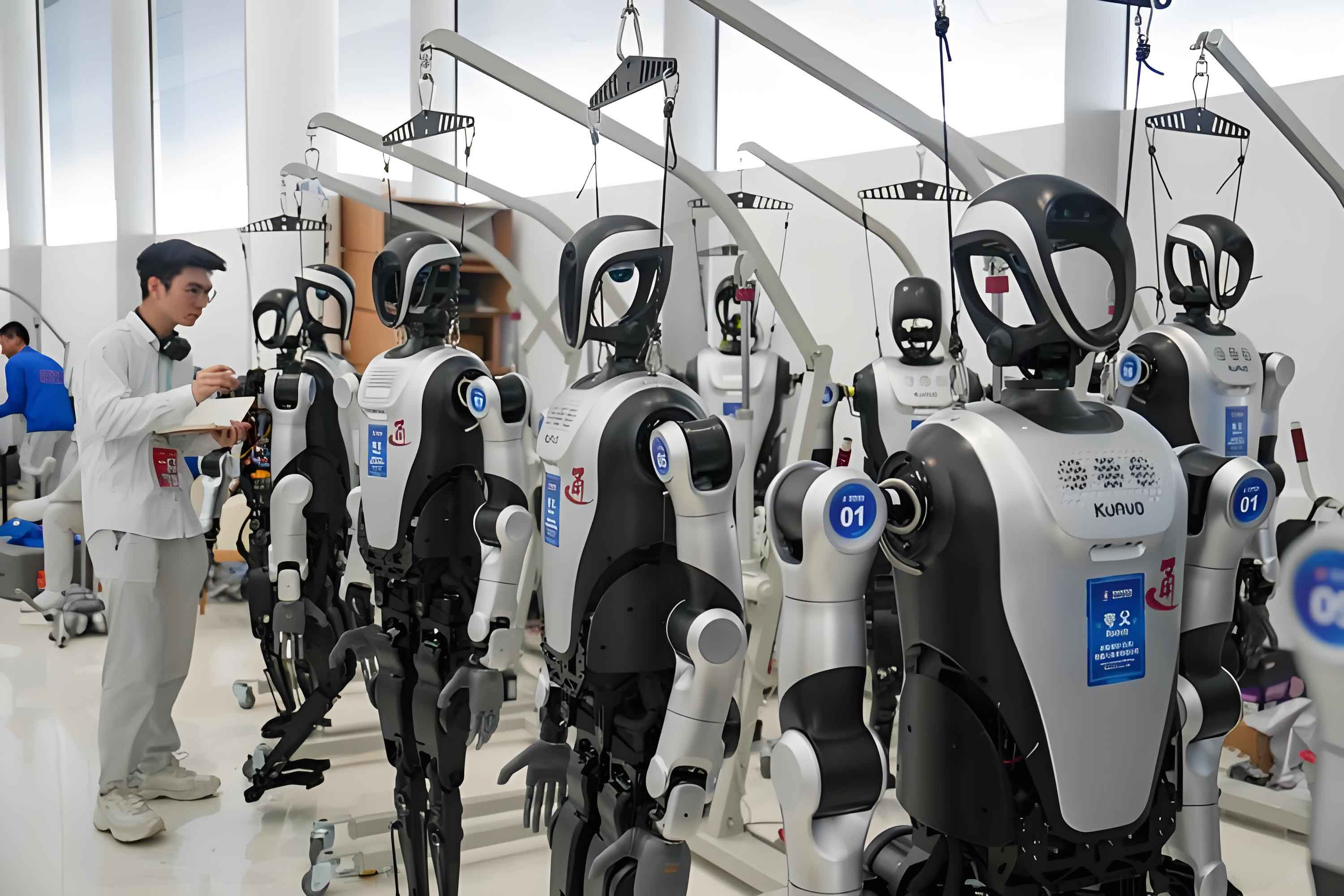
- Humanoid Robot Course Design Emphasizes Modular Topics and Student-Centered Learning
The teaching content is divided, integrated, and reorganized according to the professional foundation knowledge required by the course. Teachers deliver classroom instruction in modular thematic form. Each thematic unit, whether it discusses principles or application examples, is closely combined with the relevant content of the course, and is highly condensed and organized. The course introduces the development history of robots, the system structure of robots, the humanoid robot hardware system, humanoid robot software applications, and humanoid robot assembly and debugging. These topics provide a coherent path for understanding how a humanoid robot is built, programmed, tested, and applied.
Before the thematic lectures, a general introduction to the course is arranged so that students can first grasp the overall system framework, main content, practical methods, and application scenarios of the course. This helps students locate their interests within the course system. On this basis, teachers guide students to move beyond the textbook and connect with reality. Through specific physical demonstrations and multimedia presentations, teachers stimulate students’ interest in learning. Particular attention is paid to keeping teaching content current, pioneering, and innovative. The development origins of various robots, the latest domestic and international research results, and the current state of industry development are integrated into the course content to stimulate students’ innovative vitality.
The humanoid robot training course uses a modular organization because the humanoid robot itself is a complex integrated system. A single humanoid robot task may involve mechanical structure, servo control, communication, programming, vision, and competition rules. By dividing the learning process into modules, the course allows students to build competence step by step. Students first learn basic robot operation and hardware structure, then move to development environments, programming, motion control, vision processing, and finally comprehensive practice. Each module supports the next, and each module requires students to connect humanoid robot theory with humanoid robot operation.
The student-centered design is reflected in the way students choose topics and directions according to their interests. Students can form groups according to thematic units and select different types of humanoid robots and research directions of interest. The course content is jointly determined by college teachers and relevant experts from the robotics company. Teachers combine the current state of humanoid robot technology development to help each thematic group formulate a relevant learning plan, and they provide reference books and experimental operation guides to guide students in autonomous learning. At the same time, corresponding discussion classes and question-and-answer sessions are arranged to improve the learning quality of each thematic group. Autonomous learning does not occupy class hours; class time is used for discussion and question-and-answer sessions. Each discussion class is related to a thematic unit but is not completely limited by it, and discussion takes place interactively between teachers and students and among students.
- Curriculum Content Builds a Complete Humanoid Robot Learning Pathway
The curriculum content builds a complete humanoid robot learning pathway from basic operation to integrated practice. The humanoid robot training course introduces students to robot parameters, hardware structure, desktop software for action debugging, development environment setup, programming fundamentals, robot control through Python, visual processing, and comprehensive task completion. The sequence is designed to make the humanoid robot approachable for students with different backgrounds while maintaining a high level of practical challenge.
In the robot operation basics module, students learn the main parameters of the robot and the hardware structure of the humanoid robot. They also use desktop software to debug actions. This module establishes a direct relationship between the physical humanoid robot and the software interface used to control it. Students observe how commands affect the humanoid robot’s posture, movement, and stability, and they begin to understand the constraints that shape humanoid robot motion.
In the development environment module, students learn how to burn images, acquire basic knowledge of the Linux operating system, install remote connection software, and build a software development environment. These skills are essential for working with the humanoid robot platform and for understanding how software development tools connect to embedded and robotic systems. The humanoid robot is not treated as a closed product; students are expected to understand the development environment that supports humanoid robot programming and testing.
In the Python programming basics module, students study variables and operations, conditional statements, loop statements, functions and objects, and the installation and reference of third-party libraries. Python is used because it provides a practical way to connect high-level programming concepts with humanoid robot control. Students learn how programming structures are used in real humanoid robot tasks, and they prepare for writing programs that control the humanoid robot’s actions.
In the module on writing Python programs to control the robot, students learn the basic logic of Lua programs on the microcontroller, the Python interface and communication method with the robot, and how to run action examples and write simple Python code to control humanoid robot movement. This module marks a shift from understanding the humanoid robot to actively commanding the humanoid robot. Students see how code becomes motion and how communication between software and hardware enables the humanoid robot to perform tasks.
In the visual processing introduction module, students learn about the robot camera and how to read camera data through Python programming. They also learn interfaces in OpenCV, how to call OpenCV methods to realize color and shape recognition, and how to recognize ARtag markers. Visual processing is a critical part of humanoid robot intelligence because it allows the humanoid robot to interpret its environment, identify targets, and adjust behavior. The humanoid robot training course therefore introduces vision as an integrated practical skill rather than as a separate theoretical topic.
The comprehensive practice module requires students to complete a full humanoid robot dance with music within a specified time. The competition field is 3 meters by 3.5 meters. The humanoid robot is required to walk upright through a horizontal bar without touching it; walk upright across a single-plank bridge that is 60 cm long and 30 cm wide, with QR codes at the bridge head and tail as identification marks; walk upright through the middle of a door without touching it, with an inner height of 62 cm, an inner width of 30 cm, and a door frame width of 3 cm, with QR codes near the door frame as identification marks; climb stairs in an upright state, with 3 steps, each 3 cm high, 40 cm wide, and 15 cm long, and a QR code at the first step for identification; and handle a golf ball placed on the road surface, with a hole diameter of 10 cm, a QR code near the hole as an identification mark, and a distance of 50 cm between the hole and the ball. The humanoid robot may make multiple kicking attempts, and after finishing, it executes a bowing gesture to indicate completion of the entire project. This comprehensive practice integrates motion control, vision recognition, task sequencing, and presentation into one humanoid robot challenge.
Table: Aelos Training and AirTag Case Teaching Plan for Humanoid Robot Practice
| No. | Teaching Content | Basic Requirements | Hours |
|---|---|---|---|
| 1 | Robot operation basics | Main parameters of the robot; hardware structure of the humanoid robot; use desktop software for action debugging | 2 class hours |
| 2 | Raspberry Pi development environment setup | Image burning; basic knowledge of the Linux operating system; installation of remote connection software; building a software development environment | 2 class hours |
| 3 | Python programming basics | Variables and operations; conditional statements; loop statements; functions and objects; installation and reference of third-party libraries | 2 class hours |
| 4 | Writing Python programs to control the humanoid robot | Basic logic of Lua programs on the microcontroller; Python interface and communication method with the humanoid robot; running action examples and writing simple Python code to control humanoid robot movement | 2 class hours |
| 5 | Introduction to visual processing | Humanoid robot camera and reading camera data through Python programming; OpenCV interfaces and methods for color and shape recognition; ARtag recognition methods | 2 class hours |
| 6 | Comprehensive practice | Complete a full humanoid robot dance with music within a specified time; field size 3 m by 3.5 m; walk upright through a horizontal bar without touching it; walk upright across a single-plank bridge 60 cm long and 30 cm wide with QR codes at both ends; pass through the middle of a door without touching it, with inner height 62 cm, inner width 30 cm, and door frame width 3 cm, with QR codes near the door frame; climb stairs upright with 3 steps, each 3 cm high, 40 cm wide, and 15 cm long, with a QR code at the first step; handle a golf ball with a hole diameter of 10 cm, a QR code near the hole, and a distance of 50 cm between the hole and the ball; multiple kicks allowed; execute a bowing gesture after completion | 2 weeks |
The teaching plan shows how the humanoid robot training course moves from basic humanoid robot operation to comprehensive humanoid robot practice. The humanoid robot is present throughout the learning pathway, and each module contributes a distinct capability that students need in order to complete the final humanoid robot challenge. The table also reflects the applied nature of the course: students do not merely study humanoid robot concepts; they operate the humanoid robot, program the humanoid robot, use vision with the humanoid robot, and present a completed humanoid robot task.
- Teaching Methods Shift from Passive Instruction to Guided Practice in Humanoid Robot Training
Different from traditional spoon-feeding instruction, the course adopts guided teaching, discussion-based teaching, and other teaching models, with equal emphasis on theory and practice and on hands and brain. The humanoid robot training course requires students to think, operate, test, revise, and explain. The humanoid robot becomes a medium through which students encounter engineering problems and develop solutions. Teachers act as guides and facilitators, while students take greater responsibility for their own learning.
Students can choose different types of humanoid robots and research directions of interest according to their own interests and according to thematic group assignments. The course content is jointly determined by college teachers and relevant experts from the robotics company. This joint determination helps ensure that the humanoid robot training course remains connected to industrial practice and to the current state of humanoid robot technology. Teachers help each thematic group formulate a relevant learning plan based on the current development of humanoid robot technology and provide reference books and experimental operation guides to guide students in autonomous learning.
Discussion classes and question-and-answer sessions are arranged to improve the learning quality of each thematic group. Autonomous learning does not occupy class hours; class time is used for discussion and question-and-answer sessions. Each discussion class is related to a thematic unit but is not completely limited by it. Discussion takes place interactively between teachers and students and among students. This format allows students to raise problems encountered with the humanoid robot, compare solutions, and receive targeted guidance. The humanoid robot training course thus combines independent exploration with structured support.
The teaching method also encourages students to connect humanoid robot practice with broader professional knowledge. Students in software engineering, communication engineering, computer science and technology, and related majors bring different strengths to the humanoid robot training course. Some are more comfortable with programming, some with communication and interfaces, and some with system integration. Group discussion and collaborative work allow these strengths to complement one another. The humanoid robot becomes a shared object of inquiry that requires multidisciplinary coordination.
Teachers also guide students to move from observing the humanoid robot to analyzing the humanoid robot. Students learn to ask why a humanoid robot movement fails, how a sensor reading affects humanoid robot behavior, how vision recognition can support humanoid robot navigation, and how software commands are translated into humanoid robot actions. This analytical habit is central to the course’s emphasis on hands-on ability and innovation and creation capacity. The humanoid robot training course therefore supports both practical skill development and engineering reasoning.
- Assessment Reform Uses Competitions and Reports to Evaluate Humanoid Robot Competence
The course reforms the original assessment method and focuses on examining students’ practical application ability and innovation ability. In the course assessment stage, teachers assign a comprehensive competition. Each thematic group is required to demonstrate its learning results in software and hardware implementation and to submit a corresponding technical report. Each student must report the tasks undertaken in the design and the design results, and answer questions raised by teachers. Teachers score each student separately. The final course score is comprehensively determined according to performance at the competition site and in the results presentation.
This assessment design is closely tied to the humanoid robot training course. The humanoid robot competition requires students to demonstrate not only whether the humanoid robot can complete a task but also whether they understand the design choices behind the humanoid robot’s behavior. The technical report requires students to document their humanoid robot development process, explain their software and hardware implementation, and reflect on the performance of the humanoid robot. The oral defense requires each student to articulate their individual contribution and to respond to technical questions. In this way, assessment evaluates both team outcomes and individual competence.
After the course assessment is completed, excellent groups are recommended to participate in relevant domestic and international competitions and science and technology innovation achievement exhibitions as an extension and expansion of classroom teaching. Promoting teaching through competition and promoting learning through competition allows students to better understand the direction of technological innovation, the trend of dynamic development, and frontier science and technology. These activities broaden students’ horizons and help them establish career directions. The humanoid robot training course thus extends beyond the classroom and connects students with broader communities of practice.
The assessment reform also reinforces the course’s student-centered approach. Because students know that they must demonstrate and explain their humanoid robot work, they are encouraged to take ownership of their learning. They must plan, test, debug, document, and present. The humanoid robot becomes the focus of a complete engineering cycle rather than a one-time classroom demonstration. The humanoid robot training course uses assessment to promote serious engagement with humanoid robot technology and with the collaborative process of humanoid robot development.
- Humanoid Robot Training Outcomes and Future Development
Through innovation in collaboration models, course content organization, teaching methods, and assessment methods, the university has reformed its original curriculum system and carried out teaching reform and practice for the humanoid robot training course. The latest enterprise humanoid robot technology has been brought into the classroom and integrated into the course. Practice has shown that the new teaching model effectively stimulates students’ interest in learning and enhances teaching effectiveness. Students’ learning enthusiasm has increased, and they have achieved strong results in various competitions. The overall hands-on ability and innovation and creation capacity of students have been improved.
The humanoid robot training course demonstrates how a humanoid robot can serve as an integrating platform for applied education. The humanoid robot connects mechanical structure, electronic control, software development, vision processing, and task execution. Students who study the humanoid robot are not limited to a single discipline; they learn to coordinate multiple layers of a humanoid robot system. The humanoid robot training course therefore supports the development of application-oriented, composite, and innovative talent, which is aligned with modern industrial needs and with the demand for humanoid robot professionals.
In the future, the college will continue to improve the course teaching syllabus, practical training guide, lecture presentation materials, and other teaching resources. It will deepen industry-education integration and cultivate more high-quality specialized talent that meets market demand. The humanoid robot training course will remain focused on the humanoid robot as a platform for practical innovation, and it will continue to integrate new humanoid robot technologies, new humanoid robot applications, and new humanoid robot development methods into teaching. The collaboration between the college and the robotics company provides a foundation for further development of the humanoid robot training course and for broader cooperation in humanoid robot education.
The humanoid robot field continues to evolve, and the humanoid robot training course is designed to evolve with it. By combining enterprise humanoid robot technology with applied teaching, the course gives students access to current tools and real humanoid robot tasks. The humanoid robot training course also creates a pathway for students to participate in competitions, exhibitions, and collaborative projects. As the humanoid robot industry develops, the demand for professionals who understand humanoid robot systems, humanoid robot software, humanoid robot vision, and humanoid robot integration is expected to remain strong. The humanoid robot training course represents a practical response to that demand, and it demonstrates how industry-university collaboration can support humanoid robot education, humanoid robot innovation, and humanoid robot talent cultivation.