
The image of a humanoid robot sprinting down a straight track has become one of the most visible symbols of the current robotics era. Its stride is clean, its joints are precise, and its speed is no longer a mere laboratory demonstration. The humanoid robot can now reach velocities that were once treated as the exclusive property of trained human athletes. Yet the most important part of the story does not begin on the straight. It begins at the turn.
A human sprinter approaching a bend does not calculate every angle consciously. The body adjusts, the stride shortens or lengthens, the torso leans, the muscles absorb force, and the inner ear, cerebellum, and sensory feedback systems cooperate in a loop that is almost invisible to the athlete. The humanoid robot has no such inherited wisdom. It must sense, compute, and actuate in real time. When speed rises, every small delay in that chain becomes larger. A humanoid robot that looks flawless on a straight line can lose balance at a curve, drift off the lane, or fall heavily. The contrast is not a minor engineering detail. It is a precise portrait of how far the humanoid robot has come and how much further it must go.
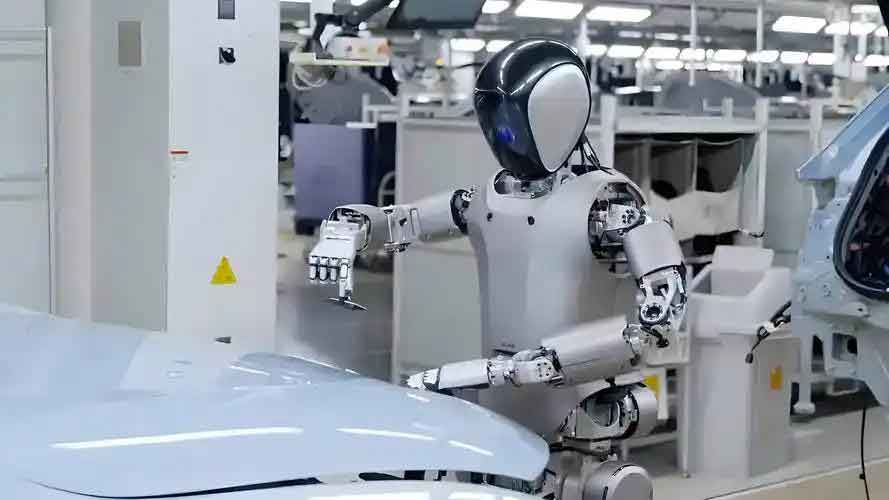
The rise of the humanoid robot is often described in the language of records. A machine outruns a human, and the headline writes itself. But speed is only one dimension of human capability, and it is only one dimension of machine capability. The humanoid robot may be faster on a straight track, yet the human body remains a remarkable model of energy recovery, balance, adaptation, and prediction. The humanoid robot can reproduce parts of that model with motors, sensors, and algorithms, but it cannot yet reproduce the whole. The gap is most visible when the environment stops being predictable.
This news feature examines that gap. It considers the humanoid robot as an engineering project, a commercial opportunity, and a social question. It looks at why turning is harder than sprinting, why the human body remains such a demanding benchmark, what barriers remain before a humanoid robot can become a more understanding partner, and why the final responsibility for the humanoid robot must remain human.
- Key observation: straight-line speed demonstrates the humanoid robot’s motor and control progress.
- Key observation: cornering exposes the humanoid robot’s dependence on sensing, computation, and balance control.
- Key observation: the human body offers a model of energy recovery and predictive movement that the humanoid robot still struggles to match.
- Key observation: understanding people requires more than movement; the humanoid robot must handle language, context, memory, action, and value boundaries.
- Key observation: industrial ecosystems can accelerate the humanoid robot, but human responsibility must remain the final safeguard.
1. The sprint record and the humanoid robot baseline
Human sprinting is a brief and intense expression of biological evolution. The nervous system recruits muscle fibers, the skeleton transfers force, the tendons store and release energy, and the metabolism supports the effort. The result is a peak output produced by a body that must also protect itself from damage. The human athlete cannot simply increase power without regard for joints, ligaments, and recovery. The body is a compromise between performance and durability.
The humanoid robot begins from a different premise. Its designers do not need to negotiate with biological tissue. They can choose motors with high power density, joints with fast response, and structures that are engineered for repeated stress. The humanoid robot does not need to preserve a living metabolism. It needs electricity, control, and maintenance. This difference explains why the humanoid robot can overtake human sprinting records without implying that it has overtaken human movement in general.
The humanoid robot’s sprint is a systems achievement. It reflects the quality of actuators, the stiffness and weight of the frame, the grip of the feet, the speed of the controller, and the reliability of the sensors. A fast humanoid robot is not fast because it has discovered a new principle of motion. It is fast because many engineering constraints have been pushed outward at the same time. The record is real, but it is a record of component performance and integration.
That is why the humanoid robot’s sprint should be read with precision. It is a landmark, not a conclusion. The humanoid robot can run faster than a human on a prepared surface, but it cannot yet match the human ability to run through a crowded street, step over an unexpected obstacle, recover from a slip, or change direction without losing momentum. The humanoid robot’s straight-line success makes the next problem more urgent, not less: how does the humanoid robot control its body when the path is no longer straight?
The humanoid robot is also entering a phase in which progress is no longer defined by a single dramatic demonstration. Each advance depends on the next material, the next control algorithm, the next power source, the next manufacturing process, or the next model update. The humanoid robot improves on an engineering timetable, not on a biological one. That timetable can move quickly, but it still requires the integration of many disciplines. A humanoid robot that runs well is therefore a platform for further work, not a finished product.
The public sees the humanoid robot sprint and imagines a future in which machines surpass human physical limits across the board. The engineering reality is more specific. The humanoid robot has surpassed a narrow human record under controlled conditions. The human body still exceeds the humanoid robot in adaptability, energy efficiency, self-repair, and learned movement. The humanoid robot can be faster, but it is not yet more capable in the round.
2. The turn reveals the humanoid robot’s control problem
A curve is a test of control. On a straight line, the humanoid robot can focus on forward propulsion. At a turn, the humanoid robot must manage centripetal force, body lean, foot placement, joint coordination, and speed reduction. The humanoid robot must estimate its center of mass and predict how that center will move as each foot lands. The humanoid robot must also decide how much speed to sacrifice and how much balance margin to preserve. These decisions are not separate. They form a continuous loop.
For a human athlete, much of this loop is automatic. The vestibular system detects changes in orientation. The cerebellum adjusts timing. The muscles respond to feedback. The runner may think about strategy, but the body handles much of the mechanics. The humanoid robot has no equivalent inherited loop. It must build that loop from sensors, models, and control software. The humanoid robot’s balance is not a natural gift. It is a computation.
At high speed, computation becomes fragile. A small delay in sensor data can produce a late correction. A small error in the estimated center of mass can produce an excessive lean. A small mismatch between the planned foot placement and the actual contact can produce a slip. The humanoid robot may have enough power to run quickly, but power without timely control becomes a liability. The faster the humanoid robot moves, the less time it has to correct a mistake.
This is why spectators see such striking failures. A humanoid robot may lead on the straight and then fall at the bend. Another humanoid robot may show impressive acceleration and then lose direction at the turn. These failures are not embarrassing accidents. They are diagnostic events. They show where the humanoid robot’s sensing, modeling, and actuation are not yet tightly coupled enough. They show that the humanoid robot’s speed has outpaced its balance intelligence.
The humanoid robot’s difficulty at the turn also reveals a broader truth about robotics. Motion is not a single skill. It is a hierarchy of skills. The humanoid robot must be able to move, stop, turn, recover, and adapt. Each layer depends on the layers below. A humanoid robot that can sprint but cannot turn is like a machine that can produce power but cannot direct it. The engineering challenge is to make the humanoid robot’s body and control system work as one integrated system.
The humanoid robot’s balance problem is especially demanding because the machine must operate in the physical world. Simulation can test many scenarios, but the real world contains uneven surfaces, unexpected contacts, sensor noise, and changing friction. The humanoid robot must handle all of these without human intervention. A human can use experience to recover from a stumble. The humanoid robot must use algorithms to detect the stumble and plan a recovery. That recovery must happen in milliseconds, not in a post-event analysis.
The humanoid robot’s turning problem is therefore not a footnote to the sprint. It is the main story. Straight-line speed shows what the humanoid robot can do when the environment is simplified. Turning shows what the humanoid robot must do when the environment becomes real. The humanoid robot’s future depends on closing that gap.
3. The human body as a closed-loop engineering benchmark
The human body is often described as a product of evolution, but from an engineering perspective it is also a highly integrated machine. The skeleton acts as a system of levers. The tendons store elastic energy and release it during movement. The muscles provide force and absorb shock. The foot arch and the hip muscles provide suspension and lateral stability. The brain and cerebellum predict and adjust. The human body does not merely move. It moves while managing energy, balance, and risk.
One of the most instructive examples is running. The human body can recover a substantial share of the elastic energy from each landing. This recovery helps the runner rebound with less additional effort. The humanoid robot does not have the same biological spring. Its motors and joints must supply the force more directly. The humanoid robot can be designed with compliant elements, but the integration of those elements with control and power remains difficult. The humanoid robot’s efficiency is therefore not only a battery problem. It is a biomechanics problem.
The human body also functions as an adaptive suspension system. The arch of the foot can absorb impact. The muscles around the hip can resist unwanted side-to-side motion. The body makes hundreds of small adjustments during running, and the runner is often unaware of them. The humanoid robot must reproduce these adjustments through sensors and actuators. The humanoid robot must detect the need for correction and apply it without destabilizing another part of the body. The humanoid robot’s balance is a whole-body problem, not a foot problem alone.
The human brain adds another layer. The cerebellum and basal ganglia can anticipate conditions before the foot lands. The body prepares joint stiffness and muscle tone in advance. The human runner is not only reacting to the ground. The human runner is predicting the ground. This predictive control is a combination of feedforward and feedback. The humanoid robot can implement similar ideas, but the humanoid robot must do so with models that are never perfectly accurate and sensors that are never perfectly clean.
The human body’s advantage is not that it is infinitely strong. Its advantage is that it is deeply integrated. The human body’s sensing, prediction, actuation, and energy management are woven together. The humanoid robot’s subsystems are often developed separately. The humanoid robot’s vision system, balance controller, motor driver, and planning module must be integrated into a coherent whole. Integration is where many humanoid robot programs encounter their hardest problems.
The comparison should not lead to the conclusion that the humanoid robot is doomed to fall short. It should lead to a clearer understanding of what the humanoid robot must achieve. The humanoid robot does not need to copy biology exactly. The humanoid robot needs to achieve comparable outcomes through engineering. The humanoid robot can use better sensors, faster processors, and different actuator designs. But the humanoid robot must still solve the same physical problems: how to stand, how to move, how to stop, how to turn, and how to recover.
The human body is therefore a benchmark, not a competitor. The humanoid robot that can learn from that benchmark will be more capable. The humanoid robot that treats speed as the only measure will remain fragile. The humanoid robot’s next stage of development must be judged by its ability to handle complexity, not just by its ability to win a straight-line race.
| Dimension | Human athlete | Humanoid robot | Editorial takeaway |
|---|---|---|---|
| Straight-line speed | Produced through muscle recruitment, skeletal leverage, and metabolic effort | Produced through motor power density, joint response, and ground grip | The humanoid robot can surpass a narrow human record under controlled conditions. |
| Cornering and balance | Uses vestibular sensing, cerebellar prediction, and automatic muscle adjustment | Uses sensors, state estimation, and real-time control algorithms | The humanoid robot’s turning ability exposes the limits of current control integration. |
| Energy recovery | Uses tendons and elastic tissues to recover part of the energy from each landing | Relies on motors, joints, and power systems for most force production | The humanoid robot must improve efficiency as well as peak power. |
| Adaptation to terrain | Learns from experience and adjusts posture with little conscious effort | Depends on models, training data, and sensor robustness | The humanoid robot must handle unpredictable surfaces, not only prepared tracks. |
| Recovery from failure | Can often regain balance through trained reflexes and experience | Must detect instability and plan a recovery in real time | The humanoid robot’s value depends on resilience, not only performance. |
| Understanding people | Uses language, context, memory, and social judgment | Must integrate multimodal signals, context, memory, and safety boundaries | The humanoid robot cannot become a true partner until it can interpret human meaning. |
| Final responsibility | Human judgment and accountability remain central | The humanoid robot can execute, but cannot bear moral responsibility | Human oversight must remain the final boundary for the humanoid robot. |
4. From balance to understanding: five hurdles for the humanoid robot
The humanoid robot’s challenges do not end with movement. If the humanoid robot is to become a partner rather than a tool, it must understand people. That shift introduces a different set of problems. Movement is physical. Understanding is contextual. The humanoid robot must interpret speech, gesture, expression, tone, and situation. The humanoid robot must also know when not to act. According to AI expert Lu Jiwen, at least five hurdles remain before the humanoid robot can become more genuinely people-aware.
- Multimodal signals are unstable in real environments. The humanoid robot may perform well in a laboratory, but lighting, occlusion, accents, and noise can reduce accuracy. The humanoid robot must combine vision, audio, and other signals without becoming confused by imperfect input.
- Context and individual differences change meaning. The same silence, gesture, or expression can mean different things to different people and in different cultures. The humanoid robot must avoid treating one interpretation as universal.
- Long-term memory must be useful without becoming intrusive. The humanoid robot should remember helpful information, but it must not create false labels or accumulate private data without limit. The humanoid robot’s memory system must be selective, transparent, and safe.
- Understanding must lead to action. Verbal comfort is not the same as safe physical behavior. The humanoid robot must close the loop between interpreting a situation and acting in the physical world with appropriate restraint.
- Value and safety boundaries must be explicit. The humanoid robot must know when to stop an interaction, when to suggest contacting family or a professional, and how to avoid flattery, manipulation, and harmful advice.
These five hurdles show why the humanoid robot cannot be judged only by movement. A humanoid robot that can run and turn is impressive, but a humanoid robot that can understand a person’s distress and respond appropriately is a different kind of achievement. The humanoid robot must combine motor competence with social competence. The humanoid robot must also combine social competence with restraint.
The first hurdle is technical. The humanoid robot’s sensors must work in messy conditions. The second hurdle is cultural and psychological. The humanoid robot’s interpretation must be sensitive to difference. The third hurdle is architectural. The humanoid robot’s memory must be designed with privacy and relevance in mind. The fourth hurdle is embodied. The humanoid robot’s understanding must translate into safe action. The fifth hurdle is ethical. The humanoid robot’s behavior must be bounded by human values.
Each hurdle reinforces the others. A humanoid robot with poor multimodal perception will make poor context judgments. A humanoid robot with poor memory will repeat mistakes or miss important history. A humanoid robot with poor action boundaries may comfort someone verbally and then act in an unsafe way. A humanoid robot with weak value boundaries may optimize for approval rather than well-being. The humanoid robot’s development must therefore be treated as an integrated program, not a collection of separate demos.
The humanoid robot’s move from the track to the home, hospital, factory, or public space raises the stakes. In a factory, a humanoid robot’s mistake may damage equipment. In a home, a humanoid robot’s mistake may affect a vulnerable person. In a public space, a humanoid robot’s mistake may create confusion or distrust. The humanoid robot’s physical capabilities must be matched by its ability to recognize limits. The humanoid robot must know what it does not know.
The humanoid robot’s social role also depends on trust. People will not accept a humanoid robot that seems unpredictable or intrusive. The humanoid robot must communicate its intentions, explain its actions, and accept correction. The humanoid robot must be designed to defer when the situation exceeds its competence. The humanoid robot’s usefulness will grow only if its boundaries are clear.
5. China’s ecosystem and the humanoid robot’s industrial transition
The humanoid robot is not developing in isolation. It is part of a broader push in embodied intelligence, where artificial intelligence is connected to physical bodies and real-world action. China’s progress in this field reflects a combination of national strategy, industrial ecosystem, and AI technology. The humanoid robot is one of the most visible expressions of that combination.
Policy has provided direction. The “Made in China 2025” initiative identified robotics as a priority. In 2025, embodied intelligence was included in the Government Work Report for the first time. These signals matter because the humanoid robot requires long-term investment in materials, components, software, testing, and safety. The humanoid robot cannot be built by a single laboratory alone. It needs a supply chain and a market.
China’s industrial base provides advantages for the humanoid robot. A complete supply chain can support rapid iteration and cost reduction. Experience from the industrial robot era provides integration know-how. The humanoid robot can draw on expertise in motors, reducers, sensors, batteries, manufacturing, and system integration. This ecosystem can help move the humanoid robot from demonstration to deployment.
The AI dimension is equally important. Large models and multimodal technologies can give the humanoid robot a stronger ability to understand language, recognize objects, and plan actions. The humanoid robot can move from being a preprogrammed machine to a more adaptive agent. The humanoid robot can become a colleague on a production line, a helper in a service setting, or a companion in a care context. But the humanoid robot’s intelligence must be grounded in safety and accountability.
The industrial transition also changes the humanoid robot’s design priorities. A laboratory humanoid robot may prioritize a dramatic demonstration. A commercial humanoid robot must prioritize reliability, maintainability, cost, and safety. The humanoid robot must work for long hours, handle variable conditions, and be repaired when something fails. The humanoid robot must be understood by its operators and trusted by the people around it.
The humanoid robot’s supply chain is not only a manufacturing issue. It is a governance issue. The humanoid robot’s components may come from many suppliers. The humanoid robot’s software may be updated remotely. The humanoid robot’s data may be collected and processed. The humanoid robot’s safety must be ensured across all these layers. The humanoid robot cannot be treated as a standalone product when its risks are distributed across a network.
The humanoid robot’s progress in China should therefore be read as a systems story. Policy creates direction. Industry creates capacity. AI creates capability. But the humanoid robot’s success will depend on whether these forces are aligned with human needs. The humanoid robot must not become an end in itself. The humanoid robot must remain a means of extending human capability.
6. Responsibility and the limits of delegation to a humanoid robot
The humanoid robot can execute instructions. It can move, sense, calculate, and act. It can even appear to make judgments. But the humanoid robot cannot bear final responsibility. The humanoid robot cannot be held accountable in the moral or legal sense. The humanoid robot’s actions must be attributed to human designers, operators, owners, and institutions. This is the fundamental boundary between people and machines.
The humanoid robot’s execution of an instruction is not the same as a human decision. The humanoid robot may optimize for a goal, but it does not understand the full meaning of that goal. The humanoid robot may follow a rule, but it does not understand why the rule exists. The humanoid robot may produce a recommendation, but it cannot take responsibility for the consequences. The humanoid robot’s role must therefore be framed as delegated action under human oversight.
This boundary becomes more important as the humanoid robot becomes more capable. A simple humanoid robot that performs a repetitive task has limited scope. A humanoid robot that interacts with people, handles private information, or operates in sensitive environments has a much wider scope. The humanoid robot’s autonomy must be matched by human accountability. The humanoid robot’s speed must be matched by human judgment.
The humanoid robot’s value boundaries must be designed, not left to chance. The humanoid robot must know when to stop. The humanoid robot must know when to ask for help. The humanoid robot must know when to defer to a human. The humanoid robot must avoid manipulation, false reassurance, and harmful advice. These requirements are not optional features. They are conditions for the humanoid robot’s acceptance.
The humanoid robot also raises questions about work and purpose. The humanoid robot can take over repetitive, dangerous, or physically demanding tasks. That can free people to focus on higher-level work. But the humanoid robot can also displace workers or change the nature of employment. The humanoid robot’s benefits must be distributed fairly. The humanoid robot’s risks must be managed openly. The humanoid robot’s development must include social dialogue, not only engineering breakthroughs.
The humanoid robot’s ultimate purpose should be to extend human capability, not to replace human responsibility. The humanoid robot can be a tool, a colleague, or a partner. It cannot be the final decision-maker. The humanoid robot can help people make better choices, but people must remain the authors of those choices. The humanoid robot’s intelligence must be oriented toward human well-being.
The humanoid robot’s ability to turn is a technical milestone. The humanoid robot’s ability to choose where to turn is a human responsibility. That distinction must remain clear. The humanoid robot can calculate a path. It cannot decide what path is worth taking. The humanoid robot can optimize a route. It cannot define the values that make a route good.
7. The next answer: the humanoid robot turns, humanity chooses direction
The humanoid robot’s progress invites both excitement and caution. The excitement is justified. The humanoid robot can run faster, move more precisely, and perform tasks that are difficult or dangerous for people. The humanoid robot can become a platform for new services, new industries, and new forms of assistance. The humanoid robot can help people overcome physical limits and expand what is possible.
The caution is also justified. The humanoid robot is still fragile in complex environments. The humanoid robot still struggles with balance, adaptation, understanding, and responsibility. The humanoid robot’s failures are not only technical. They are also social and ethical. The humanoid robot must be developed with humility. The humanoid robot must be tested against real-world conditions. The humanoid robot must be governed by clear rules.
The humanoid robot’s sprint record is a useful reminder of how far engineering has come. The humanoid robot’s stumble at the turn is a useful reminder of how much remains. The humanoid robot should not be judged by a single demonstration. The humanoid robot should be judged by its ability to operate safely, reliably, and respectfully in the human world. The humanoid robot’s value is not only in what it can do. It is also in what it refuses to do.
The humanoid robot’s future will depend on the integration of many fields. Materials science can make the humanoid robot lighter and stronger. Control theory can make the humanoid robot more stable. AI can make the humanoid robot more perceptive. Design can make the humanoid robot more understandable. Policy can make the humanoid robot more accountable. No single advance will solve all problems. The humanoid robot’s progress will be cumulative.
The humanoid robot’s relationship with people will also evolve. At first, the humanoid robot may be seen as a machine. Later, the humanoid robot may be seen as a tool with social presence. Eventually, the humanoid robot may be seen as a partner in specific contexts. That transition must be earned. The humanoid robot must demonstrate competence, safety, and respect. The humanoid robot must not demand trust before it has earned it.
The humanoid robot’s most important lesson may be about human beings. The humanoid robot shows how extraordinary the human body is. The humanoid robot shows how deeply human intelligence is connected to the body, the senses, and the social world. The humanoid robot shows that speed is only one measure of ability. The humanoid robot shows that responsibility cannot be automated away. The humanoid robot is a mirror as much as a machine.
When the humanoid robot learns to turn, it will have achieved a major engineering goal. But the human question will remain: where should the humanoid robot turn, and why? The humanoid robot can supply power. It can supply precision. It can supply computation. It cannot supply the final purpose. That purpose must come from people. The humanoid robot can write motion into code. Humanity must write the answer into the direction.
The humanoid robot’s next chapter will not be written by speed alone. It will be written by balance, understanding, trust, and accountability. The humanoid robot that can turn without falling will be impressive. The humanoid robot that can turn toward human well-being will be significant. The difference between the two is the difference between a machine that moves and a technology that belongs in human life.