
Planetary roller screw mechanisms represent a highly efficient class of mechanical actuators that convert rotational motion into precise linear motion through the engagement of threaded components. The performance, reliability, and longevity of a planetary roller screw are intrinsically linked to the characteristics of the meshing interfaces between its core elements: the screw, the planetary rollers, and the nut. A critical parameter defining these interfaces is the meshing clearance—the permissible relative movement between contacting thread surfaces before a load is transmitted. This clearance is not a singular value but manifests differently depending on the direction of potential part movement: axially, radially, or circumferentially. A thorough understanding and accurate modeling of these directional clearances are paramount for optimizing the design of planetary roller screw systems for applications demanding high stiffness, precision, and dynamic response. This article presents a detailed, first-principles derivation of the meshing clearance models for a planetary roller screw along all three primary axes, followed by an extensive analysis of how key structural parameters influence these clearances.
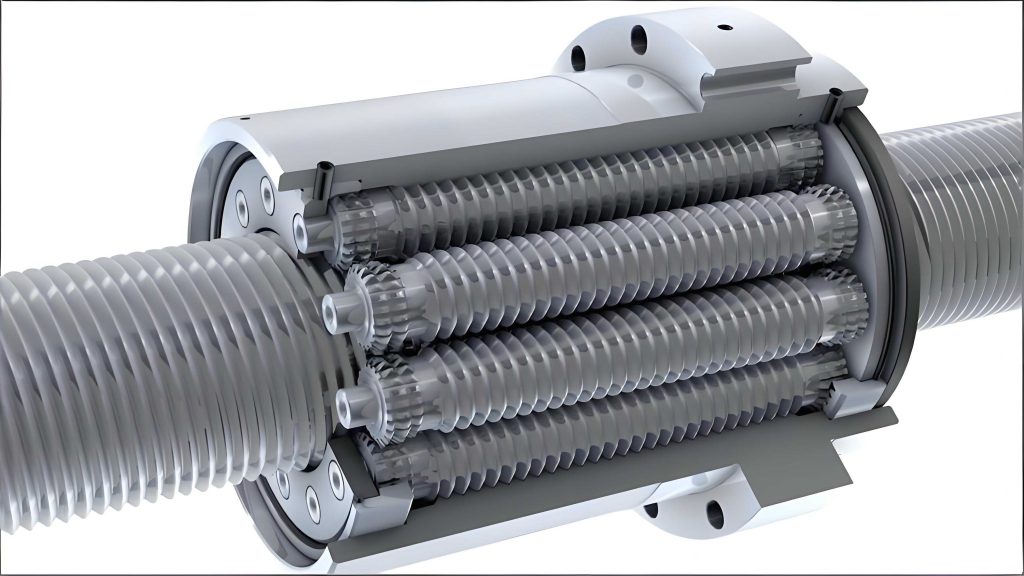
The foundational step in analyzing the meshing behavior of a planetary roller screw is the mathematical description of the helical surfaces that constitute its threads. Each component—screw, roller, and nut—features a thread profile that is swept along a spatial helix. We define component-specific coordinate systems. Let $$O_i-x_i y_i z_i$$ denote the coordinate system fixed to the component, where the subscript $$i = s, r, n$$ corresponds to the screw, roller, and nut, respectively. The thread profile itself is defined in a separate local coordinate system $$O’_i-u_i v_i w_i$$ attached to the helix curve.
The thread profiles for standard trapezoidal forms (for screw and nut) and a circular arc form (for the roller) can be parameterized. For the screw (an external thread), the profile coordinates are:
$$
\begin{cases}
u_s = u’_s \\
v_s = 0 \\
w_s = \zeta_s \left[ -\tan\left(\frac{\beta_s}{2}\right) (u’_s – a_s) + \frac{b_s}{2} \right]
\end{cases}
$$
For the roller (external thread with circular arc profile of radius $$r_{tr}$$), the profile is:
$$
\begin{cases}
u_r = u’_r \\
v_r = 0 \\
w_r = \zeta_r \left( \sqrt{r_{tr}^2 – [u’_r + (r_{mr} – a_r)]^2} + \frac{b_r}{2} – r_{tr} \cos\left(\frac{\beta_r}{2}\right) \right)
\end{cases}
$$
For the nut (an internal thread), the profile is:
$$
\begin{cases}
u_n = u’_n \\
v_n = 0 \\
w_n = \zeta_n \left[ \tan\left(\frac{\beta_n}{2}\right) (u’_n – a_n) + \frac{b_n}{2} \right]
\end{cases}
$$
In these equations, $$a_i$$ is the radial distance from the pitch diameter to the root diameter, $$b_i$$ is the thread tooth thickness at the pitch line, $$\beta_i$$ is the thread flank angle, and $$r_{mi}$$ is the nominal (pitch) radius. The parameter $$\zeta_i$$ takes a value of +1 for the “upper” flank and -1 for the “lower” flank of the thread. The circular arc radius for the roller is defined as $$r_{tr} = r_{mr} / \sin(\beta_r/2)$$.
Transforming these local profile coordinates into the global component coordinates involves a rotation and a helical displacement. The transformation matrix $$\mathbf{H}$$ is:
$$
\mathbf{H} =
\begin{bmatrix}
\cos(\theta_i + \theta_{0i}) & -\sin(\theta_i + \theta_{0i}) & 0 & r_{fi}\cos(\theta_i + \theta_{0i}) \\
\sin(\theta_i + \theta_{0i}) & \cos(\theta_i + \theta_{0i}) & 0 & r_{fi}\sin(\theta_i + \theta_{0i}) \\
0 & 0 & 1 & r_{fi} \theta_i \tan\lambda_i \\
0 & 0 & 0 & 1
\end{bmatrix}
$$
where $$r_{fi} = r_{mi} – a_i$$ is the root radius, $$\theta_i$$ is the angular parameter of the helix, $$\theta_{0i}$$ is the initial phase angle of the thread start, and $$\lambda_i$$ is the lead angle at the root radius, related to the lead $$L_i$$ ($$L_i = n_i p$$, with $$n_i$$ being the number of starts and $$p$$ the pitch) by $$\tan \lambda_i = L_i / (2\pi r_{fi})$$.
Applying this transformation, we obtain the parametric equations for the helical surfaces in their component coordinates. For the screw:
$$
\begin{cases}
x_s = r_s \cos(\theta_s + \theta_{0s}) \\
y_s = r_s \sin(\theta_s + \theta_{0s}) \\
z_s = \zeta_s \left[ -\tan\left(\frac{\beta_s}{2}\right) (r_s – r_{ms}) + \frac{b_s}{2} \right] + r_{fs}\theta_s \tan\lambda_s
\end{cases}
$$
For the roller:
$$
\begin{cases}
x_r = r_r \cos(\theta_r + \theta_{0r}) \\
y_r = r_r \sin(\theta_r + \theta_{0r}) \\
z_r = \zeta_r \left[ \sqrt{r_{tr}^2 – r_r^2} + \frac{b_r}{2} – r_{tr} \cos\left(\frac{\beta_r}{2}\right) \right] + r_{fr}\theta_r \tan\lambda_r
\end{cases}
$$
For the nut:
$$
\begin{cases}
x_n = r_n \cos(\theta_n + \theta_{0n}) \\
y_n = r_n \sin(\theta_n + \theta_{0n}) \\
z_n = \zeta_n \left[ \tan\left(\frac{\beta_n}{2}\right) (r_n – r_{mn}) + \frac{b_n}{2} \right] + r_{fn}\theta_n \tan\lambda_n
\end{cases}
$$
To assemble the complete planetary roller screw model, these component equations must be placed into a common global coordinate system $$O-xyz$$. The screw and nut coordinates are aligned with the global system, while each roller’s coordinate system is offset by its orbital radius $$(r_{mr} + r_{ms})$$ and its orbital phase angle $$\phi_r$$. Considering the multi-start nature and assembly requirements, the initial phase angles are related by $$\theta_{0n} = \theta_{0s} – \pi / n_n$$ and $$\theta_{0r} = \theta_{0s} + (1 – n_s)\phi_r$$, where $$n_s$$ and $$n_n$$ are the number of starts on the screw and nut, respectively.
The final global coordinates for the roller surface, incorporating both its rotation about its own axis and its revolution around the screw, become:
$$
\begin{cases}
x_r = r_r \cos(\theta_r + \theta_{0s} + (1 – n_s)\phi_r) + (r_{mr} + r_{ms}) \cos(\theta_{0s} + \phi_r) \\
y_r = r_r \sin(\theta_r + \theta_{0s} + (1 – n_s)\phi_r) + (r_{mr} + r_{ms}) \sin(\theta_{0s} + \phi_r) \\
z_r = \zeta_r \left[ \sqrt{r_{tr}^2 – r_r^2} + \frac{b_r}{2} – r_{tr} \cos\left(\frac{\beta_r}{2}\right) \right] + r_{fr}\theta_r \tan\lambda_r
\end{cases}
$$
The condition for meshing between two surfaces is based on the principle of the shortest distance along a specified direction of potential relative motion. Consider two surfaces $$\Lambda_1$$ and $$\Lambda_2$$ with points $$Q_1$$ and $$Q_2$$. When the surfaces are moved along a direction vector $$\mathbf{n}_{12}$$ until they are tangent, the connecting vector between the initial contact points must be parallel to $$\mathbf{n}_{12}$$, and the surface normals at these points must be collinear. Mathematically, this is expressed as:
$$
\mathbf{n}_1 = \mu \mathbf{n}_2
$$
$$
\overrightarrow{Q_1 Q_2} = \tau \mathbf{n}_{12}
$$
where $$\mu$$ and $$\tau$$ are scalar coefficients. The distance $$\tau$$ represents the clearance ($$\tau > 0$$) or interference ($$\tau < 0$$) along $$\mathbf{n}_{12}$$ before contact.
To apply this condition, the normal vector to any point on the helical surface is required. It can be derived from the cross product of the partial derivatives of the surface with respect to its parameters $$r_i$$ and $$\theta_i$$. For a general thread form, the components of the unit normal vector (or its direction) are:
$$
\mathbf{n}_i =
\begin{bmatrix}
n^x_i \\
n^y_i \\
n^z_i
\end{bmatrix}
=
\begin{bmatrix}
r_{fi} \tan\lambda_i \sin(\theta_i+\theta_{0i}) + \varepsilon_i \zeta_i r_i \tan(\beta_i/2) \cos(\theta_i+\theta_{0i}) \\
\varepsilon_i \zeta_i r_i \tan(\beta_i/2) \sin(\theta_i+\theta_{0i}) – r_{fi} \tan\lambda_i \cos(\theta_i+\theta_{0i}) \\
r_i
\end{bmatrix}
$$
where $$\varepsilon_i = 1$$ for an external thread (screw, roller) and $$\varepsilon_i = -1$$ for an internal thread (nut).
The axial clearance is the maximum relative displacement possible along the axis of the planetary roller screw (the z-axis) before the threads bear load. The direction vector is $$\mathbf{n}_z = [0, 0, 1]^T$$. We consider two pairs: screw-roller and nut-roller.
For the screw-roller pair, contact occurs between the upper flank of the screw ($$\zeta_s=1$$) and the lower flank of the roller ($$\zeta_r=-1$$), and vice versa. Applying the meshing conditions from the global coordinate equations and the normal vectors, we obtain a system of equations. For the first flank combination ($$\zeta_s=1, \zeta_r=-1$$):
$$
\frac{n^x_s}{n^z_s} = \frac{n^x_r}{n^z_r}, \quad \frac{n^y_s}{n^z_s} = \frac{n^y_r}{n^z_r}, \quad x_s – x_r = 0, \quad y_s – y_r = 0
$$
Solving this system yields the meshing radii $$r^{a}_{s1}$$, $$r^{a}_{rs1}$$ and angles $$\theta^{a}_{s1}$$, $$\theta^{a}_{rs1}$$ for this specific flank pair. The axial gap for this pair, $$\delta^{a}_{sr1}$$, is simply the difference in their z-coordinates at these meshing parameters: $$\delta^{a}_{sr1} = z_s(r^{a}_{s1}, \theta^{a}_{s1}) – z_r(r^{a}_{rs1}, \theta^{a}_{rs1})$$. The process is repeated for the opposite flank combination ($$\zeta_s=-1, \zeta_r=1$$) to find $$\delta^{a}_{sr2}$$. The total nominal axial clearance between the screw and a roller is the sum: $$\delta^{a}_{sr} = \delta^{a}_{sr1} + \delta^{a}_{sr2}$$.
For the nut-roller pair, the procedure is analogous, but noting that the nut is an internal thread ($$\varepsilon_n = -1$$). The meshing conditions are applied between the nut surface and the roller surface in the global frame. For the flank combination where the nut’s lower flank ($$\zeta_n=-1$$) contacts the roller’s upper flank ($$\zeta_r=1$$), we solve:
$$
\frac{n^x_n}{n^z_n} = \frac{n^x_r}{n^z_r}, \quad \frac{n^y_n}{n^z_n} = \frac{n^y_r}{n^z_r}, \quad x_n – x_r = 0, \quad y_n – y_r = 0
$$
This gives the clearance $$\delta^{a}_{nr1}$$. Solving for the opposite combination ($$\zeta_n=1, \zeta_r=-1$$) gives $$\delta^{a}_{nr2}$$. The total axial clearance for the nut-roller pair is $$\delta^{a}_{nr} = \delta^{a}_{nr1} + \delta^{a}_{nr2}$$.
Radial clearance refers to the permissible movement of the roller relative to the screw or nut along the line connecting their centers (the radial direction within the orbital plane). For a roller at an orbital phase $$\phi_r$$, the radial direction vector from the screw center towards the roller center is $$\mathbf{d}_{sr} = [\cos(\theta_{0s}+\phi_r), \sin(\theta_{0s}+\phi_r), 0]^T$$.
For screw-roller radial meshing, the conditions require the normals to be collinear and the displacement vector between meshing points to have components only in this radial direction (with no axial component). This leads to the condition set:
$$
\frac{n^x_s}{n^z_s} = \frac{n^x_r}{n^z_r}, \quad \frac{n^y_s}{n^z_s} = \frac{n^y_r}{n^z_r}, \quad (y_s – y_r) = \sin(\theta_{0s}+\phi_r), \quad z_s – z_r = 0
$$
Solving this system provides the meshing parameters $$r^{r}_{s}$$, $$r^{r}_{rs}$$, $$\theta^{r}_{s}$$, $$\theta^{r}_{rs}$$. The radial clearance $$\delta^{r}_{sr}$$ is then the magnitude of the projection of the vector between the screw and roller meshing points onto the radial direction $$\mathbf{d}_{sr}$$. A simplified expression can be derived from the geometry of the solved points.
For the nut-roller radial clearance, a similar set of conditions is applied, substituting the nut surface equations for the screw’s, resulting in:
$$
\frac{n^x_n}{n^z_n} = \frac{n^x_r}{n^z_r}, \quad \frac{n^y_n}{n^z_n} = \frac{n^y_r}{n^z_r}, \quad (y_n – y_r) = \sin(\theta_{0s}+\phi_r), \quad z_n – z_r = 0
$$
The solution yields the nut-roller radial clearance $$\delta^{r}_{nr}$$.
Circumferential clearance, or backlash, is the allowable relative rotation (torsional movement) between components before thread contact. This is modeled by directly seeking points on the two surfaces that are coincident in space (zero distance) while satisfying the condition of collinear normals. For the screw-roller pair, this means solving:
$$
\frac{n^x_s}{n^z_s} = \frac{n^x_r}{n^z_r}, \quad \frac{n^y_s}{n^z_s} = \frac{n^y_r}{n^z_r}, \quad x_s – x_r = 0, \quad y_s – y_r = 0, \quad z_s – z_r = 0
$$
This is a more constrained system. The angular parameter $$\theta_s$$ or $$\theta_r$$ effectively becomes the measure of clearance. The solution provides two angular differences, $$\delta^{t}_{sr1}$$ and $$\delta^{t}_{sr2}$$, for the two flank pairs. The total circumferential clearance is their sum: $$\delta^{t}_{sr} = \delta^{t}_{sr1} + \delta^{t}_{sr2}$$, typically expressed in radians.
Similarly, for the nut-roller pair, the system is:
$$
\frac{n^x_n}{n^z_n} = \frac{n^x_r}{n^z_r}, \quad \frac{n^y_n}{n^z_n} = \frac{n^y_r}{n^z_r}, \quad x_n – x_r = 0, \quad y_n – y_r = 0, \quad z_n – z_r = 0
$$
Solving this yields the nut-roller circumferential clearance $$\delta^{t}_{nr} = \delta^{t}_{nr1} + \delta^{t}_{nr2}$$.
The clearances in a planetary roller screw are not fixed properties but are highly sensitive to the chosen design parameters. Understanding these relationships is crucial for tailoring a planetary roller screw to specific application requirements, such as minimizing backlash for precision positioning or ensuring adequate clearance for lubrication and thermal expansion.
| Direction | Screw-Roller Clearance Trend | Nut-Roller Clearance Trend | Design Implication |
|---|---|---|---|
| Axial (δa) | Increases, then slightly decreases with larger p. | Increases approximately linearly with p. | A smaller pitch generally reduces axial play, enhancing axial stiffness. |
| Radial (δr) | Trend similar to axial clearance; δr ≈ δa/2. | Trend similar to axial clearance; δr ≈ δa/2. | Radial stiffness is similarly improved with a finer pitch. |
| Circumferential (δt) | Decreases linearly with increasing p. | Remains constant, independent of p. | A larger pitch reduces torsional backlash on the screw side but has no effect on the nut-side torsional play. |
The thread pitch $$p$$ is a fundamental parameter. Its primary effect is to change the lead angle $$\lambda_i$$. Analysis shows that axial and radial clearances are not monotonic with pitch but often exhibit a minimum at a specific value, depending on other parameters. However, a general trend is that finer pitches (smaller $$p$$) tend to reduce axial and radial clearances, thereby increasing stiffness in those directions. Conversely, the circumferential clearance on the screw-roller interface typically decreases with a larger pitch, meaning less rotational backlash per unit of applied torque. The nut-roller circumferential clearance is often independent of pitch due to geometric constraints in the meshing equations.
| Direction | Screw-Roller Clearance Trend | Nut-Roller Clearance Trend | Design Implication |
|---|---|---|---|
| Axial (δa) | Increases with larger β. | Unaffected by β. | A smaller flank angle on the screw reduces axial clearance. Nut flank angle can be chosen based on manufacturing or load distribution without affecting nominal axial play. |
| Radial (δr) | Increases, then plateaus for β > 90°. | Decreases with larger β. | Flank angle has opposing effects on screw-side and nut-side radial clearance, complicating optimization for overall radial stiffness. |
| Circumferential (δt) | Increases with larger β. | Unaffected by β. | Similar to axial clearance, a smaller screw flank angle minimizes torsional backlash. |
The flank angle $$\beta$$ defines the slope of the thread flanks. Its influence is directional and component-specific. For the screw-roller interface, increasing $$\beta$$ generally leads to larger clearances in all three directions. For the nut-roller interface, the axial and circumferential clearances are often independent of the nut’s flank angle in the nominal model, while the radial clearance may decrease with a larger $$\beta$$. This asymmetric effect highlights the complex interaction within the planetary roller screw assembly. A common standard flank angle of 90° offers a balance, but deviations can be used to tune clearances for specific needs, such as preload adjustment.
| Direction | Screw-Roller Clearance Trend | Nut-Roller Clearance Trend | Design Implication |
|---|---|---|---|
| Axial (δa) | Decreases linearly with increasing bs and br. | Decreases linearly with increasing bn and br. | Increasing tooth thickness is the most direct and effective way to reduce all axial clearances, potentially to zero for preloaded designs. |
| Radial (δr) | Decreases with increasing bs and br. | Decreases with increasing bn and br. | Similarly effective for reducing radial play and improving radial stiffness. |
| Circumferential (δt) | Decreases with increasing bs and br. | Decreases with increasing bn and br. | Directly reduces torsional backlash. Increasing tooth thickness is the only parameter change that reliably reduces clearance in all three directions for both interfaces. |
The tooth thickness at the pitch line, $$b_i$$, has the most consistent and predictable influence on meshing clearance. Increasing the tooth thickness on any component (screw, nut, or roller) directly reduces the clearance on both of its engaging interfaces in all three directions: axial, radial, and circumferential. This makes tooth thickness the primary parameter for controlling overall backlash in a planetary roller screw. In practice, deliberately manufacturing components with oversized tooth thickness (or selectively modifying them) is the standard method for achieving preload, which eliminates clearance entirely and creates internal compressive stress to maximize stiffness and eliminate lost motion. The fundamental limit is the avoidance of interference that would prevent assembly, which defines the maximum achievable preload.
Beyond these primary parameters, other factors play a role. The nominal pitch radii $$r_{mi}$$ set the basic geometry of the planetary roller screw. The number of starts affects the lead and the phasing relationships between components. The roller profile radius $$r_{tr}$$, specific to the circular arc profile, directly influences the curvature at the contact point and thus the meshing point location and resulting clearances. Furthermore, all clearance models presented are for the nominal, perfect geometry. In a real planetary roller screw, manufacturing tolerances (on pitch, flank angle, tooth thickness, and roundness), assembly errors (eccentricity, misalignment), and elastic deformations under load will all modify the effective operating clearances. The nominal models provide the essential baseline from which these real-world effects can be analyzed as perturbations.
In conclusion, the meshing behavior of a planetary roller screw is a complex three-dimensional phenomenon characterized by distinct clearances in the axial, radial, and circumferential directions. These clearances arise from the specific geometry of the interacting helical surfaces. Through rigorous mathematical modeling of these surfaces and the application of spatial meshing conditions, it is possible to derive precise formulas for calculating these clearances. The analysis reveals that the meshing points are not necessarily located at the nominal pitch diameters; for instance, the roller-screw meshing point shifts depending on the direction of motion, while the roller-nut meshing point on the roller side often remains at its pitch diameter.
The influence of design parameters is multifaceted and directional. The thread pitch offers a trade-off: a finer pitch generally improves axial and radial stiffness but may increase circumferential backlash. The flank angle has asymmetric effects, often increasing screw-side clearances while leaving nut-side axial/circumferential clearances unaffected or even reducing nut-side radial clearance. The most powerful and consistent design lever is the thread tooth thickness. Increasing the tooth thickness on the screw, nut, or rollers simultaneously reduces clearance in all three directions for the affected meshing interfaces. This makes tooth thickness adjustment the cornerstone of achieving preload in high-performance planetary roller screw applications. Ultimately, optimizing a planetary roller screw requires a holistic view, balancing the effects of these parameters against each other and against manufacturing constraints to achieve the desired combination of stiffness, precision, load capacity, and efficiency for the intended application.