
The disparity in access to advanced medical expertise between urban centers and suburban or remote regions represents a significant global healthcare challenge. This inequality is exacerbated by a well-documented shortage of medical professionals worldwide. In this context, the development of intelligent robotic systems offers a transformative potential. This article presents a detailed account of the research, design, and implementation of a teleoperated medical robot system. The primary objective of this system is to transcend geographical barriers, enabling remote specialist consultation, preliminary diagnosis, and patient monitoring, thereby acting as a force multiplier for skilled healthcare providers.
The conceptualization of this medical robot stems from the need to create a mobile, semi-autonomous platform that can navigate clinical or domestic environments, interact naturally with patients, and establish a seamless telepresence link for a remote clinician. Unlike industrial robots, a medical robot operating in human-centric spaces must prioritize safety, reliability, intuitive interaction, and a non-threatening physical form. The system described herein integrates several key technological domains: autonomous navigation, human-robot interaction (HRI), computer vision, and secure telecommunication.
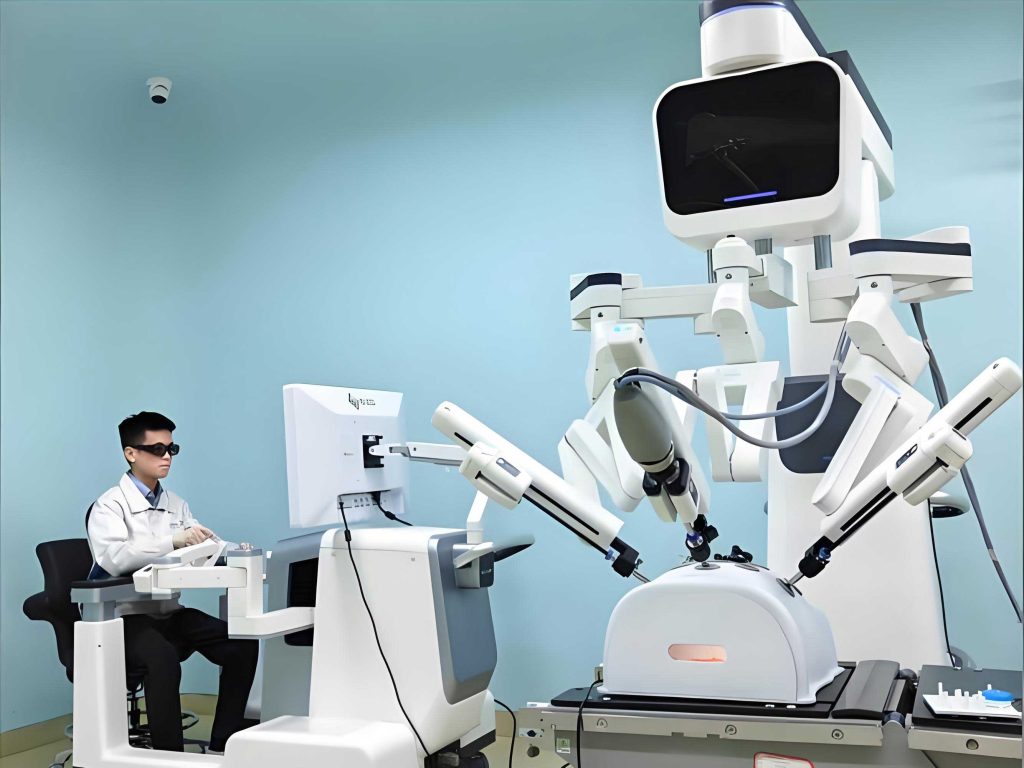
1. Overall System Architecture and Mechanical Design
The design philosophy for this telepresence medical robot was guided by a holistic system approach. The architecture is decomposed into interoperable layers, each with distinct responsibilities, ensuring modularity, scalability, and ease of maintenance.
1.1 Hierarchical System Framework
The robot’s operational intelligence is distributed across several computing units, forming a cohesive network. The high-level decision-making and perception tasks are managed by an industrial PC (IPC), which runs the Robot Operating System (ROS). ROS serves as the middleware, facilitating communication between software nodes responsible for mapping, navigation, and vision processing. This IPC acts as the central “brain.” For low-level real-time control of actuators and direct sensor polling, dedicated microcontroller units (MCUs), specifically STM32 boards, are employed. These ensure robust and timely motor control and hardware safety monitoring. Finally, an Android-based tablet provides the primary user interface (UI) for both local patients and remote operators, handling tasks like video conferencing, touch-based control, and voice interaction. This layered architecture effectively separates concerns, with the IPC handling complex algorithms, the MCUs guaranteeing real-time performance, and the Android tablet offering a rich interactive experience.
| Subsystem | Core Component | Key Specification/Role |
|---|---|---|
| Primary Controller | Industrial PC (IPC) | ROS Master, SLAM, Navigation Stack, High-level Perception |
| Low-level Controller | STM32 Microcontrollers (x2) | Real-time motor control, encoder reading, ultrasonic sensor polling, emergency stop monitoring |
| Human-Robot Interface | Android Tablet | Graphical User Interface (GUI), Voice Interaction, Video Call Client, Patient Data Input |
| Perception (Navigation) | 2D LiDAR (SICK TiM561) | Environment scanning for mapping and obstacle detection, 270° field of view |
| Perception (HRI) | RGB Camera, 6-Microphone Array | Face recognition, visual telepresence, voice capture and beamforming |
| Locomotion | Differential Drive Base with Encoders | Provides omnidirectional mobility in plane, speed range: 0.1 – 1.0 m/s |
| Safety | Ultrasonic Sensors, Software/Emergency Stop Buttons | Proximity detection for low-lying/transparent obstacles, immediate halt capability |
1.2 Mechanical and Industrial Design
The physical embodiment of the medical robot is critical for acceptance and functionality. The chassis utilizes a differential drive configuration, comprising two independently driven main wheels and one or more passive caster wheels for balance. This configuration offers high maneuverability in tight spaces, crucial for navigating corridors and patient rooms. The kinematic model for a differential drive robot is given by:
$$ \begin{bmatrix} \dot{x} \\ \dot{y} \\ \dot{\theta} \end{bmatrix} = \begin{bmatrix} \frac{r}{2} \cos\theta & \frac{r}{2} \cos\theta \\ \frac{r}{2} \sin\theta & \frac{r}{2} \sin\theta \\ -\frac{r}{L} & \frac{r}{L} \end{bmatrix} \begin{bmatrix} \omega_l \\ \omega_r \end{bmatrix} $$
where $(x, y)$ is the robot’s position in the plane, $\theta$ is its orientation, $r$ is the wheel radius, $L$ is the distance between the two driven wheels, and $\omega_l$ and $\omega_r$ are the rotational speeds of the left and right wheels, respectively.
The superstructure houses all electronic components in a secure compartment. A height of approximately 1.5 meters was chosen to facilitate natural eye-level interaction between the robot’s display and a seated or standing adult. The outer shell is designed with rounded edges and a friendly aesthetic to reduce patient anxiety. Key interfaces, such as the touchscreen, camera, and microphone array, are positioned at the front, while maintenance access ports, network connections, and charging contacts are located at the rear or base. An integrated storage compartment allows the medical robot to carry small medical instruments or supplies.
2. Core Subsystem Design: Autonomous Navigation
The ability to move safely and autonomously from one point to another is fundamental for a mobile medical robot. This capability is built upon three pillars: perception (mapping and localization), planning, and control.
2.1 Perception: Simultaneous Localization and Mapping (SLAM)
The primary sensor for navigation is a 2D LiDAR. It provides a 270° scan of the environment, producing a point cloud representing distances to obstacles. The ROS-based navigation stack employs algorithms like Gmapping (which uses a Rao-Blackwellized particle filter) or Cartographer to create a persistent 2D occupancy grid map of the environment. This map, denoted as $M$, where each cell $m_{ij}$ has a probability of being occupied, is the foundation for all subsequent navigation tasks.
Localization is the process of determining the robot’s pose $(x, y, \theta)$ within the pre-built map $M$. The Adaptive Monte Carlo Localization (AMCL) algorithm is widely used for this in ROS. AMCL is a particle filter that estimates the robot’s pose by maintaining a set of weighted samples (particles) representing possible states. The filter integrates motion data from wheel odometry (dead reckoning) and sensor observations $z_t$ from the LiDAR to update the belief state $bel(p_t)$ over time:
$$ bel(p_t) = \eta \cdot p(z_t | p_t, M) \cdot \int p(p_t | p_{t-1}, u_{t-1}) \cdot bel(p_{t-1}) \, dp_{t-1} $$
where $\eta$ is a normalization constant, $p(z_t | p_t, M)$ is the measurement model (likelihood of observation given pose and map), and $p(p_t | p_{t-1}, u_{t-1})$ is the motion model predicting the new pose based on the previous pose and control input $u$.
2.2 Planning and Control
Once localized, the medical robot must plan a path to a goal. This involves global and local planning. The global planner, typically using Dijkstra’s or A* algorithm on the occupancy grid $M$, computes the optimal path $\tau$ from the current pose $p_{start}$ to the goal $p_{goal}$, minimizing a cost function $c(\tau)$ often based on path length:
$$ \tau^* = \arg\min_{\tau} \sum_{i=1}^{n-1} cost(m_{i}, m_{i+1}) $$
The local planner, such as the Dynamic Window Approach (DWA) or Time Elastic Band (TEB), is responsible for generating feasible velocity commands $(v, \omega)$ that follow the global path while actively avoiding unforeseen dynamic obstacles detected by the LiDAR and ultrasonic sensors. The DWA algorithm searches a space of possible velocities $(v, \omega)$ within dynamic constraints (acceleration limits, max speed) and simulates trajectories a short time into the future. It selects the velocity pair that maximizes an objective function $G(v, \omega)$:
$$ G(v, \omega) = \alpha \cdot \text{heading}(v,\omega) + \beta \cdot \text{dist}(v,\omega) + \gamma \cdot \text{velocity}(v,\omega) $$
where $\text{heading}$ measures progress toward the goal, $\text{dist}$ represents the distance to the closest obstacle on the trajectory, and $\text{velocity}$ favors higher speeds. The weights $\alpha, \beta, \gamma$ are tuning parameters. The selected $(v, \omega)$ commands are sent to the low-level STM32 controller, which converts them into PWM signals for the motor drivers, closing the navigation loop.
| Module | Algorithm/Technology | Primary Function |
|---|---|---|
| Mapping | Gmapping / Cartographer (ROS) | Builds a 2D occupancy grid map from LiDAR and odometry data. |
| Localization | Adaptive Monte Carlo Localization (AMCL) | Estimates robot pose within the known map using a particle filter. |
| Global Path Planning | A* Search Algorithm | Finds the minimum-cost path from start to goal on the static map. |
| Local Motion Planning & Obstacle Avoidance | Dynamic Window Approach (DWA) | Generates safe, feasible velocity commands to follow the global path and avoid dynamic obstacles. |
| Low-level Control | PID Controller on STM32 | Accurately tracks the commanded wheel velocities from the high-level planner. |
3. Human-Robot Interaction (HRI) System Design
The efficacy of a medical robot hinges on its ability to interact naturally and effectively with humans. The HRI system, primarily hosted on the Android tablet, encompasses multiple intelligent modules designed to streamline the patient consultation process.
3.1 Multi-Modal Interaction Interface
The interaction begins with a voice-activated wake-word. A six-microphone array enables acoustic beamforming, allowing the medical robot to spatially localize sound sources and enhance speech pickup even in noisy environments. The recognized speech commands for basic navigation (e.g., “go to the reception”) are translated into navigation goals for the ROS system. For more complex tasks, a touch-based graphical interface is always available. This interface provides buttons for calling a specific doctor, accessing medical records, or initiating a symptom checker.
3.2 Electronic Medical Record (EMR) Integration via Face Recognition
Upon initiating a consultation, the robot’s front-facing camera captures the patient’s face. A face recognition pipeline is triggered. First, a face detection algorithm (e.g., based on Haar cascades or a deep neural network) locates the face within the image. Then, a face recognition model, such as one based on Principal Component Analysis (PCA) or more modern embeddings like FaceNet, extracts a compact feature vector $f_{patient}$ from the aligned face region. This vector is compared against a database of registered patient feature vectors $F_{DB} = \{f_1, f_2, …, f_n\}$ associated with their EMRs. The recognition can be formulated as finding the minimal Euclidean distance (or maximal similarity) in the feature space:
$$ ID^* = \arg\min_{i} || f_{patient} – f_i ||^2, \quad \text{for} \quad f_i \in F_{DB} $$
If a match is found ($ID^*$ with distance below a threshold), the corresponding EMR is securely retrieved, providing the remote doctor with immediate access to patient history, allergies, and past treatments. If no match is found, the system can create a new record for the patient.
3.3 Intelligent Symptom Triage (Smart Guidance)
To assist patients who are uncertain about which medical specialist they need, the medical robot incorporates an intelligent triage module. This module uses a probabilistic classification model based on Naïve Bayes. The patient inputs their symptoms $S = \{s_1, s_2, …, s_m\}$ via voice or touchscreen. The system calculates the posterior probability $P(C_k | S)$ that the patient’s condition belongs to medical department $C_k$ (e.g., Cardiology, Dermatology) given the observed symptoms:
$$ P(C_k | S) = \frac{P(C_k) \cdot P(S | C_k)}{P(S)} = \frac{P(C_k) \cdot \prod_{j=1}^{m} P(s_j | C_k)}{P(S)} $$
The Naïve Bayes “naïve” assumption is that symptoms are conditionally independent given the department $C_k$. The priors $P(C_k)$ and likelihoods $P(s_j | C_k)$ are learned from a labeled dataset of historical patient cases. The department with the highest posterior probability is recommended:
$$ C_{recommended} = \arg\max_{k} P(C_k | S) $$
This provides a data-driven, preliminary guidance, improving efficiency before the remote consultation.
| Module | Key Technology | Output/Action |
|---|---|---|
| Voice Interaction | Wake-word detection, ASR (e.g.,科大讯飞), Beamforming | Converts spoken commands to text or system actions. |
| Face Recognition | PCA / Deep Learning-based Feature Extraction & Matching | Patient identification and automatic EMR retrieval/creation. |
| Symptom Triage | Naïve Bayes Classifier | Suggests the most relevant medical department based on input symptoms. |
| Telemedicine Core | WebRTC / Custom Video Conferencing | Establishes low-latency, secure audio-video link between patient and remote doctor. |
| Data Integration | Android Services, ROS Bridge (e.g., rosbridge_suite) | Facilitates communication between Android UI, ROS navigation stack, and cloud/EMR services. |
3.4 Telemedicine Consultation Module
The culmination of the medical robot‘s function is the live teleconsultation. Using the Android tablet’s front-facing camera and display, a secure, low-latency video call is established with a remote healthcare provider. The video feed is transmitted via WebRTC or a similar protocol over a secured internet connection. Crucially, the remote doctor not only sees and hears the patient but can also, through a secure interface, control the robot’s navigation to move closer or adjust the viewing angle. Furthermore, the doctor has access to the patient’s EMR and the symptom analysis from the triage module, all within the same interface. This integrated approach makes the remote consultation highly efficient and context-aware.
4. System Integration and Workflow
The power of this medical robot lies in the seamless integration of its subsystems. A typical operational workflow is as follows:
- Initialization & Standby: The robot boots, initializes all sensors, loads the latest map, and localizes itself. The HRI interface displays a standby screen.
- Patient Approach: A patient or staff member summons the robot via voice command (“Robot, come to room 101”) or a tablet interface. The Android system sends the goal coordinates (corresponding to “room 101”) to the ROS navigation stack via a bridging protocol (e.g., ROSLib for JavaScript/Android).
- Autonomous Navigation: The ROS navigation stack plans and executes the path. The DWA local planner dynamically avoids static and moving obstacles (people, carts) using LiDAR and ultrasonic data. The STM32 controllers faithfully execute motor commands and report odometry back.
- Interaction & Pre-consultation: Upon arrival, the robot orients toward the patient. The patient initiates a consultation via the touchscreen. Face recognition retrieves the EMR. The patient describes symptoms, which are processed by the Naïve Bayes triage model to suggest a specialist department.
- Remote Teleconsultation: The patient selects a recommended or chosen doctor. A video call is connected. The remote doctor reviews the EMR and triage notes, converses with the patient, and may request the robot to maneuver for a better visual examination. Basic vital signs could be integrated via Bluetooth-connected peripherals (not detailed in initial design).
- Conclusion & Return: After the consultation, the robot can be dismissed to a charging station or standby location, either autonomously or via command, completing the service cycle.
This integrated workflow demonstrates how the medical robot functions as a unified system, not just a collection of parts.
| Functional Area | Selected Algorithm | Advantages for Medical Robot Application | Potential Limitations & Considerations |
|---|---|---|---|
| Localization | AMCL (Particle Filter) | Robust to ambiguous environments and global localization; standard in ROS. | Can be computationally heavy; requires tuning of particle counts and noise parameters. |
| Local Planning | Dynamic Window Approach (DWA) | Excellent for dynamic obstacle avoidance; considers robot dynamics and constraints. | May get trapped in local minima in very cluttered spaces; parameter tuning is critical for smooth motion. |
| Face Recognition | Principal Component Analysis (PCA) | Conceptually simple, computationally efficient for smaller databases. | Less robust to lighting, pose variation compared to deep learning methods; requires a well-controlled enrollment process. |
| Symptom Classification | Naïve Bayes Classifier | Simple, fast, works well even with limited data; provides probabilistic output. | Strong independence assumption between symptoms is often medically unrealistic; requires a reliable, labeled training dataset. |
5. Conclusion and Future Directions
This article has presented a comprehensive design study for a teleoperated medical robot system. The architecture successfully integrates autonomous mobility, based on LiDAR SLAM and dynamic planning, with a sophisticated multi-modal HRI system featuring voice control, face recognition for EMR access, and intelligent symptom triage. The use of a layered hardware/software framework (Android, ROS, STM32) ensures robustness and modularity. This medical robot prototype demonstrates a viable pathway toward mitigating geographical healthcare disparities by providing a physical telepresence platform for remote specialists.
Future enhancements to this medical robot system are abundant. The navigation stack could be augmented with 3D vision (e.g., RGB-D cameras) to better understand complex environments, including ramps and doors. The HRI system’s intelligence can be significantly upgraded by replacing traditional algorithms with deep learning models: using Convolutional Neural Networks (CNNs) for more robust face recognition and symptom analysis from visual cues, and employing Recurrent Neural Networks (RNNs) or Transformers for more natural and context-aware dialogue management. From a clinical perspective, integration with standardized hospital information systems (HIS) and Electronic Health Record (EHR) platforms is essential for real-world deployment. Furthermore, equipping the medical robot with certified, plug-and-play medical peripherals (digital stethoscopes, otoscopes, high-resolution examination cameras) would expand its diagnostic capabilities, making the remote examination more comprehensive. Finally, rigorous clinical trials and user experience studies with both patients and healthcare providers are necessary to validate the system’s efficacy, safety, and acceptability, driving the evolution of the medical robot from a technical prototype to a trusted clinical tool.