
The planetary roller screw is a sophisticated mechanical actuator that excels in converting rotational motion into high-force, high-precision linear motion. Its superior load capacity, longevity, and accuracy compared to traditional ball screws have cemented its role in critical applications such as aerospace flight control, heavy-duty industrial automation, and advanced medical robotics. The core of its performance lies in the complex, multi-body interaction between the central screw, the array of planetary rollers, and the surrounding nut. The geometric harmony and structural integrity of these components are paramount. Therefore, a systematic approach to optimizing the structural parameters of the planetary roller screw is not merely an academic exercise but a practical necessity for achieving compact, efficient, and reliable designs. This article presents a holistic optimization framework that integrates detailed geometric modeling, static load analysis, and a modern metaheuristic algorithm to determine the optimal set of design parameters for a given operational load.
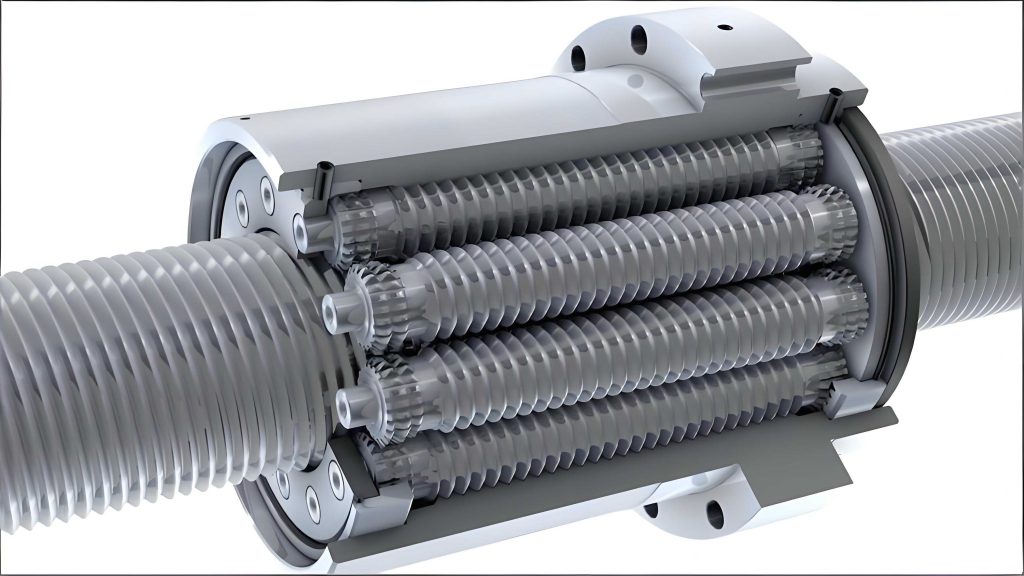
The fundamental operation of a planetary roller screw relies on precise kinematic constraints. The screw, rollers, and nut feature threads with the same hand and, critically, an identical pitch \( P \). To ensure a constant transmission ratio and prevent relative axial displacement between the rollers and the nut, the number of thread starts on the screw \( n_s \) and the nut \( n_n \) are made equal. For a standard planetary roller screw configuration, when the screw completes one revolution, the net axial displacement of a roller relative to the screw is zero, combining its planetary and spinning motions. This leads to the foundational geometric relationships governing the pitch diameters:
$$ n_s = n_n $$
$$ n_s = \frac{d_s}{d_r} + 2 $$
$$ d_n = d_s + 2d_r = n_s d_r $$
where \( d_s \), \( d_r \), and \( d_n \) are the pitch diameters of the screw, roller, and nut, respectively. The lead angles for each component are derived as:
$$ \tan \lambda_s = \frac{n_s P}{\pi d_s}, \quad \tan \lambda_r = \frac{P}{\pi d_r}, \quad \tan \lambda_n = \frac{n_n P}{\pi d_n} $$
From the equations above, it follows that \( \lambda_n = \lambda_r \).
Geometric Modeling and Meshing Conditions
Accurate modeling of the thread profiles is essential for analyzing the meshing behavior and ensuring zero-backlash operation in a planetary roller screw. Typically, the screw and nut threads have trapezoidal profiles defined by a thread angle \( \beta \), while the roller thread profile is often circular with a radius \( r_{tr} \) to reduce stress concentration. The surface of each thread is a helix generated by sweeping its profile along a helical path.
Defining a global coordinate system \( O-x_iy_iz_i \) and a local profile coordinate system \( O’-u_i v_i w_i \) for each component (where \( i = s, r, n \)), the profile curves can be mathematically described. For the screw (s) and nut (n) with trapezoidal profiles, the profile in its local coordinates is a straight line:
$$ w_s = \zeta_s \left[ -\tan\beta_s (v_s – b_s) + \frac{c_s}{2} \right] $$
$$ w_n = \zeta_n \tan\beta_n v_n $$
For the roller (r) with a circular profile of radius \( r_{tr} \), the profile is an arc:
$$ w_r = \zeta_r \left[ \sqrt{ r_{tr}^2 – (v_r + r_r – b_r)^2 } + b_r – r_r \right] $$
Here, \( \zeta_i \) takes the value +1 for the upper flank and -1 for the lower flank of the thread; \( a_i, b_i, c_i \) are the total tooth height, dedendum, and tooth thickness, respectively; and \( r_r \) is the roller pitch radius. The circular profile radius relates to the roller geometry by \( r_{tr} = d_r / (2 \cos \beta_r) \).
The resulting spatial helix surface equations are obtained by transforming these profiles:
Screw Surface:
$$ \begin{cases}
x_s = r_s \cos \theta_s \\
y_s = r_s \sin \theta_s \\
z_s = \zeta_s \left[ -\tan\beta_s (r_s – b_s) + \frac{c_s}{2} \right] + \frac{\theta_s l_s}{2\pi}
\end{cases} $$
Roller Surface:
$$ \begin{cases}
x_r = r_r \cos \theta_r \\
y_r = r_r \sin \theta_r \\
z_r = \zeta_r \left[ \sqrt{ r_{tr}^2 – (r_r + r_r – b_r)^2 } + b_r – r_r \right] + \frac{\theta_r l_r}{2\pi}
\end{cases} $$
Nut Surface:
$$ \begin{cases}
x_n = r_n \cos \theta_n \\
y_n = r_n \sin \theta_n \\
z_n = \zeta_n \tan\beta_n r_n + \frac{\theta_n l_n}{2\pi}
\end{cases} $$
By differentiating these surface equations, the normal vector \( \mathbf{n}_i \) at any point on the surface can be derived. The condition for contact between two surfaces (e.g., screw and roller) is the coincidence of their position vectors and the collinearity of their unit normal vectors at the meshing point. Applying this to the screw-roller and nut-roller interfaces yields systems of non-linear equations that define the meshing point coordinates \( (r_{sr}, \theta_{sr}) \), \( (r_{rs}, \theta_{rs}) \), \( (r_{nr}, \theta_{nr}) \), and \( (r_{rn}, \theta_{rn}) \).
The axial clearance \( \delta \) at a meshing point is the difference in the \( z \)-coordinates of the two surfaces at that point. For zero-backlash design, these clearances must be zero:
$$ \delta_{sr} = z_s(r_{sr}, \theta_{sr}) – z_r(r_{rs}, \theta_{rs}) = 0 $$
$$ \delta_{nr} = z_n(r_{nr}, \theta_{nr}) – z_r(r_{rn}, \theta_{rn}) = 0 $$
Solving the meshing equations simultaneously with the zero-clearance conditions provides the precise relationship between the thread tooth thicknesses \( c_s, c_r, c_n \) and the meshing point locations, allowing for the adjustment of tooth thickness to eliminate backlash in the planetary roller screw assembly.
Gear Pair Design and Structural Constraints
Synchronization of the planetary rollers is achieved through a gear pair: a spur gear at each end of the roller meshes with a stationary internal ring gear inside the nut. The pitch diameter of the roller’s end gear is designed to be equal to its thread pitch diameter \( d_r \). Therefore, the number of teeth on the roller gear, \( z_r \), is determined by the module \( m \):
$$ z_r = \text{int}\left( \frac{d_r}{m} \right) $$
The number of teeth on the internal ring gear is then:
$$ z_g = n_s z_r $$
To ensure proper meshing and account for any diameter mismatches, profile shift coefficients \( x_r \) and \( x_g \) are applied to the roller gear and ring gear, respectively, typically with \( x_g = -x_r \).
Structural constraints must be enforced to ensure assemblability and prevent interference. The number of rollers \( N \) is limited by their physical size. The condition to avoid clashing between adjacent rollers is:
$$ \frac{d_s + d_r}{2} \sin\left(\frac{\alpha}{2}\right) \ge r_r + a_r – b_r $$
where \( \alpha = 2\pi / N \) is the angle between rollers. The maximum integer \( N \) satisfying this inequality is selected.
Static Load Analysis and Strength Constraints
Under the assumption of uniform load distribution among all rollers and across all engaged thread teeth on a single roller, a static force analysis on a single roller is conducted. The forces acting on a roller include:
- \( F_{sx}, F_{sy}, F_{sz} \): Radial, tangential, and axial components from screw contact.
- \( F_{nx}, F_{ny}, F_{nz} \): Radial, tangential, and axial components from nut contact.
- \( F_{gx}, F_{gy} \): Radial and tangential components from the ring gear contact (two gear meshes, one at each end).
From equilibrium conditions:
$$ F_{nz} = F_{sz} = \frac{F_a}{N} $$
$$ 2F_{gx} + F_{nx} = F_{sx} $$
$$ 2F_{gy} + F_{ny} = F_{sy} $$
where \( F_a \) is the total external axial load on the nut. Using the previously calculated normal vectors \( \mathbf{n}_s \) and \( \mathbf{n}_n \), the normal contact forces \( F_{ts} \) and \( F_{tn} \) at the screw-roller and nut-roller interfaces can be related to the axial components.
Strength constraints are imposed on critical components to ensure durability and prevent failure. For the threads (screw, nut, roller), shear stress \( \tau \) and bending stress \( \sigma_b \) are evaluated:
$$ \tau_o = \frac{F_{to}}{2 e a_o \tan \beta_o} $$
$$ \sigma_{b,o} = \frac{3 F_{to}}{e a_o^2 \tan \beta_o} $$
where the subscript \( o \) denotes \( s, r, \) or \( n \), \( e \) is the number of engaged thread teeth on the roller, and \( a_o \) is the thread tooth height. These stresses must remain below the material’s allowable limits (ultimate shear and bending strength).
For the roller end gears, contact \( \sigma_H \) and bending \( \sigma_F \) fatigue strengths are checked using standard AGMA-inspired formulas:
$$ \sigma_H = \sqrt{ \frac{K F_g}{b d_r} \cdot \frac{u+1}{u} } \, Z_H Z_E Z_\epsilon $$
$$ \sigma_F = \frac{K F_g}{b m} \, Y_{Fa} Y_{Sa} Y_\epsilon $$
where \( b \) is the effective face width (considering interruption by the thread), \( u \) is the gear ratio, and \( K, Z, Y \) are the load, geometry, and elasticity factors. Additionally, the nut body is checked for tensile/compressive stress due to the axial load.
Multi-Objective Optimization Model
The goal is to find the set of design parameters that minimizes the overall size and mass of the planetary roller screw while satisfying all geometric, kinematic, and strength constraints. This is formulated as a constrained multi-objective optimization problem.
Design Variables: The primary independent variables define the core geometry.
| Variable | Symbol | Description |
|---|---|---|
| Screw Pitch Diameter | \( d_s \) | Central parameter influencing size and load capacity. |
| Number of Screw Starts | \( n_s \) | Integer defining the transmission ratio. |
| Lead / Pitch | \( l_s, P \) | Fundamental kinematic parameter. |
| Gear Module | \( m \) | Defines the size of the synchronizing gear teeth. |
| Roller Gear Width | \( B \) | Width of the roller’s end spur gear. |
| Nut-Ring Gear Distance | \( d_{ng} \) | Radial space influencing nut outer diameter. |
| Engaged Thread Teeth | \( e \) | Number of teeth in contact per roller. |
Objective Function: To minimize the overall envelope, a combined objective targeting key dimensions is used. A suitable fitness function \( F \) to be maximized (for algorithm convenience) is the reciprocal of a volume proxy:
$$ \text{Maximize: } F = \frac{1}{d_s \cdot d_{no} \cdot (eP + 2B)} $$
where \( d_{no} \) is the nut outer diameter, calculated from the ring gear geometry and \( d_{ng} \). Minimizing \( F^{-1} \) effectively minimizes the screw diameter, nut diameter, and roller length.
Constraints: The optimization is subject to a comprehensive set of constraints derived from the previous sections.
| Constraint Type | Mathematical Expression / Description |
|---|---|
| Geometric & Kinematic | \( n_s = d_s/d_r + 2 \), \( d_n = d_s + 2d_r \), Zero-backlash equations \( \delta_{sr}=0, \delta_{nr}=0 \). |
| Assembly | Roller non-interference condition: \( \frac{d_s + d_r}{2} \sin(\pi/N) \ge r_r+a_r-b_r \). |
| Strength | Thread shear: \( \tau_o \le [\tau] \); Thread bending: \( \sigma_{b,o} \le [\sigma_b] \); Gear contact: \( \sigma_H \le [\sigma_H] \); Gear bending: \( \sigma_F \le [\sigma_F] \); Nut tensile stress. |
| Variable Bounds | Practical lower and upper limits for each design variable (e.g., \( d_s^{min} \le d_s \le d_s^{max} \), \( n_s \in \{3,4,5,6\} \)). |
The Crow Search Algorithm (CSA) for Optimization
To solve this complex, non-linear, mixed-integer optimization problem, the Crow Search Algorithm (CSA), a nature-inspired metaheuristic, is employed. CSA is known for its simplicity, few tuning parameters, and effective exploration-exploitation balance. It simulates the intelligent hiding and food-thieving behavior of crows.
In CSA, each crow’s position represents a candidate solution vector \( \mathbf{x}^i = [d_s, n_s, P, m, B, d_{ng}, e] \) for the planetary roller screw. The algorithm proceeds as follows:
- Initialization: A flock of \( N_{pop} \) crows is initialized with random positions within the defined bounds.
- Memory Setup: Each crow’s initial position is stored in its memory \( \mathbf{m}^i \), representing its best-known experience (hiding place).
- Position Update: For each crow \( i \), it randomly follows another crow \( j \). Crow \( i \) updates its position toward crow \( j \)’s memory location \( \mathbf{m}^j \):
$$ \mathbf{x}^{i, \text{new}} = \begin{cases}
\mathbf{x}^{i} + r_i \cdot fl^{i} \cdot (\mathbf{m}^{j} – \mathbf{x}^{i}), & \text{if } r_j \ge AP^j \\
\text{a random position}, & \text{otherwise}
\end{cases} $$
Here, \( r_i, r_j \) are random numbers in [0,1], \( fl^i \) is the flight length of crow \( i \), and \( AP^j \) is the awareness probability of crow \( j \). If \( r_j \ge AP^j \), crow \( j \) is not aware and crow \( i \) gets closer to the hiding spot. Otherwise, crow \( j \) deceives crow \( i \) by making it fly to a random location. - Feasibility Check: The new position is evaluated against all constraints for the planetary roller screw. If infeasible, the crow remains in its old position.
- Fitness Evaluation & Memory Update: The objective function \( F \) is calculated for the new feasible position. If the new position’s fitness is better than that stored in its memory \( \mathbf{m}^i \), the crow updates its memory: \( \mathbf{m}^i = \mathbf{x}^{i, \text{new}} \).
- Iteration: Steps 3-5 repeat until a maximum number of iterations is reached. The best position in all crows’ memories is the proposed optimal solution for the planetary roller screw design.
Case Study and Validation
To validate the proposed integrated optimization model for the planetary roller screw, three distinct axial load cases were examined. The material for all critical components was set as GCr15 bearing steel, with its corresponding ultimate strengths for shear, bending, and contact. The CSA parameters were configured with a population size of 50, 1000 iterations, a flight length \( fl \) of 1, and an awareness probability \( AP \) of 0.5.
The optimization was run for each load case. The resulting optimal structural parameters were then compared with the specifications of comparable industrial planetary roller screw products from a leading manufacturer’s catalog. The comparison is summarized below:
| Structural Parameter | Load Case 1 (51,000 N) | Load Case 2 (102,100 N) | Load Case 3 (221,600 N) | |||
|---|---|---|---|---|---|---|
| Proposed Model | Product Manual | Proposed Model | Product Manual | Proposed Model | Product Manual | |
| Screw Pitch Diameter (mm) | 15 | 15 | 20 | 19.5 | 29 | 30 |
| Roller Pitch Diameter (mm) | 5 | 5 | 6.67 | 6.5 | 9.67 | 10 |
| Nut Pitch Diameter (mm) | 25 | 25 | 33.33 | 32.5 | 48.33 | 50 |
| Thread Pitch (mm) | 0.4 | 0.4 | 0.6 | 0.4 | 1.0 | 0.8 |
| Screw Thread Starts | 5 | 5 | 5 | 5 | 5 | 5 |
| Nut Outer Diameter (mm) | 31.42 | 26 | 39.20 | 42 | 56.41 | 62 |
| Roller Thread Tooth Thickness (mm) | 0.216 | – | 0.304 | – | 0.484 | – |
| Ring Gear Teeth Number | 20 | – | 26 | – | 38 | – |
The results demonstrate a strong agreement between the key performance-driving parameters (pitch diameters, number of starts) generated by the optimization model and those selected in commercial practice for a given load capacity. Discrepancies in parameters like pitch and outer diameter can be attributed to the manufacturer’s use of standardized pitch series and specific housing designs, whereas the optimization model freely selects the pitch to meet the objective function. Importantly, the proposed model provides a complete set of design parameters, including detailed thread tooth thicknesses and gear geometry necessary for manufacturing, which are typically not disclosed in product manuals.
Conclusion
This article has presented a comprehensive and systematic methodology for the optimal design of planetary roller screw mechanisms. The framework successfully integrates several critical aspects: precise geometric modeling of the space helix surfaces to enable zero-backlash meshing calculations, static load analysis to establish force distributions and strength requirements, and the formulation of a complete multi-objective optimization problem. The application of the Crow Search Algorithm provides an efficient and effective means to navigate the complex design space and identify Pareto-optimal solutions that minimize the overall size while guaranteeing structural integrity and kinematic correctness.
The validation against commercial product data confirms the practical relevance and effectiveness of the model. It generates primary dimensions that align with industry standards while offering a fuller, self-consistent set of manufacturing parameters. This integrated optimization approach for planetary roller screws is therefore a powerful tool that can significantly reduce design iteration time, improve performance-to-volume ratio, and facilitate the development of custom planetary roller screw actuators tailored to specific application requirements in advanced engineering fields.