
In the realm of precision motion control, where high reduction ratios, exceptional positional accuracy, and compact design are paramount, one technology stands out: the strain wave gear, also commonly known as a harmonic drive. In this article, I will explore the intricate principles that govern this remarkable mechanism, delve into its mathematical and mechanical foundations, and discuss its practical applications and maintenance from an engineering perspective. The strain wave gear operates on a fundamentally different principle compared to traditional gear trains, relying on elastic deformation rather than rigid body kinematics to achieve its impressive performance characteristics.
The core functionality of a strain wave gear system hinges on the controlled elastic deflection of a component. This principle transforms radial displacement into precise rotary motion. The essential components are few but work in a beautifully synchronized manner:
- Wave Generator: This is the input element, typically an elliptical cam or a bearing assembly. It is inserted into the flexible spline and causes its deformation.
- Flexible Spline (Flexspline or “柔轮”): A thin-walled, flexible cylindrical cup with external teeth. It is the heart of the mechanism, designed to undergo elastic deformation.
- Circular Spline (或 “刚轮”): A rigid, non-deformable ring with internal teeth. It has a slightly different number of teeth than the flexible spline and is usually fixed.
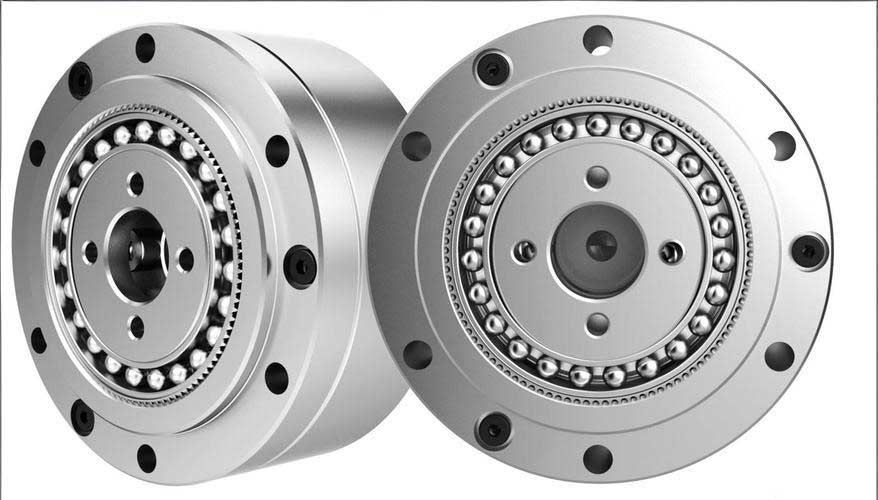
The operational sequence is elegantly simple yet powerful. The wave generator rotates, imposing an elliptical shape onto the flexible spline. This deformation causes the external teeth of the flexible spline to mesh with the internal teeth of the circular spline only at two diametrically opposite regions along the major axis of the ellipse. As the wave generator continues its rotation, the points of mesh travel around the circumference. Critically, because the flexible spline has fewer teeth (typically 2 fewer, denoted as \(N_f = N_g – 2\)) than the circular spline (\(N_g\)), each complete revolution of the wave generator results in a small relative rotation between the two splines in the opposite direction. This is the genesis of the high reduction ratio.
Mathematical Foundation and Kinematics
The kinematic relationship of a strain wave gear can be precisely described. Let us define the key variables:
- \( \omega_{wg} \): Angular velocity of the Wave Generator (Input).
- \( \omega_{fs} \): Angular velocity of the Flexible Spline (Output, if Circular Spline is fixed).
- \( \omega_{cs} \): Angular velocity of the Circular Spline (Often 0).
- \( N_g \): Number of teeth on the Circular Spline.
- \( N_f \): Number of teeth on the Flexible Spline, where \(N_f = N_g – 2\).
The fundamental kinematic equation governing the strain wave gear system is derived from the condition of no slip at the meshing interface:
$$ \frac{\omega_{fs} – \omega_{wg}}{N_f} = \frac{\omega_{cs} – \omega_{wg}}{N_g} $$
In the most common configuration, the Circular Spline is held stationary (\(\omega_{cs} = 0\)). Substituting this into the equation yields the standard reduction ratio \(i\):
$$ i = \frac{\omega_{wg}}{\omega_{fs}} = -\frac{N_f}{N_g – N_f} = -\frac{N_f}{2} $$
The negative sign indicates that the output (Flexible Spline) rotates in the opposite direction to the input (Wave Generator). For the typical case where \(N_f = N_g – 2\), this simplifies to a very large reduction ratio:
$$ i = -\frac{N_g – 2}{2} $$
For example, if the circular spline has 202 teeth and the flexible spline has 200 teeth, the reduction ratio is \(i = -100:1\). This elegant formula reveals how a minimal tooth difference generates a substantial speed reduction. The torque multiplication, assuming ideal efficiency \(\eta\), is correspondingly high:
$$ T_{out} \approx \eta \cdot i \cdot T_{in} $$
This compact, high-ratio transmission is a defining advantage of the strain wave gear.
| Feature | Strain Wave Gear (Harmonic Drive) | Planetary Gear | Cycloidal Drive |
|---|---|---|---|
| Reduction Ratio (Single Stage) | Very High (50:1 to 320:1+) | Medium (3:1 to 12:1) | High (10:1 to 120:1) |
| Backlash | Extremely Low (<1 arcmin) | Low to Moderate | Low |
| Efficiency | High (80%-90% per stage) | Very High (95%-98%) | High (85%-92%) |
| Torsional Stiffness | High | Very High | Extremely High |
| Size & Weight | Very Compact, Light | Compact | Compact but Dense |
| Key Principle | Elastic Deformation | Rigid Body Epicyclic | Eccentric Rolling |
Mechanical Analysis of the Flexspline: Stress and Strain
The flexible spline is the most critically stressed component in a strain wave gear. Its repeated elastic deflection is key to operation but also the primary source of fatigue considerations. During operation, it is subjected to a complex state of stress:
- Bending Stress: Due to the elliptical deformation imposed by the wave generator.
- Membrane Stress: From the radial deflection.
- Contact Stress: At the tooth engagement zones with the circular spline.
The bending stress \(\sigma_b\) in the thin-walled cylinder (flexspline) can be approximated using beam theory applied to its circumferential cross-section. For an elliptical deflection of magnitude \(w_0\), the maximum bending moment \(M_{max}\) and stress occur at the major axis:
$$ M_{max} \propto E I \frac{w_0}{a^2} $$
$$ \sigma_b_{max} = \frac{M_{max} \cdot t/2}{I} = k \cdot E \cdot \frac{t \cdot w_0}{a^2} $$
Where \(E\) is the Young’s modulus of the flexspline material, \(t\) is its wall thickness, \(a\) is the nominal radius, and \(k\) is a geometric constant. The total stress is a combination of this bending stress and the membrane stress. The safety factor against fatigue failure is paramount and is calculated using the modified Goodman relation or similar fatigue criteria, considering the mean and alternating stress components (\(\sigma_m\), \(\sigma_a\)):
$$ \frac{\sigma_a}{S_e} + \frac{\sigma_m}{S_{ut}} = \frac{1}{n} $$
Here, \(S_e\) is the endurance limit of the material, \(S_{ut}\) is the ultimate tensile strength, and \(n\) is the design factor of safety. Advanced finite element analysis (FEA) is indispensable for accurately modeling the multi-axial stress state and predicting the fatigue life of the strain wave gear flexspline.
Design Considerations and Material Selection
Designing a reliable strain wave gear requires careful balancing of competing factors: high fatigue strength, minimal elastic hysteresis, wear resistance, and manufacturability.
| Component | Primary Design Goal | Critical Parameters | Common Material Choices |
|---|---|---|---|
| Flexible Spline | High Fatigue Strength, Low Hysteresis | Wall thickness (t), Tooth profile, Deflection (w0) | Case-hardened alloy steels (e.g., CSS-42L®, AISI 9310), Maraging steels, High-strength stainless steels (e.g., PH17-4). Often vacuum heat treated. |
| Circular Spline | Wear Resistance, High Stiffness | Tooth profile, Number of teeth (Ng) | Through-hardened steels (e.g., AISI 4340, 52100), Carburized steels. Sometimes coated for wear. |
| Wave Generator Bearing | Low Friction, High Load Capacity, Long Life | Bearing type (e.g., deep groove, specially designed cam follower), Preload | Bearing rings: High-carbon chromium steel (SUJ2/SAE52100). Balls/rollers: Similar or ceramic (Si3N4) for high speed. |
| Dynamics & Lubrication | Minimize Losses, Control Heat, Prevent Wear | Gear mesh geometry, Lubricant viscosity, Sealing | Synthetic hydrocarbon or perfluoropolyether (PFPE) based greases. Solid lubricants (MoS2, PTFE) in vacuum/space applications. |
The tooth profile is another critical aspect. Unlike involute gears, strain wave gear teeth often use a special “S”-shaped or circular arc profile to accommodate the changing conjugate action during flexing and to optimize load distribution and stress concentration factors. The formula for the conjugate action is complex and derived from the condition of continuous contact during deformation.
Applications and a Case Study in Antenna Positioning
The unique advantages of the strain wave gear make it the actuator of choice in demanding fields. The primary application drivers are its near-zero backlash, high single-stage reduction ratio, and compact coaxial design.
- Robotics: Critical in robot joint actuators for precision, stiffness, and compactness.
- Aerospace & Satellite Systems: Used in antenna pointing mechanisms, solar array drives, and instrument actuators due to reliability and precision in harsh environments.
- Medical and Semiconductor Equipment: Essential for precision stages and manipulators requiring smooth, accurate motion.
- Industrial Automation: Deployed in high-end CNC rotary tables, indexing heads, and precision assembly systems.
Consider a precision antenna positioning system for satellite data reception, akin to the scenario described in the source material. An XY pedestal requires highly accurate tracking. The X-axis, carrying the bulk of the antenna’s inertial load, demands high output torque. A strain wave gear with a 125:1 reduction ratio can be directly coupled to a high-speed servo motor. Let’s analyze the dynamics:
Given a motor with a nominal speed \(\omega_m = 3000 \text{ rpm} = 314.16 \text{ rad/s}\) and a relatively low torque \(T_m\), the output at the strain wave gear‘s flexible spline becomes:
$$ \omega_{out} = \frac{\omega_m}{i} = \frac{314.16}{125} = 2.51 \ \text{rad/s} \ (24 \ \text{rpm}) $$
$$ T_{out} \approx \eta \cdot i \cdot T_m $$
If a continuous output torque \(T_{out} \leq 240 \ \text{N·m}\) is required, and assuming \(\eta = 0.85\), the minimum motor torque is:
$$ T_m \geq \frac{T_{out}}{\eta \cdot i} = \frac{240}{0.85 \times 125} \approx 2.26 \ \text{N·m} $$
This demonstrates how the strain wave gear effectively transforms a small, fast motor into a powerful, slow-moving drive—perfect for direct antenna drive without additional bulky gear stages, thereby minimizing backlash and compliance in the system.
Maintenance, Failure Modes, and System Integration Guidelines
While highly reliable, a strain wave gear is a precision mechanical component that can fail. Understanding failure modes is key to predictive maintenance. The primary failure modes include:
- Flexspline Fatigue Fracture: Caused by exceeding the fatigue life cycle limit or stress due to shock loads. This is the most common wear-out failure.
- Wave Generator Bearing Failure: Due to contamination, loss of lubrication, or excessive preload. Bearing wear increases backlash and can lead to catastrophic failure.
- Tooth Wear or Pitting: On either the flexspline or circular spline, typically from contaminated lubrication or overload.
- Loss of Preload/Increased Backlash: Gradual wear in the bearing or housing fits can degrade precision.
Diagnosing a failed strain wave gear in a system like an antenna drive often manifests as a loss of motion, excessive positional error, or complete mechanical lock-up. A systematic approach to replacement is crucial, especially in heavy, balanced systems like an antenna pedestal.
| Step | Action | Technical Rationale & Precautions |
|---|---|---|
| 1. System Preparation & Safety | De-energize and lock out all power. Secure the driven mass (e.g., antenna dish) using multiple redundant ties to a solid structure to prevent accidental movement. | Prevents injury and damage. The securement must handle the full static and potential dynamic loads. |
| 2. Disconnect Drive Train | Remove the input servo motor and any coupling or clutch mechanisms connected to the wave generator input shaft. | Isolates the gearbox for removal. Note alignment marks for reassembly. |
| 3. Unload & Support Critical Mass | If the gearbox supports a balanced mass (like a counterweight), safely remove/disassemble the mass. Use appropriate lifting equipment and temporary supports rated for the load. | Prevents the system from becoming unstable and allows access to the gearbox mounting. |
| 4. Gearbox Removal | Unbolt and carefully extract the entire gearbox assembly from the main structure. Document the location of all shims and spacers. | Shims are critical for re-establishing proper gear mesh alignment and preload during reinstallation. |
| 5. Unit Disassembly & Replacement | On the bench, disassemble the gearbox housing. Extract the failed strain wave gear unit. Press-fit components (output gears) may need specialized pullers. | Bench work allows for a clean, controlled environment. Avoid damaging mating surfaces. |
| 6. Installation & Alignment | Install the new strain wave gear unit. Reinstall all shims precisely. Ensure the output gear mesh with the final drive (e.g., azimuth bull gear) has proper backlash and tooth contact pattern. | Correct alignment is non-negotiable for performance and longevity. Follow manufacturer’s torque specifications for all fasteners. |
| 7. Reassembly & Verification | Reverse steps 3 and 2: reattach the counterweight/mass, reconnect the motor and couplings. Remove all safety restraints from the driven mass. | Perform a careful visual and manual check of the entire range of motion for obstructions. |
| 8. System Commissioning | Power on the control system. Execute low-speed jogging motions to verify smooth operation. Gradually test up to full operational parameters, monitoring torque and position error. | Validates the repair and ensures the system is safe for automatic operation. |
In conclusion, the strain wave gear is a masterpiece of kinematic design, elegantly solving the challenge of high-ratio, high-precision power transmission in a minimal volume. Its operation, based on elastic strain wave propagation, provides benefits unattainable by traditional rigid gearing. A deep understanding of its principles, stress analysis, proper application, and meticulous maintenance procedures is essential for engineers to fully leverage its capabilities in the most demanding motion control systems, from satellite antennas to surgical robots. The development of advanced materials and simulation tools continues to push the boundaries of what is possible with this fascinating technology.