
For years, I have observed and worked within the meat pigeon industry, a sector that has grown remarkably to become the fourth largest poultry variety in our country. This growth, however, has been paradoxically constrained by a production model rooted in tradition. The unique biology of pigeons—where a breeding pair mates, lays eggs, incubates, and raises squabs all within a single cage—has cemented a one-pair-per-cage, manual-feeding paradigm. While functional, this model is plagued by inherent inefficiencies: significant feed wastage due to the birds’ behavior and inconsistent intake needs, high and rising labor costs, poor feeding accuracy, and a general lack of digital intelligence. The need for a technological intervention was not just apparent; it was critical for the sustainable future of the industry. It was from this pressing need that the concept of a dedicated intelligent robot system was born.
The core challenge was multifaceted. How could one automate an operation that required not just bulk delivery, but precise, individualized feeding for thousands of separate cages? How could this automation also capture the health and production status of each unit? Our answer was to design not merely a machine, but an integrated cyber-physical system. Our vision was an intelligent robot that could autonomously navigate rows of cages, read the unique identity of each, dispense an exact amount of feed based on real-time physiological data, perform health checks, clean its path, and communicate seamlessly with a central brain—all while operating for hours on a single charge. This was not about replacing a single task but about re-engineering the entire workflow of a pigeon house.
The development journey focused on two symbiotic pillars: the physical intelligent robot platform and the digital expert management system. The robot serves as the eyes, arms, and legs in the physical world, while the software system acts as the decision-making brain, orchestrating production. The design philosophy was grounded in robustness, precision, and intelligence. We needed a carrier that could handle substantial weight, navigate with millimetric accuracy, operate with minimal human intervention, and integrate a suite of sensors and actuators. The solution converged on an Automated Guided Vehicle (AGV) chassis as the optimal mobile base, enhanced with Programmable Logic Controller (PLC) technology for reliable control and Internet of Things (IoT) connectivity for data exchange.
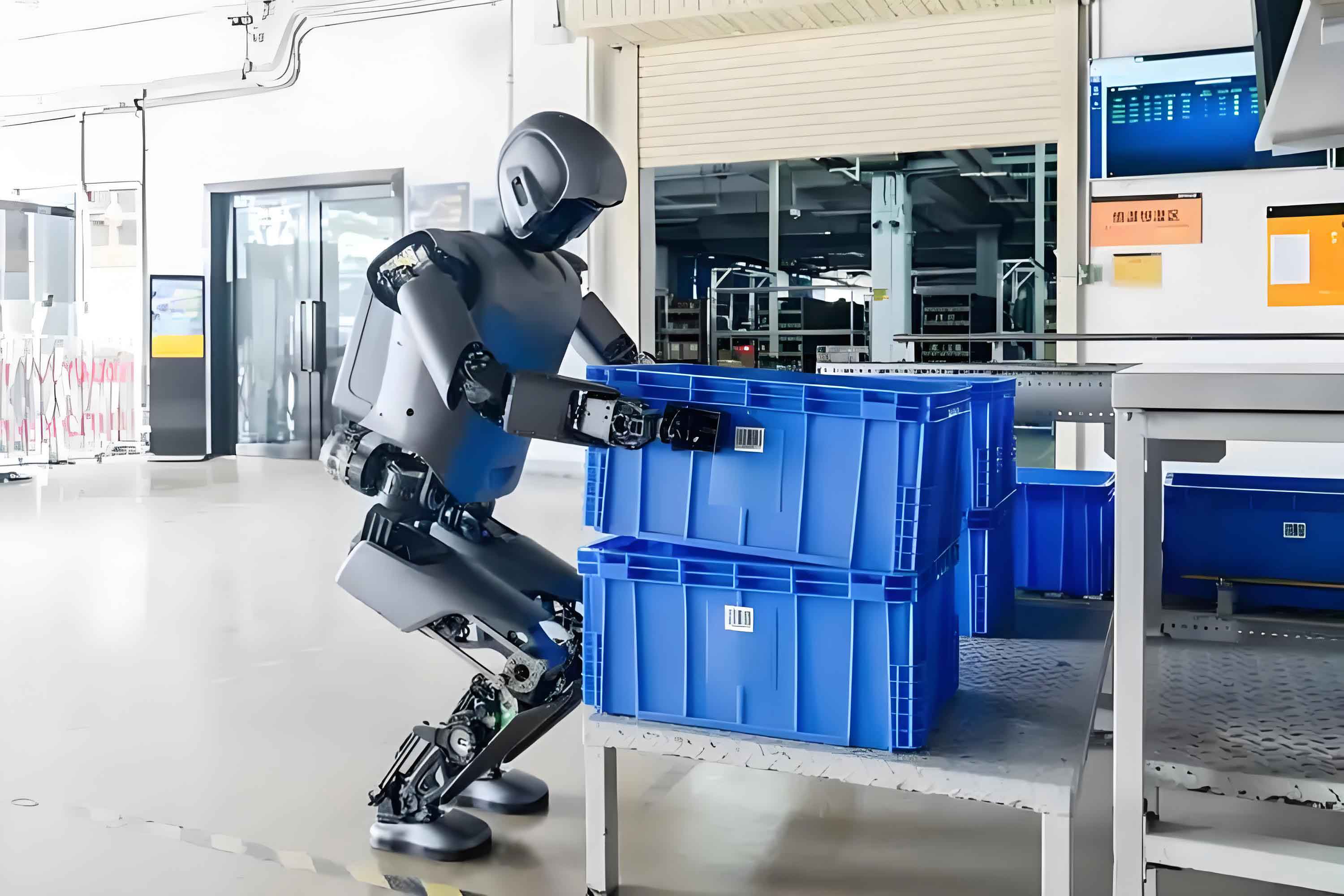
The hardware architecture of the intelligent robot is engineered for heavy-duty, continuous operation. The chassis, constructed from 40mm carbon steel square tubing, provides a stable 1.8m x 1.2m platform. Its power system, centered on high-capacity battery packs, is designed to support over 6 hours of continuous laden operation. The most distinctive feature is the three-tiered feeding system. Each tier contains a large-capacity stainless-steel hopper with a total system capacity exceeding 180kg of feed—enough for one feeding cycle for over 6,000 cages. Each tier feeds two independent, laterally opposed dispensing mechanisms. A critical component is the dispensing unit itself, which integrates a screw conveyor and a precision weighing scale to deliver feed with high accuracy.
Navigation and perception are handled by a suite of sensors. Magnetic guidance tapes installed along the central aisle provide a reliable path for the intelligent robot to follow at a consistent speed of 5-10 m/min. At the front, QR code readers are positioned at heights corresponding to the three cage tiers. Each cage is tagged with a unique QR code, serving as its digital fingerprint. As the intelligent robot glides down the aisle, it scans these codes to identify the cage. Simultaneously, infrared thermal scanners mounted near the dispensing outlets capture the thermal signature of the birds within, providing non-invasive health monitoring. A negative-pressure suction system at the base cleans spilled feed and dust from the floor during operation, maintaining hygiene.
The operational logic of the intelligent robot is a marvel of coordinated automation. Upon scheduled wake-up (e.g., for 3 meals per day at 05:00, 12:00, and 19:00), the system performs self-checks and departs from its docking station. It follows the magnetic track, and for each cage it passes, a sequence unfolds in seconds:
- Identify: The QR code is scanned, fetching the cage’s unique ID.
- Compute: The cage ID is wirelessly linked to the central Expert Management System, which returns the exact grams of feed required for that specific cage at that specific meal.
- Dispense: The command is sent to the appropriate dispensing unit, which weighs and delivers the feed precisely into the cage’s trough.
- Monitor: The IR scanner captures a thermal image, which is uploaded for analysis.
- Clean: The suction system operates continuously.
This cycle repeats for every cage, enabling the intelligent robot to service 60-70 cages per minute, or over 3,600 per hour. After completing its route, it autonomously returns to its station for recharging and bulk feed replenishment.
The true intelligence of the system resides in the cloud-based Expert Management System (EMS). This software is the operational brain, managing the entire production lifecycle. Its core function is to maintain a dynamic digital twin of every cage. Based on inputs from workers (via mobile terminals) and the intelligent robot‘s IR scans, the EMS tracks each pair’s status: empty, laying, incubating, or rearing squabs of a specific age. Using a built-in expert rule set, it calculates the precise daily nutritional requirement for each cage.
The feed calculation is not a flat rate but a dynamic model. It accounts for the maintenance needs of the breeding pair and the rapidly growing needs of the squabs. A simplified representation of the model for a three-meal-per-day schedule can be summarized in the following table, where $F_{total}$ is the total feed per meal per cage, $F_{pair}$ is the base feed for the breeding pair (e.g., ~20g/meal), $n$ is the number of squabs, and $F_{squab}(d)$ is the feed increment per squab as a function of its age $d$ in days.
| Physiological Stage | Breeding Pair Count | Squab Count (n) | Squab Age (d) Range | Feed per Squab $F_{squab}(d)$ (g/meal) | Total Meal Feed $F_{total}$ (g) |
|---|---|---|---|---|---|
| Empty / Incubating | 2 | 0 | – | 0 | $$F_{pair}$$ |
| Early Rearing | 2 | 2 | 0 – 5 | 5 | $$F_{pair} + n \times 5$$ |
| Mid Rearing | 2 | 2 | 6 – 12 | 15 – 20 | $$F_{pair} + n \times 15 \text{ to } F_{pair} + n \times 20$$ |
| Late Rearing (Post-fledge) | 2 | 2 | 13 – 22 | 25 | $$F_{pair} + n \times 25$$ |
| Pre-market | 2 | 2 | >22 | 20 | $$F_{pair} + n \times 20$$ |
The EMS also orchestrates all manual tasks. It predicts and issues alerts for expected events: “Check for eggs in Cage A205 in 2 days,” “Candling due for Cage B112 tomorrow,” “Check hatching for Cage C409,” “Squabs in Cage D307 reach market age today.” Workers use handheld mobile terminals to confirm these events (e.g., “2 eggs laid,” “1 live embryo,” “2 healthy squabs hatched”). This confirmation updates the cage’s digital status in the EMS, which then automatically adjusts the feed formula sent to the intelligent robot for subsequent meals. For mortality detected by IR scan or worker input, the system issues merge instructions and adjusts the involved cages’ records and feed plans accordingly.
The integration of the intelligent robot and the EMS creates a fully digitalized, closed-loop management system. The workflow for a single breeding cycle, from pairing to squab sale, is now a sequence of automated and prompted tasks. The intelligent robot handles the daily, data-driven physical interaction, while the EMS manages the temporal logic and decision support, with human workers performing the nuanced tasks of confirmation and care.
To validate the system, a comprehensive demonstration was implemented at a large-scale commercial farm. Four enclosed houses, each housing approximately 1,500 breeding pairs, were retrofitted for the system. The key modifications included ensuring flat, even flooring for robot navigation, aligning cages and feed troughs with precision, and installing the magnetic guide tape. One intelligent robot was deployed to service all four houses, operating on a three-meal schedule. A single technician was assigned to manage the entire unit, responding to task alerts on the mobile terminal. For comparison, four traditionally managed houses of similar size, each requiring a dedicated worker for manual feeding and inspection, were monitored.
The preliminary results from a three-month demonstration period were profoundly encouraging. The performance metrics clearly distinguished the new paradigm from the old.
| Performance Indicator | Traditional Manual Mode (Control) | Intelligent Robot & EMS Mode (Demonstration) | Change |
|---|---|---|---|
| Labor per 6,000 Pairs | 4 Workers | 1 Technician + 1 Robot | ~60-75% Direct Labor Reduction |
| Feed Consumption per Squab (incl. breeders) | Baseline (X kg) | 0.89X kg | 11% Reduction |
| Feeding Accuracy & Consistency | Variable, High Spillage | Gram-level Precision, Minimal Waste | Dramatic Improvement |
| Health Monitoring Frequency | Visual, Periodic | Automated IR Scan, Every Meal | Continuous, Data-Driven |
| Data Integration | Paper-based or Isolated Digital Records | Real-time, Cage-level Central Database | Full Traceability & Analytics Enabled |
The 11% reduction in feed cost is a direct economic triumph, stemming from the elimination of spillage and the precision of matching feed to exact biological need. The labor transformation is equally significant. The role of the worker evolves from repetitive, physically demanding feeding and walking to a more skilled supervisory and confirmation role, interacting with the digital system. This elevates job quality and enables one person to manage a vastly larger biological asset.
The implications of this intelligent robot system extend beyond immediate efficiency gains. It establishes a framework for precision livestock farming (PLF) in a niche yet significant sector. The constant stream of data—feed intake per cage, thermal profiles, production cycle timings—creates a rich dataset for further optimization. One can envision more advanced algorithms that not only track but predict health issues, optimize breeding cycles, and fine-tune nutritional formulas for genetics or environmental conditions. The system’s modularity suggests potential adaptation for other poultry or livestock species housed in cage or pen systems where individualized feeding is beneficial.
In conclusion, the development and application of this integrated intelligent robot and expert management system represent a fundamental leap forward for meat pigeon production. It successfully addresses the historical bottlenecks of waste, labor, and data opacity. By deploying a physically robust and digitally smart intelligent robot as the primary agent of daily care, synchronized with a central cognitive software system, we have demonstrated a viable path toward a more sustainable, efficient, and technologically advanced future for the industry. This is more than an automation of tasks; it is the digitization of an entire biological production process, setting a new standard for what is possible in modern, responsible animal husbandry.