
The rise of women living alone in urban environments represents a significant socio-demographic shift. While this lifestyle choice offers autonomy and independence, it also presents unique challenges, particularly concerning personal safety and psychological well-being. Traditional solutions often focus narrowly on physical security, neglecting the complex interplay of emotional, managerial, and social needs that define this group’s daily experience. This article, from a first-person research and design perspective, argues for a holistic service design approach. Through in-depth investigation, we analyze the authentic needs of solitary women and propose a comprehensive service system built around an intelligent companion robot. This system aims to transcend basic functionality, offering integrated support in time management, health, safety, and emotional companionship, thereby enhancing overall quality of life.
Understanding the User: Characteristics and Lifestyles of Solitary Women
The design of any meaningful service must begin with a deep understanding of the user. Women living alone are not a monolithic group, but they share common characteristics and challenges that form the basis for our design requirements.
Physiological and Psychological Profile
Physiological differences often translate to a perceived vulnerability regarding personal safety. The constant, low-grade awareness of this vulnerability can be a persistent stressor. Psychologically, long-term solitary living can engender feelings that, while not universal, are frequently reported:
- Loneliness and Social Isolation: The absence of daily cohabitation can reduce spontaneous social interaction, leading to profound loneliness. Research correlates chronic loneliness with adverse health outcomes, including increased risk for coronary heart disease and associations with suicidal ideation.
- Anxiety and Unrest: The quiet of an empty home can amplify minor noises into sources of anxiety. A general sense of unease or panic, especially during nights or when facing minor household emergencies, is common.
- Diminished Psychological Security: The fundamental feeling of being “safe” is often compromised, affecting sleep quality and overall mental equilibrium. Prolonged stress from this lack of security can lead to insomnia and other health complications.
This psychological state can be modeled as a function of external stimuli (E), internal resilience (R), and environmental support (S):
$$ P_{state} = f(E, R, S) $$
where a lack of positive S (support) exacerbates the negative impact of E on Pstate. An intelligent companion robot aims to augment S.
Lifestyle and Behavioral Patterns
Typically possessing financial independence, solitary women often seek a high standard of living. Their days are frequently bifurcated: high-paced professional engagements followed by a need for quality personal time. There is a marked focus on self-care, including diet, fitness, and personal style. However, paradoxes exist:
| Aspiration | Common Challenge |
|---|---|
| Healthy, managed diet | Irregular meals, reliance on takeout |
| Regular exercise routine | Procrastination, lack of motivation |
| Structured sleep schedule | Late nights, insomnia |
| Pursuit of hobbies & learning | Time consumed by passive entertainment |
| Organized, clean living space | Inconsistent cleaning routines |
The core issue often lies not in a lack of desire but in a deficit of external accountability and supportive scaffolding in the private domestic sphere. Self-management capability can wane without the implicit social contracts present in shared living.
The Imperative for a Dedicated Service Design Solution
The growing population of women choosing to live alone necessitates solutions that move beyond generic smart home devices. A dedicated service system is justified for several reasons:
- Compounded Vulnerability: The intersection of perceived physical vulnerability and potential psychological strain creates a unique need profile that generic products fail to address comprehensively.
- Acceptance of Technology: As a predominantly younger demographic, solitary women are generally receptive to novel technological solutions, provided they offer tangible value and intuitive interaction.
- Systemic Gaps: Existing services are fragmented—security apps, health trackers, smart speakers, cleaning robots—requiring manual integration by the user. A unified companion robot service can seamlessly orchestrate these functions.
The value proposition (V) of such a system can be expressed as a sum of addressed need weights (wi) and solution efficacy (ei):
$$ V = \sum_{i=1}^{n} (w_{safety} \cdot e_{safety} + w_{companionship} \cdot e_{companionship} + w_{management} \cdot e_{management} + \cdots) $$
where for solitary women, wcompanionship and wsafety are critically high.
Deep-Dive Analysis: Unpacking User Needs
Our research involved surveys and interviews targeting women living alone. Analysis of 187 valid responses revealed five core clusters of needs, which we quantified and prioritized.
Quantified Needs Analysis
| Need Cluster | Key Data Points | Derived Implication | Priority |
|---|---|---|---|
| Life Management & Services | >60% forget items; 64.7% use health/reminder apps | Need for proactive, contextual reminders and data aggregation | High |
| Safety & Security | >50% express safety concerns; majority report lack of security | Need for active monitoring, deterrence, and emergency response | Critical |
| Practical Home Assistance | ~50% explicitly desire cleaning functionality | Need for basic home maintenance to reduce chore burden | High |
| Habit Formation & Self-Regulation | 69.1% rarely adhere to personal plans; 32.6% cite lack of self-control as major issue | Need for an external accountability partner and structured coaching | High |
| Emotional Companionship | 66% feel occasional loneliness/fear; 48% desire welcoming lights/sound | Need for ambient presence, interactive dialogue, and mood modulation | Critical |
The translation of these needs into specific functionalities requires mapping them to actionable technological and interactive features. This mapping forms the blueprint for our companion robot service system.
| Functional Category | Specific Functions |
|---|---|
| Temporal Management | Smart alarm, schedule reminder,自律监督 (e.g., sleep/wake prompts), progress tracking. |
| Health & Wellness Management | Sleep aid, hydration reminder, posture/sedentary alerts, medication prompts, simple health metric integration (weight, cycle), personalized wellness tips. |
| Life Assistance | Item departure reminder, voice-activated information search, smart home control (IoT hub), weather & outfit advice, voice-dialing, low-light navigation guidance. |
| Safety Protection | Real-time environmental audio/video monitoring, simulated presence (lights, TV sounds), deterrent sounds, automatic emergency calls to pre-set contacts or authorities based on distress keywords or abnormal patterns. |
| Emotional Companionship | Conversational AI for casual chat, mood assessment via voice tone, storytelling/joke telling, music/podcast playback, therapeutic dialogue prompts. |
The user journey for different archetypes—the busy professional, the creative freelancer, the young graduate—reveals common touchpoints of anxiety, forgetfulness, and isolation, but also moments where a companion robot could provide seamless support, as visualized in the journey map above.
Proposing the Service System Architecture
Modern product design evolves into service system design. Our proposed system is an ecosystem where a core intelligent companion robot interacts with a mobile application and optional peripheral IoT devices, creating a cohesive user experience.
System Overview & Mathematical Framework
The system can be defined as a tuple: $$ S_{companion} = \langle R, M, I, \Phi \rangle $$
where:
- R is the physical Robot (the embodied agent).
- M is the Mobile application (the planning and review interface).
- I is the set of IoT peripherals (smart locks, environmental sensors, etc.).
- Φ is the set of interaction protocols and data flows between R, M, and I.
The system’s effectiveness is governed by its ability to sense (α), process (β), and act (γ) in a human-centric loop:
$$ Effectiveness = \int_{t} (\alpha_{context}(t) \cdot \beta_{intelligence}(t) \cdot \gamma_{action}(t)) \, dt $$
where the companion robot R is primarily responsible for γaction(t) in the physical world.
The Physical Companion Robot: Embodied Agent
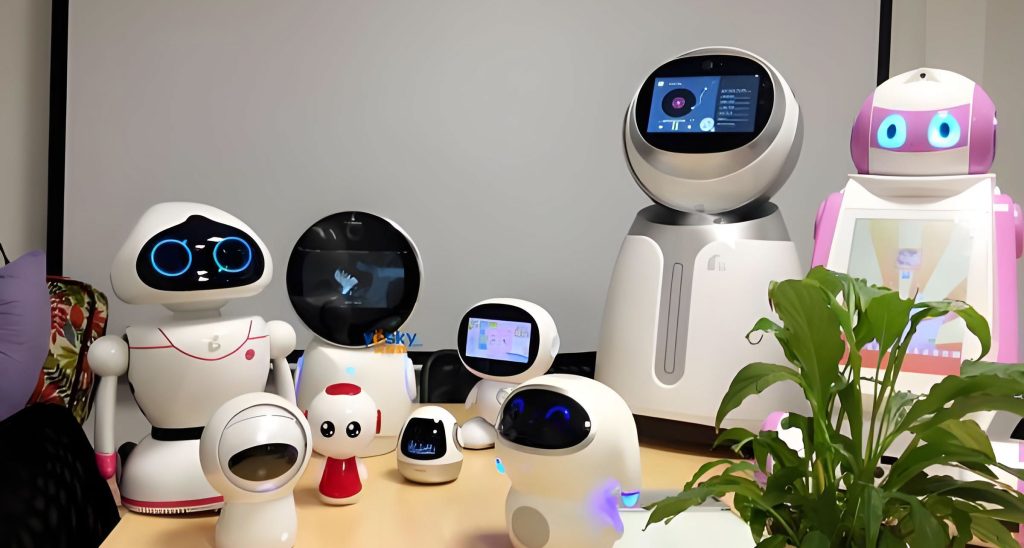
The robot (R) is the user-facing embodiment of the service. Its design prioritizes approachability and intuitive interaction, functioning like a proactive domestic assistant. Key attributes include:
- Mobility & Presence: Ability to navigate common home environments to “find” the user for reminders or companionship.
- Multimodal Interaction: Primary interaction through natural voice and simple gestures, minimizing learning curves. It should understand and generate conversational speech.
- Basic Utility: Incorporation of a cleaning module (e.g., a sweeping base) addresses a high-priority practical need, increasing daily utility.
- Ambient Awareness: Equipped with non-intrusive sensors (microphone, camera with privacy shutters) to assess context (e.g., is the user home? is there unusual noise?).
The robot’s decision to act can be modeled on a simplified risk/need assessment algorithm. For example, a safety action As is triggered when:
$$ Threat\_Score(T) = w_1 \cdot S_{audio} + w_2 \cdot S_{video} + w_3 \cdot S_{pattern} > \theta_{critical} $$
where S are anomaly scores from different sensors and θ is a predefined threshold.
The Mobile Application: Command & Control Center
The mobile app (M) serves as the user’s platform for configuration, review, and detailed input. Its interface is structured around the core need clusters:
| Module | Core Functions | Interaction with Robot (R) |
|---|---|---|
| Schedule Manager | Set calendar events, recurring reminders. View history. | R uses location and speech to deliver reminders at the appointed time and place. |
| Habit Forger | Define goals (e.g., “wake up at 7 AM daily for 2 weeks”). | R provides morning wake-up, encouragement, and logs compliance, sending data back to M for progress visualization. |
| Health Tracker | Log weight, menstrual cycle, sleep manually or via integration. Receive insights. | R gives proactive voice tips (“Your cycle suggests you might want to avoid caffeine today”). |
| Emotion Log | Optional mood logging. View emotional trend history. | R can initiate check-in conversations based on tone analysis or schedule, suggesting calming activities. |
| Safety Dashboard | Live feed from R’s sensors (user-activated). Control linked IoT devices (lock doors). Set emergency contacts. | R is the primary sensor node and can execute emergency protocols defined in M. |
Design Considerations and Evaluation Metrics
The success of such a companion robot system hinges on delicate design choices, particularly regarding privacy, trust, and emotional resonance.
Critical Design Parameters
The system must navigate a complex design space defined by competing priorities. We can model key trade-offs:
- Privacy vs. Security/Safety: This is the paramount balance. All data collection must be opt-in, transparent, and locally processed where possible. The system’s privacy coefficient (ρ) and safety coefficient (σ) should be tunable by the user: $$ User\_Trust \propto \frac{\sigma}{ρ} $$ for a given level of perceived risk.
- Personality vs. Utility: The robot’s character should be helpful and warm but not intrusive or overly anthropomorphic. Its “personality weight” (Ψ) must complement, not overshadow, its functional reliability (F): $$ Acceptability = \lambda F + (1-\lambda)\Psi, \quad 0.7 \leq \lambda \leq 0.9 $$
- Proactivity vs. Annoyance: The system must learn user preferences to time interventions appropriately. A proactivity score must factor in context, time of day, and user history to avoid becoming a nuisance.
Proposed Evaluation Framework
The impact of the companion robot service should be measured multidimensionally:
| Metric Category | Specific Measurable Indicators | Method |
|---|---|---|
| Psychological Well-being | Reduction in self-reported loneliness (UCLA Loneliness Scale). Decrease in anxiety scores (GAD-7). Improvement in perceived safety. | Pre- and post-deployment surveys over 3-6 months. |
| Behavioral Change | Increased adherence to self-set schedules (e.g., sleep/wake times). Improved consistency in habit tracking (e.g., hydration, exercise). | System logs of reminder acknowledgments and user logs. |
| Usability & Adoption | Daily active use frequency. Task completion success rate via voice. System Usability Scale (SUS) score. | Analytics, controlled task tests, surveys. |
| System Reliability | False positive/negative rates for safety alerts. Accuracy of context-aware reminders. Uptime and error rates. | System monitoring and log analysis. |
Conclusion
The trend towards solitary living among urban women is not merely a statistical blip but a lasting lifestyle evolution demanding tailored solutions. This research demonstrates that a piecemeal approach to safety or convenience is insufficient. By adopting a holistic service design perspective, we can develop intelligent companion robot systems that address the multifaceted reality of the solitary woman’s life. Such a system integrates practical assistance, life management, proactive safety, and nuanced emotional support into a single, cohesive experience. The proposed framework—encompassing an embodied robotic agent, a thoughtful mobile interface, and a scalable IoT ecosystem—provides a blueprint for developing technologies that genuinely enhance autonomy, security, and quality of life. The ultimate goal is not to replace human connection but to provide a supportive, responsive foundation that empowers women living alone to thrive in their chosen lifestyle, mitigating risks and enriching daily routines through intelligent, compassionate companionship.