
In the field of precision engineering and robotics, the harmonic drive gear has emerged as a pivotal transmission device due to its exceptional advantages, including high reduction ratios, compact structure, low noise, and high efficiency. These attributes have led to its widespread adoption in aerospace, industrial bionics, military applications, and beyond. However, the harmonic drive gear system is inherently complex, involving the coupling of multiple nonlinear factors such as torsional stiffness, friction, motion errors, and transmission hysteresis. These nonlinearities often induce intricate dynamic responses, among which fast-slow oscillations are particularly noteworthy. These oscillations, characterized by periodic bursts of high-amplitude spikes interspersed with quiescent phases, can severely impact the operational stability and performance of harmonic drive gear systems. In this study, I aim to investigate the fast-slow dynamics of a harmonic drive gear system with nonlinear torsional stiffness, revealing a novel mechanism underlying these oscillations. By constructing a fast-slow dynamical model, analyzing the transition from normal to fast-slow oscillations, and employing fast-slow analysis techniques, I will demonstrate how sharp quantitative changes in the equilibrium curve of the fast subsystem—without traditional bifurcations—can trigger fast-slow oscillations. This work enriches the understanding of pathways to fast-slow oscillations in dynamical systems and provides insights for controlling such phenomena in practical harmonic drive gear applications.
The harmonic drive gear reducer operates on the principle of elastic deformation, where a wave generator induces controlled flexing in a flexible spline, enabling precise motion transmission. Despite its advantages, the system’s dynamics are influenced by scale differences between input and output inertias, leading to coupled fast and slow time scales. This coupling can result in fast-slow oscillations, as observed in low-speed operations or under specific loading conditions. Previous studies have documented these oscillations but often focused on phenomenological reports rather than mechanistic explanations. Here, I delve into the dynamical foundations, emphasizing the role of nonlinear torsional stiffness in shaping the fast-slow behavior. The harmonic drive gear’s performance is critical in applications like robotic arms and spacecraft mechanisms, where unexpected oscillations can compromise accuracy and reliability. Thus, unraveling the fast-slow oscillation mechanisms is not only academically intriguing but also practically significant for enhancing the design and control of harmonic drive gear systems.
To begin, I establish a dynamical model for the harmonic drive gear system. Consider a simplified representation where the rigid gear is fixed, and the flexible gear serves as the output. The system involves input and output inertias, angular displacements, and nonlinear factors. Based on harmonic drive principles, the equations of motion can be derived. Let \( J_i \) and \( J_o \) denote the input and output moments of inertia, respectively, with \( \theta_i \) and \( \theta_o \) as the corresponding angular displacements. The reduction ratio is \( N \), and the nonlinear torsional stiffness is represented as \( K(\theta) \). The system is subject to an input torque \( T_{im} \) and an output torque \( T_{om} \), which includes a slow periodic disturbance. Incorporating an equivalent damping coefficient \( C_{eq} \) to approximate frictional effects, the governing equations are:
$$ J_o \ddot{\theta}_o + C_{eq} (\dot{\theta}_o – \dot{\theta}_i / N) + K(\theta) f(\theta) = T_{om} $$
$$ J_i \ddot{\theta}_i – C_{eq} (\dot{\theta}_o – \dot{\theta}_i / N) / N – K(\theta) f(\theta) / N = -T_{im} / N $$
Here, \( \theta = \theta_o – \theta_i / N \) is the relative torsion angle, and \( f(\theta) = \theta – \phi \) accounts for the backlash gap \( \phi \). The nonlinear torsional stiffness \( K(\theta) \) is modeled as a quadratic function: \( K(\theta) = k_1 + k_2 \theta^2 \), where \( k_1 \) and \( k_2 \) are stiffness coefficients. This form captures both gear meshing and flexible bearing contributions, which are essential for accurate dynamics in harmonic drive gear systems. The output torque \( T_{om} \) includes a slow-varying component: \( T_{om} = T_{fs} + T_{am} \sin(\omega t) \), with \( T_{fs} = T_{im} \) and \( \omega \ll 1 \), representing a low-frequency disturbance. By defining \( T_m = T_{fs} = T_{im} \), the system can be reduced to a single equation for the relative torsion, leading to a dimensionless form. Introducing dimensionless variables and parameters, the model simplifies to:
$$ \ddot{x} + \dot{x} + \alpha x^3 – x^2 + \gamma (x – \varepsilon) = \mu + \delta \sin(\omega t) $$
where \( x \) is the dimensionless state variable, and \( \alpha, \gamma, \varepsilon, \mu, \delta, \omega \) are dimensionless parameters derived from physical quantities. Specifically, \( \alpha = C_{eq}^2 / (k_2 \phi^2 J_{eq}) \), \( \gamma = k_1 J_{eq} / C_{eq}^2 \), \( \varepsilon = k_2 \phi^2 J_{eq} / C_{eq}^2 \), \( \mu = k_2 \phi J_{eq}^2 T_m / C_{eq}^4 \), and \( \delta = k_2 \phi J_{eq}^3 T_{am} / (J_o C_{eq}^2) \), with \( J_{eq} = N^2 J_i J_o / (N^2 J_i + J_o) \) as the equivalent inertia. This dimensionless model serves as the basis for analyzing fast-slow oscillations in the harmonic drive gear system.
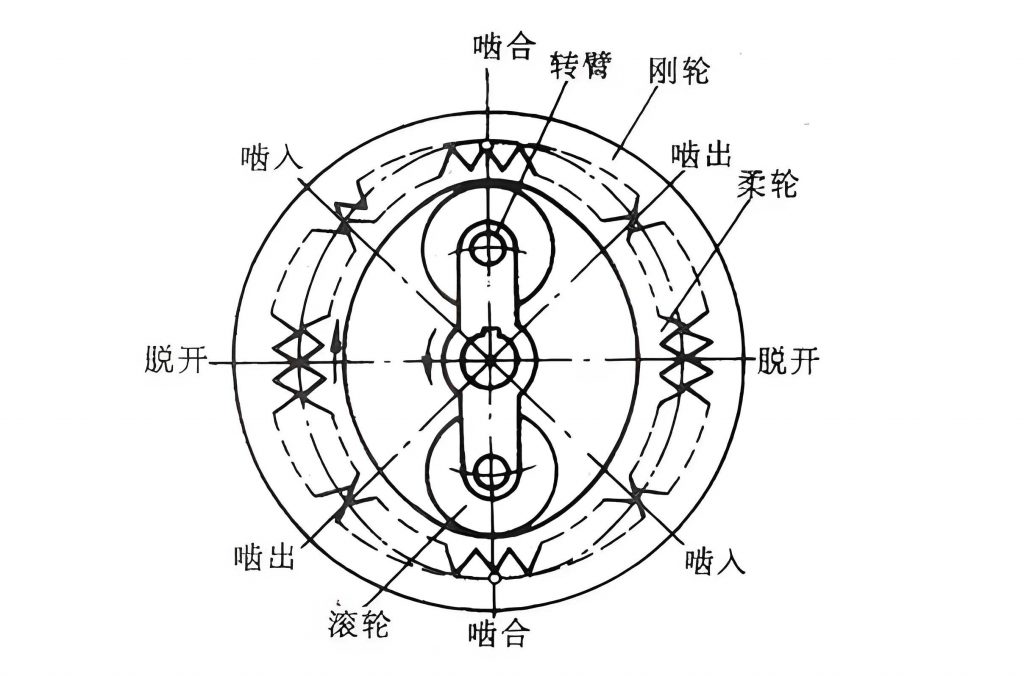
The harmonic drive gear system exhibits a rich variety of dynamic behaviors, particularly when the excitation frequency \( \omega \) is much smaller than the natural frequency of the system. This separation of time scales classifies the system as a fast-slow dynamical system, where the variable \( x \) evolves on a fast scale, and the slow variable \( a = \sin(\omega t) \) modulates the dynamics. To elucidate the mechanisms behind fast-slow oscillations, I employ fast-slow analysis, a technique that decomposes the system into fast and slow subsystems. The fast subsystem is obtained by treating the slow variable \( a \) as a parameter:
$$ \ddot{x} + \dot{x} + \alpha x^3 – x^2 + \gamma (x – \varepsilon) = \mu + \delta a $$
This fast subsystem describes the rapid dynamics for fixed values of \( a \), while the slow subsystem governs the gradual evolution of \( a \) over time: \( \dot{a} = \omega \sqrt{1 – a^2} \) (since \( a = \sin(\omega t) \), but for analysis, \( a \) is often considered as a quasi-static parameter). The interplay between these subsystems leads to complex oscillations, including bursting phenomena where the trajectory alternates between periods of quiescence (slow motion near equilibrium) and spiking (fast transitions). In harmonic drive gear applications, such oscillations can manifest as torque fluctuations or vibrational bursts, affecting precision and wear.
To understand the fast-slow oscillations, I first analyze the equilibrium points of the fast subsystem. Setting \( \dot{x} = 0 \) and \( \ddot{x} = 0 \), the equilibrium condition is:
$$ \alpha x^3 – x^2 + \gamma (x – \varepsilon) – \mu – \delta a = 0 $$
This cubic equation determines the equilibrium points \( E = (x, 0) \) in the phase plane. For parameter values typical of harmonic drive gear systems, such as those derived from physical constants, the discriminant \( \Delta \) of the cubic can be examined. With \( \alpha > 0 \) and \( \gamma > 1/(48) \) (based on parameter ranges), \( \Delta > 0 \), ensuring a single real equilibrium point. Stability analysis via linearization shows that this equilibrium is typically a stable focus, implying that for fixed \( a \), trajectories spiral toward it. However, as \( a \) varies slowly, the equilibrium point moves along a curve in the \( (a, x) \)-plane, known as the equilibrium curve. The shape of this curve is crucial for fast-slow dynamics.
I investigate the equilibrium curve by varying the parameter \( \gamma \), which relates to the linear torsional stiffness coefficient \( k_1 \). In harmonic drive gear systems, \( \gamma \) can be altered by design changes or operational conditions. For large values of \( \gamma \), the equilibrium curve is smooth and monotonic, leading to regular oscillations where the system tracks the equilibrium adiabatically. However, as \( \gamma \) decreases, the curve undergoes a sharp deformation near \( a = 0 \), becoming steep and allowing the equilibrium coordinate \( x \) to switch rapidly between positive and negative values within a small range of \( a \). This sharp quantitative change—without any bifurcation or loss of stability—creates what I term a “spiking area” on the equilibrium curve. Surrounding this area are “quiescent areas” where the curve is flat, and dynamics are sluggish. The emergence of this spiking area is central to the fast-slow oscillations in harmonic drive gear systems.
To quantify this behavior, I compute the slope of the equilibrium curve, \( dx/da \), by differentiating the equilibrium condition implicitly. From \( F(x, a) = \alpha x^3 – x^2 + \gamma (x – \varepsilon) – \mu – \delta a = 0 \), the slope is:
$$ \frac{dx}{da} = -\frac{\partial F / \partial a}{\partial F / \partial x} = \frac{\delta}{3\alpha x^2 – 2x + \gamma} $$
As \( \gamma \) decreases, the denominator \( 3\alpha x^2 – 2x + \gamma \) can approach zero near \( a = 0 \), causing a large slope and hence a rapid change in \( x \). This is not due to a bifurcation (since the equilibrium remains stable) but rather a parametric sensitivity. The following table summarizes the effect of varying \( \gamma \) on the equilibrium curve characteristics, illustrating how the harmonic drive gear system transitions from normal to fast-slow oscillation regimes.
| Parameter \( \gamma \) | Equilibrium Curve Shape | Slope \( dx/da \) near \( a=0 \) | Oscillation Mode |
|---|---|---|---|
| Large (e.g., 30) | Smooth and gradual | Small | Normal oscillations |
| Medium (e.g., 10) | Moderately steep | Moderate | Transitional |
| Small (e.g., 1) | Very steep, with sharp turn | Large | Fast-slow oscillations |
| Very small (e.g., 0.1) | Extremely steep, near-vertical | Very large | Pronounced bursting |
The dynamics of the full system are simulated numerically to observe the oscillation patterns. Using parameters representative of a typical harmonic drive gear system, I set \( \alpha = 16 \), \( \varepsilon = 0.71 \), \( \mu = 0.07 \), \( \delta = 15 \), and \( \omega = 0.01 \), with \( \gamma \) varied as shown in the table. Time series of \( \dot{x} \) reveal that for large \( \gamma \), the response is sinusoidal and regular, matching the slow excitation. As \( \gamma \) decreases, bursts of high-frequency, large-amplitude spikes appear periodically, separated by intervals of low-amplitude slow oscillations. This is the hallmark of fast-slow oscillations. The bursts coincide with the slow variable \( a \) traversing the spiking area, where the equilibrium point shifts abruptly, forcing the trajectory to make a fast transition. In contrast, during quiescent areas, the system slowly tracks the equilibrium. This mechanism differs from traditional bursting caused by bifurcations like fold or Hopf bifurcations; here, it stems from a sharp quantitative change in the equilibrium curve, a novel feature in harmonic drive gear dynamics.
To further elucidate, I analyze the phase portrait and overlay the equilibrium curve. For small \( \gamma \), the equilibrium curve has a steep segment near \( a = 0 \). As \( a \) varies slowly from negative to positive, the system state follows the stable equilibrium until it reaches the spiking area. There, the equilibrium point jumps rapidly from a negative \( x \) value to a positive one (or vice versa), but since the state cannot instantly jump, it diverges from equilibrium and executes a fast spiking orbit in the phase plane. This orbit corresponds to the burst in the time domain. Once \( a \) moves beyond the spiking area, the system relaxes back to tracking the equilibrium, entering a quiescent phase. The process repeats periodically with the slow oscillation of \( a \), generating sustained fast-slow oscillations. The following equations describe the slow evolution: \( a = \sin(\omega t) \), so the system spends proportionally more time in quiescent areas than in the spiking area, explaining the intermittent bursting pattern.
The harmonic drive gear system’s fast-slow oscillations can be characterized by metrics such as burst frequency and amplitude. These depend on parameters like \( \gamma \), \( \delta \), and \( \omega \). For instance, reducing \( \gamma \) increases the steepness of the spiking area, leading to more intense bursts. Similarly, increasing \( \delta \) amplifies the effect of the slow disturbance, modulating burst intensity. The parameter \( \omega \) controls the slow time scale; smaller \( \omega \) results in longer quiescent phases. Understanding these dependencies is crucial for controlling oscillations in practical harmonic drive gear applications. Below, I present a table linking parameter variations to observable features in harmonic drive gear systems, emphasizing the role of nonlinear torsional stiffness.
| System Parameter | Physical Meaning in Harmonic Drive Gear | Effect on Fast-Slow Oscillations |
|---|---|---|
| \( \gamma \) (related to \( k_1 \)) | Linear torsional stiffness coefficient | Decreasing \( \gamma \) promotes steep equilibrium curves and bursting; increasing it stabilizes oscillations. |
| \( \alpha \) (related to \( k_2 \)) | Nonlinear torsional stiffness coefficient | Higher \( \alpha \) enhances cubic nonlinearity, potentially amplifying burst amplitude. |
| \( \delta \) (related to \( T_{am} \)) | Amplitude of slow torque disturbance | Larger \( \delta \) increases the driving force for bursts, making oscillations more pronounced. |
| \( \omega \) | Frequency of slow disturbance | Smaller \( \omega \) lengthens quiescent phases; larger \( \omega \) can lead to more frequent bursts. |
| \( \varepsilon \) (related to backlash \( \phi \)) | Backlash gap in harmonic drive gear | Increasing \( \varepsilon \) shifts the equilibrium curve, affecting the location of spiking areas. |
The novel mechanism identified here—sharp quantitative changes in the equilibrium curve—contrasts with known bursting mechanisms in fast-slow systems. Typically, bursting oscillations arise from bifurcations such as fold bifurcations (where equilibria collide and vanish) or subcritical Hopf bifurcations (where stable equilibria become unstable, leading to limit cycles). In those cases, the fast subsystem undergoes topological changes as the slow variable varies. However, in this harmonic drive gear system, the equilibrium curve remains continuous and stable; no bifurcation occurs. Instead, the curve’s local steepness enables rapid transitions, akin to a “quantitative jump” rather than a “qualitative change.” This mechanism is reminiscent of phenomena like pulse-shaped explosions or extreme attractor escapes, but here it involves a swift shift between positive and negative coordinate values without diverging to infinity. This distinction is important for developing control strategies; for instance, in harmonic drive gear systems, adjusting torsional stiffness parameters can mitigate oscillations without triggering bifurcations.
To mathematically formalize this, consider the fast subsystem’s equilibrium condition as a function of \( a \). For fixed parameters, solve \( F(x, a) = 0 \) for \( x \). The solution \( x^*(a) \) defines the equilibrium curve. The sharp change occurs when \( |dx^*/da| \gg 1 \), which requires \( \partial F / \partial x \approx 0 \). From \( \partial F / \partial x = 3\alpha x^2 – 2x + \gamma \), setting this to zero yields \( x = [1 \pm \sqrt{1 – 3\alpha \gamma}] / (3\alpha) \). For real solutions, we need \( 1 – 3\alpha \gamma \geq 0 \), or \( \gamma \leq 1/(3\alpha) \). With typical values, this inequality can be satisfied for small \( \gamma \), explaining the emergence of steep segments. However, note that this condition does not imply bifurcation; it merely indicates a point of high sensitivity. In harmonic drive gear systems, such sensitivity can be exploited for fine-tuning dynamics.
The implications for harmonic drive gear design and control are substantial. Fast-slow oscillations can lead to increased wear, noise, and positioning errors. By understanding the role of torsional stiffness nonlinearities, engineers can select materials and geometries that modulate \( k_1 \) and \( k_2 \) to avoid steep equilibrium curves. Alternatively, active control techniques could be applied to dampen the bursts when they occur. For example, feedback control based on the slow variable \( a \) could preemptively adjust parameters to smooth the equilibrium curve. Simulation studies using the dimensionless model can guide such interventions. Moreover, this research highlights the importance of considering multiple time scales in harmonic drive gear analysis, which is often overlooked in traditional modeling approaches focused on single-scale dynamics.
In conclusion, I have explored the fast-slow oscillations in a harmonic drive gear system with nonlinear torsional stiffness. Through modeling and fast-slow analysis, I demonstrated that a decrease in the linear stiffness parameter \( \gamma \) leads to sharp quantitative changes in the equilibrium curve of the fast subsystem, creating spiking and quiescent areas. As the slow variable periodically traverses these areas, the system exhibits bursting oscillations characterized by intermittent spikes. This mechanism is distinct from bifurcation-induced bursting and enriches the repertoire of fast-slow dynamics. The harmonic drive gear, as a critical transmission device, benefits from this insight, as it provides a pathway to diagnose and control undesirable oscillations. Future work could extend this analysis to include other nonlinearities like hysteresis or time-varying loads, further refining the understanding of harmonic drive gear dynamics. Ultimately, mastering these fast-slow mechanisms will enhance the reliability and performance of harmonic drive gear systems across various high-precision applications.
The study underscores the interplay between nonlinear stiffness and time-scale separation in harmonic drive gear systems. By leveraging fast-slow theory, I have unveiled a subtle yet impactful dynamical feature. This contributes to the broader field of nonlinear dynamics and offers practical value for engineers working with harmonic drive gears. As technology advances, the demand for smoother and more accurate transmissions will grow, making such fundamental investigations increasingly relevant. I hope this work inspires further research into the multiscale dynamics of harmonic drive gear systems and other complex mechanical systems where fast-slow oscillations play a role.