
As a pioneer in the development of humanoid robots, we have witnessed remarkable advancements driven by artificial intelligence and machine learning. These technologies have significantly enhanced the intelligence of humanoid robots, expanding their application scenarios and unveiling vast market potential and broad prospects for growth. Our journey began with a focus on core control technologies and the research and production of bipedal humanoid robots. Over the years, we have accumulated fully independent intellectual property in hardware and control systems, mastering a series of advanced technologies from overall structural design and core component manufacturing to artificial intelligence algorithm development. This foundation has positioned us at the forefront of the humanoid robot industry, committed to accelerating commercialization and industrial integration.
The evolution of humanoid robots is not merely a technological endeavor but a strategic move to adapt these machines to human-centric environments. By designing robots with human-like forms, we enable them to seamlessly interact with tools and spaces built for humans, thus unlocking unparalleled utility in diverse fields. From education and research to industrial and domestic applications, the humanoid robot stands as a transformative force. In this article, we delve into our innovations, challenges, and vision for the future, emphasizing the role of key technologies like embodied AI models and open-source operating systems in propelling the humanoid robot toward widespread adoption.
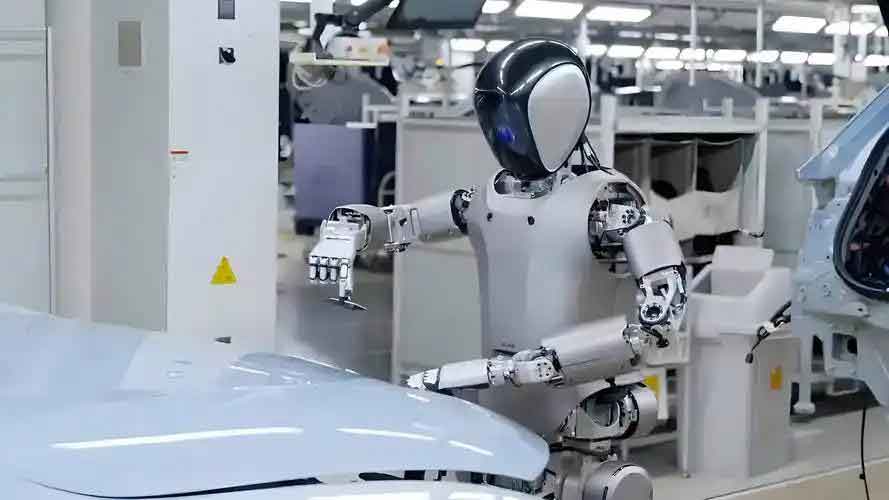
Our technological breakthroughs are centered on three core areas: joint development, gait algorithms, and ubiquitous robot operating systems. First, in joint research, we have pioneered high-toughness, high-torque composite material servo mechanisms for small-sized legged robots. This innovation represents a domestic first in the robotics industry, achieving localization of core components while enhancing lifespan, reducing weight, and minimizing noise. For large-scale dynamic legged robots, we developed high-performance modular drive units that offer greater density, overload resistance, impact tolerance, and speed ratios compared to similar technologies. These advancements are critical for meeting the demands of high-performance humanoid robots in complex scenarios. The torque density of our joints, for instance, can be expressed as:
$$ \text{Torque Density} = \frac{\text{Peak Torque}}{\text{Mass}} $$
Our joints achieve a peak torque exceeding 300 Nm and a torque density above 200 Nm/kg, enabling robust and efficient motion. The following table summarizes key parameters of our joint technology:
| Component | Peak Torque | Torque Density | Key Features |
|---|---|---|---|
| Composite Servo | 150 Nm | 180 Nm/kg | Lightweight, low noise, high durability |
| Modular Drive Unit | 350 Nm | 220 Nm/kg | High density, anti-overload, scalable |
Second, in optimizing bipedal gait algorithms, we addressed issues like low trajectory tracking accuracy and poor motion robustness. By leveraging a whole-body dynamics model and a quadratic programming-based motion trajectory control framework, we have enhanced the smoothness and robustness of humanoid robot movements. This framework allows for real-time correction of motion states at a control frequency of 2 kHz, enabling timely responses in complex environments. The dynamics model can be represented as:
$$ \mathbf{M}(\mathbf{q})\ddot{\mathbf{q}} + \mathbf{C}(\mathbf{q}, \dot{\mathbf{q}}) + \mathbf{G}(\mathbf{q}) = \boldsymbol{\tau} $$
where \(\mathbf{M}\) is the inertia matrix, \(\mathbf{q}\) denotes joint angles, \(\mathbf{C}\) accounts for Coriolis and centrifugal forces, \(\mathbf{G}\) represents gravitational forces, and \(\boldsymbol{\tau}\) is the torque vector. Our quadratic optimization problem minimizes tracking error while satisfying constraints:
$$ \min_{\ddot{\mathbf{q}}} \left\| \ddot{\mathbf{q}} – \ddot{\mathbf{q}}_{\text{des}} \right\|^2 \quad \text{subject to} \quad \mathbf{A} \ddot{\mathbf{q}} \leq \mathbf{b} $$
This approach ensures stable and adaptive locomotion for humanoid robots, crucial for real-world applications.
Third, we have deeply explored ubiquitous robot operating systems, developing an open ecosystem that marks a step toward domestic system independence. By integrating with open-source HarmonyOS, our humanoid robots gain enhanced connectivity and intelligence. This system facilitates data interconnection with external sensors and multi-device linking via soft bus technology, enabling distributed collaboration and expanding the interactive capabilities of humanoid robots. For instance, the super terminal feature allows seamless communication between robots and smart devices, fostering a cohesive intelligent environment. The integration formula for sensor data fusion can be expressed as:
$$ \mathbf{s}_{\text{fused}} = \sum_{i=1}^{n} w_i \mathbf{s}_i $$
where \(\mathbf{s}_i\) are sensor inputs and \(w_i\) are adaptive weights optimized for task performance. This interoperability is pivotal for accelerating the commercialization of humanoid robots across industries.
The advent of embodied AI large models has been a game-changer for humanoid robot intelligence. These models act as a “brain” capable of long-term task planning and decomposing generalized operations into executable steps. For example, when a user requests a humanoid robot to fetch water from the living room, the large model generates a detailed action sequence: navigate to the kitchen, locate a cup, fill it with water, and return. This process involves natural language understanding and spatial reasoning, which we implement through models trained on vast knowledge datasets. The planning algorithm can be formalized as:
$$ \mathcal{P} = \arg\max_{\pi} \mathbb{E} \left[ \sum_{t=0}^{T} \gamma^t R(s_t, a_t) \right] $$
where \(\mathcal{P}\) is the policy, \(\pi\) denotes action sequences, \(R\) is the reward function, \(s_t\) and \(a_t\) are states and actions, and \(\gamma\) is a discount factor. Moreover, large models enable few-shot generalization, allowing humanoid robots to learn new skills with minimal training. In tasks like using a wrench to tighten a nut, traditional methods require extensive programming, but our approach combines large models with machine learning: after hundreds of trials via human demonstration or VR teleoperation, the robot masters the skill and applies it to similar tasks. The learning efficiency is quantified by:
$$ \eta = \frac{N_{\text{success}}}{N_{\text{trials}}} \times 100\% $$
where \(\eta\) represents learning rate, often achieving over 80% success in real scenes after optimization. This capability significantly reduces deployment time and enhances the adaptability of humanoid robots.
Our commercialization strategy for humanoid robots unfolds in three phases, as outlined in the table below:
| Phase | Focus Area | Key Applications | Pricing Range |
|---|---|---|---|
| Phase 1 | Education and Research | Academic labs, STEM programs | Approx. $100,000 |
| Phase 2 | Industrial and Special Fields | Manufacturing, inspection, hazardous environments | Around $50,000 |
| Phase 3 | Household and Civilian Use | Elderly care, companionship, home assistance | Under $20,000 |
Currently, we have achieved initial commercialization in research education and special services, with first orders being delivered. The price per unit is in the range of tens of thousands of dollars, but we project a reduction to around ten thousand dollars within three years as scale increases. This cost reduction is driven by mass production, technological refinements, and supply chain optimizations. The cost model can be approximated as:
$$ C_{\text{total}} = C_{\text{materials}} + C_{\text{manufacturing}} + C_{\text{R&D}} \cdot \frac{1}{N} $$
where \(C_{\text{total}}\) is the total cost, \(N\) is the production volume, and economies of scale lower per-unit R&D expenses. Achieving this requires overcoming several barriers to mass production and adoption.
Key challenges in humanoid robot industrialization include motion performance, intelligence level, and cost. First, motion performance needs further optimization. While our humanoid robots exhibit enhanced dynamics, real-world applications demand higher operational dexterity and robustness. We continuously iterate on structural design, having undergone four major optimizations to boost performance metrics like speed and balance. The improvement in motion efficiency can be measured by:
$$ E_{\text{motion}} = \frac{\text{Task Completion Rate}}{\text{Energy Consumption}} $$
Second, intelligence remains a hurdle. Although large models are integrated, current AI capabilities fall short in multi-task handling and achieving desired outcomes in unstructured environments. We are enhancing this through continuous learning algorithms and real-time data processing. Third, cost is a significant factor. Limited application scenarios keep production costs high, but we are working on modular designs and cheaper components to drive down expenses. The table below compares these challenges:
| Challenge | Current Status | Target Improvement | Impact on Industrialization |
|---|---|---|---|
| Motion Performance | Good in lab settings | High in real scenes | Critical for adoption |
| Intelligence Level | Basic task planning | Advanced generalization | Enables complex use cases |
| Cost | High per unit | Mass-production affordable | Determines market penetration |
To address these, we emphasize the importance of moving prototypes out of laboratories and into real-world scenarios. The true value of a humanoid robot lies in its ability to create commercial value and perform practical tasks. We collaborate with partners in industries like telecommunications and home appliances to test our robots in actual settings, such as factory floors or smart homes. These tests reveal practical issues and provide direction for iteration. For instance, a 99% success rate in lab simulations is less meaningful than an 80% rate in field deployments, as the latter reflects real-world viability. Our testing framework involves:
$$ \text{Field Score} = \alpha \cdot \text{Reliability} + \beta \cdot \text{Efficiency} + \gamma \cdot \text{User Feedback} $$
where \(\alpha, \beta, \gamma\) are weights adjusted based on application priorities. Through such collaborations, we validate the efficiency of large models in skill acquisition, particularly for tasks difficult to simulate, like handling flexible objects or opening lids. This hands-on approach accelerates technological maturation and builds trust in humanoid robot solutions.
In terms of hardware, domestic advantages in motors and reducers give us an edge, and the rapid growth of the local chip industry supports the localization of components for humanoid robots. Our humanoid robot platforms match or exceed foreign counterparts in本体 performance, but software applications require further development. We are investing in open-source ecosystems and developer tools to foster innovation. The synergy between hardware and software is encapsulated in the performance index:
$$ \text{PI} = \frac{\text{Hardware Capability} \times \text{Software Intelligence}}{\text{Cost}} $$
By maximizing PI, we aim to deliver cost-effective humanoid robots that are both powerful and smart. Looking ahead, we envision humanoid robots becoming integral to daily life, much like industrial robots revolutionized manufacturing. The path forward involves sustained R&D, cross-industry partnerships, and a focus on scalable solutions. As we advance, each step brings us closer to a future where humanoid robots are commonplace, enhancing productivity, safety, and quality of life across the globe.
In conclusion, the journey toward humanoid robot industrialization is multifaceted, requiring innovations in control algorithms, AI integration, and system design. We remain committed to pushing boundaries, learning from real-world applications, and driving down costs. The humanoid robot is not just a technological marvel but a tool for societal transformation, and we are proud to contribute to its evolution. Through collaboration and continuous improvement, we believe that humanoid robots will soon transition from niche applications to mainstream adoption, unlocking their full potential in diverse domains.