
The evolution of actuator technology has catalyzed their widespread adoption across diverse sectors, including industrial manufacturing, medical robotics, and aerospace. A persistent and critical challenge in the deployment of robotic systems, particularly those utilizing pneumatic actuation, is the management of high-impact forces generated during the initial contact between the end effector and its operational environment. Such impacts can lead to mechanical damage to both the robot and the workpiece, compromise task precision, and pose safety risks. Consequently, achieving “friendly” or compliant contact has become a paramount research focus. This paper addresses this challenge by proposing and validating an active compliance control strategy based on impedance control for a pneumatic end effector. The primary objective is to regulate and mitigate contact forces, enabling smooth and adaptive interaction.
Current methodologies for force interaction control predominantly include position control, pure force control, and hybrid force/position control. For tasks requiring physical interaction, compliance control strategies are essential. Among these, impedance control has emerged as a powerful framework. It does not explicitly control force or position but rather regulates the dynamic relationship between them—the mechanical impedance—at the end effector. This approach allows the end effector to exhibit a desired compliant behavior when interacting with unknown or stiff environments. Prior research has demonstrated the efficacy of impedance and hybrid control for various manipulators. This work specifically tailors the impedance control paradigm to the nonlinear dynamics of a pneumatic actuator system to achieve superior active compliant contact.
System Architecture and Mathematical Modeling of the Pneumatic End-Effector
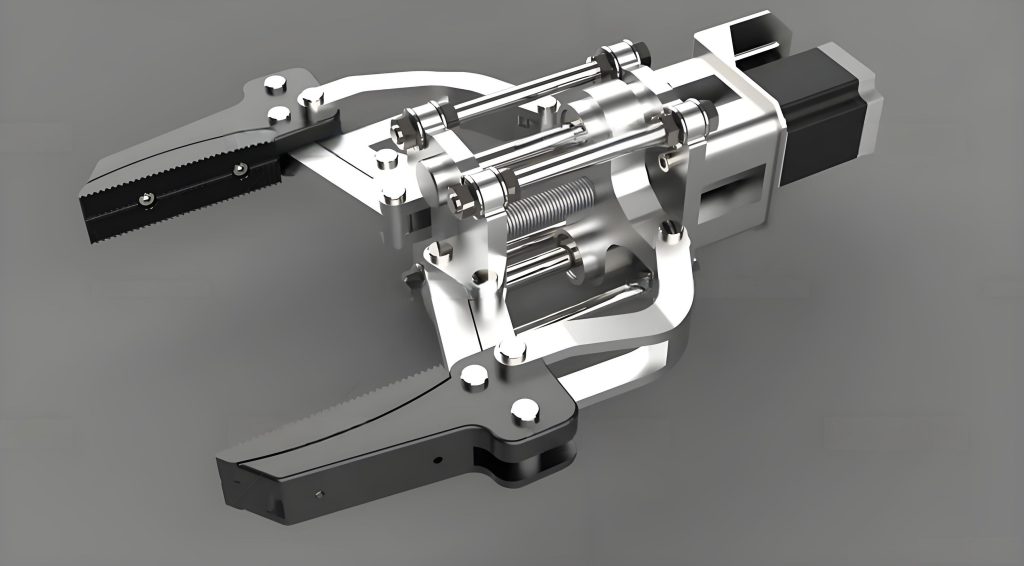
The core system developed for this research is a servo-pneumatic actuator configured as a robotic end effector. Its primary function is to execute controlled motions while managing interaction forces. The system’s architecture, as conceptually illustrated, integrates several key components to form a closed-loop control system. A double-acting pneumatic cylinder serves as the primary actuation element. A proportional flow valve, with multiple ports (e.g., A, B, C, D, E), precisely meters the air flow into and out of the cylinder chambers, enabling fine control over the piston’s extension and retraction. A high-precision displacement sensor (e.g., Linear Variable Differential Transformer – LVDT) is mounted to measure the real-time position of the piston rod (the end effector‘s point of action). A uniaxial force sensor is integrated at the tip of the rod to directly measure the contact force between the end effector and the environment. Pressure transducers are installed in both cylinder chambers to monitor the internal pressures. An inertial mass can be attached to the rod to simulate a payload and modify the system’s dynamic response. Finally, a central digital controller houses the proposed active compliance algorithm, processing sensor feedback and generating command signals for the proportional valve.
To design an effective controller, a dynamic model of the system is established. The model encompasses force balance, pressure dynamics, and valve flow characteristics.
1. Force Balance Equation: The net force driving the piston is derived from the pressure differential across it, balanced by the external contact force and friction (simplified here). For a cylinder with a rod on one side, the equation is:
$$ F_{ext} + p_2 A_2 + p_a A_r = p_1 A_1 $$
where \( F_{ext} \) is the measured external contact force from the force sensor, \( p_1 \) and \( p_2 \) are the absolute pressures in the cap-end and rod-end chambers respectively, \( A_1 \) and \( A_2 \) are the corresponding effective piston areas, \( p_a \) is the atmospheric pressure, and \( A_r \) is the cross-sectional area of the piston rod.
2. Pressure Dynamics (Actuator Chambers): Treating the air in each chamber as an ideal gas undergoing an isothermal process (a common simplification for moderate-speed actuators), the pressure rate of change is related to the mass flow rate and the volume change due to piston motion:
$$ \dot{p}_i = \frac{\kappa R T}{V_i} \dot{m}_i – \frac{\kappa p_i}{V_i} \dot{V}_i, \quad i=1,2 $$
Here, \( \kappa \) is the specific heat ratio, \( R \) is the gas constant, \( T \) is the assumed constant temperature, \( \dot{m}_i \) is the mass flow rate into chamber \( i \), and \( V_i \) is the chamber volume. The chamber volume changes with piston displacement \( x \) (positive for extension):
$$ V_1 = V_{10} + A_1 x, \quad V_2 = V_{20} – A_2 x $$
where \( V_{10} \) and \( V_{20} \) are the initial dead volumes.
3. Valve Flow Model: The mass flow rate \( \dot{m}_i \) through the proportional valve ports is modeled using the standard subsonic/sonic flow equation for a compressible gas through an orifice:
$$ \dot{m} = C_f A_v \rho_s \sqrt{\frac{T_s}{T}} \cdot \Psi\!\left(\frac{p_d}{p_u}\right) $$
$$ \Psi(r) = \begin{cases}
\sqrt{1 – \left(\frac{r – b}{1 – b}\right)^2} & \text{if } b < r \le 1 \quad \text{(subsonic)} \\
1 & \text{if } r \le b \quad \text{(sonic/choked)}
\end{cases} $$
In this model, \( C_f \) is the discharge coefficient, \( A_v \) is the effective orifice area (controlled by the valve command), \( \rho_s \) and \( T_s \) are the supply density and temperature, \( p_u \) and \( p_d \) are the upstream and downstream pressures, and \( b \) is the critical pressure ratio for choked flow (typically ~0.528 for air). The flow direction and upstream/downstream assignments depend on the valve spool position, which is determined by the control signal driving the end effector.
Design of the Active Compliance Controller Based on Impedance
The core innovation of this work lies in the design of the active compliance controller. As shown in the control schematic, the strategy seamlessly integrates a position loop with an outer impedance-based force correction loop to govern the end effector‘s interaction.
The controller operates as follows: A primary position command, \( x_{input} \), is issued, representing the desired nominal trajectory for the end effector. Simultaneously, a desired contact force, \( F_d \), is defined (often set to a small, non-damaging value for gentle contact). The actual contact force \( F_{ext} \) measured by the force sensor is compared to \( F_d \), yielding a force error \( \Delta F = F_d – F_{ext} \). This error is fed into the Impedance Controller block.
The impedance controller implements a desired second-order dynamical relationship between the force error and a resulting positional modification. Its behavior is defined by the target impedance equation:
$$ \Delta F = M_d \ddot{x}_{corr} + B_d \dot{x}_{corr} + K_d x_{corr} $$
Here, \( x_{corr} \) is the positional correction output by the impedance controller. The parameters \( M_d \), \( B_d \), and \( K_d \) represent the target inertia, damping, and stiffness, respectively. They define the “feel” of the end effector: a low \( K_d \) makes it soft and compliant, while a high \( K_d \) makes it stiff. \( B_d \) controls the damping of the interaction, preventing oscillations. The target inertia \( M_d \) is often set to zero or a small value for simplicity, making the impedance primarily a stiffness-damper system.
Taking the Laplace transform of the impedance equation, the transfer function of the controller is:
$$ G_{imp}(s) = \frac{X_{corr}(s)}{\Delta F(s)} = \frac{1}{M_d s^2 + B_d s + K_d} $$
The output \( x_{corr} \) is then subtracted from the original position command \( x_{input} \) to generate a modified desired position, \( x_d \), for the inner loop:
$$ x_d = x_{input} – x_{corr} $$
This is a key aspect: if the measured force \( F_{ext} \) is greater than the desired force \( F_d \) (e.g., pressing too hard), \( \Delta F \) becomes negative, leading to a positive \( x_{corr} \) (for a positive \( K_d \)), which reduces \( x_d \). This commands the end effector to withdraw slightly, thereby reducing the contact force. The inner loop consists of a high-gain position controller (e.g., a PID or state-feedback controller) that drives the pneumatic actuator via the proportional valve to track this modified trajectory \( x_d \). The actual position \( x_a \) is provided by the displacement sensor, closing the position loop. This cascaded structure allows the end effector to track a position trajectory in free space while seamlessly transitioning to a force-regulating compliant behavior upon contact.
Experimental Validation and Results Analysis
To validate the performance of the proposed active compliance controller for the pneumatic end effector, a comprehensive experimental testbed was constructed. The setup consisted of a vertical pneumatic actuator with a 5 kg mass attached to its rod, simulating a loaded end effector. The system was instrumented with the sensors described earlier and interfaced with a real-time digital controller. The experiment involved commanding the actuator to move downward from a height of 1.2 meters until its end effector made contact with a rigid surface (ground). The critical test was to observe the transient and steady-state contact force.
Two main experimental schemes were executed, as summarized in the table below, to isolate the effect of the impedance controller.
| Scheme | Control Mode | Impedance Parameters (M, B, K) | Objective |
|---|---|---|---|
| 1 | Position Control Only (No Active Compliance) | (0, 0, 0) – Impedance loop disabled | Establish baseline impact force. |
| 2 | Impedance-Based Active Compliance | (0, 0, 1.5 N/mm) | Evaluate the effect of target stiffness \(K_d\) on contact force mitigation. |
| (0, 0, 2.5 N/mm) | |||
| (0, 0, 3.5 N/mm) |
In all compliance tests, the desired contact force \( F_d \) was set to 49 N (approximately the weight of the 5 kg mass under gravity), representing the ideal steady-state force for a gentle hold.
Results for Scheme 1 (No Active Compliance): With only the inner position loop active, the end effector behaved as a stiff positional servo. Upon contact, it attempted to continue tracking its original trajectory into the rigid environment. This resulted in a large impact force spike. The measured force peaked at approximately 93 N, nearly double the desired 49 N. The force trace exhibited significant oscillations, taking about 1.68 seconds to settle near the desired value. This behavior clearly demonstrates the potential for damage during uncontrolled contact.
Results for Scheme 2 (With Active Compliance): Activating the outer impedance loop dramatically altered the interaction dynamics. The end effector no longer resisted the environment rigidly. Instead, it yielded upon contact, modulating its position based on the force error. The results for different stiffness gains \( K_d \) are summarized in the following table and described thereafter.
| Test Condition | Peak Contact Force (N) | Settling Time to ~49 N (s) | Force Reduction vs. Baseline | Settling Time Improvement |
|---|---|---|---|---|
| No Compliance (Baseline) | 93 | 1.68 | 0% | 0% |
| Compliance, \(K_d = 1.5\) N/mm | 73 | 1.32 | 21.5% | 21.4% |
| Compliance, \(K_d = 2.5\) N/mm | 65 | 0.91 | 30.1% | 45.8% |
| Compliance, \(K_d = 3.5\) N/mm | 56 | 0.63 | 39.8% | 62.5% |
The data reveals a clear and significant trend: The incorporation of the impedance-based active compliance controller substantially reduces both the peak impact force and the settling time. The higher the target stiffness \( K_d \) within the tested range, the better the performance. With \( K_d = 3.5 \) N/mm, the peak force was reduced to 56 N (a 39.8% reduction from the baseline), and the system settled in just 0.63 seconds (a 62.5% improvement). Notably, the force overshoot and oscillations were almost entirely eliminated, resulting in a smooth, “soft-landing” profile for the end effector. The end effector demonstrated the ability to actively regulate its contact force toward the desired setpoint by trading off position error, which is the fundamental principle of impedance control.
Conclusion
This paper successfully addressed the problem of high-impact contact for pneumatic robotic end effectors by developing and experimentally validating an active compliance control strategy. The proposed solution centers on a cascaded controller featuring an inner high-performance position loop and an outer impedance-based force-regulation loop. The impedance controller modulates the desired position trajectory in real-time based on the error between the measured and desired contact force, effectively endowing the end effector with a programmable, spring-damper-like behavior at its point of interaction.
The mathematical model of the pneumatic actuator system provided the foundation for controller tuning. Extensive experimental results conclusively demonstrated the superiority of the active compliance approach. Compared to traditional stiff position control, the impedance-controlled end effector achieved drastic reductions in peak contact force (up to ~40%) and settling time (up to ~63%). The performance was directly tunable by adjusting the target stiffness parameter \( K_d \) of the impedance model, allowing the end effector‘s compliance to be tailored to specific task and environmental requirements.
This work confirms that impedance control is a highly effective paradigm for achieving safe, gentle, and adaptive physical interaction with pneumatic end effectors. The findings provide a solid theoretical foundation and a practical control framework for implementing compliant end effectors in real-world applications such as automated assembly, polishing, human-robot collaboration, and any scenario where graceful contact is paramount.