
In recent years, the advancement of humanoid robots has captured significant attention due to their potential to perform complex tasks in various environments, such as autonomous driving, hazardous production, and aerospace applications. As a researcher deeply involved in robotics and navigation systems, I have focused on enhancing the intelligence and adaptability of humanoid robots, particularly through satellite-based navigation. The integration of Beidou Navigation Satellite System (BDS) with humanoid robots presents a promising avenue for improving autonomous path planning and decision-making. However, traditional navigation methods often lack adaptability, leading to inefficiencies in dynamic environments. This study addresses these limitations by developing an adaptive planning technology that leverages Beidou navigation for humanoid robots, aiming to optimize path planning, increase智能化程度 (intelligence), and enable more human-like navigation behaviors.
The core challenge lies in enabling humanoid robots to autonomously plan and adjust their walking routes and postures based on real-time satellite data. To tackle this, we have designed an adaptive control system that combines kinematic modeling, algorithm development, and hardware integration. In this article, I will detail our approach, starting with the kinematic model of a humanoid robot, followed by the design of the adaptive control system and algorithm. I will then present experimental results that validate the effectiveness of our technology. Throughout the discussion, I will emphasize the role of the humanoid robot in achieving adaptive navigation, using formulas and tables to summarize key concepts. Furthermore, to illustrate the practical context of humanoid robot development, I have included a visual representation below:
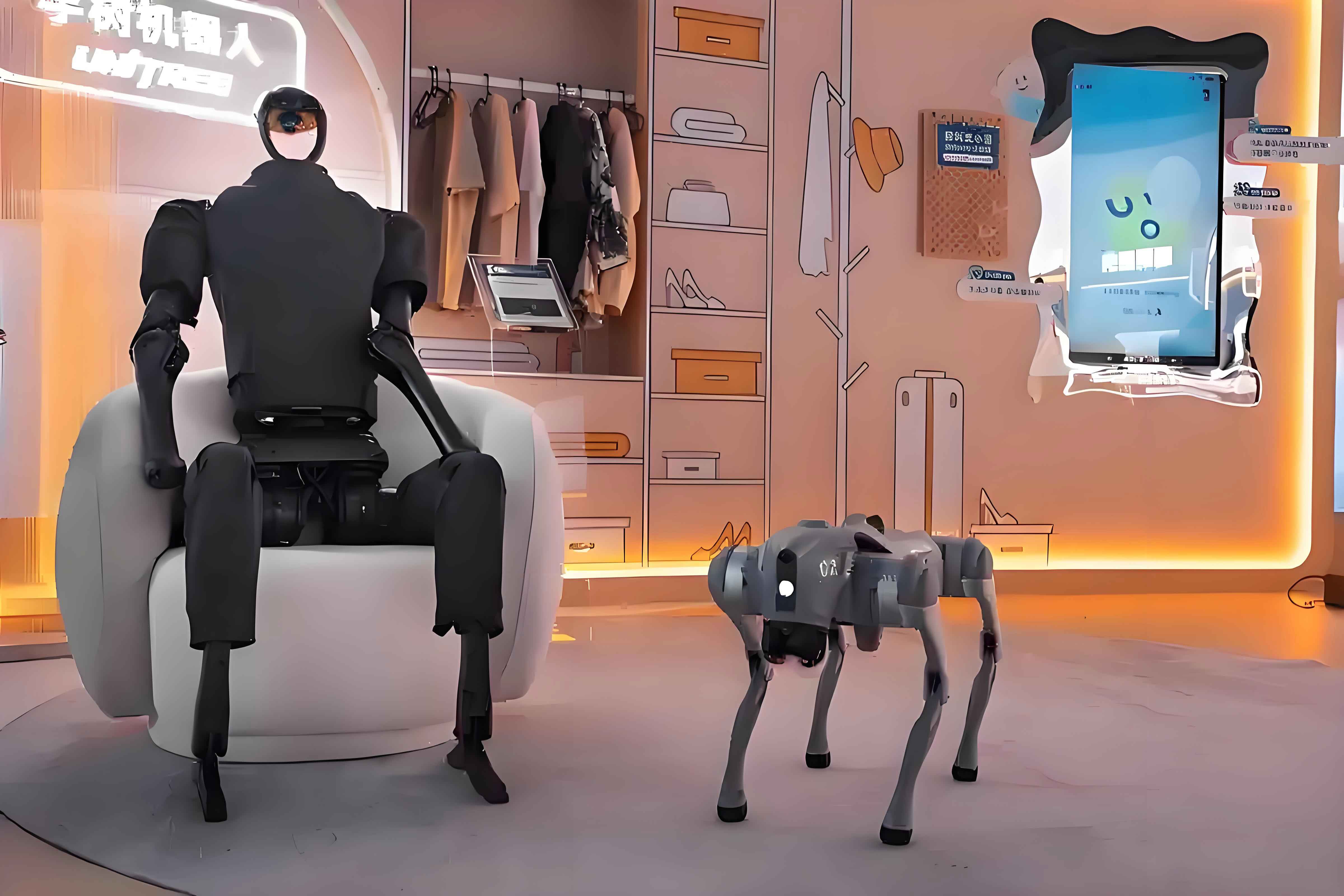
The humanoid robot used in this research is a nine-degree-of-freedom (9-DOF) servo-driven model, which mimics human-like structures for enhanced mobility. Its specifications include an angular resolution of 10° per signal for turning and a linear displacement resolution of 50 mm per signal for straight walking. With a total mass of 500 g and a 2000 mAh lithium battery for extended operation, this humanoid robot serves as an ideal platform for testing adaptive navigation. The primary goal is to move beyond pre-programmed actions and enable the humanoid robot to dynamically adjust its path and posture using Beidou navigation data, thereby improving its adaptability in real-world scenarios.
To achieve this, we first established a kinematic mathematical model for the humanoid robot. This model describes the relationship between the robot’s position, orientation, and control signals. Let (x_c, y_c) represent the current coordinates of the humanoid robot in the Earth-fixed frame, and (x_g, y_g) denote the target coordinates. The航向角 (heading angle) ψ_h during walking is derived from these coordinates as follows:
$$ \psi_h = -\arctan\left(\frac{x_g – x_c}{y_g – y_c}\right) $$
This equation guides the humanoid robot toward the target. Additionally, we define the转向角 (steering angle) α, which is adjusted based on the error between the current heading and the desired orientation. For control purposes, we discretize the motion using a time interval T, leading to the following state-update equations:
$$
\begin{bmatrix}
x((n+1)T) \\
y((n+1)T) \\
\psi((n+1)T) \\
\alpha((n+1)T) \\
v((n+1)T)
\end{bmatrix}
\approx
\begin{bmatrix}
x(nT) \\
y(nT) \\
\psi(nT) \\
\alpha(nT) \\
v(nT)
\end{bmatrix}
+
\begin{bmatrix}
-v_{\text{ROBERT}}(nT) \cdot \sin \psi_h(nT) \\
v_{\text{ROBERT}}(nT) \cdot \cos \psi_h(nT) \\
\alpha'(nT) \\
m_1(nT) \\
m_2(nT)
\end{bmatrix}
$$
Here, v_{\text{ROBERT}} represents the linear walking speed of the humanoid robot. To simplify, we set v_{\text{ROBERT}} = V, where V is a constant speed determined by the robot’s structure. The displacement S after n_x straight-walking signals is given by:
$$ S = n_x \cdot V = n_x \cdot \Delta S $$
where ΔS is the displacement per signal. Similarly, the steering angle α is controlled by:
$$ \alpha = K (\psi_g – \psi_c) = n_z \cdot \Delta \alpha $$
In this equation, K is an error coefficient (initially set to 1), n_z is the number of turning signals, and Δα is the angle adjustment per signal. The heading angle ψ_h and target orientation ψ_g are related as:
$$ \psi_h = \psi_c + \alpha = \psi_c + n_z \cdot \Delta \alpha $$
$$ \psi_g = \psi_h + \alpha = \psi_h + n_q \cdot \Delta \alpha $$
where ψ_c is the initial posture, ψ_g is the desired final posture, n_z is the number of signals for heading adjustment, and n_q is the number of signals for posture adjustment. These formulas form the basis for the adaptive planning algorithm, allowing the humanoid robot to compute necessary control signals autonomously.
Next, we designed the adaptive control system hardware, which integrates the humanoid robot with a Beidou navigation active controller. The system comprises three main components: the Beidou positioning system, the adaptive planning system, and the humanoid robot itself. The Beidou system uses an ICE610 navigator to obtain real-time coordinates of the humanoid robot. The adaptive planning system includes a human-machine interface (a 7-inch industrial touchscreen), a central processor (Siemens S7-200 PLC), and an intermediate controller developed in-house. This intermediate controller converts signals from the processor into commands for the humanoid robot, enabling seamless navigation. Additionally, the system incorporates vision and obstacle detection modules to enhance adaptability in complex environments. The overall hardware setup is summarized in Table 1, highlighting key parameters and components.
| Parameter | Symbol/Unit | Value |
|---|---|---|
| Degrees of Freedom | — | 9 |
| Angular Resolution per Signal | Δα / ° | 10 |
| Linear Displacement per Signal | Δs / mm | 50 |
| Turning Signal Time Interval | T_z / s | 4 |
| Walking Signal Time Interval | T_x / s | 4 |
| Total Mass | m / kg | 0.5 |
| Linear Gain Coefficient | K_x | 1.0 |
| Posture Gain Coefficient | K_q | 1.0 |
| Heading Gain Coefficient | K_z | 1.0 |
The adaptive path planning control process is central to enhancing the humanoid robot’s intelligence. As illustrated in the flowchart (adapted from the original study), the system begins by inputting initial and target coordinates, along with posture parameters. It then autonomously generates navigation paths and adjusts the humanoid robot’s heading and posture through left or right turns, based on real-time comparisons. The process involves several steps: first, computing the required number of control signals (n_z, n_x, n_q) using the formulas above; second, issuing turning signals to adjust the heading; third, issuing straight-walking signals to move toward the target; fourth, issuing posture adjustment signals to align with the desired orientation; and finally, verifying position and posture errors to trigger adaptive corrections if needed. This iterative approach ensures that the humanoid robot can handle uncertainties and achieve precise navigation.
To implement this, we developed the control algorithm using structured text language (STL). The algorithm calculates n_z, n_x, and n_q as follows:
$$ n_z = \frac{\alpha}{\Delta \alpha} = \frac{K_z \cdot (\psi_g – \psi_c)}{\Delta \alpha} $$
$$ n_x = \frac{S}{\Delta s} = \frac{K_x \cdot \sqrt{(y_g – y_c)^2 + (x_g – x_c)^2}}{\Delta s} $$
$$ n_q = \frac{\alpha_q}{\Delta \alpha} = \frac{K_q \cdot (\psi_g – \psi_c)}{\Delta \alpha} $$
These calculations enable the humanoid robot to adaptively plan its route. For instance, if the desired posture ψ_g is greater than the current posture ψ_c, the humanoid robot will generate left-turn signals; otherwise, it will generate right-turn signals. This decision-making mimics human-like behavior, increasing the adaptability of the humanoid robot. The control principles are embedded in the central processor, which communicates with the intermediate controller to execute motions.
We conducted extensive experiments to validate the adaptive navigation technology. The experimental setup involved initializing the humanoid robot at a known Beidou coordinate and setting two target coordinates with different postures: -34° and -73°. The goal was to test whether the humanoid robot could autonomously generate paths and adjust its posture adaptively. Key input parameters for the experiments are listed in Table 2, which includes initial and target coordinates, gain coefficients, and error thresholds.
| Input Parameter | Symbol/Unit | Value for ψ_g = -34° | Value for ψ_g = -73° |
|---|---|---|---|
| Initial Beidou Coordinate (x_c) | x_c / mm | 3835534000.0 | 3835534000.0 |
| Initial Beidou Coordinate (y_c) | y_c / mm | 1974867000.0 | 1974867000.0 |
| Target Beidou Coordinate (x_g) | x_g / mm | 3835534419.3 | 3835534419.3 |
| Target Beidou Coordinate (y_g) | y_g / mm | 1974867272.3 | 1974867272.3 |
| Initial Posture | ψ_c / ° | -33 | -33 |
| Target Posture | ψ_g / ° | -34 | -73 |
| Distance Allowable Error | R / mm | 50 | 50 |
| Posture Allowable Error | δ / ° | 10 | 10 |
During the experiments, the humanoid robot successfully generated navigation signals. For both target postures, the system computed n_z = 2, n_x = 14, and n_q = 2 for the initial planning phase. This demonstrates the consistency of the algorithm in path generation. The humanoid robot then executed these signals, adjusting its heading, moving straight, and fine-tuning its posture. We recorded the actual trajectories and postures, comparing them with ideal and simulated paths. The results for the target posture of -34° are summarized in Table 3, which shows a subset of coordinate and posture data during the navigation process.
| Step | Ideal Trajectory (x, y) mm | Simulated Trajectory (x, y) mm | Actual Trajectory (x, y) mm | Actual Posture ψ / ° |
|---|---|---|---|---|
| 1 | (3835534000.0, 1974867000.0) | (3835534000.0, 1974867000.0) | (3835534007.9, 1974867008.6) | -33 |
| 2 | (3835534000.0, 1974867000.0) | (3835534000.0, 1974867000.0) | (3835534015.7, 1974867006.8) | -44 |
| 3 | (3835534000.0, 1974867000.0) | (3835534000.0, 1974867000.0) | (3835534023.6, 1974867010.7) | -54 |
| 4 | (3835534041.9, 1974867027.2) | (3835534039.9, 1974867030.1) | (3835534056.5, 1974867039.1) | -52 |
| … (additional rows for brevity) | … | … | … | … |
| Final | (3835534419.3, 1974867272.3) | (3835534399.3, 1974867300.9) | (3835534458.5, 1974867406.7) | -20 |
As observed, the actual trajectory of the humanoid robot deviated slightly from the ideal path due to systemic errors, such as mechanical inaccuracies in the humanoid robot’s structure. However, after the initial navigation phase, the humanoid robot entered an adaptive adjustment stage to correct these errors. For the target posture of -34°, the system generated additional signals: 18 heading adjustment signals, 3 straight-walking signals, and 16 posture adjustment signals. This adaptive process involved right turns for heading correction and left turns for posture alignment, showcasing the humanoid robot’s ability to make intelligent decisions based on real-time data. Ultimately, the humanoid robot achieved a final position of (3835534444.6 mm, 1974867287.0 mm) with a posture of -37°, which is within the allowable errors (distance error 29.3 mm < 50 mm, posture error 3° < 10°). Similarly, for the target posture of -73°, the humanoid robot adapted by generating 13 heading adjustment signals, 2 straight-walking signals, and 12 posture adjustment signals, resulting in a final position of (3835534440.0 mm, 1974867281.0 mm) and posture of -79°, also within acceptable limits.
The results highlight the effectiveness of our adaptive planning technology. The humanoid robot demonstrated improved satellite navigation adaptability, as it could autonomously adjust its path and posture using Beidou data. Key performance metrics include reduced position and orientation errors, as well as the ability to handle different target postures through adaptive left or right turns. This enhances the智能化程度 (intelligence) of the humanoid robot, making it more suitable for real-world applications where dynamic environments require flexible navigation. The integration of Beidou navigation with the humanoid robot’s control system proved robust, with the adaptive algorithm successfully compensating for inherent system errors.
In conclusion, this research has developed an adaptive planning technology for humanoid robots utilizing Beidou navigation. We established a kinematic model for the humanoid robot, designed an adaptive control system, and implemented a path planning algorithm that enables autonomous decision-making. Experimental validations confirmed that the humanoid robot can adaptively plan walking routes and adjust postures, thereby increasing its intelligence and practicality. Future work will focus on refining the algorithm for more complex environments, such as those with dynamic obstacles, and integrating additional sensors to further enhance the humanoid robot’s adaptability. Overall, this study lays a foundation for advancing humanoid robot navigation and promoting the adoption of Beidou satellite systems in robotics.