
In the field of robotics, the development of dexterous robotic hands is crucial for enabling humanoid robots to perform fine manipulation tasks in diverse environments such as space exploration and service applications. As a researcher focused on robotic manipulation, I have been involved in designing and implementing control systems that enhance the performance of dexterous robotic hands. The primary challenge lies in creating a control architecture that not only handles the high degree of freedom (DoF) and sensor integration of these hands but also seamlessly integrates with larger robotic systems like humanoid robots. In this article, I present our work on a task-oriented control system for a multi-fingered dexterous robotic hand, emphasizing a centralized control with decentralized data processing approach. Additionally, I delve into a novel multi-fingered spatial coordinating impedance control strategy that reduces control complexity while maintaining flexibility and stability. Throughout this discussion, I will highlight key aspects using formulas and tables, and ensure the frequent mention of “dexterous robotic hand” to underscore its importance.
The core of our work revolves around a specific dexterous robotic hand model, which features 15 DoFs and numerous sensors, requiring a control cycle of 5 kHz. Traditional control architectures often struggle with such high-integration mechatronic systems, especially when real-time performance is paramount. Our solution involves a three-layer control system structure: a real-time control layer, an embedded communication and control layer, and a drive control layer. This hierarchy allows for efficient data handling and motor control while enabling hard real-time operations. The real-time control layer is built on a Simulink/QNX platform, which simplifies controller design through graphical modeling and automatic code generation. This platform supports rapid development and integration with other robotic modules via distributed network communication. The embedded layer, integrated within the dexterous robotic hand, manages sensor data preprocessing and communication interfaces, ensuring low-latency data transfer. The drive control layer utilizes DSP and FPGA components for direct motor driving and sensor acquisition, optimizing performance in a compact form factor. This architecture is designed to meet the stringent requirements of dexterous robotic hand operations, facilitating tasks like grasping and manipulation with high precision.
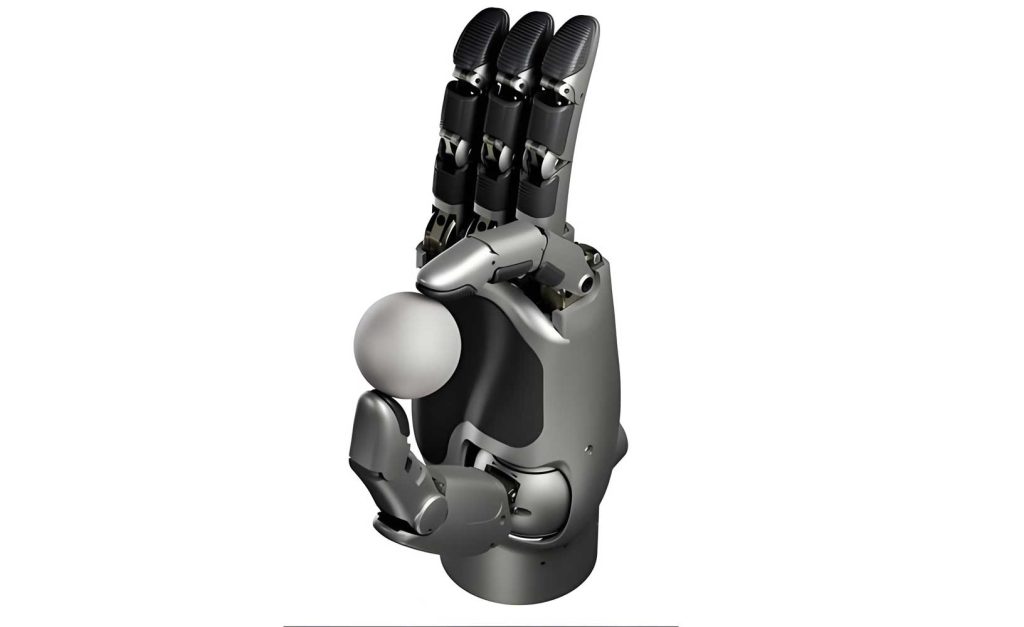
To achieve dexterous manipulation, the control system must coordinate multiple fingers effectively. One significant innovation in our work is the development of a multi-fingered spatial coordinating impedance control strategy. This approach aims to control the position and orientation of a grasped object using only six inputs, regardless of the number of fingers involved—a drastic reduction from the 30 inputs typically required for a five-fingered dexterous robotic hand. The foundation of this strategy is the definition of an object-level coordinate frame based on fingertip positions. For an n-fingered dexterous robotic hand (where n ≥ 3), the object frame center $$x_o$$ is computed as the average of all fingertip positions:
$$ x_o = \frac{x_1 + x_2 + \ldots + x_n}{n} $$
Here, $$x_i(\theta)$$ represents the Cartesian position of the i-th fingertip, dependent on joint angles $$\theta$$. The orientation matrix $$R_o = [r_{o1}, r_{o2}, r_{o3}]$$ of the object frame is derived from linear combinations of fingertip vectors. For instance, the first axis $$r_{o1}$$ is given by:
$$ r_{o1} = \frac{v_1 + v_2}{\|v_1 + v_2\|} $$
where $$v_1$$ and $$v_2$$ are sums of normalized vectors from the object center to alternating fingertips, ensuring a balanced representation. The third axis $$r_{o3}$$ is perpendicular to the plane spanned by $$v_1$$ and $$v_2$$:
$$ r_{o3} = \frac{\hat{v}_1 v_2}{\|\hat{v}_1 v_2\|} $$
with $$\hat{v}$$ denoting the skew-symmetric matrix for vector cross products. The second axis $$r_{o2}$$ is then obtained as $$r_{o2} = r_{o3} \times r_{o1}$$. This coordinate frame allows us to describe the object’s pose succinctly, facilitating control based on spatial displacements.
The impedance control strategy employs three types of virtual springs in six-dimensional space: translational, rotational, and connective springs. These springs generate driving torques based on the energy stored due to displacements between the current object frame $$\Sigma_o = [R_o, x_o]$$ and a desired frame $$\Sigma_d = [R_d, x_d]$$. The translational spring energy is defined as:
$$ V_t = \frac{1}{2} \Delta x_{od}^{o^T} K_t \Delta x_{od}^o $$
where $$\Delta x_{od}^o = R_o^T (x_o – x_d)$$ is the translational displacement in the object frame, and $$K_t = k_t I$$ is a diagonal stiffness matrix. The resulting force in the object frame is $$f_t = K_t \Delta x_{od}^o$$, mapped to joint torques via the Jacobian $$J_t$$:
$$ \tau_t = J_t^T f_t $$
The rotational spring energy uses a quaternion representation. Let $$\phi_{od}^o$$ be the vector part of the unit quaternion derived from $$R_o^e = R_o^T R_d$$. The energy is:
$$ V_o = 2 \phi_{od}^{o^T} K_o \phi_{od}^o $$
with $$K_o = k_o I$$. The moment in the object frame is $$m_o = K_o \phi_{od}^o$$, leading to joint torques:
$$ \tau_o = J_o^T m_o $$
The connective spring energy ensures grasp stability by maintaining desired distances between fingertips and the object center:
$$ V_c = \frac{1}{2} K_c \sum_{i=1}^n (\| \Delta x_i \| – l_{di})^2 $$
where $$\Delta x_i = x_i – x_o$$, $$l_{di}$$ is a preset spring length, and $$K_c$$ is a stiffness matrix. The force for each finger is $$f_{ci} = K_c (\| \Delta x_i \| – l_{di})$$, with joint torques:
$$ \tau_{ci} = J_{ci}^T f_{ci} $$
The total driving torque from these springs is $$\tau_{\Delta} = \tau_t + \tau_o + \tau_c$$. The overall control law incorporates damping and compensation terms:
$$ \tau = -\tau_{\Delta} – D v_o + N(\theta) + \tau_{ext} $$
Here, $$D$$ is a damping matrix, $$v_o$$ is the spatial velocity of the object frame relative to the object space, $$N(\theta)$$ compensates for passive forces like gravity and friction, and $$\tau_{ext}$$ represents joint torque feedback for enhanced stability. This formulation enables impedance control that adapts to external disturbances, making the dexterous robotic hand more robust during manipulation tasks.
To validate our control system and strategy, we conducted experiments using a modular dexterous robotic hand capable of configuring three, four, or five fingers. The real-time control platform, based on Simulink/QNX, ensured a control cycle of 200 µs. We tested the spatial coordinating impedance control on objects of varying shapes and weights, as summarized in the table below:
| Number of Fingers | Object Shape | Weight (g) | Radial Size (mm) | Translational Stiffness $$K_t$$ (N/m) | Rotational Stiffness $$K_o$$ (N·m/rad) | Connective Stiffness $$K_c$$ (N/m) |
|---|---|---|---|---|---|---|
| 3 | Cylinder | 100 | 35 | 2 × 10³ I | 2 I | 4 × 10² I |
| 4 | Sphere | 86 | 65 | 2.3 × 10³ I | 2.5 I | 4 × 10² I |
| 5 | Irregular Spherical | 59 | 78 | 2.5 × 10³ I | 3 I | 4 × 10² I |
The experiments involved both rotational and translational impedance control. For rotation, the object was driven to rotate around the z-axis by a desired angle, while for translation, it was moved along the x-axis. The results demonstrated stable control with fast response times. For instance, with three fingers, the object achieved a rotation of $$\Delta \gamma = 0.7$$ rad within 5 ms, settling to a steady-state error below 0.01 rad. Similarly, translational displacements converged to errors under 0.01 m. The connective forces showed that the thumb (finger 1) exerted higher forces due to its oppositional role, highlighting its importance in grasp stability. The dexterous robotic hand maintained low coupling between translational and rotational motions, ensuring precise control.
A key advantage of our multi-fingered spatial coordinating impedance control is its ability to reduce control inputs without sacrificing flexibility. Unlike methods such as Eigengrasp or Postural Synergies, which couple joints and reduce DoFs, our approach allows independent joint control while coordinating fingers through object-level commands. This is particularly beneficial for dexterous robotic hands, as it preserves their inherent agility. The table below compares our method with other multi-fingered control strategies:
| Control Strategy | Real-Time Capability | Control Flexibility | Number of Controllable Fingers | Grasp Compliance |
|---|---|---|---|---|
| Our Spatial Coordinating Impedance (SCI) | Real-time control | Independent joint control | Any number (n ≥ 3) | Impedance-based with torque feedback, stable |
| Eigengrasp (EG) | Offline planning | Joint coupling reduces flexibility | Any number | No compliance |
| Postural Synergies (PS) | Real-time control | Joint coupling reduces flexibility | Any number | No compliance |
| Synchronized Base Joint Control (SCB) | Real-time control | Joint coupling | Any number | No compliance |
| Four-Fingered Spatial Impedance (4SI) | Real-time control | Independent joint control | 4 fingers only | Impedance-based with fingertip feedback, less stable |
From this comparison, it is evident that our SCI method excels in real-time performance, flexibility, and adaptability to various dexterous robotic hand configurations. The use of joint torque feedback enhances compliance, making the dexterous robotic hand more responsive to external forces during manipulation. This is crucial for tasks where environmental interactions are unpredictable, such as handling fragile objects or operating in cluttered spaces.
The implementation of our control system also involved developing a distributed network communication module to integrate the dexterous robotic hand with other robotic components, like arms and vision systems. This module uses UDP protocols and can achieve real-time communication at 1 kHz by prioritizing tasks in the QNX system. The Simulink-based interface allows seamless connection between control modules, enabling complex tasks like coordinated arm-hand movements. For example, in a humanoid robot setup, the dexterous robotic hand can receive target grasp points from a vision-based planning module via non-real-time channels, while the real-time controller executes the impedance control to achieve precise grasping. This integration showcases the practicality of our system for real-world applications.
In terms of performance, we observed that increasing the number of fingers improved stability but slightly reduced steady-state accuracy due to frictional and coupling forces. With five fingers, the dexterous robotic hand exhibited higher stiffness and better stability for lighter objects, while three fingers provided higher accuracy for heavier objects but required careful tuning of damping parameters. This trade-off can be managed by adaptive control laws, which we plan to explore in future work. Additionally, the modular design of the dexterous robotic hand allows reconfiguration for specific tasks, such as using fewer fingers for power grasps or more fingers for precision manipulation. This versatility underscores the importance of adaptable control systems for advanced dexterous robotic hands.
To further illustrate the control dynamics, consider the Jacobian matrices involved in mapping object-level commands to joint torques. For the translational spring, the Jacobian $$J_t$$ is derived as:
$$ J_t = \frac{\partial (R_o^T \Delta x_{od})}{\partial \theta} + \left( R_o^T \frac{\partial x_o}{\partial \theta} \right)^T $$
For the rotational spring, $$J_o$$ involves the angular velocity Jacobian:
$$ J_o = 2 R_o^T (\eta_{od} I – \hat{\phi}_{od}) \frac{\partial \omega_o}{\partial \theta} $$
where $$\omega_o = (R_o^T \dot{R}_o)^\vee$$ is the angular velocity in object frame. The connective spring Jacobian $$J_{ci}$$ is simpler:
$$ J_{ci} = \frac{\partial \| \Delta x_i \|}{\partial \theta} $$
These Jacobians are computed in real-time based on sensor feedback, ensuring accurate torque generation. The use of FPGA and DSP hardware accelerates these computations, meeting the 5 kHz control cycle requirement. This high-speed processing is essential for dexterous robotic hands to respond quickly to disturbances, akin to human reflex actions.
In conclusion, our work presents a comprehensive control solution for dexterous robotic hands, combining a robust hardware architecture with an innovative multi-fingered spatial coordinating impedance control strategy. The system reduces control complexity from 30 inputs to just 6 for a five-fingered dexterous robotic hand, while maintaining full flexibility and providing compliant interactions. The real-time platform based on Simulink/QNX facilitates easy development and integration, making it suitable for humanoid robot applications. Experimental results confirm the stability and effectiveness of our approach across different finger configurations. Future directions include incorporating machine learning for adaptive stiffness tuning and extending the control to dynamic manipulation tasks. As dexterous robotic hands become more prevalent in robotics, advancements in control systems like ours will be pivotal in achieving human-like manipulation capabilities.
Throughout this article, I have emphasized the significance of dexterous robotic hands in modern robotics. By addressing control challenges through hierarchical architectures and impedance-based strategies, we can unlock new potentials for robotic manipulation. The frequent mention of “dexterous robotic hand” in this discussion highlights its central role in our research. As we continue to refine these systems, I believe that dexterous robotic hands will play an increasingly vital role in automating complex tasks, from industrial assembly to personal assistance. The journey toward truly dexterous robotic hands is ongoing, and our contributions aim to push the boundaries of what is possible in robotic control and manipulation.