
As a researcher deeply involved in the field of precision mechanical transmission, my work has long been focused on addressing the inherent limitations of conventional gearing systems. Among these, strain wave gearing, also known as harmonic drive, has always presented a fascinating paradox: it offers exceptional advantages like high reduction ratios in a compact package, minimal backlash, and high torque capacity, yet its very principle of operation introduces sources of inaccuracy. The core of my investigation began with a critical examination of the traditional strain wave gear architecture, specifically targeting the elusive problem of motion error often attributed to “slippage” within the flex spline (FS)-wave generator (WG) interface. This pursuit led to the conceptualization, analytical modeling, and experimental validation of a novel strain wave gear reducer designed to achieve a deterministic and highly precise transmission ratio.
The foundational principle of a strain wave gear is elegant in its simplicity. It comprises three primary components: a rigid circular spline (CS) with internal teeth, a flexible spline (FS) with external teeth, and a wave generator (WG) that deforms the FS into an elliptical shape. This controlled deformation causes the teeth of the FS to progressively engage with those of the CS at two diametrically opposite regions. As the WG rotates, the engagement zones travel, resulting in a slow relative rotation between the FS and CS. The theoretical reduction ratio \( i \) is given by the fundamental equation:
$$ i = \frac{\omega_{WG}}{\omega_{FS}} = -\frac{Z_{FS}}{Z_{CS} – Z_{FS}} $$
where \( \omega_{WG} \) and \( \omega_{FS} \) are the angular velocities of the wave generator and flex spline, respectively, and \( Z_{CS} \) and \( Z_{FS} \) are the number of teeth on the circular spline and flex spline. The negative sign indicates opposite directions of rotation. For a typical configuration where \( Z_{CS} = 202 \) and \( Z_{FS} = 200 \), the ratio is a substantial \( i = -100 \).
Despite this precise theoretical basis, the practical implementation of this principle in a standard strain wave gear is where discrepancies arise. The conventional wave generator employs a specially designed thin-walled ball bearing. The outer race of this bearing is elliptical and is press-fitted into the bore of the flex spline. The problem is twofold, as my analysis confirmed. First, microscopic relative sliding can occur at the interface between the outer race of the bearing and the inner surface of the flex spline. Second, the rolling elements within the bearing itself are not guaranteed perfect rolling contact; minute sliding friction exists. While these effects are small, they are non-deterministic and accumulate over revolutions, leading to a deviation from the ideal kinematic transmission ratio—a phenomenon often generalized as “slippage.” This directly compromises the positional accuracy and repeatability critical for applications in robotics, aerospace, and precision instrumentation.
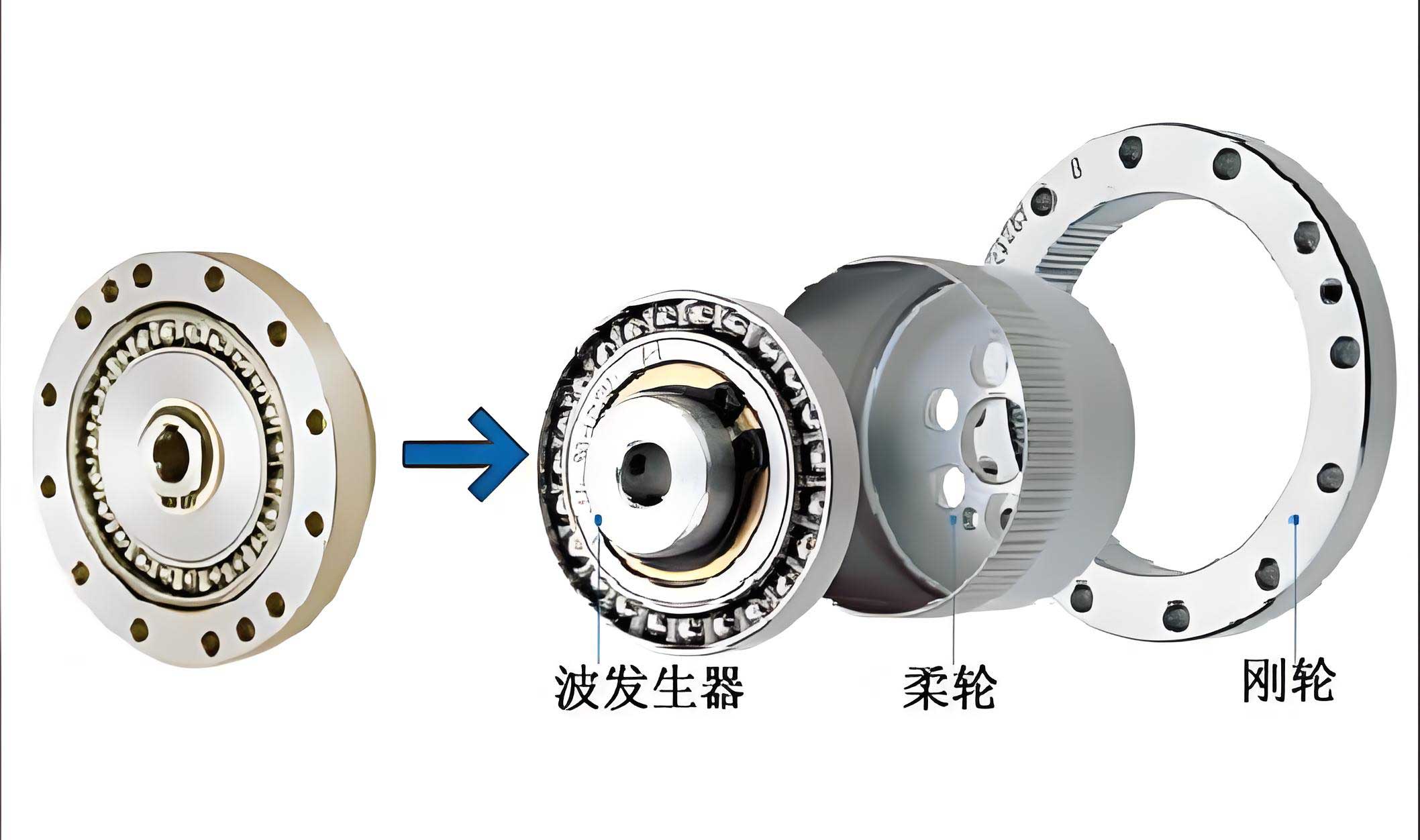
To fundamentally resolve this issue, I proposed and designed a novel strain wave gear reducer featuring a planetary wave generator. The core innovation lies in replacing the standard thin-walled bearing with a compact planetary gear system. In this design, the elliptical profile is not created by a dedicated bearing race but is defined by the orbit of planetary gears. The sun gear acts as the input, driving multiple planet gears housed within a carrier. The key design feature is that the ring gear of this planetary system is fixed and is rigidly bonded—using a high-strength structural adhesive—to the inner surface of the flex spline. This bonding eliminates the first source of slippage entirely, creating a monolithic connection between the wave-generating element and the flex spline. Furthermore, the motion transmission within the planetary system occurs through guaranteed gear meshing, eliminating the indeterminate sliding of rolling elements and establishing a strictly kinematic, deterministic relationship. This new architecture not only addresses the precision problem but also offers a secondary benefit: the inherent reduction ratio of the planetary stage can be used to augment the overall reduction ratio of the strain wave gear without significantly increasing its envelope dimensions. The overall reduction ratio \( i_{total} \) for the compound system becomes:
$$ i_{total} = i_{planetary} \times i_{strain\ wave} = \left(1 + \frac{Z_{ring}}{Z_{sun}}\right) \times \left(-\frac{Z_{FS}}{Z_{CS} – Z_{FS}}\right) $$
For my prototype design, the planetary stage was configured for a modest ratio to primarily ensure kinematic certainty, while the strain wave stage used \( Z_{CS} = 202 \) and \( Z_{FS} = 200 \). The key performance targets for this new design are summarized below:
| Performance Parameter | Target Value | Traditional Design Challenge |
|---|---|---|
| Transmission Ratio Accuracy | Deterministic, Minimal Error | Affected by bearing slippage |
| Overall Reduction Ratio | High (>100:1) | Fixed by gear tooth counts |
| Structural Integrity | High, Monolithic FS-WG connection | Stress concentration at bearing race |
| Backlash | Near Zero | Good, but sensitive to wear |
A critical and often oversimplified aspect of strain wave gear design is the behavior of the flex spline itself. The common analytical approach treats the toothed flex spline as an equivalent smooth, thin-walled cylinder for calculating stress and deformation. However, my research strongly indicates that the presence of the teeth significantly influences the strain field, which in turn affects the true loaded tooth contact pattern and the kinematic accuracy, especially for small-module gears. To investigate this, I conducted a detailed comparative finite element analysis (FEA) using ANSYS, modeling both the actual toothed flex spline and an equivalent smooth ring of calculated mean thickness under identical load conditions from the wave generator.
The contact analysis simulated the wave generator exerting a radial deformation to create the major axis of the ellipse. Due to symmetry, only a quarter-model of the flex spline was analyzed to reduce computational cost. The boundary conditions and material properties applied in the simulation are as follows:
| FEA Parameter | Setting / Value |
|---|---|
| Model Type | Static Structural, Non-linear Contact |
| Material (Flex Spline) | Alloy Steel (E = 210 GPa, ν = 0.3) |
| Radial Deformation (Major Axis) | 0.3 mm |
| Element Type | High-Order 3D Solid Elements |
| Contact Pair (WG-FS) | Frictional, Surface-to-Surface |
The results were revealing. For the toothed flex spline, the nodal displacement analysis along a path on the neutral surface showed that the maximum radial displacement aligned with the major axis of the ellipse. The tangential displacement, however, exhibited a more complex profile, reaching its maximum magnitude at an angle of approximately \( \theta = 45^\circ \) from the major axis. The total displacement minimum was found near \( \theta = 44^\circ \). The elastic strain field was highly non-uniform. The maximum values were concentrated at the tooth root fillets, while the strain on the neutral surface of the shell wall was relatively low but displayed distinct periodic fluctuations corresponding to the pitch of the teeth.
In stark contrast, the analysis of the equivalent smooth ring yielded a much more uniform strain field. The strain on its neutral surface was negligible and followed a smooth, predictable pattern, increasing from the major axis towards \( 45^\circ \) and then decreasing, perfectly aligning with classic thin-shell theory. There were no fluctuations. This fundamental difference in neutral surface strain directly causes the differing displacement patterns between the toothed and smooth models.
The implication is profound. When designing the conjugate tooth profile for the circular spline using the envelope method, assuming the flex spline deforms as a smooth ellipse—as is standard practice—introduces a systematic error. The actual loaded contact points will deviate from those predicted by the smooth model because the teeth locally stiffen the flex spline and modulate its strain field. This error is particularly significant for high-precision or zero-backlash strain wave gear applications. Therefore, an optimal tooth profile design must account for the localized influence of the teeth on the flex spline’s compliance. The strain wave gear’s ultimate accuracy depends not just on the macro kinematics but on this micro-scale interaction.
Theoretical innovation must be validated by experiment. To quantitatively assess the performance gain of my planetary wave generator design, I constructed a precision transmission ratio measurement test bench. The core of the bench was a high-resolution optical encoder mounted on the input (wave generator) shaft and a precision mechanical dividing head on the output (flex spline) shaft. The setup was carefully aligned to minimize parasitic errors from couplings and bearings. Both a conventional strain wave gear unit (with a thin-walled bearing WG) and my novel prototype (with the planetary WG) were tested sequentially under identical mounting conditions.
The test procedure involved rotating the input shaft through precise increments using the dividing head and recording the corresponding output rotation from the encoder. The measured transmission ratio at every position was calculated and compared to the theoretical value. The error, expressed as an angular deviation, was plotted over a full rotation of the output shaft. The aggregated results clearly demonstrated the superiority of the new design.
| Performance Metric | Traditional Strain Wave Gear | Novel Planetary WG Strain Wave Gear | Improvement |
|---|---|---|---|
| Maximum Positive Error | +3.82 arc-min | +0.95 arc-min | Reduction of 2.87 arc-min |
| Maximum Negative Error | -2.15 arc-min | -0.98 arc-min | Reduction of 1.17 arc-min |
| Peak-to-Peak Error | 5.97 arc-min | 1.93 arc-min | Reduction of 4.04 arc-min (68%) |
| Error Character | Non-cyclic, indicative of slip | Cyclic, indicative of fixed kinematic error (e.g., tooth profile) | Error becomes deterministic and correctable |
The data is conclusive. The novel strain wave gear reducer with the planetary wave generator exhibited a dramatic reduction in transmission error. The peak-to-peak error was reduced by approximately 68%. Crucially, the nature of the error changed. The traditional design showed a non-cyclic, less predictable error pattern, consistent with the random slip phenomena. In contrast, the error in the new design was cyclic and repeated over each revolution, which is characteristic of a fixed kinematic error source, such as a slight deviation in the manufactured tooth profile from the ideal. This type of error is fundamentally different from slippage; it is deterministic and can potentially be compensated for in a control system or further refined in manufacturing.
In conclusion, my research into high-precision strain wave gear mechanisms has followed a path from problem identification to innovative design and rigorous validation. The investigation confirmed that the traditional wave generator design is a primary source of non-deterministic motion error in strain wave gears. By introducing a planetary gear system as a kinematically exact wave generator and permanently coupling it to the flex spline, a new class of strain wave gear reducer was realized. This design successfully eliminates the interface slippage that plagues conventional units. Furthermore, the detailed FEA study underscored the critical importance of accounting for the flex spline’s tooth-modulated strain field in high-accuracy tooth profile design. The experimental results provided definitive proof, showing a substantial reduction in transmission error and a shift from stochastic to deterministic error sources. This advancement represents a significant step forward in realizing the full potential of strain wave gear technology for applications demanding the utmost in precision and reliability. The planetary wave generator concept opens new avenues for designing strain wave gears with built-in, compound reduction ratios and inherently guaranteed kinematic fidelity, paving the way for their use in next-generation precision robotic and aerospace systems.