
In the field of robotics, the study of bionic robots has emerged as a transformative discipline, drawing inspiration from the intricate structures and functionalities of biological organisms. As a researcher in this domain, I have witnessed how bionic robots—machines that mimic flying, terrestrial, aquatic, amphibious, and human-like creatures—are revolutionizing applications in surveillance, rescue, exploration, and beyond. This article delves into the latest progress in bionic robot research, categorizing them based on their biological inspirations, and explores the underlying mechanisms that enable their remarkable capabilities. Through detailed analysis, I will highlight the key characteristics, structural designs, performance metrics, and future prospects of these bionic robots, emphasizing the importance of mechanisms such as redundant actuation, underactuation, metamorphic structures, motion stability, high load-to-weight ratios, and novel biomimetic materials. To enhance clarity, I will incorporate tables and mathematical formulations to summarize critical aspects, ensuring a comprehensive understanding of how bionic robots are pushing the boundaries of technology.
The concept of bionics, formally established as a discipline in 1960, involves imitating biological systems to engineer advanced technical devices. In robotics, this has led to the development of bionic robots that replicate the locomotion, adaptability, and efficiency of living organisms. From micro-scale flapping-wing drones to humanoid assistants, bionic robots offer unparalleled flexibility in navigating complex environments. In this discussion, I will first outline the research progress across five categories of bionic robots, providing insights into their design and functionality. Subsequently, I will examine the unique features of bionic mechanisms, focusing on principles that drive innovation in this field. Throughout, the term “bionic robot” will be frequently referenced to underscore its centrality in modern robotics research.
Bionic robots inspired by flying organisms, such as bats, birds, and insects, have garnered significant attention due to their potential for agile aerial maneuverability. These bionic robots often employ flapping-wing mechanisms to generate lift and thrust, mimicking natural flight. For instance, micro bionic robots like the MicroBat utilize lightweight materials and MEMS technology to achieve flight with minimal power consumption. The aerodynamic principles behind such bionic robots can be modeled using equations that account for wing kinematics. Consider the lift force generated by a flapping wing, which can be approximated as:
$$L = \frac{1}{2} \rho C_L A v^2$$
where $\rho$ is air density, $C_L$ is the lift coefficient, $A$ is wing area, and $v$ is the velocity of wing motion. This equation highlights how bionic robots optimize these parameters to achieve efficient flight. Table 1 summarizes key examples of flying bionic robots, detailing their specifications and applications. The development of these bionic robots underscores the importance of biomimicry in achieving stealth and adaptability in aerial missions.
| Bionic Inspiration | Key Features | Size/Weight | Performance Metrics | Applications |
|---|---|---|---|---|
| Bat | Flapping wings, MEMS actuators, lightweight design | Wingspan: 15-183 cm, Weight: 10-113 g | Flight frequency: 20 Hz, Endurance: up to 6 minutes | Surveillance, environmental monitoring |
| Hummingbird | Nano-scale design, high-speed flapping, camera integration | Wingspan: 16 cm, Weight: 19 g | Speed: 5 m/s, Wind resistance: 2.2 m/s | Reconnaissance, data collection in urban areas |
| Dragonfly | Four-wing configuration, servo motors for wing control | Length: 44 cm, Wingspan: 63 cm, Weight: 175 g | Wing beat: 20 Hz, omnidirectional flight capability | Remote-controlled exploration, adaptive flight studies |
| Fly | Micro-scale actuators, sensor integration for obstacle detection | Wingspan: 3 cm, Weight: 60 mg | Flight duration: ~5 minutes, directional control | Search and rescue, military espionage |
Transitioning to terrestrial environments, bionic robots that mimic land-based organisms exhibit remarkable mobility across varied terrains. These bionic robots, such as those inspired by inchworms, cockroaches, spiders, and geckos, leverage leg mechanisms and adhesive properties to climb, crawl, and run. For example, the BigDog bionic robot uses hydraulic actuation and sensor feedback to maintain balance on rough surfaces. The dynamics of such legged bionic robots can be described using the Lagrangian formulation for multibody systems:
$$\frac{d}{dt} \left( \frac{\partial L}{\partial \dot{q}_i} \right) – \frac{\partial L}{\partial q_i} = Q_i$$
where $L$ is the Lagrangian, $q_i$ are generalized coordinates, and $Q_i$ are non-conservative forces. This equation helps in optimizing the gait and stability of terrestrial bionic robots. Table 2 provides a comparative analysis of terrestrial bionic robots, highlighting their design innovations. The versatility of these bionic robots makes them ideal for tasks in construction, disaster response, and military logistics, showcasing how bionic principles enhance robustness in unstructured settings.
| Bionic Inspiration | Locomotion Mechanism | Key Specifications | Stability Features | Use Cases |
|---|---|---|---|---|
| Inchworm | Sequential contraction and expansion of body segments | Length: 32 cm, Weight: 700 g, DOF: 5 | Vacuum adhesion for surface climbing | Wall inspection, maintenance in confined spaces |
| Cockroach | Hexapodal running with elastic C-shaped legs | Length: 10 cm, Speed: 2.7 m/s | High-speed stabilization via plastic fin | Rapid terrain traversal, search operations |
| Spider | Six-legged walking with independent limb control | Variable size, Weight: up to several kg | Adaptive gait for uneven surfaces, load-bearing capacity | Rescue missions, construction in hazardous areas |
| Gecko | Van der Waals force-based adhesion using synthetic setae | Length: 15-20 cm, Weight: 250 g | Molecular adhesion for vertical climbing | Space satellite repair, surveillance on structures |
Aquatic bionic robots, modeled after underwater creatures like fish, jellyfish, and octopuses, excel in marine exploration and monitoring. These bionic robots often use undulatory or jet propulsion to navigate water efficiently, with some incorporating soft robotics for enhanced flexibility. For instance, the robotic jellyfish Cyro employs silicone-based skin and mechanical arms for propulsion, enabling long-duration missions. The fluid dynamics of such bionic robots can be analyzed using the Navier-Stokes equations, simplified for incompressible flow:
$$\rho \left( \frac{\partial \mathbf{v}}{\partial t} + \mathbf{v} \cdot \nabla \mathbf{v} \right) = -\nabla p + \mu \nabla^2 \mathbf{v} + \mathbf{f}$$
where $\mathbf{v}$ is velocity, $p$ is pressure, $\mu$ is viscosity, and $\mathbf{f}$ represents body forces. This formulation aids in optimizing the hydrodynamic efficiency of bionic robots. Table 3 summarizes notable aquatic bionic robots, emphasizing their operational depths and sensor capabilities. The advancement of these bionic robots is crucial for oceanographic research, pollution detection, and underwater infrastructure inspection, demonstrating how bionic designs improve autonomy in aquatic environments.
| Bionic Inspiration | Propulsion Method | Size/Weight | Endurance and Depth | Primary Functions |
|---|---|---|---|---|
| Fish (Trout-like) | Undulatory tail motion, mimicking natural swimming | Length: 13 cm, Weight: variable | Adaptive to currents, used in shallow to mid-waters | Environmental monitoring, habitat studies |
| Jellyfish | Pulsating bell with silicone actuators | Diameter: up to 1.7 m, Weight: 177 kg | Months of operation via rechargeable batteries | Marine data collection, long-term surveillance |
| Octopus | Soft tentacle manipulation with strain sensors | Tentacle length: 43 cm, Weight: light | Flexible movement in confined spaces | Search and rescue, pipeline inspection |
Amphibious bionic robots, which operate both on land and in water, represent a fusion of terrestrial and aquatic capabilities. Inspired by organisms like snakes, crabs, and lobsters, these bionic robots exhibit multimodal locomotion, such as slithering, walking, and swimming. The robotic snake, for example, uses modular segments with actuators to traverse complex terrains, with kinematics described by serial chain models. The position of each segment can be expressed as:
$$\mathbf{x}_i = \mathbf{x}_{i-1} + l_i \mathbf{R}(\theta_i) \mathbf{e}$$
where $\mathbf{x}_i$ is the position of segment $i$, $l_i$ is length, $\mathbf{R}$ is a rotation matrix for joint angle $\theta_i$, and $\mathbf{e}$ is a unit vector. This enables precise control of amphibious bionic robots. Table 4 outlines key amphibious bionic robots, noting their transition mechanisms. The ability of these bionic robots to adapt to dual environments makes them valuable for coastal monitoring, disaster response in flooded areas, and military reconnaissance, highlighting the integrative potential of bionic robot designs.
| Bionic Inspiration | Locomotion Modes | Key Design Features | Environmental Adaptability | Typical Missions |
|---|---|---|---|---|
| Snake | Serpentine motion, modular joint control | Length: 1-2 m, DOF: up to 30, Weight: 3-20 kg | Can climb, swim, and squeeze through gaps | Urban search and rescue, bridge inspection |
| Crab | Multi-legged walking, underwater crawling | Leg count: 8, stable gait on rough substrates | Operates on seabed and land, resistant to currents | Underwater exploration, mineral detection |
| Lobster | Legged propulsion with claw stabilization | Size: similar to biological counterpart | Maintains stability in turbulent waters | Marine resource assessment, obstacle navigation |
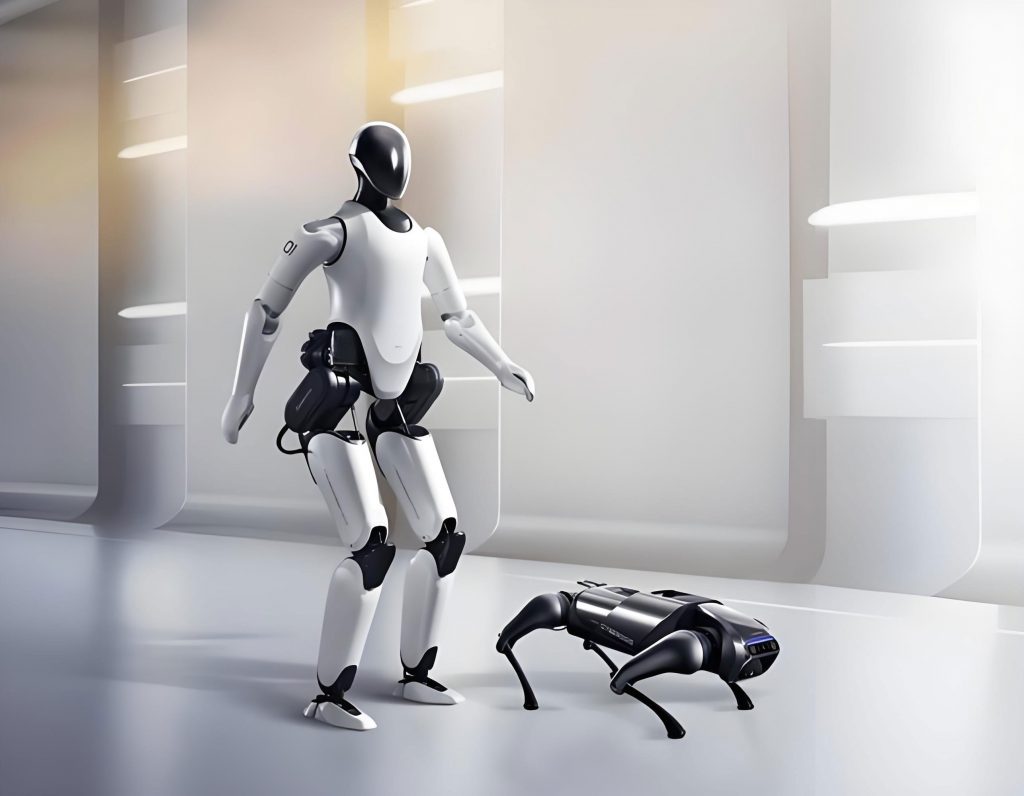
Humanoid bionic robots, which mimic human form and function, are perhaps the most advanced category, aiming to replicate bipedal walking, manipulation, and social interaction. These bionic robots, such as ASIMO and HRP-4, integrate numerous degrees of freedom (DOF) and sensory systems to achieve human-like dexterity. The kinematics of a humanoid bionic robot can be modeled using Denavit-Hartenberg parameters, with forward kinematics for a limb given by:
$$T = \prod_{i=1}^{n} A_i(\theta_i)$$
where $A_i$ are homogeneous transformation matrices for each joint. This framework supports motion planning for bionic robots in dynamic environments. Table 5 compares humanoid bionic robots, focusing on their DOF and applications. The development of these bionic robots drives progress in service robotics, healthcare, and human-robot collaboration, underscoring how bionic principles can create machines that seamlessly integrate into society.
| Robot Model | DOF Count | Height/Weight | Key Capabilities | Deployment Areas |
|---|---|---|---|---|
| ASIMO | 34-57 (varies by version) | 130-160 cm, 48-130 kg | Running, stair climbing, object recognition | Public demonstrations, assistive tasks |
| HRP-4 | 42 | Similar to human proportions | Singing imitation, facial expression control | Entertainment, human-robot interaction studies |
| THBIP series | 24-32 | 70-170 cm, 18-130 kg | Bipedal walking on uneven terrain, vision systems | Research on mobility, disaster response simulations |
Beyond the specific categories, the mechanisms underlying bionic robots exhibit distinct characteristics that differentiate them from traditional rigid robots. As I analyze these bionic robots, several key features emerge: high flexibility and complex functionality, often with redundant degrees of freedom; the use of novel materials like shape-memory alloys; and topological variability in structures, enabling metamorphic transformations. These traits necessitate focused research on bionic robot mechanisms, which I will elaborate on through mathematical formulations and design principles.
Redundant actuation is a critical principle in bionic robots, where the number of actuators exceeds the degrees of freedom, enhancing dexterity and fault tolerance. For a bionic robot with $n$ actuators and $m$ DOF (where $n > m$), the kinematic relationship can be expressed using the Jacobian matrix $\mathbf{J} \in \mathbb{R}^{m \times n}$. The velocity equation is:
$$\dot{\mathbf{x}} = \mathbf{J} \dot{\mathbf{q}}$$
where $\dot{\mathbf{x}}$ is the task-space velocity and $\dot{\mathbf{q}}$ is the joint velocity vector. Due to redundancy, infinite solutions exist for $\dot{\mathbf{q}}$, which can be optimized using the pseudoinverse $\mathbf{J}^+$ with a null-space term:
$$\dot{\mathbf{q}} = \mathbf{J}^+ \dot{\mathbf{x}} + (\mathbf{I} – \mathbf{J}^+ \mathbf{J}) \mathbf{z}$$
Here, $\mathbf{z}$ is an arbitrary vector that can be used to avoid singularities or minimize joint torques in bionic robots. This redundancy allows bionic robots to maintain performance even in constrained environments, such as during intricate manipulations or when overcoming obstacles. Research in this area focuses on optimizing actuator placement and control algorithms to maximize the efficiency of bionic robots.
Underactuation is another fundamental concept in bionic robots, where fewer actuators than DOF are used, relying on dynamic coupling for control. This reduces weight and energy consumption, making bionic robots more biomimetic. Consider an underactuated bionic robot with generalized coordinates $\mathbf{q} = [\mathbf{q}_a, \mathbf{q}_p]^T$, where $\mathbf{q}_a$ are actuated joints and $\mathbf{q}_p$ are passive joints. The dynamics can be described by the Euler-Lagrange equations:
$$\mathbf{M}(\mathbf{q}) \ddot{\mathbf{q}} + \mathbf{C}(\mathbf{q}, \dot{\mathbf{q}}) \dot{\mathbf{q}} + \mathbf{G}(\mathbf{q}) = \mathbf{B} \boldsymbol{\tau}$$
where $\mathbf{M}$ is the inertia matrix, $\mathbf{C}$ captures Coriolis effects, $\mathbf{G}$ is gravity, $\boldsymbol{\tau}$ are torques, and $\mathbf{B}$ is a mapping matrix. For underactuated bionic robots, $\mathbf{B}$ has fewer rows than columns, introducing nonholonomic constraints that require nonlinear control strategies. This principle is evident in bionic robots like passive-dynamic walkers, which achieve natural gait patterns with minimal actuation. Advancements in underactuation aim to improve the stability and adaptability of bionic robots in unstructured terrains.
Metamorphic structure design enables bionic robots to change their topology or DOF during operation, enhancing adaptability. This can be modeled using variable constraint matrices, where the configuration space evolves over time. For a metamorphic bionic robot, the mobility $M$ can be computed using Grübler’s formula with time-varying parameters:
$$M = d(n – j – 1) + \sum_{i=1}^{j} f_i – \nu$$
where $d$ is dimension, $n$ is links, $j$ is joints, $f_i$ is DOF of joint $i$, and $\nu$ is the number of redundant constraints. As the bionic robot transitions between configurations, $f_i$ or $\nu$ may change, allowing it to, for example, switch from a legged to a rolling mode. This capability is crucial for bionic robots operating in dynamic environments, such as those navigating from land to water.
Motion stability design ensures that bionic robots maintain balance and orientation during locomotion. For bipedal bionic robots, the Zero Moment Point (ZMP) criterion is often used, defined as the point where the net moment of inertial forces equals zero. The ZMP coordinates $(x_{zmp}, y_{zmp})$ can be derived from:
$$x_{zmp} = \frac{\sum_i m_i (g + \ddot{z}_i) x_i – \sum_i m_i \ddot{x}_i z_i}{\sum_i m_i (g + \ddot{z}_i)}$$
where $m_i$ are point masses, $g$ is gravity, and $(x_i, z_i)$ are positions. By keeping the ZMP within the support polygon, bionic robots achieve dynamic stability. Similarly, for aquatic bionic robots, stability involves maintaining buoyancy and orientation under disturbances, often analyzed using hydrodynamic coefficients. Research in this domain focuses on real-time sensor feedback and control algorithms to enhance the robustness of bionic robots.
High load-to-weight ratio design is essential for bionic robots to carry payloads efficiently, such as sensors or tools. This involves optimizing structural materials and actuator placement. The load-to-weight ratio $R$ can be expressed as:
$$R = \frac{F_{load}}{W_{robot}}$$
where $F_{load}$ is the maximum payload force and $W_{robot}$ is the robot’s weight. For bionic robots, achieving high $R$ often requires lightweight composites like carbon fiber and efficient power transmission systems. For example, some bionic robots use tendon-driven mechanisms to reduce mass while maintaining strength. Ongoing research aims to develop novel materials and topological optimizations to push the limits of bionic robot performance.
Novel biomimetic materials play a pivotal role in advancing bionic robots, enabling properties such as self-healing, flexibility, and adaptive stiffness. These materials include shape-memory alloys (SMAs), which recover original shape upon heating, and dielectric elastomers, which deform under electric fields. The behavior of SMAs can be modeled using phase transformation kinetics, with strain $\varepsilon$ related to temperature $T$ and stress $\sigma$:
$$\varepsilon = \varepsilon_L \xi(T, \sigma) + \varepsilon_e$$
where $\varepsilon_L$ is maximum transformation strain, $\xi$ is martensite fraction, and $\varepsilon_e$ is elastic strain. Integrating such materials into bionic robots allows for lifelike movements and improved energy efficiency. For instance, soft bionic robots use elastomers to mimic muscular contractions, enhancing their ability to interact safely with humans and environments. The exploration of new materials continues to expand the functionality and applications of bionic robots.
In conclusion, the field of bionic robot research has made significant strides, driven by insights from biological systems across flying, terrestrial, aquatic, amphibious, and humanoid domains. Each category of bionic robot demonstrates unique advantages, from the stealth of micro fliers to the versatility of amphibious crawlers. The underlying mechanisms, including redundant actuation, underactuation, metamorphic structures, motion stability, high load-to-weight ratios, and biomimetic materials, are critical to the evolution of bionic robots. As I reflect on these developments, it is clear that bionic robots hold immense potential for transforming industries such as defense, healthcare, environmental monitoring, and disaster response. Future research should focus on integrating these principles to create more autonomous, efficient, and adaptable bionic robots. By leveraging mathematical modeling and material science, we can overcome current limitations and unlock new capabilities for bionic robots, ultimately bringing us closer to machines that seamlessly blend with the natural world.