
In recent years, the field of bionic robots has seen tremendous growth, driven by the need for machines that can operate in complex, dynamic environments. As a researcher in this domain, I have witnessed how bionic robots—inspired by biological systems—offer unparalleled agility, adaptability, and efficiency. These bionic robots are not mere copies of nature but sophisticated systems that integrate modeling, design, control, and perception to achieve tasks in rescue operations, public safety, healthcare, and defense. The core challenge lies in bridging the gap between biological performance and robotic implementation, which requires interdisciplinary approaches. In this article, I delve into the key aspects of bionic robot systems, emphasizing recent innovations and future directions. Through detailed discussions, formulas, and tables, I aim to provide a comprehensive overview that underscores the importance of bionic robots in advancing robotics technology.
The essence of a bionic robot lies in its ability to mimic biological principles, whether in locomotion, sensing, or decision-making. From fish-like swimmers to bird-inspired fliers, bionic robots leverage nature’s optimized designs. However, achieving such mimicry demands rigorous mathematical modeling to capture the dynamics of biological systems. For instance, the locomotion of a bionic robotic fish involves complex fluid-structure interactions that can be modeled using Lagrangian mechanics. Consider a multi-joint bionic robot fish with n links; its dynamics can be expressed as:
$$ M(q)\ddot{q} + C(q, \dot{q})\dot{q} + D(q)\dot{q} + G(q) = \tau $$
where \( q \) is the vector of joint angles, \( M(q) \) is the inertia matrix, \( C(q, \dot{q}) \) represents Coriolis and centrifugal forces, \( D(q) \) is the damping matrix from hydrodynamic effects, \( G(q) \) denotes gravitational forces, and \( \tau \) is the control torque. This model is crucial for simulating and controlling bionic robots in aquatic environments. Similarly, for aerial bionic robots like flapping-wing vehicles, the dynamics incorporate aerodynamic forces derived from reduced-order models or computational fluid dynamics. The integration of such models enables the design of controllers that adapt to uncertainties, a hallmark of bionic robot resilience.
Designing bionic robots involves biomimicry at multiple levels: morphological, material, and functional. A well-designed bionic robot not only looks like its biological counterpart but also emulates its efficiency and robustness. For example, the use of soft materials in bionic robots allows for compliant interactions, similar to muscle tissues. In my work, I have explored various design paradigms, as summarized in Table 1, which compares different bionic robot types based on their inspiration and key features. This table highlights how bionic robots span diverse domains, each with unique design challenges.
| Bionic Robot Type | Biological Inspiration | Key Design Features | Typical Applications |
|---|---|---|---|
| Robotic Fish | Fish swimming mechanisms | Multi-joint tail, streamlined body, hydrodynamic skin | Underwater exploration, environmental monitoring |
| Flapping-Wing Aerial Vehicle | Bird or insect flight | Lightweight wings, variable stiffness joints, aerodynamic surfaces | Surveillance, search and rescue in confined spaces |
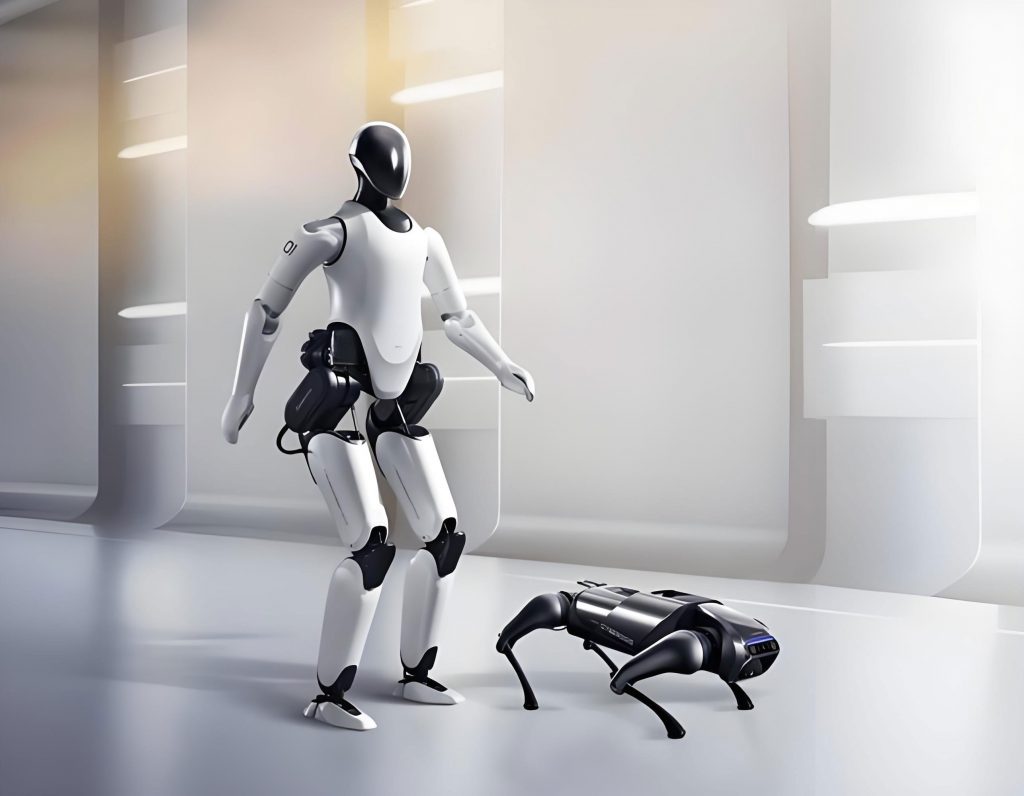
| Legged Bionic Robot | Animal locomotion (e.g., cheetah, human) | Compliant legs, adaptive gait patterns, energy-efficient actuators | Rough terrain navigation, disaster response |
| Soft Bionic Exosuit | Human musculoskeletal system | Flexible materials, ER fluid dampers, wearable design | Rehabilitation, human augmentation |
| Snake-like Bionic Robot | Serpentine movement | Modular segments, anisotropic friction, continuum mechanics | Inspection in pipes, medical procedures |
The design process often involves trade-offs between performance metrics like speed, energy efficiency, and payload capacity. For a bionic robot, optimizing these requires iterative simulation and prototyping. Moreover, the advent of new materials, such as electroactive polymers and shape memory alloys, has revolutionized bionic robot design, enabling actuation that closely resembles biological muscles. In one case, a bionic robot damper using electrorheological (ER) fluids demonstrated enhanced yield stress and faster response times, making it suitable for shock absorption in robotic joints. Such innovations underscore the synergy between biology and engineering in bionic robot development.
Control strategies for bionic robots must account for their nonlinear dynamics and environmental interactions. Traditional control methods often fall short, prompting the adoption of bio-inspired approaches. For instance, impedance adaptation in bionic robots allows for compliant human-robot collaboration. By modeling the interaction dynamics, a controller can adjust stiffness and damping in real-time. Consider a bionic robot arm collaborating with a human; the impedance model can be expressed as:
$$ M_d \ddot{e} + B_d \dot{e} + K_d e = F_{ext} $$
where \( e \) is the position error, \( M_d \), \( B_d \), and \( K_d \) are desired inertia, damping, and stiffness matrices, and \( F_{ext} \) is the external force from the human. Adaptive algorithms tune these parameters online, ensuring safe and efficient cooperation. Another promising method is iterative learning control (ILC), which improves trajectory tracking for repetitive tasks. For a bionic robotic fish, ILC updates control inputs based on past errors:
$$ u_{k+1}(t) = u_k(t) + \Gamma e_k(t) $$
where \( u_k(t) \) is the control input at iteration k, \( e_k(t) \) is the tracking error, and \( \Gamma \) is a learning gain matrix. This approach enhances the bionic robot’s ability to navigate uncertain water currents, a key advantage for aquatic bionic robots.
Table 2 summarizes various control techniques applied to bionic robots, highlighting their principles and benefits. This diversity in control methods reflects the adaptability required for bionic robots to function in real-world scenarios.
| Control Method | Principle | Advantages for Bionic Robots | Typical Use Cases |
|---|---|---|---|
| Impedance Control | Adjusts robot stiffness and damping to interact softly with environments | Enables safe human-robot collaboration, reduces impact forces | Bionic exosuits, collaborative manipulators |
| Iterative Learning Control (ILC) | Learns from previous executions to improve tracking performance | Handles repetitive motions, compensates for periodic disturbances | Bionic robotic fish, legged robot gait cycles |
| Model Predictive Control (MPC) | Optimizes future control inputs based on a dynamic model | Accounts for constraints, improves energy efficiency | Flapping-wing bionic robots, autonomous navigation |
| Reinforcement Learning (RL) | Learns control policies through trial and error | Adapts to unknown environments, requires minimal prior knowledge | Bionic robot perception, multi-task planning |
| Sliding Mode Control (SMC) | Forces system trajectories to slide along a predefined surface | Robust to uncertainties, ensures fast convergence | Underactuated bionic robots, harsh conditions |
Perception in bionic robots equips them with situational awareness, akin to biological senses. Vision, tactile sensing, and proprioception are integral for tasks like obstacle avoidance and terrain adaptation. For a bionic flapping-wing robot, stereo vision systems estimate obstacle distances using triangulation. The depth \( Z \) of an obstacle can be computed as:
$$ Z = \frac{f B}{d} $$
where \( f \) is the focal length, \( B \) is the baseline distance between cameras, and \( d \) is the disparity in pixels. This enables the bionic robot to navigate cluttered spaces autonomously. Moreover, multi-sensor data fusion enhances reliability. A Bayesian fusion approach combines sensor readings probabilistically. Given sensors \( S_1, S_2, \dots, S_n \) with measurements \( z_i \), the fused estimate of a state \( x \) is:
$$ P(x | z_1, \dots, z_n) \propto P(x) \prod_{i=1}^n P(z_i | x) $$
where \( P(x) \) is the prior and \( P(z_i | x) \) is the likelihood. Reinforcement learning can further optimize fusion weights, improving accuracy for bionic robot perception in dynamic settings.
The integration of perception with control leads to autonomous bionic robots capable of complex behaviors. For example, a bionic humanoid robot climbing stairs uses vision to locate steps, then plans gaits using inverse kinematics. The foot trajectory can be parameterized as:
$$ x_f(t) = x_0 + A \sin(\omega t), \quad y_f(t) = y_0 + B \cos(\omega t) $$
for cyclic motion, with constants \( A, B, \omega \) adjusted based on step height. This synergy is vital for bionic robots operating in unstructured environments.
Energy efficiency is another critical aspect of bionic robots. Inspired by birds that use gliding to conserve energy, tail-sitter UAVs employ intermittent flight strategies. The mechanical power \( P_m \) during gliding can be modeled as:
$$ P_m = \frac{1}{2} \rho C_D A v^3 $$
where \( \rho \) is air density, \( C_D \) is drag coefficient, \( A \) is reference area, and \( v \) is velocity. By switching between powered and gliding phases, bionic robots extend their operational range. This bio-inspired approach underscores how nature informs bionic robot design for sustainability.
In terms of hardware, actuation systems for bionic robots have evolved significantly. Electroactive polymers (EAPs) and pneumatic artificial muscles (PAMs) provide high power-to-weight ratios, mimicking biological muscles. The force \( F \) generated by a PAM can be approximated as:
$$ F = P \cdot \pi \left( \frac{D_0^2}{4} – \frac{d_0^2}{4} \right) \cdot \cos(\theta) $$
where \( P \) is pressure, \( D_0 \) and \( d_0 \) are initial diameters, and \( \theta \) is the braid angle. Such actuators enable smooth, compliant movements in bionic robots, essential for interactions with humans or delicate objects.
Table 3 lists key perception technologies used in bionic robots, along with their metrics and challenges. This table illustrates the diversity of sensors that empower bionic robots to perceive their surroundings effectively.
| Sensor Type | Measured Quantity | Accuracy/Range | Challenges in Bionic Robots |
|---|---|---|---|
| Stereo Vision | Depth, object recognition | Accuracy: ~1 cm at 5 m; Range: up to 50 m | Computational load, sensitive to lighting |
| Inertial Measurement Units (IMUs) | Acceleration, angular velocity | Accuracy: ±0.1°/s; Drift over time | Integration errors, vibration noise |
| Force/Torque Sensors | Contact forces, torque | Accuracy: ±0.1 N; Range: up to 1000 N | Calibration, hysteresis |
| LiDAR | Distance mapping | Accuracy: ±2 cm; Range: up to 200 m | Cost, size, reflective surfaces |
| Electromyography (EMG) | Muscle signals for exosuits | Signal-to-noise ratio: ~20 dB; Latency: ~10 ms | Skin contact issues, user variability |
Looking ahead, the future of bionic robots lies in greater autonomy and symbiosis with humans. Advances in AI, particularly deep learning, will enhance perception and decision-making. For instance, convolutional neural networks (CNNs) can process visual data for obstacle detection in bionic robots, with an output layer classifying objects as:
$$ \hat{y} = \text{softmax}(W \cdot \text{CNN}(I) + b) $$
where \( I \) is the input image, \( W \) and \( b \) are weights and bias. Additionally, swarm intelligence inspired by insect colonies could enable cooperative bionic robots that perform tasks collectively. Research in soft robotics will further blur the line between biological and artificial systems, leading to bionic robots that are safer and more adaptable.
In conclusion, bionic robots represent a convergence of biology and engineering, with profound implications for technology and society. Through continuous improvements in modeling, design, control, and perception, bionic robots are poised to overcome current limitations and achieve performance closer to their biological counterparts. As I reflect on this journey, it is clear that interdisciplinary collaboration and innovation are key to unlocking the full potential of bionic robots. The integration of bio-inspired principles into robotic systems will undoubtedly drive progress in automation, healthcare, and beyond, making bionic robots indispensable in our future world.
To further illustrate the mathematical foundations, consider the unified dynamics of a bionic robot system with n degrees of freedom. Using the Euler-Lagrange formulation, the equations of motion can be derived as:
$$ \frac{d}{dt} \left( \frac{\partial L}{\partial \dot{q}_i} \right) – \frac{\partial L}{\partial q_i} = Q_i, \quad i = 1, \dots, n $$
where \( L = T – V \) is the Lagrangian, \( T \) is kinetic energy, \( V \) is potential energy, and \( Q_i \) are generalized forces. This framework underpins the modeling of diverse bionic robots, from aerial to aquatic. For control design, Lyapunov stability theory ensures robustness. A candidate Lyapunov function \( V(x) \) for a bionic robot control system might satisfy:
$$ \dot{V}(x) = \frac{\partial V}{\partial x} f(x) \leq -W(x) $$
with \( W(x) \) positive definite, guaranteeing asymptotic stability. Such theoretical rigor is essential for deploying bionic robots in safety-critical applications.
In summary, the advancement of bionic robots relies on a holistic approach that embraces biological inspiration while leveraging cutting-edge technology. By addressing challenges in modeling nonlinear dynamics, designing efficient mechanisms, developing adaptive controllers, and integrating sophisticated perception, the field continues to evolve. As researchers, we must persist in exploring these avenues to realize the vision of bionic robots that seamlessly interact with the world, ultimately enhancing human capabilities and addressing global challenges.