
As a researcher deeply involved in the field of robotics, I have witnessed significant strides in the development of dexterous robotic hands, which represent a pinnacle of mechatronic integration and intelligent control. These systems are not merely tools but emulate the complex functionalities of the human hand, enabling robots to perform delicate and varied tasks. In this article, I will elaborate on the design, capabilities, and applications of modern dexterous robotic hands, drawing from recent advancements and projecting future directions. The core focus will remain on the dexterous robotic hand, a technology that has revolutionized manipulation in robotics.
The concept of a dexterous robotic hand revolves around replicating the human hand’s agility and sensory feedback. A typical dexterous robotic hand features multiple fingers, each with several degrees of freedom (DoF), allowing for intricate movements. For instance, a common design includes five modular fingers, each with three DoF, resulting in a total of 15 DoF. However, to optimize control and reduce complexity, some joints may be coupled. This coupling can be mathematically represented. Consider a finger with two coupled joints; the relationship between joint angles can be expressed as:
$$ \theta_2 = k \cdot \theta_1 + c $$
where $\theta_1$ and $\theta_2$ are the joint angles, $k$ is the coupling ratio, and $c$ is a constant offset. This simplification aids in real-time control while maintaining dexterity. The table below summarizes the kinematic configuration of a standard dexterous robotic hand:
| Component | Degrees of Freedom (DoF) | Function |
|---|---|---|
| Thumb Finger | 3 DoF (independent) | Opposition and precision grip |
| Index Finger | 3 DoF (two coupled) | Fine manipulation |
| Middle Finger | 3 DoF (two coupled) | Power grasp support |
| Ring Finger | 3 DoF (two coupled) | Stability in grasping |
| Little Finger | 3 DoF (two coupled) | Auxiliary functions |
| Total DoF | 15 DoF | Overall dexterity |
The integration of sensing capabilities is crucial for a dexterous robotic hand. Each finger is equipped with position sensors, force/torque sensors, and tactile arrays, providing feedback for closed-loop control. The force sensing can be modeled using Hooke’s law for elastic deformation:
$$ F = -k \cdot \Delta x $$
where $F$ is the force applied, $k$ is the stiffness constant, and $\Delta x$ is the displacement. For tactile perception, a matrix of pressure sensors generates a pressure map $P(x,y)$, which can be processed to recognize object textures and shapes. The fusion of these sensory inputs enables the dexterous robotic hand to perform tasks like object recognition and adaptive grasping. The control architecture often employs PID controllers for each joint, with the error term defined as:
$$ e(t) = \theta_{desired}(t) – \theta_{actual}(t) $$
and the control output:
$$ u(t) = K_p e(t) + K_i \int e(t) dt + K_d \frac{de(t)}{dt} $$
where $K_p$, $K_i$, and $K_d$ are proportional, integral, and derivative gains, respectively. This ensures precise positioning and force regulation in the dexterous robotic hand.
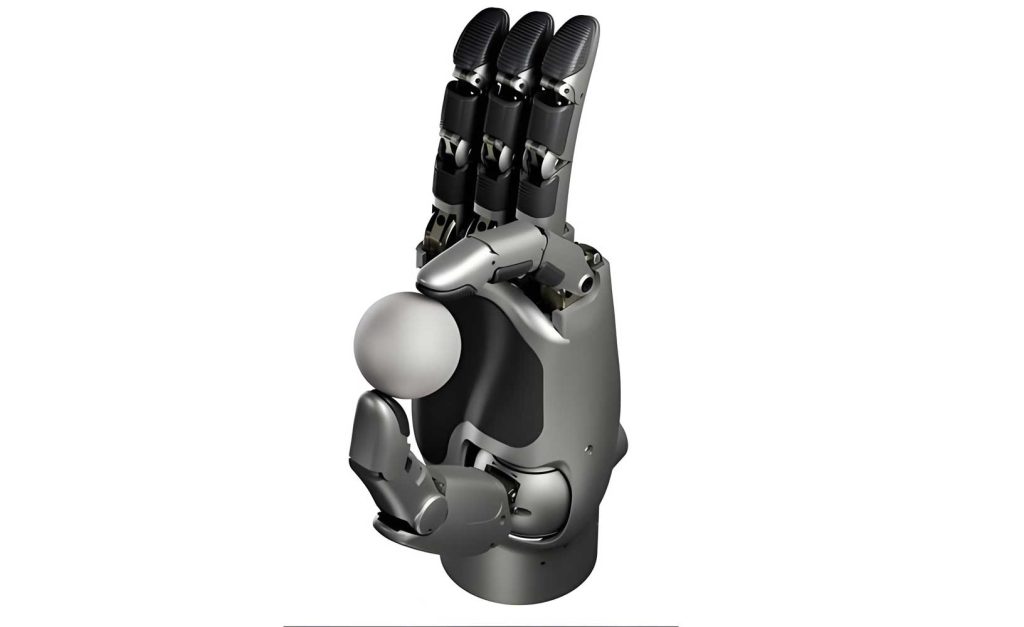
The modular design philosophy behind the dexterous robotic hand encapsulates mechanical, electrical, and sensory components within the palm or fingers. This high level of integration reduces external wiring and enhances reliability. For example, the actuators—often brushless DC motors or servo motors—are embedded with encoders for position feedback. The power consumption and torque characteristics can be summarized in the following table:
| Actuator Type | Torque Range (Nm) | Power Consumption (W) | Integration Level |
|---|---|---|---|
| Brushless DC Motor | 0.1 to 0.5 | 10-20 | High (embedded in finger) |
| Servo Motor | 0.05 to 0.3 | 5-15 | Moderate (modular assembly) |
| Piezoelectric Actuator | 0.01 to 0.1 | 1-5 | High (for micro-movements) |
Such compactness allows the dexterous robotic hand to be mounted on various robotic arms, enabling whole-body manipulation. The kinematics of the entire system can be described using the Denavit-Hartenberg (D-H) parameters. For a robotic arm with a dexterous robotic hand, the transformation from the base to the end-effector is given by:
$$ T_n^0 = A_1 A_2 \cdots A_n $$
where $A_i$ is the homogeneous transformation matrix for joint $i$. This framework facilitates path planning and obstacle avoidance.
Beyond hardware, the dexterous robotic hand leverages advanced algorithms for autonomous operation. Machine learning techniques, such as convolutional neural networks (CNNs), are used for object recognition from tactile data. The loss function for training such a network might be:
$$ \mathcal{L} = -\sum_{i=1}^{N} y_i \log(\hat{y}_i) $$
where $y_i$ is the true label and $\hat{y}_i$ is the predicted probability. This enables the dexterous robotic hand to distinguish between objects of different shapes and materials, enhancing its versatility.
One groundbreaking application of the dexterous robotic hand is in teleoperation over the Internet. By combining 3D graphic predictive simulation with local autonomy, the system can compensate for variable time delays. The predictive model uses Kalman filtering to estimate future states:
$$ \hat{x}_{k|k-1} = F_k \hat{x}_{k-1|k-1} + B_k u_k $$
$$ P_{k|k-1} = F_k P_{k-1|k-1} F_k^T + Q_k $$
where $\hat{x}$ is the state estimate, $P$ is the error covariance, $F$ is the state transition matrix, $B$ is the control matrix, $u$ is the control input, and $Q$ is the process noise covariance. This allows a dexterous robotic hand to perform remote tasks, such as deploying solar panels, with high precision despite network latency. The success of such experiments underscores the robustness of the dexterous robotic hand in critical scenarios.
The versatility of the dexterous robotic hand extends to numerous fields. In space missions, it can assist in satellite maintenance and repairs, reducing human risk. In healthcare, it enables robotic surgery with fine motor skills. In hazardous environments like nuclear facilities, the dexterous robotic hand can handle radioactive materials safely. The table below outlines key application domains:
| Application Domain | Specific Tasks | Benefits of Dexterous Robotic Hand |
|---|---|---|
| Space Exploration | Solar panel deployment, tool manipulation | Reduces astronaut EVA risks, enhances mission flexibility |
| Medical Robotics | Minimally invasive surgery, rehabilitation | High precision, tactile feedback for delicate tissues |
| Industrial Automation | Assembly of small parts, quality inspection | Adapts to varied objects, improves production efficiency |
| Service Robotics | Elderly assistance, household chores | Natural interaction, safe handling of fragile items |
| Disaster Response | Search and rescue, debris removal | Operates in unstructured environments, robust sensing |
The global impact of the dexterous robotic hand is evident from its adoption by research institutions worldwide. Collaborations have led to refinements in design and control algorithms. For instance, shared datasets on grasping strategies have accelerated innovation. The dexterous robotic hand serves as a platform for interdisciplinary studies, merging robotics with biomechanics and cognitive science.
Transitioning to service robotics, the principles underlying the dexterous robotic hand find expression in applications like robot-assisted restaurants. These environments showcase how robotic systems can enhance customer experience and operational efficiency. In a typical setup, multiple robots serve as waiters, navigating along predefined paths to deliver food and beverages. The navigation relies on line-following sensors and magnetic markers for localization. The control logic can be formalized using state machines. Let $S$ represent the robot’s state, such as “moving,” “stopped,” or “avoiding obstacle.” The transition function is:
$$ S_{next} = f(S_{current}, \text{sensor inputs}) $$
For collision avoidance, ultrasonic or infrared sensors measure distance $d$ to obstacles. If $d < d_{threshold}$, the robot decelerates according to:
$$ a = -k_d \cdot (d_{threshold} – d) $$
where $a$ is the deceleration and $k_d$ is a gain constant. This ensures safe interaction in crowded spaces.
The restaurant robots often employ modular designs akin to the dexterous robotic hand, with interchangeable components for different tasks. For example, a drink-serving robot might have a specialized gripper, while a food-delivery robot uses a tray. The efficiency of such systems can be analyzed through queueing theory. Assuming Poisson arrivals and exponential service times, the average wait time $W$ for customers is given by:
$$ W = \frac{\lambda}{\mu(\mu – \lambda)} $$
where $\lambda$ is the arrival rate and $\mu$ is the service rate. By deploying multiple robots, $\mu$ increases, reducing $W$. Future enhancements aim to incorporate autonomous path planning, allowing robots to calculate optimal routes dynamically. This involves solving the traveling salesman problem (TSP) for multiple tables. The objective is to minimize the total travel distance $D$:
$$ D = \sum_{i=1}^{n} d_{i,i+1} $$
where $d_{i,i+1}$ is the distance between consecutive tables. Heuristics like ant colony optimization can be applied to find near-optimal solutions.
Moreover, the integration of robotic arms for serving dishes mirrors the manipulation capabilities of the dexterous robotic hand. These arms can be equipped with force sensors to handle plates gently. The inverse kinematics for a 6-DoF arm can be solved using numerical methods, such as the Newton-Raphson iteration:
$$ \mathbf{q}_{k+1} = \mathbf{q}_k + J^{-1}(\mathbf{q}_k) (\mathbf{x}_d – f(\mathbf{q}_k)) $$
where $\mathbf{q}$ is the joint angle vector, $\mathbf{x}_d$ is the desired end-effector position, $f$ is the forward kinematics function, and $J$ is the Jacobian matrix. This precision enables tasks like pouring beverages consistently, where the volume $V$ is controlled by monitoring weight $w$:
$$ V = \frac{w}{\rho} $$
with $\rho$ as the fluid density. Such automation reduces human labor and ensures standardization.
The evolution of these service robots points toward multi-layered establishments where robots navigate stairs using legged locomotion. This requires advanced servo motors for joint control, similar to those in the dexterous robotic hand. The dynamics of a bipedal robot can be modeled using the Lagrangian formulation:
$$ L = T – U $$
where $T$ is the kinetic energy and $U$ is the potential energy. The equations of motion are derived as:
$$ \frac{d}{dt} \left( \frac{\partial L}{\partial \dot{q}_i} \right) – \frac{\partial L}{\partial q_i} = \tau_i $$
with $q_i$ as generalized coordinates and $\tau_i$ as generalized forces. Stabilizing such systems involves real-time feedback, underscoring the complexity of humanoid robotics.
In summary, the dexterous robotic hand stands as a cornerstone of modern robotics, enabling sophisticated manipulation across diverse sectors. Its design—featuring high DoF, integrated sensing, and modularity—sets a benchmark for mechatronic systems. The dexterous robotic hand’s adaptability is further demonstrated in service scenarios, where robotic waiters and cleaners enhance automation. As research progresses, we anticipate more intelligent dexterous robotic hands with enhanced cognitive abilities, such as learning from demonstration. The dexterous robotic hand will continue to drive innovations in biomimetics, human-robot interaction, and autonomous systems.
To quantify the advancements, consider the performance metrics of a state-of-the-art dexterous robotic hand. The table below compares key parameters over hypothetical generations:
| Generation | DoF per Hand | Force Sensitivity (N) | Response Time (ms) | Integration Level |
|---|---|---|---|---|
| First Generation | 10 | 0.5 | 100 | Low (external sensors) |
| Second Generation | 15 | 0.1 | 50 | Medium (partial embedding) |
| Current Dexterous Robotic Hand | 15-20 | 0.05 | 20 | High (full integration) |
| Future Vision | 20+ | 0.01 | 10 | Ultra-high (with AI chips) |
Mathematically, the dexterity of a robotic hand can be evaluated using metrics like the manipulability index $w$, defined for a given configuration as:
$$ w = \sqrt{\det(J J^T)} $$
where $J$ is the Jacobian matrix. Higher $w$ indicates better ability to move in arbitrary directions, a key feature of the dexterous robotic hand. Optimization algorithms are used to maximize $w$ across the workspace.
In conclusion, the journey of the dexterous robotic hand from a laboratory prototype to a widely adopted tool reflects the synergy of mechanical engineering, electronics, and computer science. Its applications, ranging from space to hospitality, highlight its transformative potential. As we continue to refine the dexterous robotic hand, we pave the way for more autonomous, sensitive, and capable robotic systems that will reshape industries and daily life. The dexterous robotic hand is not just a technological marvel; it is a testament to human ingenuity in replicating and extending our own capabilities.