
As a leader in the development of cutting-edge automation technologies, we are thrilled to present our latest innovations that are reshaping industries worldwide. In this article, we delve into the details of new products, with a particular emphasis on humanoid robots, which represent a significant leap forward in robotic capabilities. Our work spans volume measurement systems, material handling solutions, high-precision imaging, and composite robots, all designed to enhance efficiency, adaptability, and intelligence in various applications. Humanoid robots, in particular, have captured our attention due to their potential to mimic human movements and perform complex tasks in unstructured environments. Throughout this discussion, we will explore the technical aspects, supported by tables and mathematical formulations, to provide a comprehensive understanding of these advancements. The integration of humanoid robots into automation workflows is a key focus, and we believe that their continued evolution will drive unprecedented progress in fields such as logistics, manufacturing, and beyond.
One of our flagship developments is a compact volume measurement system that employs active binocular stereo imaging technology. This system combines color cameras to generate high-frame-rate RGB-D images, which are essential for accurate depth perception and object analysis. By incorporating deep learning algorithms, we have enabled this system to handle a wide range of package types, including those with challenging characteristics like black surfaces, high reflectivity, thin profiles, and irregular shapes. This makes it ideal for applications such as logistics volume measurement and robotic grasping, where precision is critical. The camera itself measures only 98.5mm by 55.5mm by 33mm, and it comes with a standard mounting plate for easy installation. Its small form factor allows for flexible placement in real-world scenarios, while the Gigabit Ethernet interface ensures robust anti-interference performance, long-range transmission, and stable data flow. In terms of technical foundation, the depth calculation in stereo vision can be expressed using the formula: $$ d = \frac{f \cdot B}{D} $$ where \( d \) is the depth, \( f \) is the focal length of the cameras, \( B \) is the baseline distance between them, and \( D \) is the disparity measured from the images. This principle underpins the system’s ability to deliver reliable volume estimates, which we have validated through extensive testing in warehouse environments.
Building on this, we have extended our research into humanoid robots, which are becoming increasingly sophisticated in their design and functionality. A prominent example is the recent introduction of a next-generation humanoid robot by a major technology company, which showcases remarkable improvements in human-like motion and interaction. This humanoid robot features newly developed actuators and sensors that enhance task efficiency and accuracy, making it suitable for a variety of industrial and service roles. Key upgrades include a 2-degree-of-freedom (DoF) neck mechanism that allows for natural head movements, an 11-DoF hand with articulated joints for delicate manipulations, and integrated electronics that improve system stability. Additionally, the walking speed has been increased by 30%, boosting its adaptability to dynamic environments, and the incorporation of foot force and torque sensing enables it to adjust to different ground conditions seamlessly. The overall weight has been reduced by 10 kg, enhancing mobility and energy efficiency. From our observations, this humanoid robot can perform deep squats of up to 90 degrees, demonstrating advanced limb control, and its fingers are equipped with tactile sensors to handle fragile items like eggs with care. These attributes highlight the growing maturity of humanoid robots in replicating human abilities, and we are actively exploring ways to integrate such humanoid robots into our automation ecosystems.
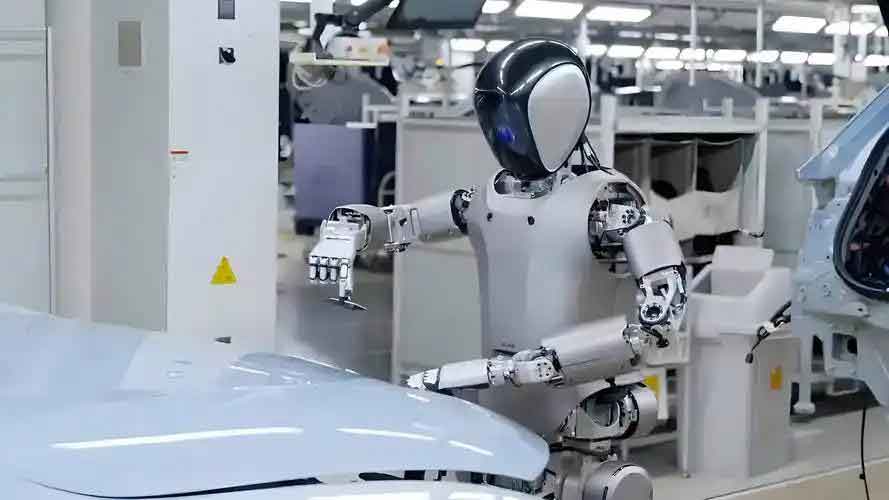
To provide a clearer comparison of the evolution in humanoid robots, we have compiled a table that outlines the key specifications between previous and current generations. This table emphasizes the advancements in mobility, dexterity, and sensing that are critical for the deployment of humanoid robots in real-world settings.
| Feature | Previous Generation | Current Generation |
|---|---|---|
| Neck Degrees of Freedom | 1 | 2 |
| Hand Degrees of Freedom | 8 | 11 |
| Walking Speed Improvement | Base | 30% increase |
| Weight | Approximately 70 kg | Approximately 60 kg |
| Key Sensors | Basic vision and inertial | Foot force/torque, tactile fingers |
| Actuator Integration | Modular | Fully integrated with electronics |
In parallel, we have developed specialized material handling solutions, such as an autonomous guided vehicle (AGV) designed for the textile industry. This vehicle uses a ring-clamp mechanism to transport cylindrical materials like cotton barrels efficiently. It employs laser navigation for precise movement and features a sliding rail system with fixed dimensions that align with the transported items. When the vehicle detects a cylindrical object, the clamp extends to conform to its surface, securing it for transport. The clamp size is customizable, allowing for adaptation to various client needs. This automation reduces labor costs and ensures continuous, reliable operation in production cycles. The kinematic model for such vehicles can be described using simple equations for motion planning. For instance, the position update in 2D space can be given by: $$ x_{t+1} = x_t + v \cos(\theta) \Delta t $$ $$ y_{t+1} = y_t + v \sin(\theta) \Delta t $$ where \( x \) and \( y \) are coordinates, \( v \) is velocity, \( \theta \) is orientation, and \( \Delta t \) is time step. This facilitates smooth navigation in confined spaces, similar to how humanoid robots navigate complex environments.
Another area of innovation is in high-precision imaging, where we have launched a 103-megapixel global shutter Gigabit Ethernet camera. This camera is equipped with a advanced sensor that supports applications in panel, LED, and PCB inspection, among others. Compared to earlier 101-megapixel models, its body size has been reduced to 80mm by 80mm, simplifying installation. It uses an M58 standard lens interface, which can be adapted to F-mounts, enabling seamless upgrades from lower-resolution cameras without lens changes. This expands the field of view and enhances inspection accuracy. The relationship between resolution and field of view can be expressed as: $$ \text{Field of View} = \frac{\text{Sensor Size}}{\text{Focal Length}} $$ which highlights the trade-offs in optical design. Additionally, we offer an RGB-D intelligent stereo camera that leverages active binocular stereo imaging for high-frame-rate RGB-D output. With embedded deep learning algorithms, it supports volume measurement and robotic grasping, similar to our earlier system, but in a more compact form. These cameras are integral to automation systems that may eventually incorporate humanoid robots for tasks requiring visual feedback.
We have also made strides in composite robotics with the introduction of a domestically developed model that combines collaborative robots with autonomous mobile platforms. This system, which we refer to as a composite robot, integrates laser, visual, and force sensing modules under a unified control system, enabling seamless functionality in diverse scenarios. It achieves core technology independence and is tailored for applications in smart factories, data center management, power inspection, warehouse sorting, and automated storage. By addressing challenges in high-performance components, multi-device fusion, and system safety, this composite robot promotes large-scale use in sectors such as new energy, medicine, food, and aerospace. The control architecture can be modeled using state-space representations: $$ \dot{x} = A x + B u $$ $$ y = C x + D u $$ where \( x \) is the state vector, \( u \) is the input, \( y \) is the output, and \( A, B, C, D \) are matrices defining the system dynamics. This approach ensures robust performance in integrated environments, much like the coordinated movements seen in humanoid robots.
To further illustrate the capabilities of humanoid robots, we can examine their kinematic and dynamic modeling. The forward kinematics of a humanoid robot limb can be described using the Denavit-Hartenberg (DH) parameters. For each joint \( i \), the homogeneous transformation matrix is given by: $$ A_i = \begin{bmatrix} \cos\theta_i & -\sin\theta_i \cos\alpha_i & \sin\theta_i \sin\alpha_i & a_i \cos\theta_i \\ \sin\theta_i & \cos\theta_i \cos\alpha_i & -\cos\theta_i \sin\alpha_i & a_i \sin\theta_i \\ 0 & \sin\alpha_i & \cos\alpha_i & d_i \\ 0 & 0 & 0 & 1 \end{bmatrix} $$ where \( \theta_i \) is the joint angle, \( a_i \) is the link length, \( d_i \) is the link offset, and \( \alpha_i \) is the twist angle. This framework allows for precise control of limb positions and orientations, which is essential for tasks like walking and object manipulation. In dynamics, the Lagrangian formulation can be applied to model the robot’s motion: $$ L = T – V $$ where \( T \) is the kinetic energy and \( V \) is the potential energy, leading to the equations of motion: $$ \frac{d}{dt} \left( \frac{\partial L}{\partial \dot{q}} \right) – \frac{\partial L}{\partial q} = \tau $$ where \( q \) is the generalized coordinate vector and \( \tau \) is the torque input. These mathematical tools are crucial for optimizing the performance of humanoid robots in real-time applications.
In terms of application scenarios, humanoid robots are being deployed in increasingly diverse settings. For example, in logistics, they can assist with sorting and transporting goods, while in manufacturing, they perform assembly tasks that require dexterity. The following table summarizes potential applications and benefits of humanoid robots across various industries, underscoring their versatility and the growing interest in their adoption.
| Industry | Application | Benefits |
|---|---|---|
| Logistics | Package handling and sorting | Reduced labor costs, increased speed |
| Manufacturing | Assembly line tasks | Improved precision, flexibility |
| Healthcare | Patient assistance and rehabilitation | Enhanced care, 24/7 availability |
| Retail | Customer service and inventory management | Personalized interactions, efficiency |
| Agriculture | Harvesting and monitoring | Labor savings, data collection |
Moreover, the integration of sensory feedback in humanoid robots is a key area of our research. For instance, the use of tactile sensors on fingers enables force control during grasping, which can be modeled with a simple proportional law: $$ F = k_p (x_d – x) $$ where \( F \) is the applied force, \( k_p \) is a proportional gain, \( x_d \) is the desired position, and \( x \) is the actual position. This ensures gentle handling of objects, mimicking human touch. As we continue to refine these technologies, we anticipate that humanoid robots will become even more adept at navigating complex social and physical environments, further blurring the lines between machines and humans.
Looking ahead, we are committed to advancing the field of humanoid robots through ongoing innovation and collaboration. The potential for humanoid robots to transform industries is immense, and we are investing in research that addresses challenges such as energy efficiency, real-time decision-making, and human-robot interaction. For example, we are exploring machine learning algorithms for predictive control in humanoid robots, using formulations like: $$ J = \sum_{k=0}^{N-1} (x_k^T Q x_k + u_k^T R u_k) $$ where \( J \) is the cost function to minimize, \( x_k \) is the state at time \( k \), \( u_k \) is the control input, and \( Q \) and \( R \) are weighting matrices. This optimization helps in achieving smooth and efficient movements. Additionally, we are developing simulation platforms to test humanoid robots in virtual environments before real-world deployment, reducing risks and costs.
In conclusion, the advancements in automation technologies, particularly in humanoid robots, are paving the way for a more efficient and adaptable future. Our efforts in volume measurement, material handling, imaging, and composite robotics are complemented by a strong focus on humanoid robots, which we believe will play a central role in the next wave of industrial automation. By leveraging mathematical models, sensory integration, and intelligent control systems, we are pushing the boundaries of what humanoid robots can achieve. As we move forward, we invite stakeholders from across industries to join us in exploring the limitless possibilities of humanoid robots, and we remain dedicated to delivering solutions that enhance productivity and innovation on a global scale.