
The miniaturization of robotic systems represents a significant frontier in robotics, offering unprecedented access to confined spaces for applications in biomedical engineering, environmental monitoring, and search-and-rescue operations. Among various actuation methods, magnetic control has emerged as a particularly promising strategy due to its capacity for remote, untethered, and precise manipulation with minimal biological interference. This field draws profound inspiration from nature, where small organisms like water striders, snails, and geckos expertly navigate complex liquid-gas, solid-liquid, and solid-gas interfaces. Their remarkable abilities are governed by fundamental interfacial phenomena such as wettability, dynamic adhesion, and anisotropic friction. This article, from a first-person perspective, synthesizes recent progress in small-scale magnetically controlled bionic robots, analyzing their locomotion mechanisms, fabrication technologies, and control strategies, while highlighting the untapped potential of interfacial engineering for enhancing their performance.
Interfacial Phenomena in Small Animals: A Blueprint for Bionic Design
Small animals have evolved exquisite adaptations to thrive at various interfaces, providing a rich source of inspiration for the design of resilient and agile bionic robots.
Liquid-Gas Interface
Organisms like the water strider exploit surface tension to remain afloat. Their legs are covered with superhydrophobic microsetae, creating a composite interface described by the Cassie-Baxter model. The macroscopic contact angle $$\theta_C$$ is given by:
$$\cos\theta_C = \phi(\cos\theta_Y + 1) – 1$$
where $$\phi$$ is the solid fraction and $$\theta_Y$$ is the Young’s contact angle. This design minimizes liquid adhesion, allowing efficient propulsion. Similarly, fire ants can assemble into rafts using air bubbles trapped by hydrophobic hairs, demonstrating collective buoyancy control—a concept highly relevant for swarm bionic robot systems.
Solid-Liquid Interface
Underwater adhesion is critical for many small animals. The adhesion force $$F_A$$ for soft materials can be approximated by the Johnson-Kendall-Roberts (JKR) theory:
$$F_A = -\frac{3}{2}\pi R \Delta\gamma$$
where $$R$$ is the characteristic radius and $$\Delta\gamma$$ is the work of adhesion. Mussels use chemical glues, while beetles like the leaf beetle utilize trapped air pockets (plastrons) to form capillary bridges for reversible underwater attachment. This mechanism combats buoyancy and provides a model for designing bionic robot surfaces with switchable wet adhesion.
Solid-Gas Interface
On dry surfaces, dynamic and anisotropic friction are key. Snake skin exhibits nanoscale fibrils with asymmetric, “hook-like” profiles, creating a pronounced friction anisotropy that facilitates forward sliding while preventing backward slip. The frictional force $$F_f$$ is simply:
$$F_f = \mu N$$
where $$\mu$$ is the coefficient of friction and $$N$$ is the normal load. Geckos use van der Waals forces enabled by hierarchical micro- and nanostructures (spatulae) on their toes for powerful yet easily detachable adhesion. These principles inform the development of bionic robot skins with programmable grip and release capabilities.
Magnetically Controlled Bionic Robots at Interfaces
Inspired by these biological strategies, researchers have developed a variety of magnetically driven bionic robots capable of operating across different phases.
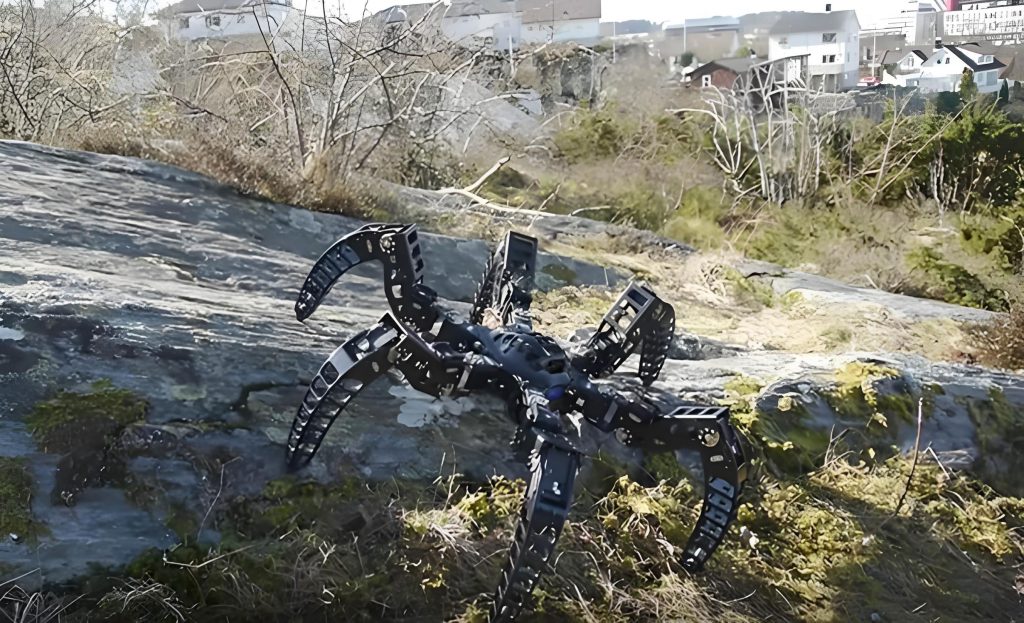
Recent designs include multi-legged soft millirobots that mimic caterpillars, capable of walking on both dry and wet surfaces by minimizing contact area and friction. Hydrogel-based bionic robots can walk underwater and perform object manipulation under combined magnetic and optical stimuli. Furthermore, ferrofluid droplet bionic robots represent a paradigm of fully reconfigurable, liquid-state machines that can navigate, split, merge, and transport cargo by deforming in response to programmed magnetic fields, showcasing extreme adaptability.
Locomotion Mechanisms of Magnetic Bionic Robots
The actuation of magnetic bionic robots relies on the fundamental electromagnetic interactions between an applied field $$\mathbf{B}$$ and the robot’s magnetization $$\mathbf{m}$$. The governing equations are derived from Maxwell’s equations for a static magnetic field:
$$\nabla \cdot \mathbf{B} = 0$$
$$\nabla \times \mathbf{B} = 0$$
The magnetic force $$\mathbf{f}$$ and torque $$\boldsymbol{\tau}$$ acting on the robot are:
$$\mathbf{f} = (\mathbf{m} \cdot \nabla)\mathbf{B}$$
$$\boldsymbol{\tau} = \mathbf{m} \times \mathbf{B}$$
These equations underpin the primary locomotion strategies.
| Mechanism | Principle | Typical Robot Morphology | Key Equation/Feature |
|---|---|---|---|
| Magnetic Gradient Propulsion | Uses spatial field gradient to exert a pulling/pushing force. | Spherical or simple shaped particles/agents. | $$\mathbf{f} = m \nabla |\mathbf{B}|$$; Used for targeted delivery in vasculature. |
| Helical Propulsion | Rotational field causes a helical tail to rotate, generating thrust like a bacterial flagellum. | Artificial bacterial flagella (ABFs), spiral microswimmers. | Step-out frequency limits speed: $$f_{\text{step-out}} \propto \frac{\tau_{\text{drag}}}{mB}$$. |
| Undulatory/Swing Propulsion | Oscillating or rotating field induces traveling wave or swinging deformation in a flexible body. | Fish-like swimmers, multi-segment snakes, ciliary carpets. | Motion modeled via Euler-Bernoulli beam theory under magnetic torque. |
| Surface Walking/Crawling | Sequential deformation of a soft body to break and make contact with the substrate. | Caterpillar-inspired robots, triangular crawlers. | Relies on programmable magnetization profiles and anisotropic friction. |
Fabrication Technologies for Magnetic Bionic Robots
The creation of small-scale bionic robots with complex magnetization patterns requires advanced micro-nanofabrication techniques. The choice of method significantly impacts the robot’s design freedom, material composition, and functional capabilities.
| Fabrication Method | Core Principle | Typical Materials | Magnetization Process | Advantages for Bionic Robots |
|---|---|---|---|---|
| Direct Ink Writing (DIW) | Extrusion of composite ink under a guiding magnetic field at the nozzle. | PDMS with NdFeB or Fe particles. | In-situ particle alignment during printing; post-curing pulse magnetization (~2-3 T). | Enables 3D structures with locally programmed magnetic anisotropy. |
| Ultraviolet (UV) Lithography | Selective UV exposure of resin containing magnetic particles. | UV-curable resin with Fe$_3$O$_4$ or NdFeB. | Particles aligned by a uniform field during exposure; then polymerized. | High 2D resolution, batch fabrication of planar microswimmers. |
| Magnetic Spray & Coating | Spraying a composite mixture onto a pre-shaped substrate. | Polymer glue (e.g., polyvinyl alcohol) with Fe particles. | Magnetization by applying a field during solvent evaporation. | Rapid, can “magnetize” arbitrary objects, good for prototyping. |
| Heat-Assisted 3D Magnetic Programming | Heating a composite above the Curie temperature of the filler, then cooling under a field. | PDMS with CrO$_2$ particles. | Thermal reset allows re-magnetization with a weak field (~15 mT). | Allows reprogramming of magnetic domains in already fabricated 3D structures. |
| Multi-Material 3D Printing | Vat photopolymerization or DIW with multiple resins. | Photoresins with varying particle loadings. | Post-print pulse magnetization, followed by specific reorientation steps. | Unprecedented design freedom for heterogeneous, multi-functional bionic robots. |
Control Methodologies for Magnetic Bionic Robots
Precise navigation and task execution of bionic robots in complex environments demand sophisticated control strategies, which can be broadly categorized into model-based and model-free approaches.
Model-Based Control
This approach relies on a mathematical model of the robot’s dynamics. For a soft magnetic robot, the deformation is often modeled using continuum mechanics. The material’s hyperelastic behavior can be described by strain energy density functions like the Neo-Hookean model:
$$\Psi = C_{10}(\bar{I}_1 – 3) + \frac{1}{D_1}(J_{el} – 1)^2$$
where $$C_{10}$$ and $$D_1$$ are material constants, $$\bar{I}_1$$ is the first deviatoric strain invariant, and $$J_{el}$$ is the elastic volume ratio. Coupling this with the magnetic potential energy $$U_m = -\mathbf{m} \cdot \mathbf{B}$$ and solving the equilibrium equations allows prediction of robot shape under a given field. Controllers, such as Proportional-Integral-Derivative (PID) or model predictive control (MPC), then use this model to compute the necessary field sequences for path following.
Model-Free & Learning-Based Control
For robots with highly complex or unknown dynamics, model-free methods are advantageous. Visual servoing is common, where feedback from a microscope camera is used directly to minimize the error between the robot’s and target’s image coordinates. More recently, machine learning techniques like Reinforcement Learning (RL) and Bayesian Optimization (BO) have been applied. In BO, the control policy is treated as a black-box function, and a probabilistic model (e.g., Gaussian Process) is used to efficiently find optimal control parameters with minimal experiments. This is highly effective for tuning the gait of a walking bionic robot on unknown terrain. Adaptive control techniques can also handle parameter uncertainties and bounded disturbances, enhancing robustness during in vivo navigation.
Future Perspectives: Interfacial Engineering for Next-Generation Bionic Robots
The convergence of biomimetics, magnetic actuation, and interfacial science holds immense promise. Future advancements in bionic robots will likely focus on several key areas inspired by the nuanced behaviors of small animals.
Firstly, the development of multi-modal surface properties is crucial. A single bionic robot could integrate surfaces with spatially varied wettability (superhydrophobic/hydrophilic gradients) for directional propulsion on water, or switchable adhesive pads that use microfluidic channels to secrete and retract bio-inspired glue for climbing. Secondly, dynamic morphology control beyond simple bending will be essential. Imagine a bionic robot that can not only change its global shape but also actively reconfigure its surface topography—raising or retracting microspines like a snake or altering the density of fibrils like a gecko—to adapt friction and adhesion in real-time.
From a fabrication standpoint, 4D printing—where the “fourth dimension” is time-dependent transformation—will be pivotal. Printing stimuli-responsive materials (like liquid crystal elastomers or hydrogels) with embedded magnetic particles will allow robots to exhibit pre-programmed, complex shape-shifting under combined magnetic and thermal/optical stimuli. Finally, intelligent control will evolve towards fully autonomous systems. Leveraging onboard micro-sensors and edge computing, future bionic robots could perceive their interfacial environment (e.g., surface roughness, liquid viscosity) and autonomously select the most efficient locomotion gait from a learned repertoire, truly embodying the adaptive intelligence of their biological counterparts.
In conclusion, the study of small animals’ mastery over multiphase interfaces provides a deep well of inspiration. By harnessing magnetic actuation and advancing fabrication and control, the next generation of small-scale bionic robots will move beyond simple locomotion to achieve sophisticated, environment-aware interaction, unlocking their full potential in medicine, environmental science, and beyond.