
In the rapidly evolving landscape of artificial intelligence, embodied intelligence represents a paradigm shift from disembodied cognition to systems that interact physically with their environment. The 2025 Government Work Report in China首次 highlighted “embodied intelligence” and “intelligent robots” as key future industries, placing them alongside biomanufacturing, quantum technology, and 6G in the national科技创新 strategy. Embodied intelligence, when integrated into physical entities like robots, enables perception, learning, and environmental interaction, positioning it as a strategic emerging industry that can reshape global manufacturing competition. Suzhou, as a critical hub in the Yangtze River Delta, has made significant strides in robot industry development, with over 600 enterprises in the robot industry chain and 273 scale-above industrial enterprises, including more than 80 core embodied robot manufacturers. In 2024, the industrial scale reached 139.5 billion yuan, forming a complete产业链 covering upstream core components, midstream本体 manufacturing, and downstream system integration. However, as an emerging field, embodied robot industry faces numerous challenges across China, including Suzhou, in achieving the goals outlined in the “Suzhou Embodied Intelligent Robot Industry Innovation Development Three-Year Action Plan (2025–2027),” which aims to establish Suzhou as a national source of technological innovation, a high-end manufacturing cluster, and a model city for demonstration applications. From a first-person perspective, this paper investigates the current state of embodied robot enterprises in Suzhou, constructs an evaluation system for high-quality development, and proposes targeted strategies to overcome bottlenecks and foster industry advancement.
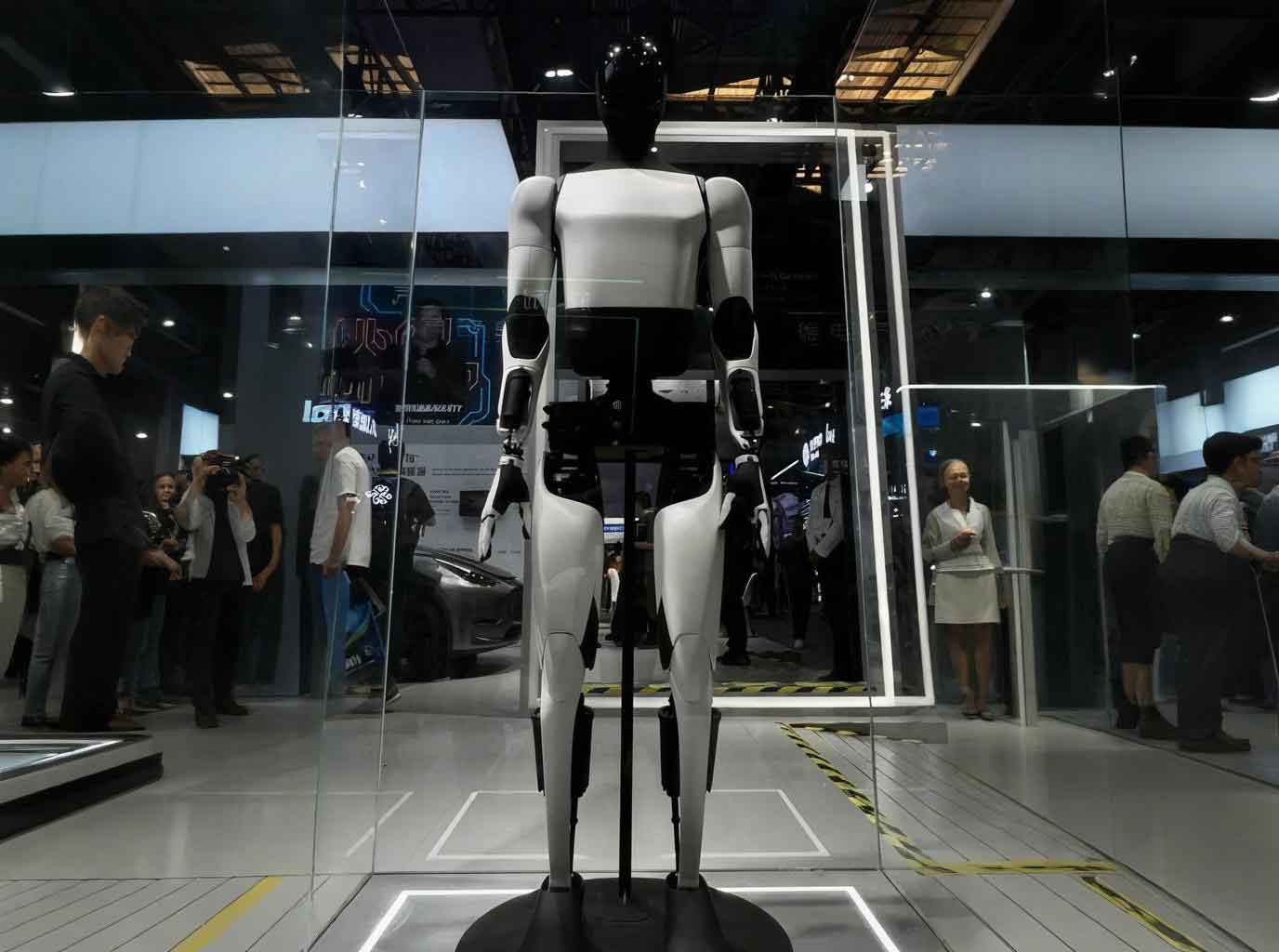
The concept of embodied intelligence, first proposed by Alan Turing in the 1950s, refers to machines that autonomously interact with their environment, perceive, make decisions, plan actions, and execute tasks. Embodied robots are intelligent robotic systems with physical entities capable of sensing environments, understanding tasks, and autonomously performing actions. Unlike traditional industrial robots, embodied robots exhibit superior environmental adaptability, task comprehension, and autonomous decision-making. Core characteristics include: heightened perceptual abilities through multi-modal sensors like vision, touch, and hearing; robust cognitive capabilities for understanding complex instructions and reasoning; flexible execution skills for completing tasks in unstructured environments; and learning evolution abilities to optimize performance through experience accumulation. Embodied robots come in various forms tailored to different applications, as summarized in the table below.
| Robot Form | Typical Products | Application Scenarios |
|---|---|---|
| Fixed-base Robot | Flexible Assembly Arm | Industrial manufacturing, laboratory automation, education and training |
| Mobile Robot | Tourism Guide Robot | Service industry, healthcare, collaborative environments |
| Humanoid Robot | Sterile Environment Operator | Medical care, agricultural and forestry maintenance, industrial manufacturing |
| Bionic Robot | Urban Waterlogging Monitor | Environmental monitoring, biological research, industrial inspection, post-disaster reconstruction |
An embodied robot enterprise is defined as a high-tech organization engaged in fundamental theory R&D, core technology攻关, key component manufacturing, whole machine integration, and application services related to embodied intelligence. These enterprises must possess independent legal personality, stable operations, and the ability to conduct independent accounting. Based on national and local policies, the criteria for such enterprises encompass several dimensions, as outlined in the following table.
| Category | Specific Criteria |
|---|---|
| Basic Enterprise Conditions | Independent legal personality, stable operations, financial independence |
| R&D and Technical Conditions | Self-developed capabilities, core patents, R&D investment ≥5% of revenue, technical platforms |
| Product and Application Conditions | Batch products, demonstration applications in at least one scenario, passing certifications |
| Industrial and Market Conditions | Scale production, key component localization, related revenue >50%, participation in “robot+” applications |
| Innovation and Talent Conditions | Core teams with relevant expertise, talent plans, industry-academia-research collaboration |
| Policy and Compliance Conditions | Alignment with national policies, adherence to standards, inclusion in government support lists |
The embodied robot industry is构建 a comprehensive system from basic research to end-use applications, forming a full-chain雏形 covering “key components—robot本体—system integration—application services.” As an industrial载体 for AI’s transition from “disembodied cognition” to “embodied cognition,” the embodied robot industry is experiencing rapid growth driven by technological innovation and policy support. It encompasses an integrated闭环 from upstream core hardware and software R&D to midstream本体 manufacturing and downstream multi-scenario integration. Upstream focuses on key components and basic technology breakthroughs, including traditional parts like sensors, controllers, and reducers, as well as cutting-edge innovations such as embodied AI models for multi-modal perception and complex task decision-making, and motion control algorithms for enhancing mobility in dynamic environments. Midstream involves robot本体 manufacturing, evolving from traditional single-form robots to humanoid robots equipped with “intelligent brains.” For instance, high-performance “electronic skin” and bionic multi-finger “dexterous hands” are maturing, endowing humanoid robots with multi-dimensional tactile perception and fine manipulation capabilities. Downstream application services demonstrate unprecedented expansion potential, penetrating from industrial manufacturing to social services and daily life, as detailed in the table below.
| Application Field | Specific Industries |
|---|---|
| Industrial Manufacturing | Automotive, electronics, pharmaceuticals, focusing on welding, assembly, handling, sorting, inspection |
| Commercial and Services | Business services, industrial parks, community properties, cultural tourism, focusing on operations management, facility maintenance, security patrols, guide reception |
| Public and Livelihood Fields | Education, urban management, medical care, garden maintenance, focusing on辅助 teaching, facility inspection, life care (e.g., accompanying, bathing assistance), environmental cleaning |
Suzhou has established a robust foundation for the embodied robot industry, leveraging its comprehensive manufacturing system and favorable business environment to accelerate technological integration and application scenario deployment. With consistent leading advantages, Suzhou has ranked third in the “China Robot City Comprehensive Strength TOP10” for four consecutive years, forming a complete产业链 covering core components,本体 manufacturing, and system integration, with an industrial scale of 139.5 billion yuan in 2024. In terms of industrial clusters, the city has gathered nearly 800 enterprises in robots and key components, including 24 national-level “little giant” enterprises and 14 listed or New OTC Market enterprises, employing approximately 63,000 people. Technological innovation capabilities are evident from the 3,125 robot-related patents granted in 2024, an 18.7% year-on-year increase, with invention patents accounting for 42%, indicating strong autonomous innovation vitality. Leading enterprises like Ecovacs, with global shipments of service robots exceeding 10 million units, and Harmonic Drive, with an annual production capacity of over 2 million sets of reducers, have driven significant industry growth. Innovation载体 construction includes the Suzhou Embodied Intelligent Robot Comprehensive Innovation Center, which has attracted 20 high-level R&D institutions, undertaken 83 provincial-level or above projects, and landed 84 industrial projects covering industrial parks, R&D headquarters, and manufacturing bases, with government funding exceeding 800 million yuan. Additionally, multiple provincial-level intelligent robot攻关 projects have been launched, and high-level R&D platforms like the Jiangsu Provincial Embodied Intelligent Robot Technology Key Laboratory have been approved. In application, the city has implemented 136 “robot+” demonstration projects across areas such as ancient city inspection, smart factories, and intelligent scenic spot guidance, stimulating upstream and downstream industrial investments of about 21 billion yuan, laying a solid foundation for the sustained growth of Suzhou’s embodied robot industry.
Suzhou’s rapid rise in the embodied robot industry is also attributed to its active integration into the Shanghai-Suzhou同城化 and Nanjing-Hangzhou ecological circle, deeply embedding itself in the Yangtze River Delta integration strategy to build an “internal linkage, external collaboration, global connection” open innovation pattern. Internally, Suzhou utilizes platforms like the Industrial Park Embodied Intelligent Robot Industrial Park and the High-tech Zone “Innovation Port” to rapidly导入 cross-regional technological achievements into local pilot, verification, and mass production processes, shortening the transition time from innovation chain to industrial chain. In fields like artificial intelligence, high-end manufacturing, and integrated circuits, Suzhou has achieved cross-regional resource sharing and complementary advantages, becoming a key hub in the provincial and national industrial chains. Simultaneously, local universities and research institutions such as Soochow University and the Suzhou Institute of Nano-Tech and Nano-Bionics collaborate with international platforms like the Oxford University Suzhou Advanced Research Centre to establish joint laboratories, creating “intellectual core” bases for attracting and aggregating high-end talent, and encouraging the formation of innovation consortia with enterprises to accelerate the transformation of cutting-edge technologies. Externally, Suzhou actively builds cross-regional innovation consortia to enhance the global competitiveness of its industrial chain. Specifically, Suzhou is协同构建 the “Su-Shang-Hang” innovation collaboration circle, strengthening cooperation with innovation highlands like Shanghai Zhangjiang AI Island and Hangzhou Future Sci-Tech City, focusing on bottlenecks in reducers, servo systems, and multi-modal perception algorithms, sharing Zhangjiang’s large-model computing power, Hangzhou’s algorithm platforms, and Suzhou’s manufacturing capabilities to form cross-regional industry-academia-research攻关 consortia, achieving complementary advantages and division of labor synergy, and jointly tackling technical bottlenecks in core components and前沿 algorithms. Meanwhile, by establishing international recruitment task forces, Suzhou actively links to global innovation networks, attracting international robot giants to set up regional headquarters or R&D centers, and regularly hosting international technical forums and industry competitions, aiming to gather global top-tier intellectual and technological resources to systematically strengthen the high-end segments of the local industrial chain, thereby securing a more favorable position in global industrial division.
To achieve high-quality and systematic development of the embodied robot industry, Suzhou has adopted a “three core categories” classification layout strategy, supported by a multi-layered policy linkage system of “national direction setting, provincial scale strengthening, and municipal implementation.” First, for basic theory R&D, focusing on source innovations like algorithms and control theory, the “Suzhou Measures to Support the Innovative Development of the Embodied Intelligent Robot Industry” explicitly propose “building high-level innovation platforms,” offering up to 200 million yuan support for institutions striving to create national key laboratories, and up to 20 million yuan for approved Jiangsu Provincial Key Laboratories and Jiangsu Provincial Engineering Technology Joint Laboratories, aiming to break through key core technologies in areas like humanoid robot “brains” and “cerebella,” addressing potential shortcomings in source innovation. Second, for applied technology innovation, focusing on accelerating the transformation of basic成果 into core technologies like key components and integrated drive-control joints, the “Suzhou Industrial Park Embodied Intelligent Robot Industry Development Action Plan (2025–2027)” emphasizes “strengthening the cultivation of technological innovation entities,” encouraging enterprises to form innovation consortia to collaboratively tackle common industry bottlenecks, and setting clear targets to achieve a core embodied robot industry scale of 15 billion yuan and a related industry scale of 30 billion yuan in the park by 2027. Finally, for industrialization and services, focusing on supporting major project aggregation and enterprise expansion, by strengthening financial capital support and opening application scenarios like smart healthcare and urban governance, the plan aims to land at least 10 benchmark innovation application projects in industrial, service, and special fields, vigorously promoting the commercialization of technological成果 and industrial chain extension. Through these precise policy practices, Suzhou is building a complete support chain from source innovation to market application, systematically guiding the industry toward in-depth development.
To scientifically evaluate and promote the high-quality development of Suzhou’s embodied robot industry, we employed a questionnaire survey method, analyzing预设 observation indicators to examine their impact on enterprise high-quality development, with the goal of constructing an evaluation system for the embodied robot industry with a structure of target layer—criterion layer—indicator layer. This provides theoretical guidance and policy basis for the healthy development of Suzhou’s embodied robot industry. We used a Likert 5-point scale, dividing each set of questions into five levels based on respondents’ emphasis, as shown in the encoding table below. After compiling the questionnaire, we distributed it to enterprises registered in centers like the Suzhou Embodied Intelligent Robot Comprehensive Innovation Center and the Industrial Park Zhongxin Embodied Intelligent Robot Industrial Park, collecting 42 valid responses.
| Number | Indicator | Measurement Scale | Question Item |
|---|---|---|---|
| P1 | Originality of Basic Algorithms | High-level papers, cutting-edge technology breakthroughs, original innovations | Does your enterprise have original breakthroughs in embodied AI basic algorithms? |
| P2 | Self-sufficiency Rate of Key Components | Proportion of self-developed key components | What is the self-sufficiency rate of key components in embodied robots at your enterprise? |
| P3 | Scale of High-quality Open Datasets | Dataset size, data quality | Does your enterprise possess high-quality, large-scale open datasets for embodied AI? |
| P4 | Source Technology Supply | Position on embodied AI technology development curve, original breakthroughs | Does your enterprise have unique source technology supply capabilities in embodied AI development? |
| P5 | Proportion of High-value Patents | Number of domestic and foreign authorized patents, proportion of high-value patents | What is the proportion of high-value patents among your enterprise’s invention patents in embodied robots? |
| P6 | Enterprise Incubation Success Rate | Number of incubation projects, success rate | How successful is your enterprise in incubating innovative companies related to embodied robots? |
| P7 | Technology Maturity Transition Cycle | Commercialization success rate of R&D projects, conversion cycle | Is the maturity transition cycle from lab to market for embodied AI technologies at your enterprise efficient? |
| P8 | Scenario Deployment Density | Breadth and depth of embodied robot product applications across industries | Are your enterprise’s embodied robot products deeply applied in multiple industry sectors? |
| P9 | Proportion of Commercial Revenue | Sales revenue growth rate, profit margin, R&D return on investment | Is the proportion of commercial revenue from embodied robot business significant in total revenue? |
| P10 | Economic Benefits | Sales revenue growth rate, profit margin, R&D return on investment | Is the annual sales revenue growth rate of your enterprise’s embodied robot business significant? |
| P11 | Proportion of PCT Patents | Number of domestic and foreign authorized patents, international patent layout | What is the proportion of PCT patents in total patents applied for in embodied AI at your enterprise? |
| P12 | Number of Overseas Joint Laboratories | Number of cooperative projects with universities and research institutions,成果 sharing mechanisms | Has your enterprise established multiple overseas joint laboratories in embodied AI? |
| P13 | Contribution to International Standards | Participation in industry technical standard setting, international standard adoption | How much does your enterprise contribute to the formulation and promotion of international technical standards in embodied AI? |
| P14 | Aggregation and Cultivation of High-end Talent | R&D team size, PhD/master ratio, core talent attrition rate | Does your enterprise have a high-quality, highly-educated R&D team in embodied AI? |
| P15 | Depth and Breadth of Industry-Academia-Research Collaboration | Number of cooperative projects with universities and research institutions,成果 sharing mechanisms | Are your enterprise’s collaborations with domestic and foreign universities and research institutions in embodied AI close and productive? |
| P16 | Ability to Build Innovation Consortia | Cooperation with upstream and downstream enterprises, tech intermediaries | Does your enterprise actively build embodied AI innovation consortia including upstream and downstream partners? |
| P17 | International Market Expansion Capability | Proportion of overseas business revenue, international brand知名度 | How do your enterprise’s embodied robot products perform in international markets and in terms of brand recognition? |
To ensure the questionnaire data met the requirements for principal component analysis, we first verified reliability and validity. For reliability, Cronbach’s Alpha coefficient was 0.926, well above the commonly accepted threshold of 0.6, indicating high internal consistency and reliability. For validity, we assessed using KMO and Bartlett’s sphericity tests. The KMO value was 0.816, greater than 0.8. Meanwhile, Bartlett’s test yielded an approximate chi-square value of 1921.000 with 136 degrees of freedom and a significance probability Sig. of 0.000 (less than 0.05), rejecting the hypothesis of variable independence and confirming significant correlations among variables, satisfying the preconditions for factor analysis. In summary, the questionnaire data demonstrated good reliability and validity, allowing further operations like principal component extraction and factor rotation.
Using principal component analysis to extract variables, we identified four principal components with eigenvalues greater than 1, which together explained 65.30% of the total variance, as shown in the total variance explanation table below.
| Component | Initial Eigenvalues | Extraction Sums of Squared Loadings | Rotation Sums of Squared Loadings |
|---|---|---|---|
| 1 | 6.482 (38.13%) | 6.482 (38.13%) | 4.011 (23.59%) |
| 2 | 2.001 (11.77%) | 2.001 (11.77%) | 3.875 (22.79%) |
| 3 | 1.464 (8.61%) | 1.464 (8.61%) | 2.114 (12.43%) |
| 4 | 1.155 (6.79%) | 1.155 (6.79%) | 1.102 (6.49%) |
We applied the varimax method with a maximum of 25 iterations for rotation loadings on all indicators. If an indicator had loadings below 0.4 on all principal components or loadings above 0.4 on multiple components, it was剔除. Ultimately, we retained 12 indicators, establishing the indicator layer for evaluating the high-quality development of Suzhou’s embodied robot industry, as shown in the rotated component matrix below.
| Indicator | Principal Component 1 | Principal Component 2 | Principal Component 3 | Principal Component 4 |
|---|---|---|---|---|
| Originality of Basic Algorithms | 0.83 | 0.18 | 0.12 | 0.09 |
| Self-sufficiency Rate of Key Components | 0.79 | 0.15 | 0.21 | 0.14 |
| Scale of High-quality Open Datasets | 0.77 | 0.22 | 0.19 | 0.11 |
| Source Technology Supply | 0.16 | 0.81 | 0.14 | 0.20 |
| Proportion of High-value Patents | 0.19 | 0.78 | 0.17 | 0.10 |
| Enterprise Incubation Success Rate | 0.21 | 0.75 | 0.12 | 0.15 |
| Technology Maturity Transition Cycle | 0.15 | 0.18 | 0.82 | 0.14 |
| Scenario Deployment Density | 0.11 | 0.21 | 0.80 | 0.19 |
| Proportion of Commercial Revenue | 0.14 | 0.16 | 0.76 | 0.22 |
| Proportion of PCT Patents | 0.12 | 0.14 | 0.18 | 0.84 |
| Number of Overseas Joint Laboratories | 0.19 | 0.15 | 0.17 | 0.80 |
| Contribution to International Standards | 0.10 | 0.18 | 0.20 | 0.77 |
From the rotated component matrix, we extracted four principal components. Aligning with Suzhou’s embodied robot enterprises’ pursuit of “high-end autonomy, scenario deployment, ecological synergy, and global leadership” for high-quality development, and based on the high-loading characteristics of indicators in the matrix, we named these four principal components as follows.
First, Technological R&D Capability: High-loading indicators include originality of basic algorithms, self-sufficiency rate of key components, and scale of high-quality open datasets. These collectively point to the enterprise’s most core, foundational technological strength and degree of autonomy in the embodied robot field. Originality of basic algorithms determines technological advancement and uniqueness; self-sufficiency rate of key components reflects industrial chain resilience and localization level; scale of high-quality open datasets is the foundation for AI and robot training and iteration. These three constitute the technical cornerstone and core competitiveness for enterprises to achieve high-quality development, emphasizing independent R&D and control over core technologies. In Suzhou, a hub for robot components, “self-sufficiency rate of key components” directly indicates supply chain resilience, while large-scale, high-quality datasets serve as fuel for continuous algorithm model evolution.
Second, Technological Innovation Level: High-loading indicators include source technology supply, proportion of high-value patents, and enterprise incubation success rate. This factor focuses on the enterprise’s “source” capability at the front end of the innovation chain, as well as the quality and transformation efficiency of its innovation成果. Existing national technology transfer demonstration institutions and innovation vouchers in Suzhou minimize “friction” between research and industry, manifesting as high activity in patents and incubation projects. Source technology supply implies the ability to create disruptive or pioneering technologies; proportion of high-value patents measures the quality and market competitiveness of intellectual property; enterprise incubation success rate reflects the efficiency of transforming innovation成果 into emerging industries and business models. For high-quality development, not only innovation is required but also originality, high value, and the ability to drive new industries.
Third, Commercialization Efficiency: High-loading indicators include technology maturity transition cycle, scenario deployment density, and proportion of commercial revenue. Suzhou’s rich scenarios in automotive, medical, semiconductor, etc., provide “testing grounds” for high-frequency iteration, corresponding to “high scenario deployment density.” This factor concentrates on improving the efficiency and breadth of transitioning embodied robot technology from R&D to market application. Technology maturity transition cycle reflects the ability to rapidly iterate and deploy technologies into the market; scenario deployment density indicates the breadth and adaptability of products in practical applications; proportion of commercial revenue directly measures market acceptance and economic benefit realization. High-quality development is not only about technological leadership but also about quickly converting technology into actual social value and economic benefits, achieving extensive market penetration.
Fourth, International Influence: High-loading indicators include proportion of PCT patents, number of overseas joint laboratories, and contribution to international standards. This factor reflects the enterprise’s influence, collaborative ability, and rule-making power on a global scale. Proportion of PCT patents is a key indicator for measuring international intellectual property layout and protection; number of overseas joint laboratories indicates the extent of international scientific research collaboration and talent introduction; contribution to international standards represents the enterprise’s leadership and “voice” in the global technology ecosystem. In the cutting-edge field of embodied robots, high-quality development necessarily requires enterprises to have a global perspective, actively participate in international competition and cooperation, and strive for a dominant role in global rule-making.
We employed the entropy weight method to determine the entropy weight of each indicator within its principal component, reflecting the degree of variation and information content. Lower entropy values indicate greater information content and higher weights. The derived weights are used for subsequent comprehensive evaluation or model construction to more finely reflect the importance of each indicator within its principal component, as shown in the weight table below.
| Dimension (Principal Component) | Indicator | Information Entropy | Entropy Weight | Weight Ranking |
|---|---|---|---|---|
| Technological R&D Capability | Self-sufficiency rate of key components | 0.698 | 0.201 | 1 |
| Technological R&D Capability | Originality of basic algorithms | 0.713 | 0.187 | 2 |
| Technological R&D Capability | Scale of high-quality open datasets | 0.735 | 0.164 | 4 |
| Technological Innovation Level | Source technology supply | 0.721 | 0.179 | 3 |
| Technological Innovation Level | Proportion of high-value patents | 0.754 | 0.146 | 5 |
| Technological Innovation Level | Enterprise incubation success rate | 0.772 | 0.128 | 7 |
| Commercialization Efficiency | Scenario deployment density | 0.764 | 0.136 | 6 |
| Commercialization Efficiency | Technology maturity transition cycle | 0.789 | 0.111 | 8 |
| Commercialization Efficiency | Proportion of commercial revenue | 0.805 | 0.095 | 9 |
| International Influence | Contribution to international standards | 0.819 | 0.081 | 10 |
| International Influence | Number of overseas joint laboratories | 0.831 | 0.069 | 11 |
| International Influence | Proportion of PCT patents | 0.846 | 0.054 | 12 |
The principal component analysis process can be mathematically represented as follows. Let the original data matrix be $X$ with $p$ variables and $n$ observations. PCA aims to find linear combinations of the variables that capture the maximum variance. The first principal component $Y_1$ is given by:
$$Y_1 = w_{11}X_1 + w_{12}X_2 + \cdots + w_{1p}X_p$$
where $w_1$ is the eigenvector corresponding to the largest eigenvalue of the covariance matrix of $X$. Subsequent components are derived similarly, subject to orthogonality to previous ones. The total variance explained by the components is calculated as the sum of eigenvalues, and the proportion explained by each component is its eigenvalue divided by the total variance. For our analysis, the cumulative proportion reached 65.30%, indicating satisfactory representation of the original data.
The entropy weight method involves calculating the information entropy for each indicator. For indicator $j$, the entropy $e_j$ is computed as:
$$e_j = -k \sum_{i=1}^{n} p_{ij} \ln p_{ij}$$
where $p_{ij}$ is the normalized value of indicator $j$ for sample $i$, and $k$ is a constant such that $0 \leq e_j \leq 1$, typically $k = 1 / \ln(n)$. The weight $w_j$ is then determined by:
$$w_j = \frac{1 – e_j}{\sum_{j=1}^{m} (1 – e_j)}$$
These weights are used to aggregate scores for each dimension, providing a nuanced assessment of embodied robot enterprise development. The lower the entropy, the higher the weight, signifying greater discriminatory power of the indicator. In our results, self-sufficiency rate of key components had the highest weight (0.201), underscoring its critical role in high-quality development.
Based on the evaluation results, we propose a four-in-one countermeasure framework to advance the high-quality development of Suzhou’s embodied robot industry, emphasizing core foundation building, innovation driving, commercialization acceleration, and global leapfrogging.
Core Foundation: Self-Sufficiency in Key Components and Intelligent Algorithm Closed Loop
Addressing the highest-weight indicators of self-sufficiency rate of key components and originality of basic algorithms, Suzhou should establish a special fund for the localization of key components in embodied robots. This fund should provide equity investment from seed to VC stages and specialized grants for mature enterprises’ R&D projects. Focus on core shortfalls like reducers, high-performance servo motors, high-precision force sensors, intelligent drivers, and bionic tendons. Mechanisms like “unveiling the list and appointing the best” can invite global teams to tackle technical bottlenecks, significantly reducing market entry costs and R&D trial-and-error risks. Simultaneously, build a high-standard open data lake and supercomputing platform for embodied AI training, aggregating massive real-scenario data from embodied robot operations, interactions, and environmental perceptions in Suzhou and the Yangtze River Delta. Allocate computing vouchers based on enterprises’ contributions to data assets, guiding accelerated iteration of autonomous algorithms. This aims to create an efficient circulating “data-algorithm-hardware” closed-loop ecosystem, driving leapfrog improvements in basic algorithm originality and key component localization rates, thereby forging the hard “chips” and “brains” of Suzhou’s embodied robot industry and solidifying the foundation for industrial development.
Innovation Engine: R&D Enclave Linkage and High-Value Patent Cultivation
Given the prominence of source technology supply and proportion of high-value patents despite elongated technology conversion chains, Suzhou urgently needs to build a dual-driven innovation ecosystem model of “R&D enclaves + pilot acceleration.” Externally, Suzhou can collaborate with top Yangtze River Delta universities and research institutions like Fudan University, Nanjing University, Zhejiang University, and Southeast University to establish embodied AI R&D enclave centers in research-intensive areas, attracting original technology teams with pioneering topics. Provide long-term stable R&D funding, talent introduction subsidies, and flexible incentives for research成果 transformation to ensure a continuous inflow of source innovation. Concurrently, within core carriers like Suzhou High-tech Zone and Xiangcheng Economic Development Zone, accelerate the construction of pilot and scenario verification bases with capabilities for multi-modal robot testing, complex environment simulation, human-robot interaction analysis, and safety reliability validation. Offer professional technical support, specialized equipment sharing, and standardized certification services for projects that have passed lab-stage verification, significantly shortening the cycle from prototype to small-batch production. Additionally, establish “high-value patent cultivation vouchers,” providing tiered rewards for international patents applied via PCT and for significant increases in patent citations, encouraging enterprises to form high-quality intellectual property layouts, effectively building technical barriers and enhancing market competitiveness, and accelerating the transformation of source innovation into practical productivity.
Commercialization Acceleration: Scenario Order Traction and Commercial Incentives
To address the mid-range weights in commercialization efficiency and insufficient scenario deployment density, Suzhou should proactively play a guiding role in creating a “thousand enterprises, ten thousand robots” embodied robot demonstration project. This project will use diverse scenarios like smart healthcare, intelligent manufacturing, smart commerce, smart elderly care, and smart agriculture as core entry points. Regularly release opportunity lists for embodied robot application scenarios annually, detailing scenario needs, technical specifications, and expected benefits, and innovatively implement “scenario + order” joint bidding models, encouraging deep collaboration between embodied robot enterprises and scenario providers. For enterprises that successfully bid and complete demonstration applications, the government should provide scenario testing subsidies and risk-sharing mechanisms, significantly reducing trial-and-error costs. More critically, establish a government-guided venture capital follow-on investment mechanism directly linked to enterprises’ commercial revenue, encouraging social capital participation, so that successfully deployed scenario orders can directly become key basis for enterprise revenue and valuation, enhancing “blood-making” capacity and market recognition, thereby accelerating the process of embodied robots from proof-of-concept to scale replication, achieving rapid proliferation of application scenarios.
Global Leap: Institutional Openness Empowering International Innovation Networks
Although international influence currently has the lowest entropy weight ranking, it is decisive for Suzhou’s future competitive position in the embodied robot industry. Therefore, Suzhou should fully leverage the pioneering trial advantages of its free trade zone’s institutional innovation, boldly implement a “zero-tariff equipment import for international joint laboratories” policy, simplifying cross-border procedures for cutting-edge research equipment and reducing costs, ensuring conditions for international前沿 research. Simultaneously, comprehensively optimize “one-stop service for work permits for foreign high-end talent,” achieving seamless integration of visa, work permit, residence permit, and supporting services, creating a “green channel” for international talent to innovate and start businesses in Suzhou. By providing specialized research startup funds, talent apartments, and children’s education support, attract them to co-build internationally influential joint laboratories and R&D centers with local enterprises or universities. Establish an “international standard navigation reward plan,” offering policy support and financial subsidies to enterprises leading the formulation or revision of ISO/IEC international standards in embodied AI, encouraging participation in global technical rule-making. Additionally, regularly organize Suzhou embodied robot enterprises to participate in global top robot and AI exhibitions (e.g., Germany’s Hannover Messe, U.S. CES, Japan’s iREX), collectively promoting the “Suzhou model,” using institutional openness to drive technological openness, talent openness, and market openness, building a globally oriented, open, and collaborative embodied AI innovation network, and establishing Suzhou as a global embodied robot innovation highland.
In conclusion, the embodied robot industry in Suzhou holds immense potential for driving economic growth and technological advancement. By implementing these strategies focused on core technologies, innovation, commercialization, and global integration, Suzhou can overcome existing challenges and achieve its vision of becoming a national leader in embodied robot innovation and application. Continuous monitoring and adaptation of these policies based on evolving industry dynamics will be essential for sustained high-quality development.