
As a researcher focused on emerging technologies and industrial policy, I have observed the rapid rise of embodied AI robots as a transformative force in global manufacturing and service sectors. The inclusion of “embodied intelligence” in China’s 2025 Government Work Report as a key future industry underscores its strategic importance, aligning with national innovation goals in biomanufacturing, quantum technology, and 6G. This paradigm shift from “disembodied cognition” to “embodied cognition” represents a critical breakthrough in artificial intelligence, where embodied AI robots—physical entities integrated with AI capabilities—are redefining competitiveness through perception, learning, and environmental interaction. In this context, I explore the case of Suzhou, a major hub in the Yangtze River Delta, to analyze how embodied AI robot industry can achieve high-quality development. Through a comprehensive evaluation framework and policy recommendations, this article aims to provide insights into fostering innovation, enhancing industrial chains, and positioning regions like Suzhou as global leaders in embodied AI robotics.
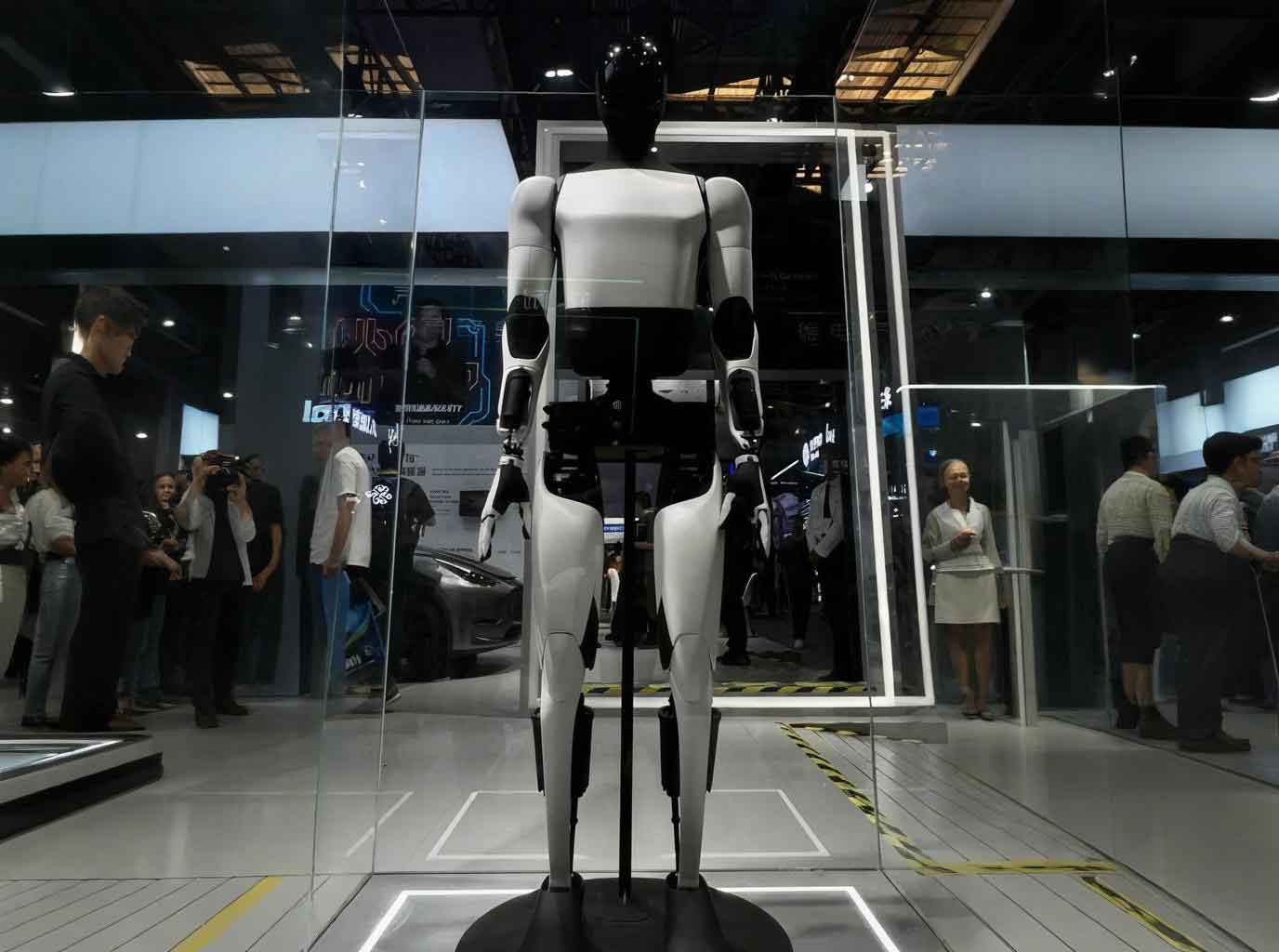
The concept of embodied intelligence, initially proposed by Alan Turing in the 1950s, refers to machines that autonomously interact with environments, perceive, decide, plan, and execute tasks. Embodied AI robots are intelligent robotic systems with physical bodies capable of sensing environments, understanding tasks, and performing actions independently. Unlike traditional industrial robots, embodied AI robots exhibit superior adaptability, task comprehension, and autonomous decision-making. Core characteristics include: heightened perceptual abilities through multimodal sensors (e.g., vision, touch, hearing); robust cognitive capabilities for reasoning and decision-making; flexible execution in unstructured environments; and learning evolution through experience accumulation. These embodied AI robots manifest in various forms tailored to different applications, as summarized in Table 1.
| Robot Form | Typical Products | Application Scenarios |
|---|---|---|
| Fixed-Base Robots | Flexible assembly robotic arms | Industrial manufacturing, laboratory automation, education and training |
| Mobile Robots | Tourism guide robots | Service industries, healthcare, collaborative environments |
| Humanoid Robots | Sterile environment operation robots | Medical care, agriculture and forestry maintenance, industrial manufacturing |
| Biomimetic Robots | Urban waterlogging monitoring robots | Environmental monitoring, biological research, industrial inspection, post-disaster reconstruction |
Embodied AI robot enterprises are high-tech organizations engaged in R&D, core technology攻关, key component manufacturing, system integration, and application services related to embodied AI robots. To qualify as such an enterprise, certain standards must be met, based on national and regional policies. I have synthesized these criteria into a comprehensive set, as shown in Table 2. These standards ensure that embodied AI robot enterprises possess the necessary研发 capabilities, product viability, and market orientation to drive industrial growth.
| Category | Specific Standards |
|---|---|
| Basic Enterprise Conditions | 1. Independent legal entity status with continuous operation. 2. Capability for independent financial accounting and stable operations. 3. Main business focused on R&D, production, sales, and services of embodied AI or humanoid/service robots. |
| R&D and Technical Conditions | 1. Possession of independent R&D capabilities and core intellectual property patents. 2. Achievements in key areas such as algorithms, operating systems, sensors, joint drives, and high-precision reducers. 3. R&D investment intensity not less than 5% of revenue. 4. Establishment or co-construction of technical R&D platforms (e.g., key laboratories, engineering centers). |
| Product and Application Conditions | 1. Development of batch-produced embodied AI robot本体 or key components. 2. Demonstration applications in at least one scenario (e.g., industrial, logistics, medical, elderly care, service). 3. Compliance with national or provincial industry standards and certifications. |
| Industrial and Market Conditions | 1. Certain scale production capacity with逐步 increasing domestic supply rates for key components. 2. Over 50% of annual revenue from embodied AI robot-related business. 3. Active participation in “robot+” application scenarios and development of典型案例. |
| Innovation and Talent Conditions | 1. Core R&D teams with expertise in humanoid robotics, AI, or advanced manufacturing, including合理 ratios of硕士 and博士. 2. Support from省级 or above talent programs or引进 of influential innovators. 3.建立产学研 cooperation mechanisms with universities and research institutes. |
| Policy and Compliance Conditions | 1. Alignment with national industrial directions如工信部 guidelines. 2. Adherence to industry standards, safety norms, and data compliance. 3. Inclusion in local government “robot+” application catalogs or industry support lists. |
The embodied AI robot industry encompasses a comprehensive ecosystem from upstream R&D to downstream applications, forming a闭环 of “key components—robot本体—system integration—application services.” This industry serves as the industrial载体 for AI’s paradigm shift, driven by technological innovation and policy support. Table 3 outlines the primary application domains of embodied AI robots, highlighting their expanding role across sectors. As embodied AI robots evolve, they are transitioning from单一形态 like robotic arms to advanced humanoid robots with “intelligent brains,” enabling broader societal integration.
| Application Domain | Specific Industries |
|---|---|
| Industrial Manufacturing | Automotive, electronics, pharmaceuticals, focusing on welding, assembly,搬运, sorting, and quality inspection. |
| Commercial and Service Sectors | Business services, industrial parks, community property, tourism, focusing on operations management, facility maintenance, security patrols, and guide reception. |
| Public and民生 Fields | Education, urban市政 management, medical care, elderly assistance, garden maintenance, focusing on辅助 teaching, facility inspection, daily care (e.g., accompanying, bathing), and environmental cleaning. |
Turning to Suzhou’s context, this city has emerged as a key player in the embodied AI robot industry within China. Suzhou boasts a robust manufacturing base and favorable business environment, contributing to its连续四年 ranking among the top three in China’s robot city comprehensive strength index. By 2024, the embodied AI robot industry scale reached ¥139.5 billion, with over 800 related enterprises, including 24 national-level专精特新 “little giant” firms and 14 listed companies. The workforce comprises approximately 63,000 professionals, and innovation output is strong, with 3,125 new robot-related patent authorizations in 2024—a 18.7% year-on-year increase, of which 42% were发明专利. Leading enterprises like科沃斯 and绿的谐波 have achieved significant milestones, such as global shipments exceeding 10 million service robots and annual reducer production surpassing 2 million units, respectively. Suzhou’s innovation infrastructure includes the Embodied AI Robot Comprehensive Innovation Center, which hosts 20 high-level R&D institutions and has undertaken 83 provincial-level projects. Furthermore, 136 “robot+” demonstration projects have been implemented across scenarios like ancient city inspection and smart factories, driving upstream-downstream investments of about ¥21 billion.
Suzhou’s success is partly due to regional collaboration within the Yangtze River Delta. The city actively integrates into the沪苏同城化 and宁杭生态圈 initiatives, fostering an open innovation network. Internally, industrial parks like Suzhou Industrial Park and高新区 “Innovation Port” facilitate rapid technology transfer from R&D to mass production. Externally, Suzhou collaborates with Shanghai’s张江 AI Island and Hangzhou’s Future Sci-Tech City to form cross-regional产学研 alliances, addressing bottlenecks in reducers, servo systems, and multimodal perception algorithms. This synergy leverages Shanghai’s computing power, Hangzhou’s algorithm platforms, and Suzhou’s manufacturing prowess, enhancing the global competitiveness of embodied AI robots.
Policy实践 in Suzhou follows a layered approach: national direction-setting, provincial scale-building, and municipal implementation. The city adopts a “three-core-category” strategy: (1)基础理论研发类, focusing on algorithm and control theory breakthroughs with support for high-level platforms like national key laboratories; (2)应用技术创新类, accelerating转化 of core technologies through innovation consortia and targets like ¥15 billion core industry scale by 2027; and (3)产业化与服务类, promoting project aggregation and application scenarios in智慧医疗 and城市治理. Measures include financial incentives, scene openness, and标杆 project implementation, creating a full-chain support system for embodied AI robots.
To scientifically assess and drive high-quality development of Suzhou’s embodied AI robot industry, I developed an evaluation system using survey methods, principal component analysis (PCA), and entropy weight method. This approach helps identify strengths, weaknesses, and potential bottlenecks for embodied AI robot enterprises. I conducted a questionnaire survey among 42 embodied AI robot enterprises in Suzhou, using a Likert 5-point scale to measure the importance of 17 preliminary indicators. After reliability and validity tests (Cronbach’s Alpha = 0.926, KMO = 0.816, Bartlett’s test sig. = 0.000), I performed PCA to extract key factors. Four principal components were identified, explaining 65.30% of the total variance. Through varimax rotation, 12 indicators were retained, forming the evaluation index system as shown in Table 4. These indicators reflect the multidimensional nature of high-quality development for embodied AI robot enterprises.
| Indicator | Principal Component 1: Technological R&D Capability | Principal Component 2: Technological Innovation Level | Principal Component 3: Commercialization Efficiency | Principal Component 4: International Influence |
|---|---|---|---|---|
| Originality of fundamental algorithms | 0.83 | 0.18 | 0.12 | 0.09 |
| Self-sufficiency rate of key components | 0.79 | 0.15 | 0.21 | 0.14 |
| Scale of high-quality open datasets | 0.77 | 0.22 | 0.19 | 0.11 |
| Source technology supply capability | 0.16 | 0.81 | 0.14 | 0.20 |
| Proportion of high-value patents | 0.19 | 0.78 | 0.17 | 0.10 |
| Success rate of enterprise孵化 | 0.21 | 0.75 | 0.12 | 0.15 |
| Cycle for technology maturity跨越 | 0.15 | 0.18 | 0.82 | 0.14 |
| Density of scenario deployment | 0.11 | 0.21 | 0.80 | 0.19 |
| Proportion of商业化 revenue | 0.14 | 0.16 | 0.76 | 0.22 |
| Proportion of PCT patents | 0.12 | 0.14 | 0.18 | 0.84 |
| Number of overseas joint laboratories | 0.19 | 0.15 | 0.17 | 0.80 |
| Contribution to international standards | 0.10 | 0.18 | 0.20 | 0.77 |
The four principal components are named based on their high-loading indicators: Technological R&D Capability (focusing on core technical foundations), Technological Innovation Level (emphasizing源头 innovation and intellectual property), Commercialization Efficiency (highlighting market转化 and应用), and International Influence (reflecting global engagement and standards setting). To refine the evaluation, I applied the entropy weight method to determine the importance of each indicator within its component. The entropy weight calculation involves several steps. First, standardize the原始 data for each indicator. For indicator \( j \), the standardized value \( p_{ij} \) for enterprise \( i \) is computed as:
$$ p_{ij} = \frac{x_{ij}}{\sum_{i=1}^{n} x_{ij}} $$
where \( x_{ij} \) is the raw score for enterprise \( i \) on indicator \( j \), and \( n \) is the number of enterprises. Then, the information entropy \( e_j \) for indicator \( j \) is given by:
$$ e_j = -\frac{1}{\ln n} \sum_{i=1}^{n} p_{ij} \ln p_{ij} $$
with the convention that if \( p_{ij} = 0 \), \( p_{ij} \ln p_{ij} = 0 \). The entropy weight \( w_j \) is then calculated as:
$$ w_j = \frac{1 – e_j}{\sum_{j=1}^{m} (1 – e_j)} $$
where \( m \) is the number of indicators. Based on this, I derived the weights for the 12 indicators, as presented in Table 5. The results show that self-sufficiency rate of key components and originality of fundamental algorithms have the highest weights, underscoring their critical role in embodied AI robot industry development.
| Principal Component | Indicator | Information Entropy | Entropy Weight | Weight Ranking |
|---|---|---|---|---|
| Technological R&D Capability | Self-sufficiency rate of key components | 0.698 | 0.201 | 1 |
| Originality of fundamental algorithms | 0.713 | 0.187 | 2 | |
| Scale of high-quality open datasets | 0.735 | 0.164 | 4 | |
| Technological Innovation Level | Source technology supply capability | 0.721 | 0.179 | 3 |
| Proportion of high-value patents | 0.754 | 0.146 | 5 | |
| Success rate of enterprise incubation | 0.772 | 0.128 | 7 | |
| Commercialization Efficiency | Density of scenario deployment | 0.764 | 0.136 | 6 |
| Cycle for technology maturity跨越 | 0.789 | 0.111 | 8 | |
| Proportion of商业化 revenue | 0.805 | 0.095 | 9 | |
| International Influence | Contribution to international standards | 0.819 | 0.081 | 10 |
| Number of overseas joint laboratories | 0.831 | 0.069 | 11 | |
| Proportion of PCT patents | 0.846 | 0.054 | 12 |
Building on this evaluation, I propose a four-pillar strategy to advance the high-quality development of Suzhou’s embodied AI robot industry. These recommendations align with the principal components and权重 findings, aiming to address bottlenecks and leverage strengths for embodied AI robot enterprises.
Pillar 1: Core Foundation – Enhancing Key Element Self-Sufficiency and Intelligent Algorithm闭环. Given the high weights of key component self-sufficiency and algorithm originality, Suzhou should establish a dedicated fund for domestic supply of critical embodied AI robot components. This fund could support R&D projects through “challenge悬赏” mechanisms, targeting reducers, servo motors, force sensors, and仿生 actuators. Simultaneously, creating an open data lake and supercomputing platform for embodied AI robot training can accelerate algorithm iteration. Enterprises contributing data assets could receive computing vouchers, fostering a “data-algorithm-hardware”闭环 that strengthens the industrial foundation for embodied AI robots.
Pillar 2: Innovation Engine – Fostering R&D Enclave Linkage and High-Value Patent Cultivation. To boost source technology supply and high-value patents, Suzhou should develop “R&D enclave + pilot acceleration” models.设立 R&D enclaves in collaboration with top universities like Fudan and Zhejiang can attract源头 innovation teams. Within Suzhou, pilot testing bases with multimodal simulation capabilities can shorten technology maturation cycles. Additionally, “high-value patent cultivation vouchers” could incentivize PCT applications and citation growth, building intellectual property barriers for embodied AI robot technologies.
Pillar 3: Commercialization Acceleration – Driving Scenario Order牵引 and Market Incentives. To improve commercialization efficiency, Suzhou can launch a “Thousand Enterprises, Ten Thousand Robots” demonstration project. Regularly publishing opportunity lists for embodied AI robot applications in healthcare, manufacturing, and elderly care, coupled with “scene + order” joint bidding, can reduce trial costs. Government-guided venture capital co-investment tied to商业化 revenue can enhance market recognition, speeding up the scale replication of embodied AI robot solutions.
Pillar 4: Global Leap – Empowering International Innovation Networks through Institutional Openness. Despite lower weights, international influence is crucial for long-term competitiveness. Suzhou should leverage free trade zone policies to simplify import procedures for research equipment in overseas joint labs. Streamlining work permits for foreign talent and offering “international standard navigation rewards” for ISO/IEC contributions can attract global innovators. Participating in major international robot expos like汉诺威工业博览会 can showcase Suzhou’s embodied AI robot advancements, integrating the city into global innovation networks.
In conclusion, the embodied AI robot industry represents a pivotal frontier in AI and robotics, with Suzhou positioned as a key player in China. Through a systematic evaluation framework, I have identified critical dimensions—technological R&D capability, innovation level, commercialization efficiency, and international influence—that define high-quality development for embodied AI robot enterprises. The proposed four-pillar strategy offers a roadmap for Suzhou to enhance its embodied AI robot ecosystem, from strengthening core technologies to expanding global reach. As embodied intelligence continues to evolve, such targeted efforts can help Suzhou achieve its goal of becoming a national innovation source, high-end manufacturing cluster, and示范 application city for embodied AI robots. Future research could explore dynamic changes in these indicators or comparative studies with other regions to further refine policies for embodied AI robot industry growth.
Throughout this article, I have emphasized the transformative potential of embodied AI robots, not only as technological artifacts but as drivers of economic and social progress. The integration of embodied AI robots into diverse sectors—from industrial lines to healthcare facilities—highlights their versatility and impact. By fostering collaboration, innovation, and open policies, regions like Suzhou can lead the way in harnessing embodied AI robots for sustainable development. As I reflect on this analysis, it is clear that the journey toward high-quality development for embodied AI robot industry requires continuous adaptation and commitment, but the rewards—in terms of technological sovereignty, job creation, and improved quality of life—are immense. Let us embrace the era of embodied AI robots with strategic vision and concerted action.