
In recent years, the surge in interest surrounding AI humanoid robots has captured global attention, driven by advancements in computational power, big data, and large-scale AI models. As an observer of this technological revolution, I believe that AI humanoid robots represent a pivotal convergence of artificial intelligence and robotics, with the potential to reshape industries and daily life. This article delves into the evolution, key technologies, applications, and future prospects of AI humanoid robots, emphasizing their integration into sectors like automotive manufacturing. Through detailed analysis, tables, and mathematical formulations, I will explore how these machines are transitioning from concept to reality.
The concept of AI humanoid robots is not entirely new; it has evolved over nearly a century. Early examples include Televox in 1927, which demonstrated basic human-like functions, and later innovations like WABOT-1 in 1973 and ASIMO in 2000, which advanced autonomy and mobility. Today, AI humanoid robots are characterized by their ability to mimic human form and behavior, leveraging AI for perception, decision-making, and execution. Unlike traditional industrial robots that operate in structured environments, AI humanoid robots are designed for unstructured settings, requiring advanced sensory and cognitive capabilities. This shift is largely fueled by generative AI and large language models, enabling robots to learn and adapt dynamically. In my view, the human form offers a universal interface for interacting with human-centric environments, making AI humanoid robots a promising platform for general-purpose applications.
| Decade | Key Milestone | Impact on AI Humanoid Robot Development |
|---|---|---|
| 1920s | First humanoid robot prototypes | Basic mechanical mimicry of human actions |
| 1970s | Introduction of autonomous humanoid robots | Early integration of sensors and control systems |
| 2000s | Electric motor-driven humanoid robots | Improved mobility and energy efficiency |
| 2020s | AI and large model integration | Enhanced learning, perception, and adaptability |
From a technical standpoint, AI humanoid robots rely on three core systems: environmental perception, interactive decision-making, and control and execution. Environmental perception involves sensors such as cameras, LiDAR, and force sensors to capture data from the surroundings. This can be modeled mathematically using sensor fusion algorithms; for instance, the integration of visual and tactile data can be represented as a weighted sum: $$ S_f = \alpha V + \beta T $$ where \( S_f \) is the fused sensor output, \( V \) denotes visual data, \( T \) represents tactile data, and \( \alpha \) and \( \beta \) are weighting coefficients based on environmental conditions. Interactive decision-making leverages AI models, including deep learning networks, to process this data and generate real-time responses. A common approach involves reinforcement learning, where the robot maximizes a reward function \( R(s, a) \) over states \( s \) and actions \( a \): $$ Q(s, a) = \mathbb{E} \left[ \sum_{t=0}^{\infty} \gamma^t R(s_t, a_t) \right] $$ where \( \gamma \) is a discount factor. Control and execution focus on hardware and software coordination, such as managing multiple joints for balance and movement. The dynamics of a humanoid robot can be described using Lagrangian mechanics: $$ \tau = M(q) \ddot{q} + C(q, \dot{q}) \dot{q} + G(q) $$ where \( \tau \) is the torque vector, \( M(q) \) is the mass matrix, \( C(q, \dot{q}) \) accounts for Coriolis and centrifugal forces, and \( G(q) \) represents gravitational effects. This equation highlights the complexity of maintaining stability in AI humanoid robots, especially during tasks like walking or grasping.
| Component Category | Examples | Value Share (%) in Typical AI Humanoid Robot |
|---|---|---|
| Perception Systems | Cameras, LiDAR, force sensors | 18 |
| Actuation Systems | Motors, gears, linear actuators | 62 |
| Power and Computation | Batteries, AI chips, thermal management | 20 |
In terms of hardware and software integration, AI humanoid robots face significant challenges. The perception systems require robust algorithms for object recognition and scene understanding, often using convolutional neural networks (CNNs): $$ y = f(W * x + b) $$ where \( y \) is the output, \( x \) is the input image, \( W \) represents weights, \( b \) is the bias, and \( f \) is an activation function. For decision-making, large language models enable natural language interactions, but real-time execution demands efficient optimization. The actuation systems, which constitute the majority of the cost, involve electric motors and reducers that must deliver high torque and precision. A key metric for performance is the power-to-weight ratio, which can be expressed as: $$ P_w = \frac{P}{m} $$ where \( P \) is power output and \( m \) is mass. Improving this ratio is crucial for enhancing the agility of AI humanoid robots. Additionally, software algorithms for motion planning often involve inverse kinematics: $$ \dot{q} = J^{-1} \dot{x} $$ where \( \dot{q} \) is the joint velocity vector, \( J \) is the Jacobian matrix, and \( \dot{x} \) is the end-effector velocity. This equation is fundamental for tasks like reaching and grasping in unstructured environments.
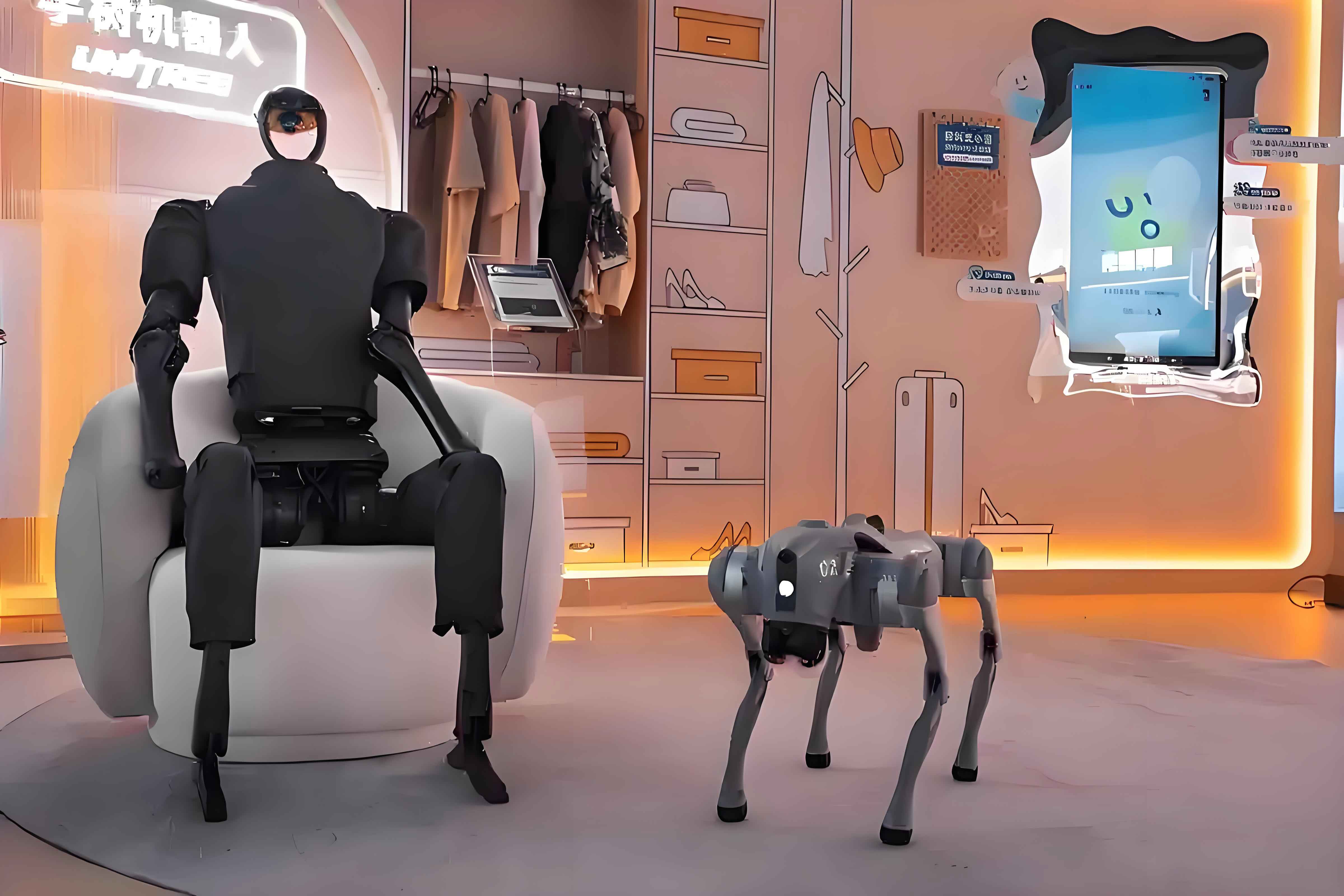
The applications of AI humanoid robots span multiple domains, including industrial, service, and specialized sectors. In industrial settings, AI humanoid robots can perform tasks such as assembly, welding, and material handling, but they must compete with specialized robots like robotic arms in terms of cost and efficiency. For example, in automotive manufacturing, current automation systems achieve high precision with dedicated tools, whereas AI humanoid robots offer flexibility for varied tasks. In service domains, such as healthcare or domestic assistance, AI humanoid robots can provide companionship, perform chores, or aid in rehabilitation. The decision to deploy an AI humanoid robot often hinges on a cost-benefit analysis, which can be modeled as: $$ C_{total} = C_h + C_m + C_o $$ where \( C_{total} \) is the total cost, \( C_h \) is hardware cost, \( C_m \) is maintenance, and \( C_o \) is operational cost. In specialized applications like disaster response or military operations, AI humanoid robots navigate hazardous environments, requiring robust perception and decision-making under uncertainty. The risk assessment for such scenarios can be quantified using probabilistic models: $$ P_{success} = 1 – \prod_{i=1}^{n} (1 – p_i) $$ where \( p_i \) is the probability of success for each subtask.
| Application Sector | Potential Tasks for AI Humanoid Robots | Challenges |
|---|---|---|
| Industrial Manufacturing | Assembly, painting, quality inspection | High cost, integration with existing systems |
| Service and Healthcare | Elderly care, surgical assistance, education | Safety, ethical considerations, user acceptance |
| Specialized Operations | Search and rescue, space exploration, defense | Extreme environment adaptability, reliability |
When examining the current landscape, several companies are pioneering AI humanoid robot development. Products like Tesla’s Optimus and Boston Dynamics’ Atlas showcase advanced capabilities, but they are still in experimental stages. The table below compares key parameters of prominent AI humanoid robots, highlighting variations in design and performance. From my perspective, the diversity in approaches—such as hydraulic versus electric actuation—reflects the ongoing innovation in this field. However, widespread adoption depends on reducing costs and improving reliability. For instance, the level of autonomy in AI humanoid robots can be measured using a scale from 0 to 5, where 0 indicates no autonomy and 5 represents full self-learning capability. Most current models operate at level 2 or 3, requiring human oversight for complex decisions.
| Company | Robot Model | Height (cm) | Weight (kg) | Degrees of Freedom | Maximum Speed (km/h) | Estimated Cost (USD) |
|---|---|---|---|---|---|---|
| Tesla | Optimus | 173 | 73 | 28 | 8 | 20,000 |
| Boston Dynamics | Atlas | 150 | 89 | 28 | 9 | 2,000,000+ |
| Xiaomi | Cyber One | 177 | 52 | 21 | 3.6 | N/A |
| Fourier Intelligence | GR-1 | 165 | 55 | 40 | 5 | N/A |
| Da Tao | XR4 | 165 | 65 | 60 | 5 | N/A |
| Zhi Yuan | Expedition A1 | 175 | 55 | 49 | 7 | 20,000 |
In the context of the automotive industry, AI humanoid robots present both opportunities and challenges. Automotive manufacturing relies on highly optimized production lines with specialized robots for tasks like welding and painting. The efficiency of these systems can be expressed using throughput formulas: $$ T = \frac{N}{t} $$ where \( T \) is throughput, \( N \) is the number of units produced, and \( t \) is time. AI humanoid robots could introduce flexibility by handling multiple tasks without retooling, but their current limitations in speed and precision may offset benefits. Moreover, the automotive sector has a well-established supply chain for sensors, actuators, and AI chips, which could be leveraged for AI humanoid robot production. For example, electric vehicle batteries and motor technologies can be adapted for robot power systems, reducing development costs. The synergy can be modeled as a shared resource optimization problem: $$ \min \sum_{i=1}^{k} c_i x_i \quad \text{subject to} \quad A x \leq b $$ where \( c_i \) represents costs, \( x_i \) are decision variables for resource allocation, and \( A x \leq b \) defines constraints like production capacity.
Looking ahead, the future of AI humanoid robots hinges on advancements in AI, materials science, and economic factors. Based on technology adoption curves, I estimate that AI humanoid robots will undergo a hype cycle with an initial peak of expectations, followed by a trough of disillusionment before reaching stable growth. The time to maturity can be projected using logistic growth models: $$ N(t) = \frac{K}{1 + e^{-r(t-t_0)}} $$ where \( N(t) \) is the adoption level at time \( t \), \( K \) is the carrying capacity, \( r \) is the growth rate, and \( t_0 \) is the inflection point. For AI humanoid robots, \( K \) might represent the maximum market penetration in industrial or service sectors. In the long term, as AI models become more capable of embodied learning—where robots learn through physical interaction—the performance of AI humanoid robots could approach human-like dexterity. However, ethical considerations, such as job displacement and safety, must be addressed through regulatory frameworks and public dialogue.
In conclusion, AI humanoid robots are at a nascent stage, with potential to revolutionize various industries through their general-purpose design and AI-driven capabilities. While current applications in automotive manufacturing are limited by cost and technical hurdles, the shared technological foundation with smart vehicles offers a pathway for integration. As research progresses, I anticipate that AI humanoid robots will evolve from niche applications to broader use, driven by continuous improvements in AI algorithms, sensor technologies, and actuator systems. The journey toward truly autonomous AI humanoid robots may take a decade or more, but the convergence of digital and physical worlds promises a transformative impact on society.