
On the morning of Sept. 28, inside the Aishida flagship store in Wenling, a humanoid robot named Aibao moved steadily between shelves, answered customer questions with clear product parameters, turned sideways to avoid passing shoppers, and raised a hand to guide customers toward the relevant display area. The scene was not a rehearsed stage demonstration. It was a real-time live broadcast of an Aishida humanoid robot officially going on duty in a retail store.
The same day, Aishida joined hands with Zhiyuan to launch a retail deployment described as “100 stores launch, three stores live broadcast,” while also starting a community public-welfare activity called the “One-Billion Old-Pot Healthy Replacement Public-Welfare Campaign.” Under the deployment, 100 humanoid robots are being phased into 100 stores nationwide, and simultaneous real-scene live broadcasts were opened in Wenling, Shanghai and Wuxi. The move marks the entry of a humanoid robot manufactured in Taizhou into large-scale commercial retail scenarios.
1. Deployment Details and Public Launch
The retail deployment places the humanoid robot directly into the customer-facing service chain rather than keeping it within a controlled laboratory, exhibition hall or industrial line. According to the announced plan, the humanoid robots involved in the deployment are expected to perform a complete set of store guide functions, covering greeting and reception, demand identification, product explanation, product recommendation, route guidance and scan-code conversion.
The deployment is being presented through live broadcasts rather than through edited promotional material. Over three consecutive days, the live broadcasts are expected to publicly present operating data, including runtime, the number of customers received, interaction frequency and scenario conversion rate. The arrangement creates a public operating record for the humanoid robot deployment and allows the retail performance of the humanoid robot to be observed in real time.
The launch also connects retail service with community outreach. On the same day, the humanoid robots entered a residential community to interact face to face with residents and to carry out kitchen health education. The combination of store service and community interaction extends the humanoid robot from a single sales floor into broader public communication settings.
2. Live Store Operations Show Humanoid Robot Service Chain
The flagship store scene illustrated how a humanoid robot is expected to operate in a retail environment. Aibao moved among shelves, responded to customer questions, explained product parameters, avoided passing traffic and guided customers toward displays. These actions correspond to the service chain outlined for the deployment: reception, needs identification, product explanation, recommendation, route guidance and conversion support.
The live format is significant for the commercial rollout of the humanoid robot. Instead of relying on a short scripted demonstration, the deployment exposes the humanoid robot to ordinary store conditions, including random customer movement, changing questions and the need to move safely through a retail floor. The humanoid robot is therefore being evaluated through its ability to maintain basic service over time and across varied interactions.
The public live broadcast also links the humanoid robot deployment to measurable retail indicators. Runtime, customer reception, interaction frequency and scenario conversion rate are presented as part of the operating record. These indicators do not replace direct observation of service quality, but they provide a structured way to review how the humanoid robot performs when it is placed in front of real customers.
The store deployment is part of a broader effort to move the humanoid robot from technical demonstration to commercial use. The humanoid robot is not only required to move and speak; it is expected to support a complete retail service flow. That shift places demands on hardware reliability, interaction stability, route planning and data collection at the same time.
3. Retail Floor as a Real-World Test for Humanoid Robot Adaptability
Retail environments present a different set of challenges from laboratories and industrial production lines. In industrial settings, robots often execute fixed process tasks within structured conditions. In a store, customer traffic is random, needs are diverse and questions can vary widely. A humanoid robot must handle complex route avoidance, sudden changes in surroundings and higher interaction pressure during peak periods.
The live deployment therefore serves as a demanding real-world test for the humanoid robot. The store is not a controlled stage. Shoppers may approach from different directions, ask unexpected questions or move through the same aisle at the same time. The humanoid robot must combine perception, movement, interaction and guidance in a continuously changing environment.
During the on-site observation, the humanoid robots were able to respond to changing conditions in the store. Some interaction details still have room for optimization, but the basic service was able to run in a stable manner. That assessment is important for the commercial path of the humanoid robot because it distinguishes between a polished demonstration and a service system that can continue operating under ordinary retail conditions.
The community visit added another layer to the real-world test. Face-to-face interaction with residents required the humanoid robot to operate outside the store and in a more open public setting. The kitchen health education activity also showed how the humanoid robot can be used for public information delivery, not only for product sales support.
4. Manufacturing Foundation and Core Components Support Humanoid Robot Commercialization
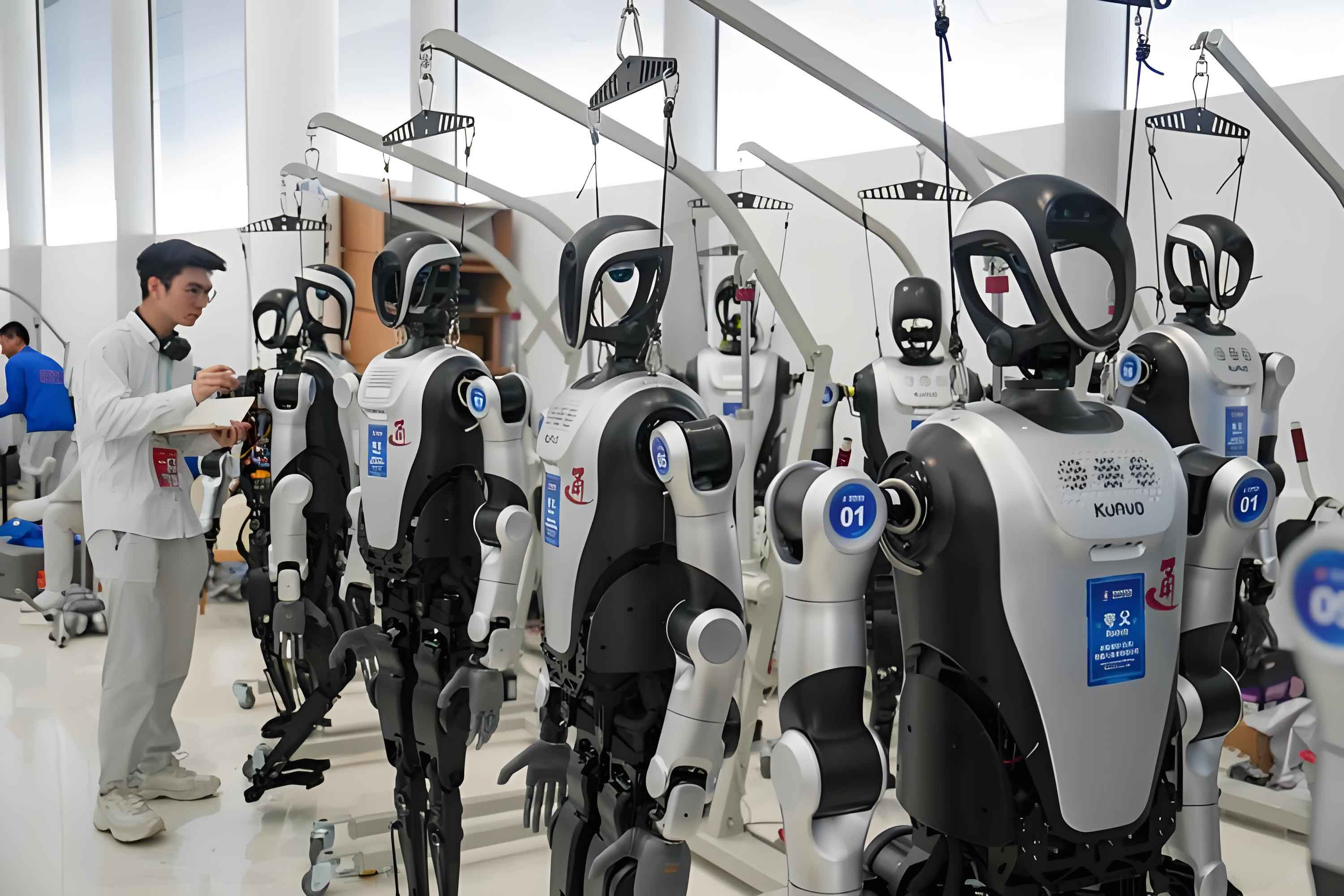
The movement from technical research to large-scale store deployment is supported by Aishida’s manufacturing experience and industrial coordination. In 2016, Aishida acquired Wenling Qianjiang Robot and formally entered the industrial robot sector. Over more than ten years of technical accumulation, the company has carried out independent research and development in core components such as joint modules, controllers and drive systems, forming a complete hardware manufacturing capability.
That hardware foundation is directly relevant to the commercial deployment of the humanoid robot. A humanoid robot used in retail must combine mobility, manipulation, sensing, interaction and control within a reliable hardware platform. The ability to develop and manufacture core components supports the stability, maintainability and scalability of the humanoid robot system.
The deployment also reflects a broader manufacturing transition. Aishida’s experience in industrial robots provides a base for humanoid robot hardware production, while the retail network provides real application scenarios. The combination of manufacturing capability and scenario access is positioned as a practical route toward humanoid robot commercialization.
The company’s manufacturing layout is not limited to assembly. The reference to joint modules, controllers and drive systems indicates that key hardware links are part of the humanoid robot development effort. For a humanoid robot to move from small-scale deployment to larger production, core component capability and production consistency are essential.
5. Strategic Partnership Creates Algorithm, Manufacturing and Scenario Loop
In the strategic cooperation with Zhiyuan, Aishida is responsible for hardware manufacturing, scenario deployment and data collection. The arrangement is described as building a complete closed loop of “algorithm + manufacturing + scenario.” This division of work links the humanoid robot’s software and algorithm development with hardware production and real application environments.
The retail store is central to that loop. A humanoid robot operating in a store generates interaction data from real customers, real questions and real movement conditions. That data can flow back into model iteration and support continued improvement. At the same time, the hardware must be reliable enough to keep operating in the field, and the scenario must be practical enough to generate meaningful use.
Chen Helin, chairman and general manager of Aishida Co., Ltd., stated that the humanoid robot parts production line at the Shanghai base is scheduled to land soon. The plan also calls for some humanoid robot production lines to be transferred to Wenling next year, relying on the local precision manufacturing industrial base to expand capacity and gradually move toward a 10,000-unit-level production scale.
The disclosed plan connects the humanoid robot deployment to a larger production vision. The retail rollout provides early scenario experience and data, while the manufacturing plan prepares for capacity expansion. The humanoid robot is therefore being positioned within an integrated system that includes components, hardware production, scenario deployment and data feedback.
6. Production Capacity Plan Points Toward 10,000-Unit-Level Humanoid Robot Output
The production plan is one of the clearest signals that the humanoid robot effort is moving beyond isolated demonstrations. The Shanghai base humanoid robot parts production line is described as coming soon, and some humanoid robot production lines are planned to move to Wenling next year. The stated goal is to rely on the local precision manufacturing base to expand capacity and gradually approach a 10,000-unit-level production scale.
That capacity plan does not stand alone. It is connected to the retail deployment, because store operations generate data and scenario requirements that can inform hardware and software improvement. As the humanoid robot moves into more stores, the need for consistent production, maintenance and component supply becomes more important. The manufacturing plan is therefore part of the same commercialization path as the retail rollout.
Wenling’s precision manufacturing base is presented as an advantage for scaling humanoid robot production. The plan to transfer some humanoid robot production lines to Wenling next year links local manufacturing resources with the company’s broader humanoid robot strategy. The 10,000-unit-level target is described as a gradual goal rather than an immediate output figure.
The humanoid robot production plan also supports the idea of a data-driven cycle. A larger fleet of humanoid robots in real scenarios can generate more operating data, which can then support further iteration. The retail network provides an early deployment field, while the manufacturing base provides the capacity path for broader use.
7. Leadership View: Value Creation Replaces Demonstration
Chen Helin said the humanoid robot has long passed the technical demonstration stage of comparing walking, jumping and movement. In the past, many efforts focused on which laboratory could perform more complex actions. Now, the real competition is about which humanoid robot can first work reliably in real scenarios and create actual value.
That view places retail deployment at the center of the humanoid robot commercialization discussion. A humanoid robot that can move impressively but cannot sustain service in a store does not prove commercial value. A humanoid robot that can receive customers, explain products, guide routes and support conversion demonstrates a more practical form of capability.
In Chen Helin’s view, Aishida’s nationwide offline retail network is a differentiated advantage. Stores are natural training grounds. Every day, real human-robot interaction data can flow back and continuously support model iteration. The humanoid robot can become more useful through use, forming a positive cycle.
The leadership perspective reflects a shift in evaluation criteria. The humanoid robot is no longer judged only by the complexity of its actions. It is judged by stability, service continuity, scenario adaptation and actual value creation. The retail store provides a concrete environment for that evaluation.
8. Data Feedback and Store Network as Differentiated Advantage
The public live broadcast and the store deployment together create a feedback structure for the humanoid robot. Runtime, customer reception, interaction frequency and scenario conversion rate are presented during the live period. These indicators reflect different aspects of operation and interaction, and they can be reviewed alongside direct observation of the humanoid robot’s service behavior.
The store network adds scale to that feedback structure. With 100 humanoid robots being phased into 100 stores nationwide, the deployment can generate interaction data across different store environments, customer groups and traffic conditions. The humanoid robot is exposed to more varied situations than a single flagship store could provide.
Data feedback is valuable only when it connects to iteration. The described loop of algorithm, manufacturing and scenario places data collection within a larger system. Real interactions in stores can inform model improvement, while hardware performance in the field can inform manufacturing and maintenance. The humanoid robot thus becomes part of a continuous improvement process.
The nationwide retail network is also a practical deployment asset. Stores already have service processes, customer flows and product display systems. A humanoid robot deployed in that environment does not need a completely new setting to begin operation. The store becomes both a commercial front line and a real-world training ground for the humanoid robot.
9. Next Steps: Retail Optimization and Expansion Into Industrial and Community Service Scenarios
The next step is to continue optimizing the humanoid robot’s adaptability in retail scenarios. The current deployment covers greeting, demand identification, product explanation, recommendation, route guidance and scan-code conversion. Further optimization can focus on interaction details, movement stability and service continuity in different store conditions.
The plan also calls for gradual expansion into industrial production, community service and other scenarios. The retail floor is the first large-scale commercial front line, but it is not the only intended application. The experience gained in stores can support the humanoid robot’s adaptation to other environments with different requirements.
The Wenling intelligent manufacturing base is expected to provide capacity and technical support for this expansion. The combination of manufacturing capability, scenario access and data feedback is presented as the basis for exploring a local path toward humanoid robot commercialization. The humanoid robot is therefore being developed as a platform that can move across service and production settings.
The expansion path remains grounded in real deployment. Retail provides immediate customer interaction, industrial production provides structured operational tasks, and community service provides public-facing engagement. Each scenario places different demands on the humanoid robot, and each can contribute data and experience to the broader commercialization effort.
10. Key Deployment Facts at a Glance
| Item | Details |
|---|---|
| Launch event | Aishida and Zhiyuan opened a retail deployment described as “100 stores launch, three stores live broadcast.” |
| Date | Morning of Sept. 28. |
| Flagship location | Wenling Aishida flagship store, where the humanoid robot named Aibao operated among shelves. |
| Deployment scale | 100 humanoid robots are being phased into 100 stores nationwide. |
| Live broadcast locations | Wenling, Shanghai and Wuxi, with simultaneous real-scene live broadcasts. |
| Service scope | Greeting and reception, demand identification, product explanation, product recommendation, route guidance and scan-code conversion. |
| Public operating data | Runtime, number of customers received, interaction frequency and scenario conversion rate, presented during three consecutive days of live broadcast. |
| Community activity | A public-welfare campaign for healthy cookware replacement, including kitchen health education. |
| Manufacturing background | Aishida acquired Wenling Qianjiang Robot in 2016 and developed core components including joint modules, controllers and drive systems. |
| Capacity plan | The Shanghai base humanoid robot parts line is scheduled to land soon; some humanoid robot production lines are planned to move to Wenling next year; the goal is to move gradually toward a 10,000-unit-level production scale. |
| Expansion scenarios | Retail optimization first, followed by industrial production and community service. |
11. Significance for Humanoid Robot Commercialization
The deployment is significant because it places the humanoid robot in a commercial retail setting with public operating data. The humanoid robot is not presented only as a technological concept or a demonstration platform. It is assigned a service role and evaluated through store operation.
The combination of hardware manufacturing, scenario deployment and data collection gives the humanoid robot a practical development path. Hardware capability supports reliable operation, the retail network provides real interaction data, and the data feedback supports model iteration. The humanoid robot can thus improve through deployment rather than through laboratory work alone.
The public live broadcast adds transparency to the process. By presenting runtime, customer reception, interaction frequency and scenario conversion rate, the deployment allows the humanoid robot’s performance to be discussed in operational terms. The humanoid robot is measured not only by what it can do in a demonstration, but by how it performs during sustained service.
The 100-store deployment also indicates that the humanoid robot is being tested across a wider range of retail conditions. Different stores, customers and traffic patterns can reveal different strengths and limitations. That variety is valuable for the humanoid robot’s development because it exposes the system to conditions that cannot be fully reproduced in a single test environment.
The production plan toward a 10,000-unit-level scale connects the current deployment with a larger commercial vision. The humanoid robot is being prepared for broader use through component development, production line planning and scenario expansion. The retail rollout is an early commercial step in that broader path.
12. Conclusion
Aishida’s deployment places 100 humanoid robots into 100 stores nationwide, with Wenling, Shanghai and Wuxi hosting simultaneous live broadcasts and with three consecutive days of public operating data. The humanoid robot named Aibao has moved from a staged demonstration to a store service role that includes reception, product explanation, recommendation, route guidance and conversion support.
The retail floor is a demanding environment for the humanoid robot because customer traffic is random, needs are diverse and interaction pressure can rise during peak periods. The deployment shows that the humanoid robot can maintain basic service while still leaving room for optimization in interaction details. The community visit extends the humanoid robot’s public-facing role beyond the store.
The manufacturing and partnership structure supports the commercialization path. Aishida’s hardware manufacturing experience, its 2016 acquisition of Wenling Qianjiang Robot, its work on joint modules, controllers and drive systems, and its strategic cooperation with Zhiyuan together form a loop of algorithm, manufacturing and scenario. The planned Shanghai parts line, the planned transfer of some humanoid robot production lines to Wenling next year and the gradual 10,000-unit-level production goal point toward a larger humanoid robot capacity path.
The leadership view is clear: the humanoid robot has moved beyond comparing walking, jumping and movement in laboratories. The real test is stable work in real scenarios and the creation of actual value. The store network provides a natural training ground, and real human-robot interaction data can flow back to support model iteration. The humanoid robot becomes more useful through use, creating a positive cycle.
The next phase will focus on optimizing the humanoid robot’s retail adaptability and gradually expanding into industrial production, community service and other scenarios. With the Wenling intelligent manufacturing base providing capacity and technical support, the humanoid robot commercialization effort is being explored through a local manufacturing and real-scenario path. The deployment marks a concrete step in that direction for the humanoid robot.