
The evolution of modern warfare increasingly emphasizes unmanned systems and operations in complex, contested domains. Among these, the littoral zone—the transitional area between sea and land—presents a unique set of challenges and opportunities. Traditional amphibious assaults, reliant on surface vessels and conventional landing craft, often entail significant risk during the vulnerable approach phase. As a commander or systems engineer analyzing future force requirements, I recognize an urgent need for platforms that can operate stealthily and effectively across both the underwater and terrestrial domains. This capability would fundamentally alter tactical planning, turning the sea from a barrier into a concealed highway and enabling access to non-traditional, undefended landing sites.
The development of bionic robot platforms for this role is not merely an incremental improvement but a potential paradigm shift. By drawing inspiration from nature’s solutions to multi-environment locomotion, we can engineer systems with superior stealth, survivability, and terrain adaptability compared to conventional propeller or track-based designs. This article will explore the strategic rationale for such systems, analyze current technological approaches, and propose integrated concepts for their application in future operations.
I. Strategic Rationale and Performance Advantages of Bionic Designs
The operational necessity for sub-surface to surface transition capability is clear. It moves the initial point of vulnerability from the open ocean to the very moment of egress from the water, compressing the enemy’s reaction time. When this capability is endowed through bionic principles, the bionic robot gains distinct advantages over its mechanical counterparts.
1. Enhanced Stealth and Acoustic Signature Reduction
Conventional propulsion methods, such as propellers or water jets, generate distinct hydrodynamic noise signatures that are easily detectable by modern sonar arrays, especially in the quiet acoustic conditions of shallow water. A bionic robot employing undulatory (e.g., fish-like) or oscillatory (e.g., penguin flipper) propulsion can achieve thrust through low-velocity, high-displacement movements. The resulting fluid dynamics often produce a noise spectrum that blends more effectively with the ambient background noise of the near-shore environment. The governing principle for thrust generation in such systems can be modeled by considering the reaction force from accelerated fluid. For an oscillating foil, the average thrust \(T\) over a cycle can be related to its kinematics:
$$T \approx \frac{1}{2} \rho C_T A U^2$$
where \(\rho\) is fluid density, \(C_T\) is a thrust coefficient highly dependent on the Strouhal number \(St = fA / U\) (with \(f\) being frequency, \(A\) peak-to-peak amplitude, and \(U\) forward speed), and \(A\) is a characteristic area. Bionic systems often operate in an optimal \(St\) range (0.2-0.4) that promotes efficient, vorticity-based thrust generation with lower radiated noise compared to cavitating propellers.
2. Increased Survivability in the Approach Phase
An underwater approach leverages the water column as a physical barrier. Even if detected, engaging a small, maneuvering, submerged bionic robot with direct or indirect fire is exceedingly difficult. Kinetic projectiles lose momentum rapidly upon water entry. The platform’s survivability is thus decoupled from the traditional requirement for air and sea dominance during the initial transit, allowing for more flexible and distributed launch strategies, including deployment from submarines or unmanned surface vessels.
3. Superior Terrain and Environmental Adaptability
This is the most compelling advantage. Conventional landing systems require relatively flat, firm beaches or purpose-built ramps. A legged or undulating bionic robot, inspired by crabs, salamanders, or sea lions, possesses an innate ability to traverse complex terrain. This includes rocky shores, mangrove swamps, soft sediment, and even moderate underwater obstacles. This “all-terrain” capability denies the enemy the ability to predict and concentrate defenses at a few likely landing points, forcing them to defend all possible points of ingress—a logistically prohibitive task. The mobility of a legged robot over uneven ground \(G\) can be quantified by a stability margin \(S_m\), and its energy expenditure \(E\) per distance \(d\) can be compared to wheeled/tracked systems under similar conditions, often showing advantage in extreme terrain.
$$S_m = \min(\text{Distance from Center of Mass to Support Polygon Boundary})$$
$$E_{\text{legged}} / d = f(\text{terrain roughness}, \text{gait efficiency})$$
The following table contrasts the key performance parameters of conventional amphibious systems versus a conceptual bionic approach.
| Performance Parameter | Conventional Tracked/Propeller System | Bionic Robot (Legged/Oscillatory) |
|---|---|---|
| Approach Stealth | Low (High acoustic signature) | High (Low, biomimetic signature) |
| Landing Site Requirement | Restrictive (Flat, firm beach) | Permissive (Rocky, uneven, vegetated) |
| Water-to-Land Transition | Often abrupt, requires specific slope | Seamless, can climb or crawl out |
| Locomotion Efficiency | High on flat terrain/water, low on complex terrain | Moderate in primary medium, high in complex secondary medium |
| Mechanical Complexity | Lower (mature technology) | Higher (multi-DOF joints, seals) |
II. Analysis of Technological Pathways and Design Philosophies
The field of amphibious robotics explores various design philosophies to bridge the aquatic-terrestrial gap. These can be categorized by their level of biomimicry and integration of propulsion methods.
1. Monomorphic Bionic Design
This approach strictly emulates a single, existing amphibious animal, such as a salamander or turtle. The bionic robot uses the same morphological and gait principles for both environments. For instance, a salamander-inspired robot uses axial body undulation for swimming and a derived walking gait for terrestrial locomotion. The governing equation for serpentine locomotion in a resistive medium can be simplified as a traveling wave along the body:
$$y(x,t) = A \sin\left(\frac{2\pi}{\lambda}x – 2\pi f t\right)$$
where \(y\) is lateral displacement, \(x\) is body coordinate, \(A\) is amplitude, \(\lambda\) is wavelength, and \(f\) is frequency. The robot’s speed is proportional to \(f \cdot \lambda\). While elegant and providing good adaptability, this design often represents a compromise, as the animal’s natural locomotion is not optimized for peak performance in either domain. Energy efficiency in one medium may be sub-optimal.
2. Polymorphic or Hybrid Bionic Design
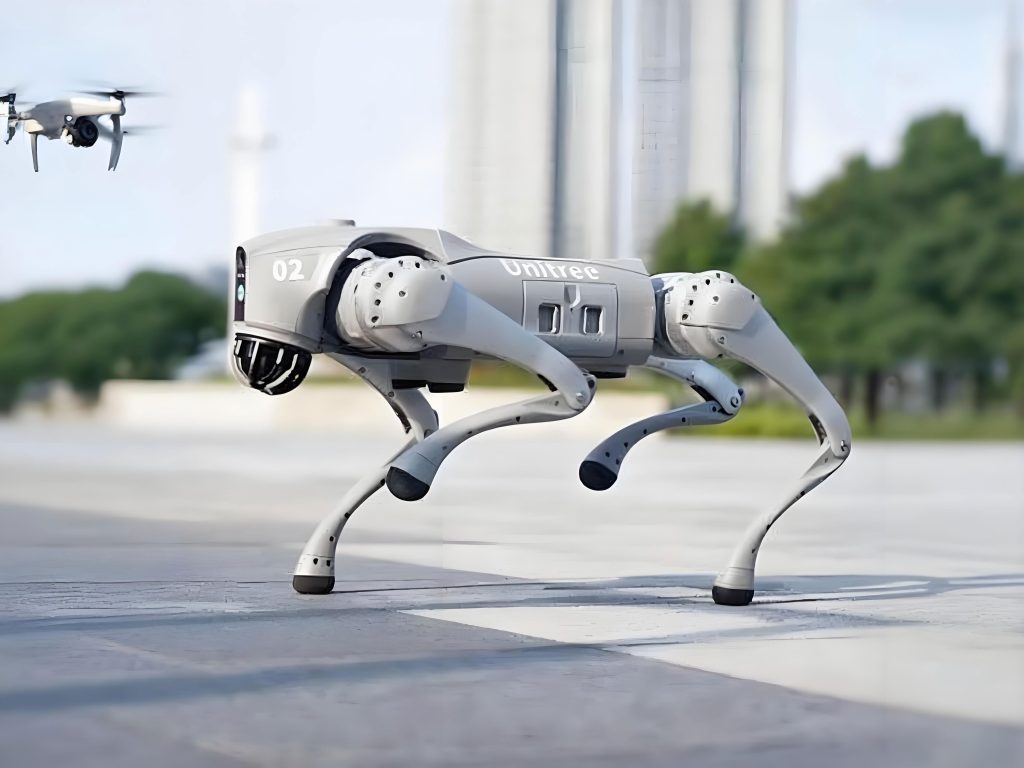
A more pragmatic approach involves combining different bionic principles or integrating bionic and conventional mechanisms. A robot might use efficient fish-like swimming underwater and deploy wheeled or legged systems on land. Alternatively, it could use a single actuator system that reconfigures its morphology: for example, limbs that act as flippers for swimming and reconfigure joint kinematics for walking. This is a highly promising path for a practical bionic robot. The design challenge lies in creating a seamless transition mechanism and managing the added mechanical complexity and weight. The decision matrix often involves optimizing a weighted cost function \(C\):
$$C = w_1 \cdot P_{\text{water}} + w_2 \cdot P_{\text{land}} + w_3 \cdot M_{\text{complexity}} + w_4 \cdot E_{\text{transition}}$$
where \(P\) represents performance metrics (speed, efficiency), \(M\) is mechanical complexity, \(E\) is the energy/time for transition, and \(w\) are weights based on mission priority.
3. Enabling Technologies and Integration Challenges
Beyond locomotion, a functional amphibious bionic robot requires integrated solutions for sensing, control, and power.
- Sensing and Perception: The robot must navigate in turbid water, on dark beaches, and in cluttered environments. Sensor fusion is critical: inertial measurement units (IMUs), Doppler velocity logs (DVL) for underwater dead reckoning, sonar for obstacle avoidance, and vision/LIDAR upon emergence. The perception system must be context-aware, switching modalities based on the environment.
- Adaptive Control Architecture: Control must handle discontinuous dynamics during water exit/entry. Central pattern generators (CPGs)—neural network-inspired oscillators—are effective for generating stable, adaptable gaits for bionic locomotion. The phase \(\phi_i\) of each oscillator (joint) can be coupled:
$$\dot{\phi}_i = \omega_i + \sum_j w_{ij} \sin(\phi_j – \phi_i – \psi_{ij})$$
where \(\omega_i\) is the natural frequency, and \(w_{ij}\), \(\psi_{ij}\) are coupling weights and phase biases. This allows smooth gait transitions (e.g., from swim to walk) via parameter modulation. - Power and Energy Density: Amphibious operation is energy-intensive. High-density energy sources (e.g., lithium-based batteries, fuel cells) are essential. Dynamic power management that throttles actuator effort based on terrain and mode is crucial for mission endurance. The total energy budget \(E_{\text{total}}\) must satisfy:
$$E_{\text{total}} \geq E_{\text{swim}} + E_{\text{transition}} + E_{\text{walk}} + E_{\text{payload}} + E_{\text{margin}}$$
III. Proposed Application Concepts and Tactical Integration
The unique capabilities of amphibious bionic robot systems enable novel concepts of operation (CONOPS) that can be categorized by mission duration and platform recoverability.
1. First-Wave Assault & Shaping Operations (Expendable/Attritable)
In this high-intensity scenario, swarms of relatively simple, weaponized amphibious bionic robot units are deployed from stand-off platforms. Their mission is to create chaos, destroy key sensors or communications nodes on the beach, and secure a small foothold. They are designed for one-way missions. Upon landing, they could shed their aquatic propulsion modules (e.g., specialized flippers or fairings) to become lighter, more agile ground combatants. Their deployment signatures and attack vectors would be unpredictable, saturating local defenses.
2. Persistent ISR and Target Designation (Recoverable)
For longer-duration intelligence, surveillance, and reconnaissance (ISR) missions, a recoverable, stealthy bionic robot is ideal. It can infiltrate via river mouths or remote coastlines, travel underwater to avoid detection, land covertly, and establish a hidden observation post. It can carry multi-spectral sensors, signals intelligence (SIGINT) packages, and most importantly, a laser designator. This allows it to mark high-value targets for precision-guided munitions (PGMs) launched from ships, aircraft, or land-based systems, acting as a forward-deployed, survivable “light” for stand-off weapons. The table below outlines potential payloads for this role.
| Payload Type | Example Systems | Mission Impact |
|---|---|---|
| Electro-Optical/Infrared (EO/IR) | Gimballed day/night camera, thermal imager | Provides positive identification, surveillance |
| Laser Designator/Rangefinder | Eye-safe designator, pulsed rangefinder | Enables precision strike guidance |
| SIGINT Receiver | Software-defined radio (SDR) | Detects and locates comms/radar emissions |
| Environmental Sensors | Salinity, depth, soil moisture probes | Collects data for follow-on forces |
3. Counter-Personnel and Area Denial
Smaller amphibious bionic robot platforms could be deployed as autonomous sentries or mobile mines in contested littoral areas. They could lurk underwater in a low-power state, activate upon detecting specific acoustic or magnetic signatures (e.g., boat hulls, diver propulsion vehicles), and engage with non-lethal or lethal effectors. Their ability to reposition makes them far more challenging to clear than traditional static mines.
IV. Conclusion and Path Forward
The development of capable amphibious bionic robot systems represents a significant technological challenge but promises a disproportionate strategic and tactical advantage. The core value proposition lies in enabling covert, distributed, and unpredictable littoral maneuvers. Current research has successfully demonstrated proof-of-principle in locomotion but has yet to fully address the integrated system challenges of endurance, reliability, sensing, and autonomous decision-making in harsh, dynamic environments.
The path forward requires a focused, multidisciplinary effort. Advances in materials science are needed for durable, lightweight, and corrosion-resistant structures and dynamic seals. Progress in compact, high-torque density actuators (e.g., series elastic actuators, hydraulic artificial muscles) is crucial for powerful and compliant limb movement. Finally, the development of robust autonomy—capable of navigating ambiguous environments, managing energy, and executing mission tasks with minimal human intervention—is the ultimate key to unlocking the operational potential of these systems. As these technologies mature, the amphibious bionic robot will transition from a laboratory curiosity to a transformative asset in the future security landscape.