
In the field of robotics, the development of bionic robots that mimic biological systems has gained significant attention due to their potential in overcoming complex terrains and performing agile movements. Among these, jumping bionic robots are particularly interesting because they can navigate obstacles efficiently, similar to insects like grasshoppers. This article presents a comprehensive analysis and design of a leg structure for a bionic robot based on the grasshopper’s hind leg, focusing on achieving high burst power and rapid output for jumping motions. We explore the biological principles of grasshopper jumping, propose a mechanical model using a three-link mechanism actuated by pneumatic artificial muscles, and conduct dynamic simulations to validate the design. The goal is to contribute to the advancement of bionic robots with enhanced mobility and adaptability.
Bionic robots, especially those inspired by jumping organisms, have been widely studied to replicate features such as energy storage, rapid actuation, and directional control. For instance, prior research has investigated frogs, locusts, and spiders to design robots capable of explosive jumps. The grasshopper is a prime model due to its exceptional jumping ability, achieving distances 15 to 30 times its body length. This performance stems from its robust hind leg structure, which includes specialized muscles and joints that allow for efficient energy conversion. In this work, we delve into the grasshopper’s leg anatomy to inform the design of a bionic robot leg, aiming to overcome limitations in current jumping robots, such as slow response times and limited force output. By leveraging artificial muscles, we seek to create a bionic robot that emulates the grasshopper’s dynamic behavior.
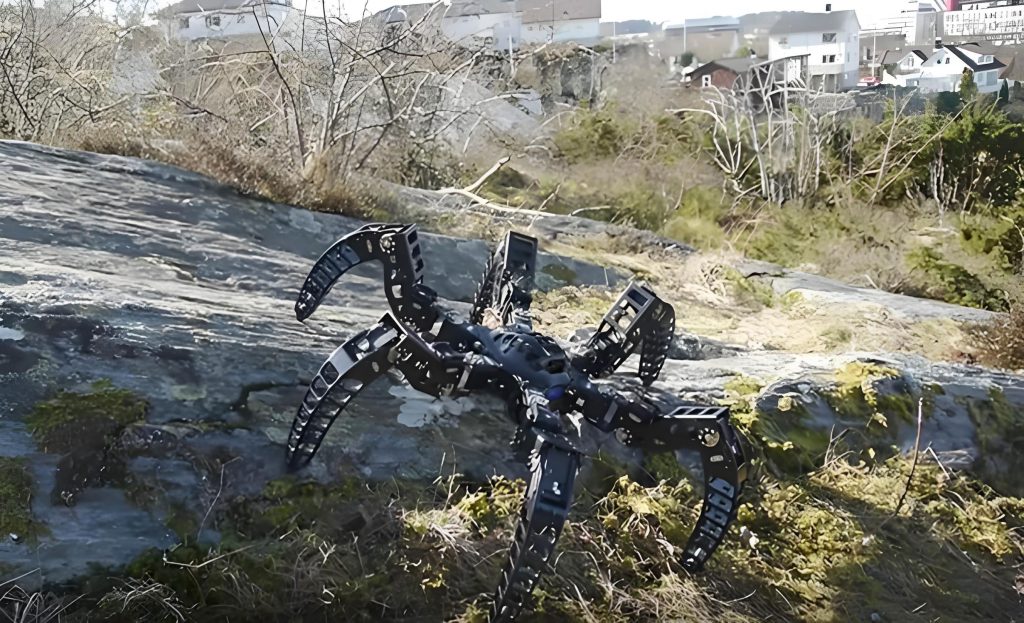
The hind leg of a grasshopper consists of three main segments: the femur (thigh), tibia (shank), and tarsus (foot), connected by joints that enable flexion and extension. The femur is particularly muscular, housing extensor and flexor muscles that work synergistically to generate jumping force. During a jump, the grasshopper rapidly extends its leg from a folded position, releasing stored energy in a short timeframe. This process involves high power output, as shown in biological studies where muscle contraction peaks within milliseconds. To replicate this in a bionic robot, we need an actuation system that can mimic these characteristics. Pneumatic artificial muscles (PAMs) are chosen for their similarity to biological muscles, offering high force-to-weight ratios and fast contraction rates, making them ideal for this bionic robot application.
Our leg model for the bionic robot uses a three-link mechanism corresponding to the femur, tibia, and tarsus, with PAMs acting as artificial muscles to drive the joints. The design incorporates a crank-slider mechanism to convert the linear contraction of PAMs into rotational motion, enabling quick leg extension. The jumping process is divided into two phases: first, the PAMs are inflated, causing rapid contraction that pulls the links to unfold the leg; second, after jumping, the PAMs deflate to return the leg to its initial position. This approach aims to achieve the suddenness and burstiness observed in grasshoppers, key features for a high-performance bionic robot. The model assumes rigid links and negligible friction at joints to simplify analysis, focusing on the dynamic behavior during takeoff.
To analyze the bionic robot leg, we establish a dynamic model using Lagrangian mechanics. The system comprises three masses representing the tibia (m1), femur (m2), and body (m3), with lengths l1, l2, and l3 respectively. The generalized coordinates are the joint angles θ1 (between tibia and ground) and θ2 (between femur and tibia). The kinetic energy (K) and potential energy (P) of each link are derived based on their velocities and positions. The Lagrangian L is given by:
$$ L = K – P $$
where K is the sum of kinetic energies and P is the sum of potential energies. For the tibia:
$$ v_1 = l_1 \dot{\theta}_1 $$
$$ K_1 = \frac{1}{2} m_1 l_1^2 \dot{\theta}_1^2 $$
$$ P_1 = m_1 g l_1 \sin \theta_1 $$
For the femur, the velocity at its center of mass is more complex due to the coupled motion:
$$ v_2^2 = l_1^2 \dot{\theta}_1^2 + \frac{1}{4} l_2^2 (\dot{\theta}_1 – \dot{\theta}_2)^2 – l_1 l_2 \dot{\theta}_1 (\dot{\theta}_1 – \dot{\theta}_2) \cos \theta_2 $$
$$ K_2 = \frac{1}{2} m_2 v_2^2 $$
$$ P_2 = m_2 g \left( l_1 \sin \theta_1 – \frac{1}{2} l_2 \sin(\theta_1 – \theta_2) \right) $$
For the body, assuming it is attached to the femur at a distance l3:
$$ v_3^2 = l_1^2 \dot{\theta}_1^2 + l_2^2 (\dot{\theta}_1 – \dot{\theta}_2)^2 + \frac{1}{4} l_3^2 (\dot{\theta}_1 – \dot{\theta}_2 + \dot{\theta}_3)^2 – 2 l_1 l_2 \dot{\theta}_1 (\dot{\theta}_1 – \dot{\theta}_2) \cos \theta_2 + \ldots $$
(Full expansion is omitted for brevity, but the complete Lagrangian is derived similarly.) The generalized forces come from the PAM actuation, modeled as torques at the joints. The Lagrangian equations are:
$$ \frac{d}{dt} \left( \frac{\partial L}{\partial \dot{q}_i} \right) – \frac{\partial L}{\partial q_i} = F_i $$
where \( q_i \) are the generalized coordinates and \( F_i \) are the generalized forces. Solving these equations yields the dynamic response of the bionic robot leg during jumping.
We simulate the bionic robot leg using ADAMS software to validate the design. The PAMs are approximated as torsional springs with high stiffness to replicate their rapid contraction. The simulation parameters are summarized in Table 1.
| Parameter | Symbol | Value | Unit |
|---|---|---|---|
| Tibia length | l1 | 0.1 | m |
| Femur length | l2 | 0.15 | m |
| Body length | l3 | 0.05 | m |
| Tibia mass | m1 | 0.05 | kg |
| Femur mass | m2 | 0.1 | kg |
| Body mass | m3 | 0.5 | kg |
| PAM force | F | 10 | N |
| Gravity | g | 9.81 | m/s² |
The simulation results show the leg extending rapidly within 0.05 seconds, mimicking the grasshopper’s jump. Displacement, velocity, acceleration, and torque data are analyzed to assess performance. For instance, the displacement in the x-direction (horizontal) increases steadily, indicating forward motion without rotation, while the y-direction (vertical) displacement peaks at around 0.3 seconds, as shown in Table 2.
| Metric | Maximum Value | Time of Peak (s) | Unit |
|---|---|---|---|
| X-displacement of body | 0.25 | 0.5 | m |
| Y-displacement of body | 0.4 | 0.3 | m |
| Leg velocity | 2.5 | 0.05 | m/s |
| Body vertical velocity | 1.8 | 0.1 | m/s |
The velocity profiles exhibit sudden increases, confirming the burstiness of the bionic robot leg. Acceleration curves show spikes at key moments, corresponding to the PAM activation and joint adjustments. The torque at the knee joint is the highest, reaching up to 0.8 Nm, while the tarsal joint torque is minimal, below 0.1 Nm. This aligns with the grasshopper’s physiology, where the knee bears the most stress during jumping. The torque distribution is critical for optimizing the bionic robot’s energy efficiency and durability.
To further analyze the energy dynamics, we compute the power output using the formula:
$$ P = \tau \cdot \omega $$
where \( \tau \) is torque and \( \omega \) is angular velocity. The peak power occurs during the initial extension phase, matching the grasshopper’s muscle output pattern. This bionic robot design demonstrates that artificial muscles can achieve high power densities, making them suitable for agile bionic robots. We also evaluate the jump height using energy conservation:
$$ m g h = \frac{1}{2} m v_y^2 $$
where \( h \) is height and \( v_y \) is vertical takeoff velocity. From simulation, \( v_y \approx 1.8 \, \text{m/s} \), giving \( h \approx 0.17 \, \text{m} \), which is reasonable for a small-scale bionic robot.
The feasibility of this bionic robot leg is supported by the simulation results, which show rapid response times and sufficient force generation. However, challenges remain, such as the control of PAMs for precise movements and the integration of sensors for stability. Future work will focus on refining the mechanism, perhaps by adding passive elastic elements to store energy, similar to the grasshopper’s cuticle. Additionally, we plan to build a physical prototype to test real-world performance. The use of bionic robots in applications like search-and-rescue or environmental monitoring could benefit from such jumping capabilities.
In conclusion, we have presented a detailed analysis and design of a leg structure for a bionic robot inspired by the grasshopper. By modeling the hind leg as a three-link mechanism actuated by pneumatic artificial muscles, we achieved dynamic behavior that mimics the insect’s high burst power. The Lagrangian dynamics provide a theoretical foundation, and ADAMS simulations validate the design’s effectiveness. This work contributes to the growing field of bionic robots, offering insights into how biological principles can be translated into robotic systems. As bionic robots evolve, incorporating features like adaptive control and energy recovery will enhance their practicality. We believe that this bionic robot leg represents a step toward more versatile and efficient mobile robots.
To summarize key equations and parameters for the bionic robot, we present Table 3, which consolidates the mathematical models used in this study.
| Description | Equation | Variables |
|---|---|---|
| Lagrangian function | $$ L = \sum K_i – \sum P_i $$ | K: kinetic energy, P: potential energy |
| Kinetic energy for tibia | $$ K_1 = \frac{1}{2} m_1 l_1^2 \dot{\theta}_1^2 $$ | m1: mass, l1: length, θ1: angle |
| Potential energy for femur | $$ P_2 = m_2 g \left( l_1 \sin \theta_1 – \frac{1}{2} l_2 \sin(\theta_1 – \theta_2) \right) $$ | g: gravity, l2: length |
| Generalized force equation | $$ \frac{d}{dt} \left( \frac{\partial L}{\partial \dot{q}_i} \right) – \frac{\partial L}{\partial q_i} = F_i $$ | qi: generalized coordinate, Fi: force |
| Power output | $$ P = \tau \cdot \omega $$ | τ: torque, ω: angular velocity |
| Jump height estimation | $$ h = \frac{v_y^2}{2g} $$ | vy: vertical velocity |
This comprehensive approach underscores the potential of bionic robots in advancing robotics technology. By continuously refining designs based on biological insights, we can create bionic robots that excel in dynamic environments. The integration of artificial muscles, as demonstrated here, opens new avenues for actuation in bionic robots, paving the way for more lifelike and efficient machines.