
The demand for efficient and selective harvesting of white asparagus presents a significant challenge in agricultural robotics. This paper details the design, theoretical analysis, and experimental validation of a specialized end-effector for a selective white asparagus harvester. Unlike conventional bulk harvesters, this mechanism aims to replicate the careful manual process, performing soil penetration, selective cutting, grasping, and extraction of individual spears with minimal damage. The core challenge lies in quantitatively determining the requisite actuation forces—penetration force, cutting force, and grasping force—to ensure reliable operation while preserving the delicate integrity of the asparagus spears. Excessive force causes damage, while insufficient force leads to incomplete cutting or failed extraction. Therefore, a systematic methodology combining Discrete Element Method (DEM) simulation and physical material testing is employed to define the optimal operational parameters for the end-effector.
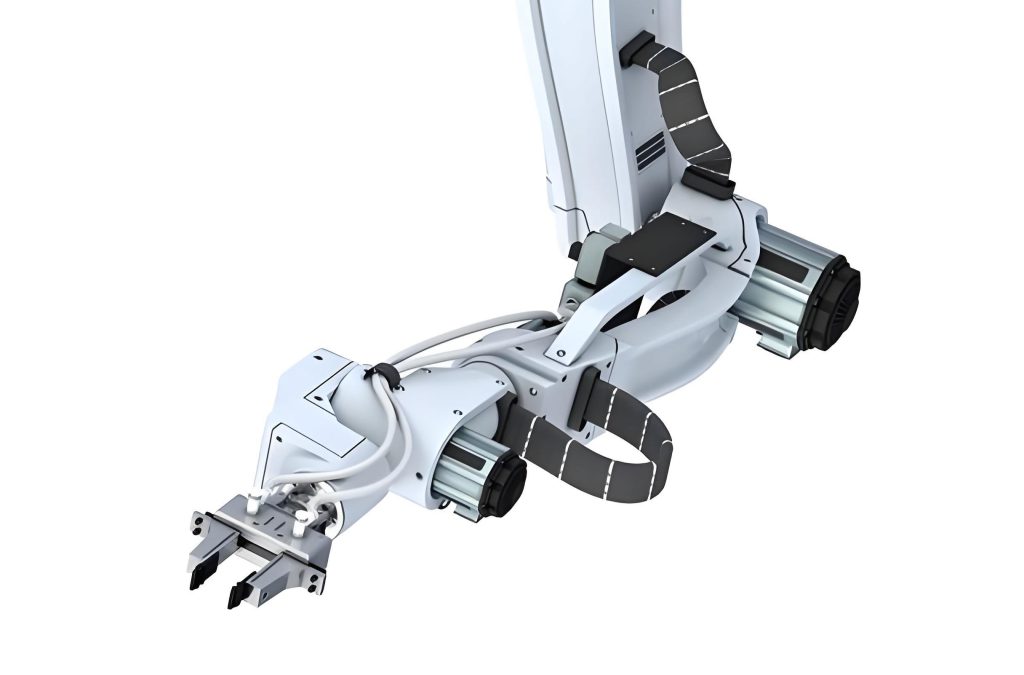
The designed end-effector features a coaxial structure consisting of an outer shell, a rotating cutting shaft, and a nested grasping shaft. The cutting shaft is fitted with a high-carbon steel blade designed to rotate 90° to sever the asparagus spear at its base underground. The grasping shaft, nested over the cutting shaft, controls a pair of opposing, angled clamping plates housed within the outer shell. The plates are designed with a specific curvature to maximize contact area with the spear. The outer shell provides structural support and incorporates a blade guard with an optimized soil-entry angle to minimize penetration resistance. The entire end-effector is intended to be mounted on a mobile platform, positioned above a detected spear using machine vision, and actuated to penetrate the soil mound to a depth of 250-300 mm, perform the cutting and grasping actions, and finally retract with the harvested spear.
Mechanical Design and Theoretical Force Models
The geometric design of the end-effector’s critical components is driven by biological and agronomic constraints. The clamping plate angle $\theta$ is determined based on the target asparagus spear diameter $R$ and the plate length $L$ to ensure effective contact:
$$
\theta = 2 \arcsin\left(\frac{R}{L}\right)
$$
For common spear diameters of approximately 20 mm and a plate length $L$ of 50 mm, an optimal angle $\theta$ of 120° is derived. The blade guard’s entry angle $\beta$ is optimized to minimize soil penetration resistance $F_f$, which is a function of soil adhesion, friction, and the guard’s geometry:
$$
F_f = 2\left(F_{T1} + F_{T2} + F_{c2}\cos\frac{\beta}{2}\right) + P_i a b + \mu P_i a b \cot\frac{\beta}{2} + c
$$
Minimizing this function leads to an optimal entry angle $\beta$ that balances cutting and frictional forces.
Theoretical Derivation of Actuation Forces for the End-Effector
To control the end-effector effectively, analytical models for the three primary forces are established.
1. Soil Penetration Force ($F_{RT}$): The force required to drive the end-effector into the soil must overcome the cumulative side friction along its length. The side resistance $f$ on a cylindrical tool element at depth $z$ is modeled using soil mechanics:
$$
\tau = c + \sigma \tan\phi, \quad \sigma = K_0 \sum \gamma_i H_i
$$
$$
f = 2\pi R_1 \int_0^h \left( c + K_0 \sum \gamma_i H_i \tan\phi \right) dz
$$
where $\tau$ is soil shear strength, $c$ is cohesion, $\sigma$ is lateral earth pressure, $\phi$ is the soil internal friction angle, $K_0$ is the coefficient of lateral earth pressure, $\gamma_i$ is soil unit weight for layer $i$, $H_i$ is layer thickness, $R_1$ is the end-effector radius, and $h$ is penetration depth. The penetration drive force must satisfy $F_{RT} > f$.
2. Cutting Force ($F_{JQ}$): The blade must overcome soil resistance and the shear strength of the asparagus spear. The total cutting force $P$ is expressed as:
$$
P = 2F_{N3}\sin\frac{\delta}{2} + 2F_{T3}\cos\frac{\delta}{2} + 2F_{T4} + 2F_{c3}\cos\frac{\delta}{2} + 2F_{c4} + c + F_j
$$
where $\delta$ is the blade edge angle, $F_{N3}, F_{T3}, F_{c3}$ are normal force, friction, and adhesion on the blade edge, $F_{T4}, F_{c4}$ are friction and adhesion on the blade face, $c$ is soil cohesion, and $F_j$ is the ultimate shear strength of the asparagus spear.
3. Grasping Force ($F_{JC}$): The clamping force must be sufficient to hold the spear against gravity and soil disturbance during extraction, but below the spear’s compressive damage threshold. A static equilibrium model for the spear held between two V-shaped plates, considering a potential soil disturbance force $F_d$, yields the required clamping force $F$:
$$
F = 2(F_{Ax} + F_{Rx})
$$
where $F_{Ax}$ and $F_{Rx}$ are horizontal components of the plate contact force and reaction force, derived from moment equilibrium equations. The final grasping force must be less than the spear’s damaging load.
Discrete Element Method (DEM) Simulation for End-Effector Interaction
To quantify the soil interaction forces beyond analytical approximations, DEM simulations were conducted. A Hertz-Mindlin with bonding contact model was used to represent cohesive sandy loam soil from the target field. Soil particle parameters were calibrated based on sieving analysis and triaxial tests.
| Parameter | Value |
|---|---|
| Soil Particle Poisson’s Ratio | 0.4 |
| Soil Particle Shear Modulus (Pa) | 1.09 × 10⁶ |
| Soil Particle Density (kg/m³) | 1350 |
| End-Effector Material Poisson’s Ratio | 0.3 |
| End-Effector Material Shear Modulus (Pa) | 1.92 × 10⁶ |
| Particle-Particle Coefficient of Restitution | 0.2 |
| Particle-Particle Static Friction Coefficient | 0.4 |
| Particle-End-Effector Static Friction Coefficient | 0.5 |
| Normal Particle Radius (m) | 1 × 10⁻³ |
Penetration Force Analysis: The simulation tracked the resistance force on the end-effector as it penetrated soil at 0.1 m/s to a depth of 300 mm. The resistance increased gradually with depth, rising sharply beyond 250 mm to a maximum of approximately 195 N at the target depth of 300 mm. Particle stress analysis showed increasing compressive stress and particle count around the tip and blade guard with depth, correlating with the force profile. This establishes a lower bound: $F_{RT} > 195 \text{ N}$.
Cutting and Grasping Force Simulation: Simulations were run with the end-effector fixed at depths of 200, 250, and 300 mm. The virtual blade was rotated, and the required torque/force was calculated. Similarly, the force required to rotate the clamping plates to a given angle was simulated.
| Penetration Depth (mm) | Max. Simulated Cutting Force (N) | Grasping Force at 40° Plate Angle (N) |
|---|---|---|
| 200 | ~1.5 | ~8 |
| 250 | ~1.7 | ~10 |
| 300 | ~1.8 | ~12 |
The cutting force requirement increased slightly with depth. The grasping force increased more significantly, with a notable rise beyond a plate rotation of 40°. The maximum simulated cutting force was 1.8 N. Therefore, the cutting force must satisfy $F_{JQ} > 1.8 \text{ N}$.
Material Property Testing for Asparagus Spears
To define the damage thresholds for the end-effector’s cutting and grasping actions, mechanical tests were performed on fresh white asparagus spears using a universal testing machine.
Shear Strength Test: Spear sections from upper, middle, and lower stalk regions were subjected to shear tests. The force-deformation curve exhibited a peak shear force followed by failure.
| Statistic | Peak Shear Force (N) | Shearing Work (N·m) |
|---|---|---|
| Maximum | 1.3 | 0.030 |
| Minimum | 0.5 | 0.017 |
| Average | 0.8 | 0.024 |
| Standard Deviation | 0.19 | 0.005 |
The peak shear force provides the minimum requirement to cut the asparagus material itself. Combining this with the DEM soil cutting force gives the total cutting force requirement: $F_{JQ} > \max(1.3, 1.8) = 1.8 \text{ N}$.
Compressive (Grasping) Strength Test: Transverse compression tests were conducted to determine the force at which spear damage initiates. The stress-strain curve showed a linear elastic region followed by a drop indicating microstructural failure.
| Statistic | Compressive Strength (MPa) | Estimated Damage Force* (N) |
|---|---|---|
| Maximum | 0.12 | ~21 |
| Minimum | 0.06 | ~13 |
| Average | 0.08 | ~18 |
*For a typical 20 mm diameter spear cross-section.
The minimum damaging force was approximately 13 N. Therefore, to avoid damage during grasping and extraction, the clamping force of the end-effector must satisfy $F_{JC} < 13 \text{ N}$. The DEM simulation indicated this corresponds to a clamping plate rotation angle of approximately 40° or less at a 300 mm depth.
Field Harvesting Trials and Performance Validation
Based on the derived parameter ranges, four sets of force parameters were selected for field testing of the end-effector prototype. The performance was evaluated based on harvest rate (successful extraction) and damage rate (visible bruising or breakage).
| Test Set | Penetration Force $F_{RT}$ (N) | Cutting Force $F_{JQ}$ (N) | Grasping Force $F_{JC}$ (N) | Harvest Rate (%) | Damage Rate (%) |
|---|---|---|---|---|---|
| 1 | 195 | 1.8 | 12 | 97.1 | 2.3 |
| 2 | 200 | 2.0 | 11 | 99.4 | 2.1 |
| 3 | 205 | 2.2 | 10 | 94.5 | 2.2 |
| 4 | 210 | 2.4 | 9 | 89.7 | 2.1 |
The results show that while penetration and cutting forces within the defined ranges had minimal impact on success, the grasping force was critical. A grasping force too close to the 13 N upper bound (Set 1, 12 N) yielded a good harvest rate. Reducing the grasping force further to 10 N and 9 N (Sets 3 & 4) significantly reduced the harvest rate due to slippage, despite maintaining a low damage rate. The optimal compromise was found with Set 2 parameters ($F_{RT}=200 \text{ N}, F_{JQ}=2.0 \text{ N}, F_{JC}=11 \text{ N}$), achieving a harvest rate greater than 99% and a damage rate below 3%, fulfilling the goal of efficient, low-damage, selective harvesting.
Conclusion
This study successfully developed a methodology for designing and calibrating a selective harvesting end-effector for white asparagus. The process involved: 1) The mechanical design of a coaxial end-effector capable of soil penetration, cutting, and grasping. 2) Theoretical modeling of the key actuation forces. 3) DEM simulation to quantify soil interaction forces, particularly penetration resistance and soil-related components of cutting and grasping. 4) Experimental determination of the asparagus spear’s mechanical properties to establish damage thresholds. The integrated analysis yielded the following quantitative parameter ranges for the end-effector controller: Penetration Drive Force $F_{RT} > 195 \text{ N}$, Cutting Force $F_{JQ} > 1.8 \text{ N}$, and Grasping Force $F_{JC} < 13 \text{ N}$. Field validation confirmed that operating the end-effector within these bounds, specifically with a parameter set of (200 N, 2.0 N, 11 N), enables highly selective harvesting with an efficiency exceeding 99% and a damage rate below 3%. This work provides a solid theoretical and experimental foundation for the development of intelligent, low-damage robotic harvesters for high-value vegetable crops like white asparagus, with the end-effector serving as the critical interface between the machine and the delicate produce.