
In the field of precision mechanical transmission, especially within servo actuator systems for aerospace applications, the planetary roller screw has emerged as a critical component for converting rotary motion into linear motion. Its advantages, such as high load capacity, exceptional accuracy, and long service life, make it indispensable. However, the nonlinear stiffness behavior arising from multi-point contact through spatial curved surfaces can induce significant axial deformation under load, leading to transmission errors that compromise positional accuracy in flight control servo systems. Therefore, developing an accurate stiffness model is paramount for the dynamic analysis and design optimization of these systems. This article presents a comprehensive investigation into the axial stiffness of the planetary roller screw, employing differential geometry and Hertzian contact theory to establish a refined model, followed by parametric analysis and experimental validation.
The core function of a planetary roller screw is based on the engagement between a threaded screw, multiple threaded rollers, and a threaded nut. The screw is typically driven by a motor, causing the rollers to rotate and revolve, which in turn drives the nut along the screw’s axis. The kinematic relationship governing the nut’s axial displacement (s) relative to the screw’s rotation angle (θ_S) is derived from the geometry of the system. For a standard design, this can be expressed as:
$$ s = \frac{\theta_S (r_R P_S + r_S P_R)}{2\pi r_R} \cdot \frac{r_S + 2r_R}{2r_S + 2r_R} $$
where \( r_S \) and \( r_R \) are the pitch radii of the screw and roller, respectively, and \( P_S \) and \( P_R \) are their corresponding thread leads. This kinematic foundation is essential for understanding how geometric parameters influence the system’s mechanical behavior, particularly its stiffness.
To accurately model the axial stiffness of a planetary roller screw, one must consider the deformation contributions from all its constituent elements under an applied axial load (F). The total axial deformation (δ_total) is the sum of deformations from the screw body, nut body, roller bodies, the thread teeth (or flanks) of all components, and the contact deformations at the screw-roller and roller-nut interfaces. Consequently, the overall axial stiffness (K_total) is not a simple linear spring constant but a nonlinear function of load and geometry, defined as \( K_{total} = F / \delta_{total} \). My approach breaks down this total stiffness into series and parallel combinations of individual stiffness elements.
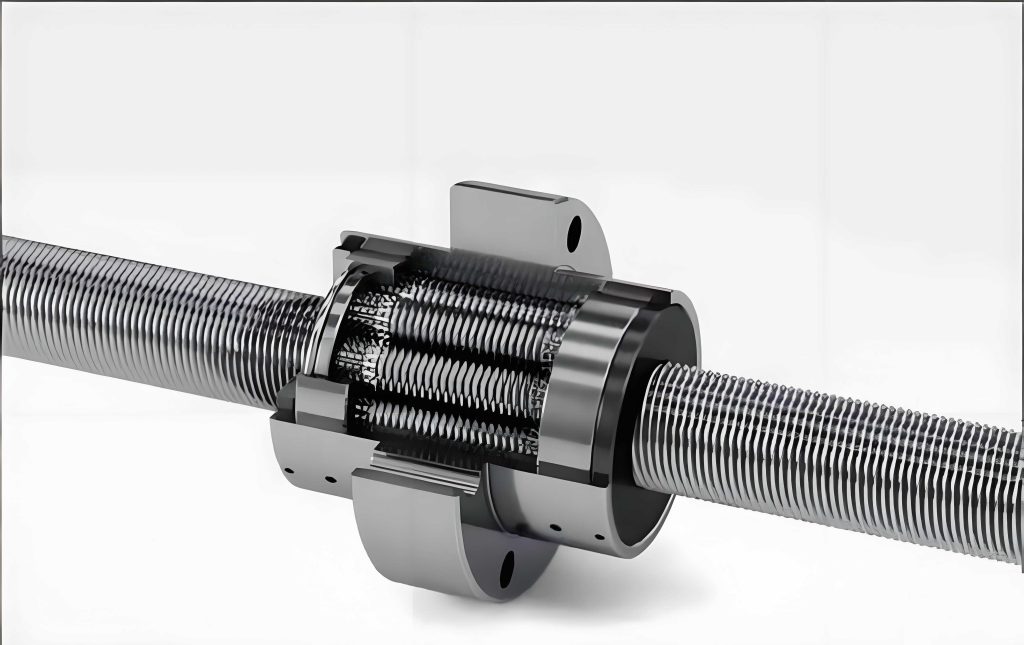
The first component is the body stiffness of the screw, nut, and rollers. These are modeled as solid or hollow cylinders under tension/compression. Their stiffness values (k_BS, k_BN, k_BR) are given by classical elasticity formulas:
$$ k_{BS} = \frac{E_S A_S}{L_S}, \quad k_{BN} = \frac{E_N A_N}{L_N}, \quad k_{BR} = \frac{n_R E_R A_R}{L_R/2} $$
Here, \( E \) denotes the elastic modulus, \( A \) the cross-sectional area, \( L \) an effective length (often related to the pitch), and \( n_R \) the number of rollers. While significant, these body stiffnesses are typically orders of magnitude higher than the compliance introduced by the threads and contacts, but they are included for completeness in a full system model.
The most critical and complex aspect of modeling the planetary roller screw stiffness lies in characterizing the thread contact stiffness. Unlike ball screws, the threads in a planetary roller screw are non-standard, typically involving modified triangular or circular profiles. The contact between the screw, roller, and nut threads occurs along spatial helicoidal surfaces. To determine the principal curvatures at the contact point—essential for Hertzian contact analysis—I employ differential geometry. The surface of a roller thread, for instance, can be described parametrically. For the upper flank of a roller thread with a circular profile of radius \( r_p \), a point on the surface is given by:
$$ \mathbf{r}_{R}(\theta, u) = \begin{bmatrix} a \cos\theta \\ a \sin\theta \\ \frac{L}{2\pi}\theta + \sqrt{r_p^2 – a^2} – \sqrt{r_p^2 – r_R^2} + p \end{bmatrix} $$
where \( a \) is the radial distance to the contact point, \( \theta \) is the angular parameter, \( L \) is the thread lead, and \( p \) is the pitch. From this parametrization, the first and second fundamental forms (E, F, G, L, M, N) of the surface are computed. The principal curvatures \( \kappa_1 \) and \( \kappa_2 \) are then found from the Gaussian curvature (K) and mean curvature (H):
$$ K = \kappa_1 \kappa_2 = \frac{LN – M^2}{EG – F^2} $$
$$ H = \frac{1}{2}(\kappa_1 + \kappa_2) = \frac{2FM – (EN + GL)}{2(EG – F^2)} $$
$$ \kappa_1 = H + \sqrt{H^2 – K}, \quad \kappa_2 = H – \sqrt{H^2 – K} $$
The principal radii of curvature are \( R_1 = 1/\kappa_1 \) and \( R_2 = 1/\kappa_2 \). Similar derivations are performed for the screw and nut thread surfaces. When two surfaces (e.g., roller and screw) come into contact, the effective curvature sum (\( \Theta \)) and difference (\( \chi \)) at the contact point are calculated using the principal radii of both bodies:
$$ \Theta_i + \chi_i = \frac{1}{2}\left( \frac{1}{R_{1}^i} + \frac{1}{R_{2}^i} + \frac{1}{R_{1i}} + \frac{1}{R_{2i}} \right) $$
$$ \Theta_i – \chi_i = \frac{1}{2} \left[ \left( \frac{1}{R_{1}^i} – \frac{1}{R_{2}^i} \right)^2 + \left( \frac{1}{R_{1i}} – \frac{1}{R_{2i}} \right)^2 + 2 \left( \frac{1}{R_{1}^i} – \frac{1}{R_{2}^i} \right) \left( \frac{1}{R_{1i}} – \frac{1}{R_{2i}} \right) \cos(2\gamma_i) \right]^{1/2} $$
Here, the subscript \( i \) denotes the contact pair, and \( \gamma_i \) is the angle between the principal curvature axes. The equivalent radius \( R_{Ei} \) is then:
$$ R_{Ei} = \frac{1}{2} (\Theta_i \chi_i)^{-1/2} $$
According to Hertzian contact theory, the contact deformation \( \delta_H \) for a given normal load \( Q \) (which is related to the axial load via the thread helix and contact angles) is:
$$ \delta_H = \left( \frac{9Q^2}{16 {E^*}^2 R_{Ei}} \right)^{1/3} \cdot \frac{F_2}{\cos\beta \cos\alpha} $$
where \( E^* \) is the equivalent elastic modulus \( \left( \frac{1}{E^*} = \frac{1-\nu_1^2}{E_1} + \frac{1-\nu_2^2}{E_2} \right) \), \( \beta \) is the thread contact angle, \( \alpha \) is the helix angle, and \( F_2 \) is a displacement correction factor. The contact stiffness \( k_H \) for that interface is the derivative \( dQ/d\delta_H \), which is nonlinear in \( Q \).
The stiffness of the individual thread teeth, modeled as annular plates under concentrated loading, also contributes. For a thread tooth loaded at a radius \( r_0 \), the deflection \( \delta_{TB} \) can be approximated by formulas from elasticity theory for thin rings:
$$ \delta_{TB} = -\frac{\omega a}{C_8} \left( \frac{r_0 C_9}{b} – L_9 \right) \frac{r_2}{D} F_2 + \frac{\omega r_0}{b} \frac{r_3}{D} F_3 – \omega \frac{r_3}{D} G_3 $$
where \( \omega \) is the concentrated load on the tooth, and \( a, b, C_8, C_9, D, F_2, F_3, G_3, L_9 \) are geometric constants and coefficients dependent on the ring’s inner and outer radii and thickness. This tooth bending compliance is significant, especially when the number of engaged threads is low.
To assemble the complete axial stiffness model for the planetary roller screw, I consider a segment with multiple engaged threads. The load distribution among consecutive threads is non-uniform due to the series compliance. A deformation compatibility equation is established for the i-th engaged thread between the nut and a roller:
$$ \frac{Q_{i-1} – Q_i}{k_{R_T}^i + k_{N_T}^i + k_{H}^i} – \frac{Q_i – Q_{i+1}}{k_{R_T}^{i+1} + k_{N_T}^{i+1} + k_{H}^{i+1}} = \frac{Q_i}{k_{N_B}^{i+1}} + \frac{Q_i}{k_{R_B}^{i}} $$
Here, \( Q_i \) is the axial load on the i-th thread pair, \( k_{R_T} \) and \( k_{N_T} \) are roller and nut thread tooth stiffnesses, \( k_H \) is the contact stiffness, and \( k_{N_B}, k_{R_B} \) are body stiffnesses. Solving this system for all engaged threads (typically 5-10 per roller) yields the load distribution and the total deformation for the engaged zone. The total axial stiffness \( K_{total} \) is then found by combining this engaged zone stiffness \( K_{engaged} \) in series with the stiffness of the non-engaged screw shaft \( K_{shaft} \):
$$ \frac{1}{K_{total}} = \frac{1}{K_{engaged}} + \frac{1}{K_{shaft}}, \quad \text{where} \quad K_{shaft} = \frac{E_S \pi r_S^2}{L_{free}} $$
This model allows for the analysis of how key design parameters influence the axial stiffness of the planetary roller screw. In the following sections, I present a detailed parametric study and experimental validation.
Using the derived model, I conducted a series of simulations to analyze the impact of axial load, thread contact angle (\( \beta \)), number of rollers (\( n_R \)), and assembly clearances on the axial stiffness of a representative planetary roller screw. The base parameters are: screw major diameter 21 mm, nut major diameter 35 mm, roller diameter 7 mm, 5-start threads, screw lead angle 1.74°, material steel (E = 210 GPa, ν = 0.3).
The axial stiffness is inherently load-dependent due to the nonlinear Hertzian contact. As axial load increases, the contact areas grow, reducing contact compliance and thus increasing overall stiffness. The relationship is sub-linear, and stiffness tends to saturate at very high loads.
The thread contact angle \( \beta \) fundamentally changes the geometry of the contact. A larger \( \beta \) generally increases the normal load component for a given axial force, affecting the contact pressure and deformation. The simulation results show a clear trend:
| Contact Angle β (degrees) | Axial Stiffness at 10 kN (N/μm) | Axial Stiffness at 50 kN (N/μm) |
|---|---|---|
| 30 | 142.5 | 285.7 |
| 45 | 178.3 | 412.6 |
| 60 | 201.8 | 498.2 |
The stiffness increases with \( \beta \). However, an excessively large contact angle can lead to higher friction and potential threading issues. A balance must be struck, and an angle near 45° often offers a good compromise for the planetary roller screw design.
The number of rollers \( n_R \) directly scales the load-sharing capacity. More rollers distribute the total axial load among more contact points, reducing the load per thread and increasing the total parallel contact stiffness. The effect is pronounced, especially at higher loads.
| Number of Rollers (n_R) | Axial Stiffness at 20 kN (N/μm) | Percent Increase from 5 Rollers |
|---|---|---|
| 5 | 156.2 | 0% |
| 7 | 218.7 | 40% |
| 9 | 281.1 | 80% |
| 11 | 343.6 | 120% |
Clearances or eccentricity in the roller assembly introduce non-uniform load distribution. If rollers are not perfectly spaced or have radial runout, some rollers will carry more load than others. This reduces the effective parallel stiffness because the most heavily loaded roller(s) deform more, dominating the total deflection. A simulation with a maximum roller eccentricity of 0.09 mm showed that the deformation of the most eccentric roller was up to 15% higher than that of a perfectly positioned roller, leading to a measurable decrease in overall system stiffness.
To validate the proposed stiffness model for the planetary roller screw, I designed and constructed a dedicated test rig. The core of the rig is the planetary roller screw unit under test. The screw is mounted vertically, constrained from rotation but free to move axially. A servo-electric loading system applies a precisely controlled axial compressive force via a load cell. The axial displacement of the screw relative to the fixed nut housing is measured using two high-precision non-contact eddy-current displacement sensors, averaged to cancel any tilt. The test procedure involves applying a quasi-static axial load in increments from 0 to 70 kN and recording the corresponding displacement at each step. The axial stiffness is calculated as the incremental load divided by the incremental displacement, and also as the secant stiffness from zero to the target load.
The experimental results were compared with the predictions from my analytical model. The model inputs were matched to the actual test specimen’s geometry and material properties. The comparison over the load range is summarized below:
| Axial Load (kN) | Experimental Stiffness (N/μm) | Model-Predicted Stiffness (N/μm) | Relative Error (%) |
|---|---|---|---|
| 10 | 165.5 | 178.3 | 7.7 |
| 20 | 215.2 | 231.0 | 7.3 |
| 30 | 253.8 | 272.5 | 7.4 |
| 40 | 285.1 | 308.9 | 8.3 |
| 50 | 311.7 | 340.2 | 9.1 |
| 60 | 335.0 | 368.4 | 9.9 |
| 70 | 356.2 | 394.1 | 10.6 |
The model consistently predicts a stiffness value higher than the measured one, with a maximum error of approximately 8.3% in the mid-load range and slightly increasing at the highest load. This discrepancy is expected and can be attributed to several factors not fully captured in the model: 1) The compliance of the test fixture itself (e.g., mounting plates, bearings), although designed to be very stiff, adds to the measured displacement. 2) Assumptions of perfect geometry and alignment in the model, whereas real parts have manufacturing tolerances and micro-geometry deviations. 3) Possible slight preload variations in the planetary roller screw assembly. Despite these minor deviations, the model accurately captures the nonlinear stiffening trend and provides a reliable quantitative prediction. The close agreement validates the fundamental approach of using differential geometry for thread contact analysis and Hertzian theory within the stiffness model of a planetary roller screw.
This investigation into the axial stiffness of the planetary roller screw has yielded a comprehensive analytical model and practical insights. The model, built upon rigorous differential geometry for thread surface characterization and nonlinear Hertzian contact mechanics, successfully predicts the load-deflection behavior. Key findings from the parametric analysis are that the axial stiffness of a planetary roller screw increases with the thread contact angle and the number of rollers, while it decreases in the presence of assembly clearances or eccentricities. The contact angle should be optimized, often around 45°, to balance stiffness gains with other performance metrics like efficiency. Increasing the roller count is a very effective way to boost stiffness and load capacity. The experimental validation confirmed the model’s accuracy, with errors within an acceptable engineering margin. This work provides a valuable tool for the design and analysis of high-performance planetary roller screw mechanisms, enabling engineers to tailor their stiffness characteristics for demanding applications such as aerospace servo actuators, where precision and reliability are critical. Future work could integrate this stiffness model into a full dynamic simulation of a servo system or explore the effects of thermal loads on the planetary roller screw’s mechanical behavior.