
In modern high-performance mechanical systems, the demand for precision, speed, and reliability has driven the adoption of advanced linear motion mechanisms. Among these, the planetary roller screw stands out due to its superior load capacity, high stiffness, and ability to operate at high speeds and accelerations. As a key component in aerospace, robotics, and precision machinery, understanding the dynamic behavior of the planetary roller screw is crucial for optimizing performance and longevity. In this study, we focus on the dynamic friction torque and transmission efficiency of the planetary roller screw, particularly during unsteady-state operations such as acceleration and deceleration. These phases are often overlooked but significantly impact overall efficiency and wear. We develop a comprehensive dynamic model that accounts for various friction sources, including lubricant viscosity, spin sliding, and differential sliding at thread contacts. Using the Lagrangian method, we derive equations of motion and analyze the effects of load and screw acceleration on friction torque and efficiency. Our goal is to provide insights that can guide the design and operation of planetary roller screw systems for enhanced performance.
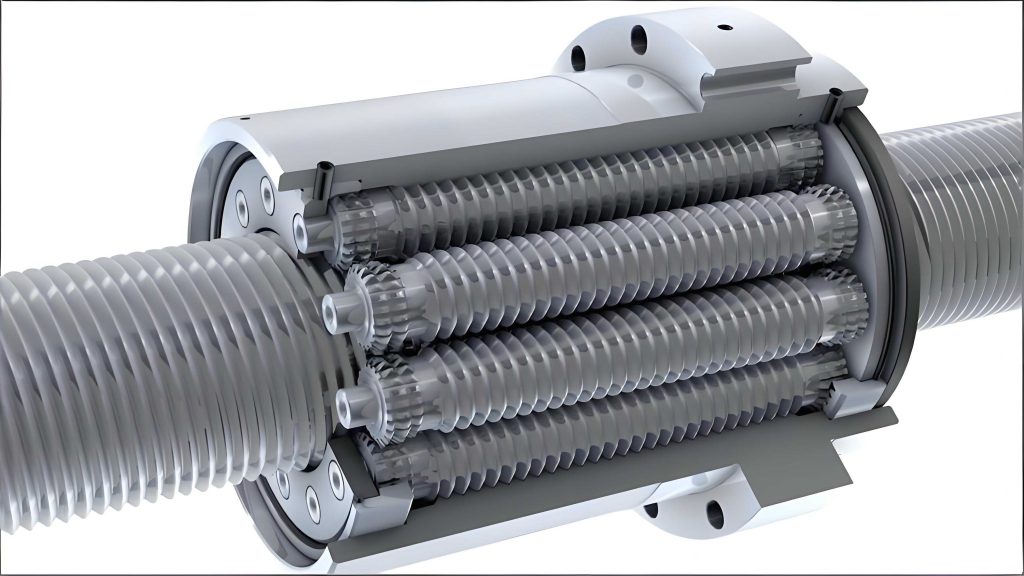
The planetary roller screw mechanism consists of several key components: a screw, multiple rollers, a nut, and an internal gear ring. The screw rotates around its axis, driving the rollers to rotate both about their own axes (spin) and around the screw axis (revolution), while the nut translates axially. This complex motion involves multiple contact points where sliding and rolling occur simultaneously, leading to friction losses. The unique geometry of the planetary roller screw, with its threaded interactions, results in relative sliding velocities at the screw-roller interfaces that vary with operational conditions. To analyze these dynamics, we first establish coordinate systems and derive the kinematic relationships. Let us define an inertial frame \( O[O; x, y, z] \), a frame attached to the screw \( O_s[O_s; x_s, y_s, z_s] \), and a frame attached to a roller \( O_r[O_r; x_r, y_r, z_r] \). The screw rotates by an angle \( \theta_s \), the roller revolves by \( \theta_R \), and the roller spins by \( \theta_r \), with the nut and roller translating axially by \( L \). The contact point between the screw and roller threads, initially at \( P_0 \), moves to \( P \) after these motions.
The relative sliding velocity at the screw-roller thread contact point is fundamental to friction analysis. Due to the helical nature of the threads, the contact point deviates from the axial plane, characterized by offset angles \( \theta_{sc} \) for the screw and \( \theta_{rsc} \) for the roller. The screw thread has a lead parameter \( p_s = \frac{z_s p}{2\pi} \), where \( z_s \) is the number of screw thread starts and \( p \) is the pitch (positive for right-hand threads). The actual contact radius for the screw is \( r_s \), and the nominal radius is \( r_{s0} \). Similarly, for the roller, the lead parameter is \( p_r = \frac{z_r p}{2\pi} \), with actual contact radius \( r_r \) and nominal radius \( r_{r0} \). The parameterization of the contact helices yields the position vectors, and differentiating with respect to time gives the velocities. After incorporating the kinematic constraints from the gear engagement between the roller ends and the nut’s internal ring, where \( \dot{\theta}_r = G \dot{\theta}_R \) with \( G = -\frac{r_{n0} – r_{r0}}{r_{r0}} \) ( \( r_{n0} \) being the nut thread nominal radius), the relative sliding velocity \( \mathbf{v}_{sr} \) at the contact point is derived as:
$$ \mathbf{v}_{sr} = \begin{bmatrix} -r_s \dot{\theta}_s \sin(\theta_R + \theta_{sc}) + G r_r \dot{\theta}_R \sin \theta_{rsc} + (r_{s0} + r_{r0}) \dot{\theta}_R \sin \theta_R \\ r_s \dot{\theta}_s \cos(\theta_R + \theta_{sc}) + G r_r \dot{\theta}_R \cos \theta_{rsc} – (r_{s0} + r_{r0}) \dot{\theta}_R \cos \theta_R \\ -p_s \dot{\theta}_s \end{bmatrix} $$
For steady-state analysis, setting \( \theta_R = 0 \) simplifies this to the velocity at the initial contact point \( P_0 \). However, in dynamic conditions, this full expression must be used to capture time-varying effects. The relative sliding velocity is crucial as it directly influences viscous friction and sliding friction components. In the planetary roller screw, the roller-nut interface is designed for pure rolling due to gear coupling, so friction there is minimal and often neglected. Thus, our focus is on the screw-roller thread contact, where friction arises from three primary sources: lubricant viscous resistance, spin sliding Coulomb friction, and differential sliding friction due to surface deformation.
Lubricant viscous resistance occurs due to the shear of lubricating oil between moving surfaces. This friction force opposes the relative sliding velocity and is proportional to its magnitude. For a planetary roller screw with \( n_R \) rollers and \( n_t \) thread pitches per roller, the total viscous friction force \( \mathbf{F}_{fs1} \) is given by:
$$ \mathbf{F}_{fs1} = \mu_1 n_R n_t \mathbf{v}_{sr} $$
where \( \mu_1 \) is the viscous friction coefficient. This component is velocity-dependent and becomes significant during high-speed or transient operations.
Spin sliding friction arises because the roller thread force direction is not aligned with the contact point velocity, causing a spinning motion. This results in Coulomb-type friction proportional to the normal force. At each screw-roller contact point, the normal force \( F_{nf} \) can be resolved into axial \( F_{af} \), radial \( F_{rf} \), and tangential \( F_{tf} \) components based on the screw thread lead angle \( \psi_s \) and flank angle \( \beta_s \):
$$ F_{rf} = F_{nf} \cos \psi_s \sin \beta_s, \quad F_{af} = F_{nf} \cos \psi_s \cos \beta_s, \quad F_{tf} = F_{nf} \sin \psi_s $$
The total axial output force \( F_{out} \) from the nut is the sum of axial components from all contact points. Assuming uniform load distribution among rollers and contact points, the normal force per contact point is:
$$ F_{nf} = \frac{F_{out}}{n_R n_t \cos \psi_s \cos \beta_s} $$
The spin sliding friction force \( \mathbf{F}_{fs2} \) is then:
$$ \mathbf{F}_{fs2} = \mu_2 F_{nf} \frac{\mathbf{v}_{sr}}{|\mathbf{v}_{sr}|} = \frac{\mu_2 F_{out}}{n_R n_t \cos \psi_s \cos \beta_s} \frac{\mathbf{v}_{sr}}{|\mathbf{v}_{sr}|} $$
where \( \mu_2 \) is the sliding friction coefficient between the screw and roller materials.
Differential sliding friction torque results from the elliptical contact patch deformation under normal load, where velocity gradients cause micro-slip. This torque \( M_{fs3} \) is proportional to the normal force and can be expressed as:
$$ M_{fs3} = -\mu_3 F_{nf} $$
with \( \mu_3 \) as a coefficient typically on the order of \( 10^{-6} \, \text{m} \) when force is in Newtons and torque in Newton-meters. This component is relatively constant and independent of sliding velocity.
To integrate these friction effects into a dynamic model, we employ the Lagrangian method. The kinetic energies of the screw, nut, rollers, and carrier are considered. The screw rotates with kinetic energy \( T_s = \frac{1}{2} I_s \dot{\theta}_s^2 \), where \( I_s \) is its moment of inertia. The nut translates axially with \( T_N = \frac{1}{2} m_N ( -p_s \dot{\theta}_s )^2 \), as \( L = -p_s \theta_s \). Each roller has kinetic energy from spin, revolution, and translation: \( T_R = \frac{1}{2} I_r \dot{\theta}_r^2 + \frac{1}{2} m_R [ (r_{r0} + r_{s0})^2 \dot{\theta}_R^2 + (-p_s \dot{\theta}_s)^2 ] \), with \( I_r \) the roller inertia and \( m_R \) its mass. The carrier revolves and translates: \( T_C = \frac{1}{2} I_c \dot{\theta}_R^2 + \frac{1}{2} m_c (-p_s \dot{\theta}_s)^2 \). The total kinetic energy \( T_{\text{total}} \) is:
$$ T_{\text{total}} = T_s + T_N + n_R T_R + T_C $$
Simplifying, and noting that \( \dot{\theta}_r = G \dot{\theta}_R \), we obtain:
$$ T = \frac{1}{2} \left[ I_s + (m_N + n_R m_R + m_c) p_s^2 \right] \dot{\theta}_s^2 + \frac{1}{2} \left[ n_R I_r G^2 + I_c + n_R m_R (r_{r0} + r_{s0})^2 \right] \dot{\theta}_R^2 $$
The generalized coordinates are \( \theta_s \) and \( \theta_R \), with corresponding generalized forces. The input torque on the screw is \( T_{in} \), and the output axial force is \( F_{out} \). The virtual work done by friction forces and input/output terms gives the generalized forces. For the screw coordinate, the generalized force \( Q_{\theta_s} \) includes contributions from viscous and spin sliding friction forces projected onto the screw motion, plus the differential sliding torque and input torque minus output work:
$$ Q_{\theta_s} = (\mathbf{F}_{fs1} + \mathbf{F}_{fs2}) \cdot \frac{\partial \mathbf{v}_{sr}}{\partial \dot{\theta}_s} + M_{fs3} + T_{in} – F_{out} p_s $$
For the roller revolution coordinate, the generalized force \( Q_{\theta_R} \) is:
$$ Q_{\theta_R} = (\mathbf{F}_{fs1} + \mathbf{F}_{fs2}) \cdot \frac{\partial \mathbf{v}_{sr}}{\partial \dot{\theta}_R} $$
Applying the Lagrangian equations:
$$ \frac{d}{dt} \left( \frac{\partial T}{\partial \dot{\theta}_s} \right) – \frac{\partial T}{\partial \theta_s} = Q_{\theta_s}, \quad \frac{d}{dt} \left( \frac{\partial T}{\partial \dot{\theta}_R} \right) – \frac{\partial T}{\partial \theta_R} = Q_{\theta_R} $$
we derive the equations of motion for the planetary roller screw. These are coupled differential equations that can be solved numerically to obtain \( \theta_s(t) \) and \( \theta_R(t) \) under given conditions. The total friction torque on the screw, \( M_f \), is computed as:
$$ M_f = (\mathbf{F}_{fs1} + \mathbf{F}_{fs2}) \cdot \frac{\partial \mathbf{v}_{sr}}{\partial \dot{\theta}_s} + M_{fs3} $$
Transmission efficiency is a key performance metric. The instantaneous transmission efficiency \( \eta(t) \) at time \( t \) is the ratio of output power to input power:
$$ \eta(t) = \frac{P_{out}(t)}{P_{in}(t)} = \frac{F_{out} \cdot p_s \cdot \dot{\theta}_s(t)}{T_{in}(t) \cdot \dot{\theta}_s(t)} = \frac{F_{out} p_s}{T_{in}(t)} $$
Over a time interval from \( t_0 \) to \( t_1 \), the overall transmission efficiency \( \eta_{\text{overall}} \) is based on total work:
$$ \eta_{\text{overall}} = \frac{\int_{t_0}^{t_1} P_{out}(t) \, dt}{\int_{t_0}^{t_1} P_{in}(t) \, dt} = \frac{\int_{t_0}^{t_1} F_{out} p_s \dot{\theta}_s(t) \, dt}{\int_{t_0}^{t_1} T_{in}(t) \dot{\theta}_s(t) \, dt} $$
To validate our model and explore dynamic effects, we consider a case study with parameters typical of planetary roller screw systems. The table below summarizes key parameters used in our simulations:
| Parameter | Symbol | Value | Units |
|---|---|---|---|
| Nominal screw thread radius | \( r_{s0} \) | 0.01 | m |
| Nominal roller thread radius | \( r_{r0} \) | 0.005 | m |
| Nominal nut thread radius | \( r_{n0} \) | 0.015 | m |
| Pitch | \( p \) | 0.002 | m |
| Screw thread starts | \( z_s \) | 1 | – |
| Number of rollers | \( n_R \) | 5 | – |
| Thread pitches per roller | \( n_t \) | 10 | – |
| Viscous friction coefficient | \( \mu_1 \) | 0.001 | N·s/m |
| Sliding friction coefficient | \( \mu_2 \) | 0.05 | – |
| Rolling friction coefficient | \( \mu_3 \) | 1e-6 | m |
| Nut mass | \( m_N \) | 0.5 | kg |
| Roller mass | \( m_R \) | 0.1 | kg |
| Carrier mass | \( m_c \) | 0.2 | kg |
| Screw mass | \( m_s \) | 1.0 | kg |
| Flank angle | \( \beta_s \) | 45 | ° |
| Contact offset angles | \( \theta_{sc}, \theta_{rsc} \) | 5, 5 | ° |
Using these parameters, we first verify our model against steady-state conditions. For a constant screw angular velocity \( \dot{\theta}_s = 1 \, \text{rad/s} \) and output force \( F_{out} = 100 \, \text{N} \), the steady-state ratio of roller revolution to screw rotation, \( \dot{\theta}_R / \dot{\theta}_s \), can be derived from equilibrium of torques on the roller. Our model yields \( \dot{\theta}_R / \dot{\theta}_s = 0.3737 \), matching established results in the literature. This confirms the accuracy of our kinematic and force balance equations.
We then investigate dynamic scenarios. Consider the screw starting from rest and accelerating linearly to \( 1 \, \text{rad/s} \) over different time intervals, with a constant output force \( F_{out} \). The dynamic friction torque \( M_f(t) \) is computed by solving the equations of motion numerically. Below, we summarize key findings through analytical expressions and simulated data.
The total friction torque in a planetary roller screw can be decomposed as:
$$ M_f(t) = M_{viscous}(t) + M_{spin}(t) + M_{diff} $$
where \( M_{viscous}(t) = \mu_1 n_R n_t \left| \mathbf{v}_{sr} \right| \cdot \frac{\partial \mathbf{v}_{sr}}{\partial \dot{\theta}_s} \), \( M_{spin}(t) = \frac{\mu_2 F_{out}}{n_R n_t \cos \psi_s \cos \beta_s} \frac{\mathbf{v}_{sr}}{|\mathbf{v}_{sr}|} \cdot \frac{\partial \mathbf{v}_{sr}}{\partial \dot{\theta}_s} \), and \( M_{diff} = -\mu_3 F_{nf} \). The viscous and spin components depend on \( \mathbf{v}_{sr} \), which varies with \( \dot{\theta}_s \) and \( \dot{\theta}_R \), while the differential component is constant for a given load.
To illustrate the impact of load, we simulate cases with \( F_{out} = 500, 1000, 3000, 5000 \, \text{N} \), and screw acceleration from 0 to 1 rad/s in 0.02 s. The table below shows peak dynamic friction torque and time to reach steady-state for each load:
| Axial Load \( F_{out} \) (N) | Peak Friction Torque \( M_{f,\text{peak}} \) (Nm) | Time to Steady-State (s) |
|---|---|---|
| 500 | 0.152 | 0.035 |
| 1000 | 0.245 | 0.030 |
| 3000 | 0.532 | 0.022 |
| 5000 | 0.801 | 0.018 |
As load increases, friction torque rises due to higher normal forces, which amplify spin and differential sliding components. Additionally, the system reaches steady-state faster because the larger forces accelerate the rollers more quickly. This highlights the load-dependence of dynamic behavior in planetary roller screw systems.
Next, we examine the effect of screw acceleration time. With \( F_{out} = 1000 \, \text{N} \), we vary the acceleration period \( t_a \) from 0.01 s to 0.09 s. The results for maximum friction torque and minimum instantaneous efficiency are:
| Acceleration Time \( t_a \) (s) | Max Friction Torque (Nm) | Min Instantaneous Efficiency \( \eta_{\min} \) (%) | Overall Efficiency \( \eta_{\text{overall}} \) (%) |
|---|---|---|---|
| 0.01 | 0.494 | 76.11 | 88.85 |
| 0.03 | 0.301 | 83.45 | 88.52 |
| 0.06 | 0.256 | 85.90 | 88.25 |
| 0.09 | 0.222 | 87.79 | 88.18 |
Shorter acceleration times lead to higher peak friction torques because the rapid change in velocity induces large relative sliding velocities, increasing viscous and spin friction. Consequently, the instantaneous efficiency drops more during acceleration. However, the overall efficiency over a cycle including steady-state operation is higher for shorter acceleration times, as the system spends less time in high-friction transient states. This suggests that in applications where peak torque is allowable, faster acceleration can improve the overall efficiency of the planetary roller screw.
The relative contributions of each friction source vary with operational phase. During steady-state, differential sliding provides a constant torque loss, while viscous and spin components stabilize at values proportional to steady-state velocities. In transient phases, viscous friction dominates due to high velocity gradients, followed by spin sliding. The differential sliding torque remains relatively small but non-negligible. This can be expressed mathematically by analyzing the time derivatives of the velocities. For instance, during acceleration, the magnitude of \( \mathbf{v}_{sr} \) increases, causing \( M_{viscous} \) and \( M_{spin} \) to rise proportionally. The spin friction also depends on the direction of \( \mathbf{v}_{sr} \), which may change during transients.
To further quantify these effects, we derive approximate formulas for key metrics. The steady-state friction torque \( M_{f,ss} \) for a planetary roller screw under constant load and speed can be estimated as:
$$ M_{f,ss} \approx \mu_1 n_R n_t v_{sr,ss} \cdot \frac{\partial v_{sr,ss}}{\partial \dot{\theta}_s} + \frac{\mu_2 F_{out}}{n_R n_t \cos \psi_s \cos \beta_s} + \mu_3 \frac{F_{out}}{n_R n_t \cos \psi_s \cos \beta_s} $$
where \( v_{sr,ss} \) is the steady-state relative sliding velocity. For dynamic conditions, the time-varying friction torque during linear acceleration with acceleration \( \alpha_s = \Delta \dot{\theta}_s / t_a \) is approximated by:
$$ M_f(t) \approx M_{f,ss} + \left( \mu_1 n_R n_t \alpha_s t + \frac{\mu_2 F_{out} \alpha_s t}{n_R n_t \cos \psi_s \cos \beta_s v_{sr,ss}} \right) \cdot \frac{\partial v_{sr}}{\partial \dot{\theta}_s} \quad \text{for } 0 \le t \le t_a $$
This linear approximation captures the rise in friction during acceleration and helps in designing control strategies to mitigate losses.
In terms of transmission efficiency, the planetary roller screw exhibits higher overall efficiency under larger loads because the output power increases proportionally more than friction losses. From our simulations, the overall efficiency \( \eta_{\text{overall}} \) as a function of load \( F_{out} \) and acceleration time \( t_a \) can be fitted to an empirical relation:
$$ \eta_{\text{overall}} \approx \eta_0 – \frac{k_1}{F_{out}} + k_2 t_a $$
where \( \eta_0 \), \( k_1 \), and \( k_2 \) are positive constants derived from system parameters. This indicates that efficiency improves with higher load and shorter acceleration time, aligning with our numerical results.
These insights have practical implications for the design and operation of planetary roller screw systems. For instance, in aerospace actuators where rapid response is critical, minimizing acceleration time within torque limits can enhance efficiency. Conversely, in precision machinery where smooth motion is paramount, longer acceleration may be preferred to reduce peak friction and wear. Additionally, selecting lubricants with optimal viscosity (affecting \( \mu_1 \)) and materials with low sliding friction ( \( \mu_2 \) ) can further improve performance.
In conclusion, our analysis of the planetary roller screw reveals that dynamic friction torque and transmission efficiency are highly influenced by operational conditions. The friction torque increases with relative sliding velocity, with viscous and spin sliding being dominant during unsteady states. Higher loads lead to greater friction but also faster stabilization and better overall efficiency. Shorter acceleration times, while increasing peak torque, result in higher overall efficiency by reducing transient duration. These findings underscore the importance of considering dynamic effects in the design and control of planetary roller screw mechanisms. Future work could explore temperature effects, wear progression, and advanced lubrication models to further optimize this vital component in high-performance systems.