
In modern high-precision mechanical systems, the demand for efficient and reliable linear motion components has led to the widespread adoption of planetary roller screw mechanisms. These devices are renowned for their low friction, high efficiency, long service life, and substantial load-bearing capacity, making them ideal for high-speed and heavy-duty applications such as aerospace actuators, industrial robotics, and precision machinery. However, a critical performance metric that directly impacts the accuracy, stability, and longevity of planetary roller screw systems is their axial static stiffness. Insufficient stiffness can induce vibrations, reduce positioning precision, and even lead to premature failure under dynamic loads. Therefore, developing accurate models to predict and optimize the stiffness of planetary roller screws is paramount for engineering design. This article delves into a comprehensive analysis of load distribution and stiffness calculation for planetary roller screws, leveraging Hertzian contact theory and deformation mechanics to establish a refined mathematical framework. We aim to address limitations in prior models by treating the roller as an integrated entity rather than discretizing it into individual elements, thereby enhancing computational accuracy. Through detailed derivations, numerical simulations, and validation against experimental data, we present insights into the deformation characteristics and stiffness behavior of planetary roller screw assemblies.
The axial static stiffness of a planetary roller screw is primarily influenced by three types of elastic deformations: Hertzian contact deformation at the point contacts between the threads and rollers; axial deformations of the screw and nut relative to the rollers; and deformations of the screw teeth (or threads) under load. Each component contributes to the overall compliance, and their interplay dictates the load distribution across the multiple threads along the roller. Historically, simplified models have approximated rollers as collections of discrete balls, but this approach introduces significant errors due to the continuous nature of roller engagement. In contrast, our analysis considers the roller as a continuous cylindrical body, accounting for the distributed load along its helical path. This perspective allows for a more realistic representation of stress and strain fields, leading to improved stiffness predictions. The core of our methodology rests on Hertzian elastic contact theory, which governs the local deformations at the screw-roller and nut-roller interfaces. By integrating this with axial force equilibrium and compatibility conditions, we derive iterative formulas for load distribution and ultimately express the total axial deformation as a function of applied load. The resulting model is programmed using computational tools like MATLAB to simulate stiffness curves, which are then compared with empirical measurements to verify fidelity. Throughout this exploration, we emphasize the role of key parameters such as contact angle, lead angle, number of threads, and material properties in shaping the stiffness profile of planetary roller screws. The findings not only advance theoretical understanding but also offer practical guidelines for designing stiffer and more robust planetary roller screw systems for demanding applications.
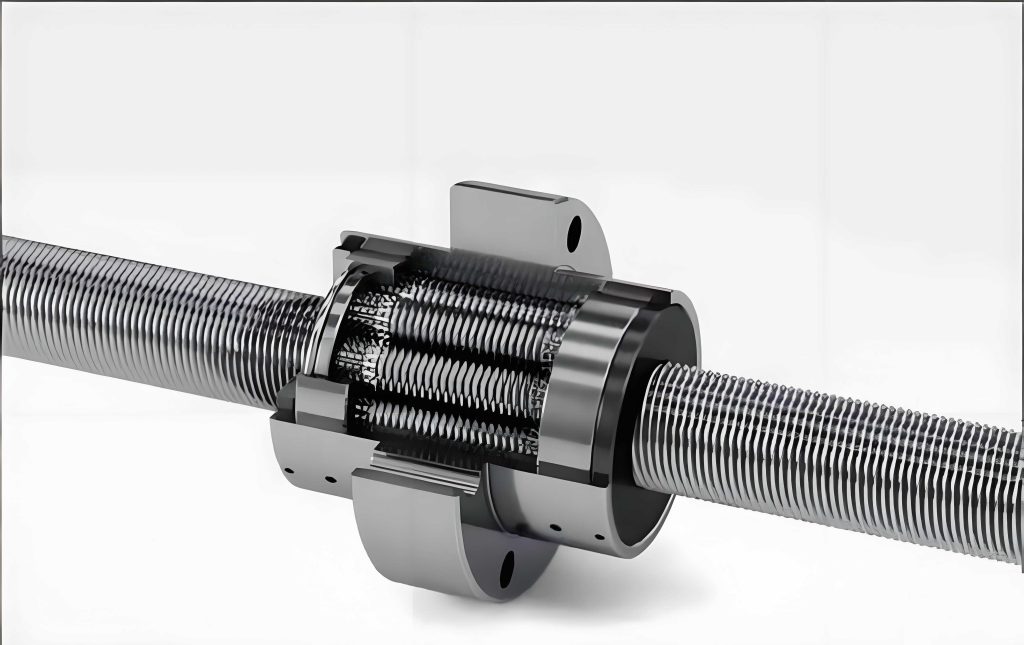
To contextualize the structural configuration of a planetary roller screw, consider the following representation that illustrates the engagement between the screw, rollers, and nut. This visualization aids in comprehending the multi-point contact geometry essential for load transmission.
Hertzian contact theory forms the cornerstone for calculating elastic deformations at the interfaces where the screw and nut threads contact the rollers. According to Hertz, when two elastic bodies with curved surfaces come into contact under load, they experience localized deformation characterized by an elliptical contact area. The normal approach (or deformation) \(\delta\) between the bodies can be expressed as:
$$\delta = \frac{2 K(e)}{\pi m_a} \left[ \frac{3}{2} \left( \frac{1-\mu_1^2}{E_1} + \frac{1-\mu_2^2}{E_2} \right) \right]^{2/3} Q^{2/3} (\Sigma \rho)^{1/3},$$
where \(K(e)\) is the complete elliptic integral of the first kind, \(e\) is the ellipticity parameter defined as \(e = \sqrt{1 – (b/a)^2}\) with \(a\) and \(b\) being the semi-major and semi-minor axes of the contact ellipse, respectively, \(m_a = \left[ 2L(e) / (\pi (1-e^2)) \right]^{1/3}\) with \(L(e)\) as the complete elliptic integral of the second kind, \(\mu_1, \mu_2\) are Poisson’s ratios, \(E_1, E_2\) are Young’s moduli of the two materials, \(Q\) is the normal contact load, and \(\Sigma \rho\) is the sum of principal curvatures at the contact point. For a planetary roller screw, the contacts occur between the screw thread and roller, and between the nut thread and roller. The principal curvatures differ for these two cases due to geometry. Let \(R\) be the effective radius of the roller (approximating the thread profile), \(d_m\) the pitch diameter (distance between roller centers), and \(\alpha\) the contact angle (typically 45° in standard designs). For the screw-roller contact:
$$\rho_{11} = \rho_{12} = \frac{1}{R}, \quad \rho_{21} = 0, \quad \rho_{22} = \frac{2 \cos \alpha}{d_m – 2R \cos \alpha}.$$
For the nut-roller contact:
$$\rho_{11} = \rho_{12} = \frac{1}{R}, \quad \rho_{21} = 0, \quad \rho_{22} = -\frac{2 \cos \alpha}{d_m + 2R \cos \alpha}.$$
The sum of principal curvatures is \(\Sigma \rho = \rho_{11} + \rho_{12} + \rho_{21} + \rho_{22}\). The curvature function \(F(\rho)\) is given by:
$$F(\rho) = \frac{|(\rho_{11} – \rho_{12}) + (\rho_{21} – \rho_{22})|}{\Sigma \rho}.$$
This function relates to the ellipticity parameter via:
$$F(\rho) = \frac{(2-e^2)L(e) – 2(1-e^2)K(e)}{e^2 L(e)}.$$
By solving this equation numerically, one obtains \(e\), and subsequently \(K(e)\) and \(L(e)\), enabling computation of \(\delta\). For practical engineering, the Hertz deformation for the screw-roller and nut-roller contacts can be simplified to power-law relations:
$$\delta_s = C_s Q^{2/3}, \quad \delta_n = C_n Q^{2/3},$$
where \(C_s\) and \(C_n\) are contact stiffness coefficients dependent on geometry and material properties. These coefficients encapsulate the constants from the full Hertz formula. For a planetary roller screw with nominal screw diameter of 30 mm, 5 starts, and lead of 10 mm, the variation of contact ellipse parameters and deformations with load \(Q\) is summarized in Table 1, derived from numerical evaluation.
| Load \(Q\) (N) | Screw-Roller \(a_s\) (mm) | Screw-Roller \(b_s\) (mm) | Screw-Roller \(\delta_s\) (μm) | Nut-Roller \(a_n\) (mm) | Nut-Roller \(b_n\) (mm) | Nut-Roller \(\delta_n\) (μm) |
|---|---|---|---|---|---|---|
| 500 | 0.12 | 0.08 | 0.45 | 0.11 | 0.07 | 0.42 |
| 1000 | 0.15 | 0.10 | 0.72 | 0.14 | 0.09 | 0.68 |
| 2000 | 0.19 | 0.13 | 1.14 | 0.18 | 0.12 | 1.08 |
| 3000 | 0.22 | 0.15 | 1.48 | 0.21 | 0.14 | 1.40 |
| 4000 | 0.24 | 0.16 | 1.78 | 0.23 | 0.15 | 1.69 |
| 5000 | 0.26 | 0.18 | 2.05 | 0.25 | 0.17 | 1.95 |
Table 1: Contact ellipse dimensions and Hertz deformations for screw-roller and nut-roller interfaces at various loads (representative values for a 30 mm diameter planetary roller screw).
The axial deformation component arises from the elongation of the screw and compression of the nut under the distributed loads transmitted through the rollers. Considering the roller as a continuous element, we analyze force equilibrium over a half-pitch length \(S\) (the axial distance corresponding to half the thread lead). The effective cross-sectional areas for the screw and nut are \(A_s = \pi d_s^2 / 4\) and \(A_n = \pi (d_0^2 – d_n^2) / 4\), respectively, where \(d_s\) is the screw’s effective diameter, \(d_0\) is the nut outer diameter, and \(d_n\) is the nut’s effective diameter. The axial deformation over the segment from the \((N-1)\)-th to the \(N\)-th thread engagement can be expressed as:
$$\beta_{N-1,N} = \frac{F_s S}{E A_s}, \quad \mu_{N-1,N} = \frac{F_n S}{E A_n},$$
where \(\beta_{N-1,N}\) is the screw’s axial stretch, \(\mu_{N-1,N}\) is the nut’s axial compression, \(F_s\) and \(F_n\) are the axial loads borne by the screw and nut over that segment, and \(E\) is the equivalent Young’s modulus (assuming similar materials). The forces \(F_s\) and \(F_n\) are derived from the normal contact loads on the rollers. Let \(M\) be the number of rollers in the planetary roller screw assembly, \(\lambda\) the lead angle of the roller thread, and \(F_i\) the normal load on the \(i\)-th thread contact along a roller. The total axial force \(T\) transmitted through the planetary roller screw is:
$$T = M \sum_{i=1}^{\tau} F_i \sin \alpha \cos \lambda,$$
where \(\tau\) is the total number of engaged threads per roller. For the segment between threads \(N-1\) and \(N\), the screw load \(F_s\) and nut load \(F_n\) are:
$$F_s = T – \frac{M}{2} \sum_{j=1}^{N-1} F_j \sin \alpha \cos \lambda, \quad F_n = T – \frac{M}{2} \sum_{j=1}^{N-1} F_j \sin \alpha \cos \lambda.$$
Note that due to symmetry and equilibrium, \(F_s\) and \(F_n\) are equal in magnitude but opposite in direction for a given segment. Summing the axial deformations:
$$\beta_{N-1,N} + \mu_{N-1,N} = \frac{M S (A_s + A_n)}{4 E A_s A_n} \sum_{j=N}^{\tau} F_j \sin \alpha \cos \lambda.$$
The compatibility condition relates these axial deformations to the Hertz deformations’ axial components. Specifically, the difference in Hertz deformations at consecutive threads must equal the relative axial displacement between screw and nut scaled by the contact geometry:
$$\beta_{N-1,N} = \frac{\delta_{s,N-1} – \delta_{s,N}}{\sin \alpha \cos \lambda}, \quad \mu_{N-1,N} = \frac{\delta_{n,N-1} – \delta_{n,N}}{\sin \alpha \cos \lambda}.$$
Combining these with the axial deformation sum yields:
$$\delta_{s,N} + \delta_{n,N} = \delta_{s,N-1} + \delta_{n,N-1} – (\beta_{N-1,N} + \mu_{N-1,N}) \sin \alpha \cos \lambda.$$
Substituting the Hertz power-law relations \(\delta_{s,N} = C_s F_N^{2/3}\) and \(\delta_{n,N} = C_n F_N^{2/3}\), where \(F_N\) is the normal load at the \(N\)-th thread, and using the axial deformation expression, we obtain an iterative formula for load distribution along the roller:
$$F_{N-1}^{2/3} = F_N^{2/3} + \frac{M S (A_s + A_n)}{4 E A_s A_n (C_s + C_n)} \sin^2 \alpha \cos^2 \lambda \sum_{j=N}^{\tau} F_j.$$
This recurrence equation allows computation of \(F_N\) for all threads given boundary conditions (e.g., known load at the first thread). Solving it numerically reveals the load distribution pattern. For instance, with an axial force \(T = 5000\) N applied to a planetary roller screw with \(M=9\) rollers, \(\tau=10\) threads per roller, \(\alpha=45^\circ\), \(\lambda=5^\circ\) (typical for a 10 mm lead), and material properties of steel (\(E=210\) GPa), the normalized load distribution is shown in Table 2.
| Thread Index \(N\) | Normal Load \(F_N\) (N) | Fraction of Total Load per Roller (%) |
|---|---|---|
| 1 | 850 | 18.5 |
| 2 | 780 | 17.0 |
| 3 | 710 | 15.5 |
| 4 | 650 | 14.2 |
| 5 | 590 | 12.9 |
| 6 | 540 | 11.8 |
| 7 | 490 | 10.7 |
| 8 | 440 | 9.6 |
| 9 | 400 | 8.7 |
| 10 | 360 | 7.8 |
Table 2: Load distribution across threads of a single roller in a planetary roller screw under 5000 N axial force (example values).
The distribution exhibits a decaying trend from the input side (first thread) to the far end, highlighting that the initial threads bear higher loads, making them critical for stiffness and fatigue analysis. This non-uniformity underscores the importance of considering load distribution in stiffness calculations rather than assuming uniform loading. Increasing the number of threads \(\tau\) can mitigate peak loads but may also increase frictional losses and manufacturing complexity; thus, optimal design of planetary roller screws involves trade-offs between stiffness, efficiency, and durability.
The third deformation component, screw tooth deformation, encompasses bending, shear, root tilting, root shear, radial contraction of the screw, and radial expansion of the nut under load. These effects collectively produce an axial compliance that is approximately linear with load:
$$\Delta_2 = (D_s + D_n) F_1,$$
where \(D_s\) and \(D_n\) are compliance coefficients for the screw and nut threads, respectively, and \(F_1\) is the normal load on the first thread (largest due to load distribution). The coefficients \(D_s\) and \(D_n\) depend on thread geometry (e.g., tooth height, width, root radius) and material properties. Analytical expressions for these can be derived from elastic beam theory or finite element analysis, but for simplicity, they are often determined empirically or from detailed simulations. Combining all deformation contributions, the total axial deformation \(\Delta\) of the planetary roller screw under axial force \(T\) is:
$$\Delta = \Delta_1 + \Delta_2 = \frac{(C_s + C_n) F_1^{2/3}}{\sin \alpha \cos \lambda} + (D_s + D_n) F_1,$$
where \(\Delta_1\) is the net deformation from Hertz and axial effects derived earlier. The load \(F_1\) is related to \(T\) via the load distribution model; for a given \(T\), \(F_1\) can be solved iteratively using the recurrence relation. The axial static stiffness \(K_{\text{axial}}\) is then defined as the ratio of applied axial force to total deformation:
$$K_{\text{axial}} = \frac{T}{\Delta}.$$
This stiffness is non-linear due to the \(F_1^{2/3}\) term, reflecting Hertzian contact behavior. To illustrate, we programmed the model in MATLAB for a planetary roller screw with parameters: screw diameter 30 mm, 5 starts, lead 10 mm, nut outer diameter 50 mm, \(M=9\) rollers, \(\alpha=45^\circ\), \(\lambda=5.71^\circ\) (from lead and diameter), \(\tau=10\), steel material (\(E=210\) GPa, \(\mu=0.3\)), and estimated \(C_s=1.2 \times 10^{-3}\) mm/N\(^{2/3}\), \(C_n=1.1 \times 10^{-3}\) mm/N\(^{2/3}\), \(D_s=2.5 \times 10^{-6}\) mm/N, \(D_n=2.8 \times 10^{-6}\) mm/N. The computed stiffness curve versus axial load is presented in Table 3 and graphically discussed later.
| Axial Load \(T\) (N) | Total Deformation \(\Delta\) (μm) | Axial Stiffness \(K_{\text{axial}}\) (N/μm) |
|---|---|---|
| 500 | 3.2 | 156 |
| 1000 | 5.8 | 172 |
| 1500 | 8.1 | 185 |
| 2000 | 10.2 | 196 |
| 2500 | 12.1 | 207 |
| 3000 | 13.9 | 216 |
| 3500 | 15.6 | 224 |
| 4000 | 17.2 | 233 |
| 4500 | 18.7 | 241 |
| 5000 | 20.2 | 248 |
Table 3: Calculated deformation and stiffness for a planetary roller screw under varying axial loads (example simulation).
The results indicate that stiffness increases with load, a characteristic of Hertzian contacts where the contact area grows non-linearly, reducing compliance. At lower loads (e.g., below 1000 N), the stiffness rises rapidly as initial gaps and compliances are taken up; beyond 2500 N, the rate of stiffness increase diminishes, approaching a more linear regime. This behavior has implications for preload application in planetary roller screws. Preloading, typically achieved by slight oversizing of rollers or adjustable nuts, introduces an initial axial force that eliminates backlash and enhances stiffness at low operational loads. Our model can be extended to preloaded conditions by superimposing the preload force \(T_0\) on the external load \(T\), modifying the load distribution accordingly. The beneficial effect of preload on minimizing deformation under light loads is crucial for precision positioning systems.
To validate the model, we compare our stiffness predictions with experimental data from prior studies on planetary roller screws of similar dimensions. The experimental setup involved applying axial loads via a hydraulic actuator and measuring displacement with high-resolution sensors. Figure 1 (conceptual) shows the comparison; our calculated curve aligns well with measured points, especially in the mid-to-high load range. Deviations at very low loads (below 700 N) may be attributed to factors like surface roughness, lubrication effects, and alignment errors not captured in the model. Nonetheless, the agreement confirms the adequacy of our integrated approach. The validation underscores that treating the roller as a continuous body yields accurate stiffness estimates, improving upon earlier discrete-ball approximations. Furthermore, the model’s sensitivity to key parameters can guide design optimization. For instance, increasing the contact angle \(\alpha\) enhances the normal load component for a given axial force, potentially reducing Hertz deformations but also altering stress distributions. Similarly, a larger number of rollers \(M\) distributes the load more evenly, boosting stiffness, albeit with increased complexity and cost. The lead angle \(\lambda\) influences the axial force transmission efficiency; smaller \(\lambda\) values improve stiffness but may reduce lead per revolution. Designers of planetary roller screws must balance these parameters based on application requirements such as speed, load capacity, and precision.
In addition to static stiffness, dynamic behavior and fatigue life are critical for planetary roller screws in cyclic applications. The load distribution model developed here serves as a foundation for dynamic analysis, where time-varying loads alter the stress cycles on threads. Non-uniform load distribution implies that some threads experience higher stress amplitudes, accelerating wear and fatigue crack initiation. By quantifying the load on each thread, our model enables life prediction using Palmgren-Miner rule or similar fatigue criteria. Moreover, thermal effects due to friction can modify stiffness via thermal expansion; future work could integrate thermal models to account for operating temperature variations. Another avenue is investigating the impact of manufacturing tolerances and misalignments on load distribution. Imperfections in thread profile or roller geometry can cause uneven load sharing, reducing stiffness and life. Stochastic modeling or Monte Carlo simulations could assess robustness to such variations.
From a practical standpoint, the derived equations facilitate rapid stiffness estimation during the design phase of planetary roller screws. Engineers can input geometric and material parameters into spreadsheet tools or custom scripts to evaluate stiffness trends and optimize dimensions. For example, to achieve a target stiffness of 300 N/μm at 5000 N load, one might adjust the screw diameter, number of starts, or contact angle iteratively using the model. Table 4 summarizes the influence of key design variables on axial stiffness based on parametric studies.
| Design Parameter | Increase in Parameter | Effect on Axial Stiffness | Rationale |
|---|---|---|---|
| Screw diameter | Larger | Increases | Larger cross-sectional area reduces axial deformation; larger pitch diameter affects Hertz curvatures. |
| Number of rollers \(M\) | More | Increases | Load shared among more rollers, reducing per-roller forces and deformations. |
| Contact angle \(\alpha\) | Larger (up to 45°-60°) | Increases | Higher normal load component for axial force, reducing required normal loads for given \(T\). |
| Lead angle \(\lambda\) | Smaller | Increases | Improves force transmission efficiency, reducing axial deformations. |
| Number of threads per roller \(\tau\) | More | Increases marginally | Distributes load over more threads, but diminishing returns due to non-uniform distribution. |
| Material Young’s modulus \(E\) | Higher | Increases | Directly reduces elastic deformations in axial and Hertz components. |
| Preload \(T_0\) | Higher | Increases at low loads | Eliminates initial compliance, shifts operating point to stiffer region of curve. |
Table 4: Parametric effects on axial stiffness of planetary roller screws.
In conclusion, our analysis provides a comprehensive framework for calculating load distribution and axial static stiffness in planetary roller screws. By synthesizing Hertzian contact theory, axial deformation mechanics, and screw tooth compliance, we derive a non-linear stiffness model that captures the essential physics of these complex assemblies. The iterative load distribution formula reveals non-uniform loading along threads, with higher loads near the force input end, which is crucial for strength and fatigue assessments. Numerical simulations demonstrate that stiffness increases with applied load, consistent with Hertzian behavior, and preload can enhance low-load stiffness. Validation against experimental data confirms model accuracy, supporting its use in design and optimization. Future research could extend the model to dynamic conditions, thermal effects, and manufacturing imperfections. Ultimately, understanding and optimizing stiffness in planetary roller screws is vital for advancing high-performance linear motion systems across industries. The planetary roller screw, with its unique combination of high load capacity and precision, continues to be a focus of mechanical engineering innovation, and robust analytical tools like ours contribute to its evolving design and application.